

Regulated industries run on documentation. When an auditor arrives or a regulator requests records, your ability to produce complete, accurate, and timestamped evidence determines whether you pass or face penalties. The role of digital work orders in compliance tracking has moved from a nice-to-have capability to a genuine operational necessity. Paper-based work orders, binders of printed logs, and disconnected spreadsheets simply cannot meet the speed, accuracy, and traceability requirements that modern regulatory frameworks demand. This article breaks down exactly how digital work orders change compliance outcomes, what pitfalls to avoid during implementation, and which practices consistently separate compliant facilities from ones that struggle in audits.
Table of Contents
- Key Takeaways
- Role of digital work orders in compliance tracking
- Compliance benefits: traceability, accuracy, and audit speed
- Implementation pitfalls to avoid
- Best practices for maximizing compliance tracking
- Emerging trends shaping digital compliance
- My perspective on what most organizations miss
- How Mpulsesoftware supports your compliance goals
- FAQ
Key Takeaways
| Point | Details |
|---|---|
| Digital work orders create audit trails | Timestamped, searchable records reduce audit failures and provide verifiable proof of maintenance activity. |
| Automation reduces human error | Standardized data capture in digital systems eliminates omissions that paper processes routinely produce. |
| Integration is the multiplier | Connecting work orders to asset and inventory systems creates a single source of truth for compliance evidence. |
| User adoption determines success | Technology alone does not fix compliance gaps; structured change management is equally critical. |
| Future-readiness requires cloud and mobile | Cloud-hosted, mobile-accessible work order platforms position organizations to meet evolving regulatory demands. |
Role of digital work orders in compliance tracking
Digital work orders are structured electronic records that document every task assigned, performed, and closed within a maintenance or operations workflow. Each record captures the technician responsible, the time of action, the materials used, the equipment involved, and the approval chain that authorized the work. That level of detail is precisely what regulators want to see.
Traditional paper work orders contain roughly the same categories of information, but the similarity stops there. Paper records cannot be searched in seconds. They can be lost, altered without a trace, or simply misfiled. A digital work order, by contrast, is indexed the moment it is created and every edit is logged with a timestamp and user ID.
The compliance benefits extend into how these records integrate with broader maintenance management systems. When digital work orders connect to a computerized maintenance management system (CMMS), every completed task automatically updates asset histories, triggers preventive maintenance schedules, and feeds compliance dashboards. The result is a living compliance record rather than a static paper file.
Key components that make digital work orders effective for compliance tracking include:
- Task assignment and timestamping to confirm when work was assigned and by whom
- Step-by-step checklists that enforce standardized procedures and prevent shortcuts
- Digital sign-offs that capture technician and supervisor authorization
- Photo and document attachments that provide visual evidence of conditions and completed repairs
- Automatic linkage to asset records for full maintenance history traceability
Pro Tip: Set mandatory fields in your digital work order template for critical compliance data such as regulatory reference numbers, equipment ID, and technician certification level. Blank fields are one of the most common causes of audit findings.
Compliance benefits: traceability, accuracy, and audit speed
The clearest proof of digital work orders’ value shows up during audits. Audit failures often arise from poor documentation rather than poor maintenance. A facility that maintains its equipment impeccably but cannot produce organized, verifiable records will still fail an audit. Digital work orders directly close that gap.
Consider what happens in aviation maintenance. Regulatory authorities expect digital records to be searchable, secure, backed up, and exportable, with clear ownership and revision control on every file. An aircraft that has received excellent maintenance but has missing or ambiguous records will face grounding orders regardless of its actual airworthiness. The same principle applies to pharmaceutical manufacturing, food processing, and any other regulated environment.

| Compliance Area | Paper-Based Work Orders | Digital Work Orders |
|---|---|---|
| Audit trail completeness | Inconsistent, manual entries | Automatic, timestamped logs |
| Record retrieval time | Hours to days | Seconds to minutes |
| Error and omission rate | High, dependent on individual diligence | Low, enforced by required fields |
| Revision tracking | Difficult to verify | Full version history retained |
| Regulatory evidence export | Manual compilation | On-demand report generation |
Digital systems allow instant search and review of order histories, supporting faster and more reliable compliance audits. That speed matters enormously when a regulator gives you 24 hours to produce documentation for a specific asset across the past 36 months.
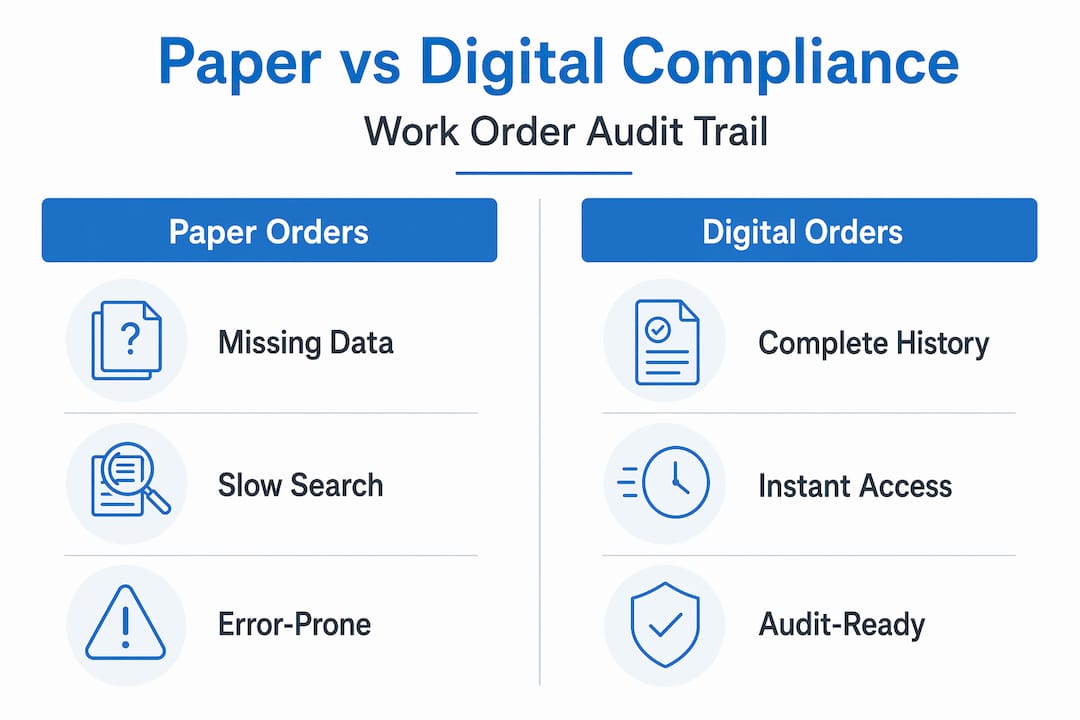
The error reduction benefit deserves specific attention. When a technician fills out a paper form at the end of a long shift, omissions happen. Digital work orders prevent that by blocking form submission until required fields are completed. Automated reminders and escalation rules catch overdue tasks before they become compliance violations. The impact of digital orders on error rates is measurable and consistent across industries.
Implementation pitfalls to avoid
The technology works. The harder challenge is the implementation. Organizations that deploy digital work orders without addressing the surrounding processes and culture frequently find that their compliance records are digital in format but still unreliable in substance.
The most damaging pitfall is data silos. When digital work orders live in one system and asset records live in another, with no integration between them, fragmented technology stacks hinder effective compliance tracking. You end up with the same reconciliation problem that plagued paper systems, just with digital files instead of printed ones.
Other common pitfalls include:
- Poor user adoption caused by insufficient training or systems that are harder to use than paper alternatives
- Inconsistent naming conventions that make records difficult to search and link to specific assets or regulatory requirements
- Lack of role-based access controls that allow unauthorized edits to compliance-critical records after the fact
- Missing version control on work order templates, leading to different technicians following different procedure versions simultaneously
- Insufficient backup and recovery planning that leaves compliance records vulnerable to data loss
Change management is not optional. Technicians who have worked with paper for years need structured onboarding, not just a login credential. Supervisors need to understand how digital sign-off workflows differ from stamping a paper form. Compliance officers need to be involved in configuring what data gets captured, not just handed a system after it is live.
Pro Tip: Before going live, audit a sample of completed digital work orders from your pilot group. If required fields are being bypassed or notes are left as “N/A,” address the training gaps before scaling. Compliance-quality records require both good software and good process discipline.
Best practices for maximizing compliance tracking
Getting the most from digital work orders for compliance requires deliberate system design and ongoing governance. Here are the practices that consistently produce the best compliance outcomes.
-
Centralize your maintenance data. Centralized digital maintenance systems provide a single source of truth that enables faster audits, cleaner traceability, and fewer discrepancies. Every work order, asset record, and inspection log should reside in one connected system, not spread across multiple platforms.
-
Integrate work orders with inventory and asset management. Digital work orders integrated with inventory management maintain accurate stock levels and prevent the kind of material discrepancies that trigger compliance findings. When a technician uses a part, the work order should automatically deduct it from inventory and flag if a substitute was used.
-
Configure role-based approval workflows. Not every employee should be able to close a compliance-critical work order. Define clear approval chains where a supervisor or compliance officer must review and digitally sign off before a task is marked complete. This mirrors the authorization structures that regulators look for in audit documentation.
-
Schedule regular internal compliance audits. Do not wait for a regulator to tell you what your records look like. Run quarterly internal audits using the same criteria an external auditor would apply. Look for incomplete records, missed sign-offs, and gaps in asset maintenance histories.
-
Use dashboards and analytics for ongoing oversight. Compliance tracking tools that surface overdue work orders, missed inspections, and documentation gaps in real time allow you to correct problems before they become violations. Tracking compliance effectively means monitoring continuously, not just at audit time.
-
Maintain standardized file naming and versioning. Every work order template, procedure document, and attached record should follow a consistent naming convention that includes the asset ID, date, and version number. This is the kind of detail that separates organizations that sail through audits from those that scramble.
Emerging trends shaping digital compliance
The capabilities of digital work order systems are advancing quickly, and staying current with these developments will shape how well your organization handles compliance in the years ahead.
- Mobile-first work order access is becoming a baseline expectation. Technicians working in the field need to open, complete, and close work orders from a mobile device without returning to a desktop terminal. Mobile and cloud-based solutions enhance accessibility, security, and compliance monitoring capabilities simultaneously.
- AI-assisted compliance monitoring is beginning to appear in advanced CMMS platforms. These systems can flag anomalies in work order completion patterns, predict which assets are approaching compliance risk thresholds, and automatically escalate overdue inspections without manual intervention.
- Direct integration with regulatory reporting portals is expanding in sectors like aviation, pharmaceuticals, and utilities. Rather than exporting records and manually uploading them to a regulator’s system, digital work order platforms will increasingly push compliance data directly through connected reporting channels.
- Enhanced data security requirements are raising the bar for how digital compliance records must be stored and transmitted. Encrypted transactions and data residency controls are becoming standard requirements that organizations and their software vendors must address together.
- Regulatory frameworks themselves are evolving. Enhanced regulatory oversight increasingly demands rapid, coordinated compliance responses supported by digital platforms. Organizations that have already invested in mature digital work order workflows will adapt to new requirements far faster than those still running manual processes.
Understanding how these trends will intersect with your industry’s specific requirements positions you to make smarter investments in digital compliance solutions today.
My perspective on what most organizations miss
I have worked with enough facility managers and compliance officers to recognize a pattern. Organizations invest in digital work order software, configure it reasonably well, and then measure success by whether the software is running. What they rarely measure is whether the records it produces would actually satisfy a regulator with specific, technical questions.
The mindset shift I believe matters most is treating every work order as if an auditor will read it tomorrow. Not someday. Tomorrow. That discipline changes how technicians enter notes, how supervisors review sign-offs, and how compliance officers configure required fields.
I have also seen organizations over-invest in technology while under-investing in the process discipline that makes technology work. A workflow automation approach that is not paired with clear accountability structures just creates faster ways to produce incomplete records.
The organizations that genuinely excel at compliance tracking with digital work orders are not the ones with the most sophisticated software. They are the ones where every person in the maintenance workflow understands why the record matters, not just how to fill it out. That understanding does not come from software. It comes from leadership that treats compliance documentation as a core operational value rather than an administrative burden.
One often-overlooked detail: version control on work order templates. When a procedure changes and the template is not updated consistently across all users, different technicians follow different steps on the same task. That inconsistency is invisible in aggregate reports but becomes very visible under regulatory scrutiny.
— Mark
How Mpulsesoftware supports your compliance goals
Mpulsesoftware’s CMMS platform is built specifically for regulated industries where compliance is not optional. The platform gives facility managers and compliance officers a centralized system for creating, assigning, and closing digital work orders with complete audit trails, role-based approvals, and on-demand reporting that meets regulatory documentation standards.
Mpulsesoftware also connects work order workflows directly to equipment inventory tracking, eliminating the material reconciliation gaps that commonly produce compliance findings. Trusted by over 3,500 customers globally, Mpulsesoftware has delivered up to 40% efficiency improvements for maintenance teams navigating demanding regulatory environments. If your organization is ready to move beyond paper and disconnected systems, Mpulsesoftware provides the structure and support to get there.
FAQ
What is the primary role of digital work orders in compliance tracking?
Digital work orders create searchable, timestamped records of every maintenance task, providing the complete audit trail that regulators require as proof of regulatory adherence.
How do digital work orders reduce audit failures?
Audit failures often stem from poor documentation rather than poor maintenance. Digital work orders enforce required fields, capture digital sign-offs, and retain full revision histories that satisfy auditor evidence requirements.
What should compliance officers configure in a digital work order system?
Compliance officers should define mandatory fields, role-based approval workflows, standardized naming conventions, and automated escalation rules for overdue tasks before the system goes live.
How do digital work orders integrate with inventory management for compliance?
When connected to inventory systems, digital work orders automatically update stock levels when materials are used, reducing discrepancies and maintaining the accurate records that inventory compliance controls require.
What trends will most impact digital work orders and compliance in 2026 and beyond?
Mobile and cloud access, AI-assisted anomaly detection, and direct integration with regulatory reporting portals are the most significant developments reshaping how digital compliance solutions function in regulated industries.