
TL;DR:
- Maintenance KPIs provide measurable benchmarks to evaluate the efficiency of maintenance processes.
- Tracking appropriate metrics like MTBF and MTTR offers clear visibility into asset reliability and repair performance.
Maintenance KPIs are defined as measurable benchmarks that allow maintenance teams to objectively evaluate the effectiveness and efficiency of their processes. The role of maintenance KPIs tracking goes far beyond simple scorekeeping. Metrics like Mean Time Between Failures (MTBF), Mean Time To Repair (MTTR), Preventive Maintenance (PM) compliance rate, and Overall Equipment Effectiveness (OEE) give facility managers concrete visibility into what is working and what is not. Unscheduled downtime costs the world’s 500 largest companies roughly 11% of annual revenue, totaling $1.4 trillion. That number alone makes the case for treating KPI tracking as a core operational discipline, not an afterthought.
What are the most critical maintenance KPIs to track?
Effective maintenance performance management starts with choosing the right metrics. Tracking the wrong KPIs produces data that looks useful but drives no real decisions. The following seven KPIs represent the core set that most facility managers should monitor.
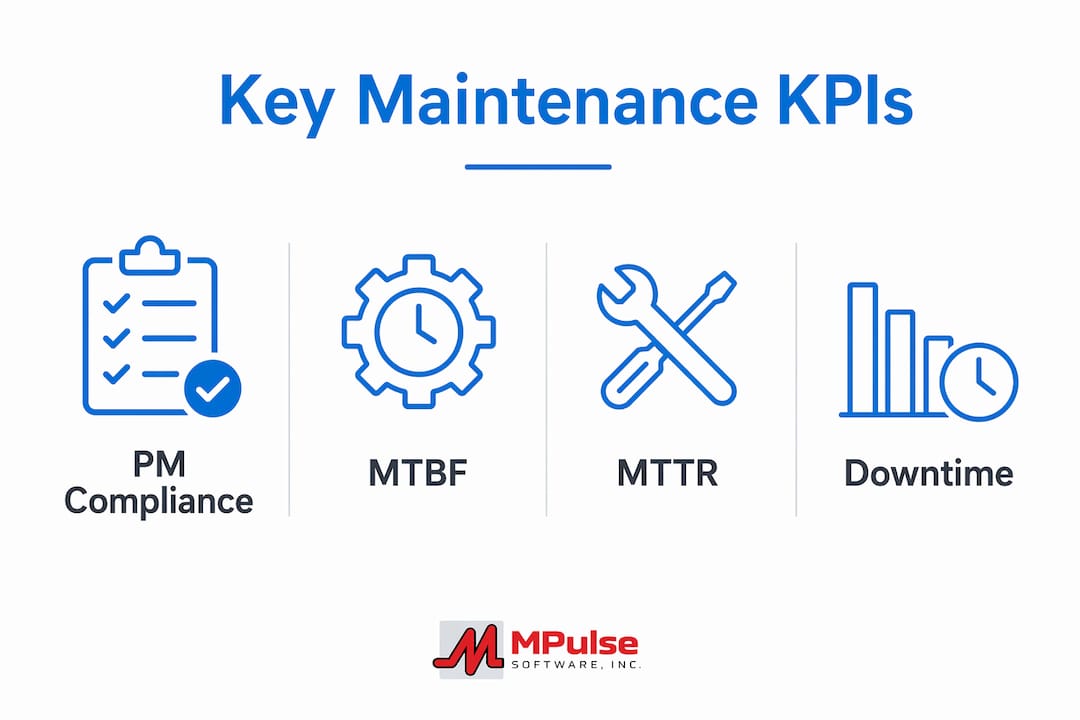
- MTBF (Mean Time Between Failures): Average operating time between asset failures. Higher MTBF signals better reliability.
- MTTR (Mean Time To Repair): Average time to restore a failed asset. Lower MTTR means faster recovery.
- PM Compliance Rate: Percentage of scheduled preventive maintenance tasks completed on time. Directly reflects planning discipline.
- Planned Maintenance Percentage (PMP): Proportion of total maintenance hours spent on planned work versus reactive repairs. A PMP above 85% is a widely cited industry target.
- Equipment Downtime: Total hours an asset is unavailable. Tracks both frequency and duration of failures.
- OEE (Overall Equipment Effectiveness): Combines availability, performance, and quality into one score. World-class OEE is generally considered 85% or above.
- Maintenance Cost as a % of Asset Replacement Value (ARV): Benchmarks spending against asset value. Most facilities target 2–3% of ARV annually.
PM compliance and MTBF serve dual roles as both leading and lagging indicators. PM compliance is a leading indicator because it predicts future reliability. MTBF is a lagging indicator because it measures past failure history. Understanding this distinction helps you build a KPI set that looks forward and backward at the same time.
| KPI | Definition | Strategic Impact |
|---|---|---|
| MTBF | Average time between asset failures | Measures reliability; guides replacement decisions |
| MTTR | Average repair time after failure | Reflects technician efficiency and parts availability |
| PM Compliance Rate | % of PM tasks completed on schedule | Predicts future failure risk |
| PMP | % of maintenance hours that are planned | Indicates shift from reactive to proactive maintenance |
| OEE | Combined availability, performance, quality score | Benchmarks overall asset productivity |

Pro Tip: A useful KPI must be understandable and actionable within one week by the people responsible for it. If your team cannot explain what drives a metric or what to do when it drops, that metric is not ready to be tracked.
How does data quality affect maintenance KPI accuracy?
Accurate KPI tracking depends entirely on the quality of data feeding into your system. Most KPI inaccuracy stems from inconsistent data entry by technicians, not from flawed software. A CMMS is only as reliable as the information technicians enter into it.
Common data quality failures include:
- Technicians skipping failure codes or entering generic descriptions like “fixed” instead of specific fault categories
- Manual, periodic reporting that captures data hours or days after the work is done
- Inconsistent definitions of what counts as “downtime” across shifts or departments
- No standardized timestamps for work order start and completion
Fixing these problems requires both process and technology. Standardized failure codes, mandatory fields in work orders, and regular audits of data entry quality all build the foundation for reliable KPIs. Data integrity at the technician level is not a software problem. It is a training and culture problem that leadership must address directly.
Automated data collection closes the gap that manual entry leaves open. CMMS platforms integrated with IoT sensors capture asset condition data continuously, removing human error from the equation. Real-time IoT sensor data combined with AI predictive models gives maintenance teams leading indicator insights that manual reporting simply cannot produce. MPulse Software’s IIoT and real-time monitoring capabilities connect asset condition directly to work order data, closing the loop between what is happening on the floor and what appears on your KPI dashboard.
Pro Tip: Build your KPI program around 3 to 5 key metrics before adding more. Teams that track 20 or more KPIs consistently fall into analysis paralysis, spending more time managing dashboards than managing equipment.
What are the proven benefits of tracking maintenance KPIs?
Disciplined KPI tracking produces measurable financial and operational results. Switching from reactive to preventive maintenance driven by consistent KPI tracking reduces downtime by 30–40% and cuts maintenance costs by 12%. Those are not marginal gains. They represent a fundamental shift in how a facility operates.
The path from reactive to proactive maintenance follows a clear pattern when KPIs are in place:
- KPI data reveals which assets fail most often and why
- PM compliance tracking confirms whether scheduled work is actually happening
- MTTR trends expose bottlenecks in parts supply or technician skill gaps
- OEE scores connect maintenance performance directly to production output
Each of these insights feeds a continuous improvement cycle. You identify a problem through KPI data, implement a fix, and then track whether the metric improves. Without KPIs, that cycle breaks down because you have no reliable way to confirm whether a change actually worked.
Pro Tip: Align each KPI to a specific business goal before you start tracking it. A KPI tied to “reduce unplanned downtime by 20% this quarter” drives behavior. A KPI tracked because “it seemed useful” collects data that nobody acts on.
How to implement KPI tracking with modern maintenance tools
Setting up effective KPI tracking requires the right tools and a clear process. The following steps give facility managers a practical path to get started.
- Select a CMMS with automated data capture. Manual spreadsheets cannot produce reliable KPIs at scale. A CMMS automates work order creation, timestamps, and failure code logging, which are the raw inputs every KPI calculation depends on.
- Integrate IoT sensor data. CMMS platforms integrating IoT and AI enable real-time KPI dashboards that reflect current asset status and predict failures weeks ahead. This moves your KPI program from historical reporting to forward-looking risk management.
- Configure role-based dashboards. A maintenance technician needs to see work order completion rates and MTTR. A facility director needs to see cost trends and OEE. Role-based views surface the right KPIs for each person without overwhelming anyone with irrelevant data.
- Establish a review rhythm. Operational KPIs like MTTR and PM compliance should be reviewed weekly. Strategic KPIs like maintenance cost as a percentage of ARV are better reviewed monthly or quarterly. Mixing these review cycles creates confusion about what requires immediate action.
- Audit your data sources regularly. Asymmetrical data, where one shift logs failures differently than another, corrupts KPI trends over time. A monthly data audit catches these inconsistencies before they distort your metrics.
Mobile maintenance management tools extend this capability to the field. Technicians can log work order data, failure codes, and timestamps directly from a mobile device at the point of work, which eliminates the transcription errors that plague paper-based or end-of-shift reporting.
Pitfalls to avoid when building your KPI tracking system:
- Tracking too many KPIs before your data quality is solid
- Using KPIs that your team cannot influence directly
- Reporting KPIs without assigning clear ownership to a specific person or role
- Letting KPI definitions drift across departments over time
Which KPIs should facility managers prioritize?
KPI selection should follow your facility’s specific production and reliability goals, not a generic industry checklist. A facility focused on uptime will prioritize MTBF, MTTR, and equipment downtime. A facility under cost pressure will weight maintenance cost as a percentage of ARV and PMP more heavily. A facility with regulatory requirements will track PM compliance rate as a non-negotiable metric.
Start with a core set of 3 to 5 KPIs that directly connect to your top operational priority. Expand the set only after your team consistently reviews and acts on those core metrics. A tightly focused KPI set enables teams to shift from managing dashboards to managing equipment.
| Facility Goal | Primary KPIs | Why They Fit |
|---|---|---|
| Maximize uptime | MTBF, MTTR, Equipment Downtime | Directly measure failure frequency and recovery speed |
| Control costs | Maintenance Cost % of ARV, PMP | Connect spending to asset value and planning efficiency |
| Regulatory compliance | PM Compliance Rate, Schedule Compliance | Demonstrate adherence to required maintenance intervals |
| Improve productivity | OEE, PMP | Link maintenance quality to production output |
Assign ownership for each KPI to a named individual. Without ownership, KPIs get reviewed but not acted on. The SLA maintenance tracking discipline used in professional services offers a useful model: each metric has a defined owner, a target, and a review date. Apply the same structure to your maintenance KPI program.
Leading indicators like predictive alerts provide early visibility to prevent failures, while lagging indicators like PM compliance show past maintenance execution success. A balanced KPI set includes both types. Facilities that track only lagging indicators are always reacting to what already happened.
What I have learned from years of watching KPI programs succeed and fail
The facilities that get the most from maintenance KPI tracking share one habit: they review a small number of metrics consistently, every single week, with the people who can actually do something about them. The facilities that struggle almost always have the opposite problem. They built a dashboard with 30 metrics, held a launch meeting, and then watched the program quietly fade because nobody owned the numbers.
Data inconsistency is the most common early obstacle. Technicians enter data differently. Shifts use different failure codes. One department counts a brief production pause as downtime while another does not. These inconsistencies do not fix themselves. They require a deliberate effort from leadership to standardize definitions and hold people accountable for data quality. That work is unglamorous, but it is the foundation everything else rests on.
The payoff, when the program matures, is real. Facilities that sustain disciplined KPI tracking for 12 months or more consistently report better asset reliability, lower emergency repair costs, and maintenance teams that spend more time on planned work and less time fighting fires. The metrics do not create that outcome on their own. They make the outcome visible, which gives teams the information they need to pursue it.
My honest advice: pick three KPIs that connect directly to your biggest operational pain point. Review them every week with your team. Fix the data quality problems as they surface. Add more metrics only when the first three are producing decisions, not just reports.
— Mark
MPulse Software and maintenance KPI tracking
MPulse Software gives facility managers the tools to move from manual KPI tracking to automated, real-time performance monitoring.
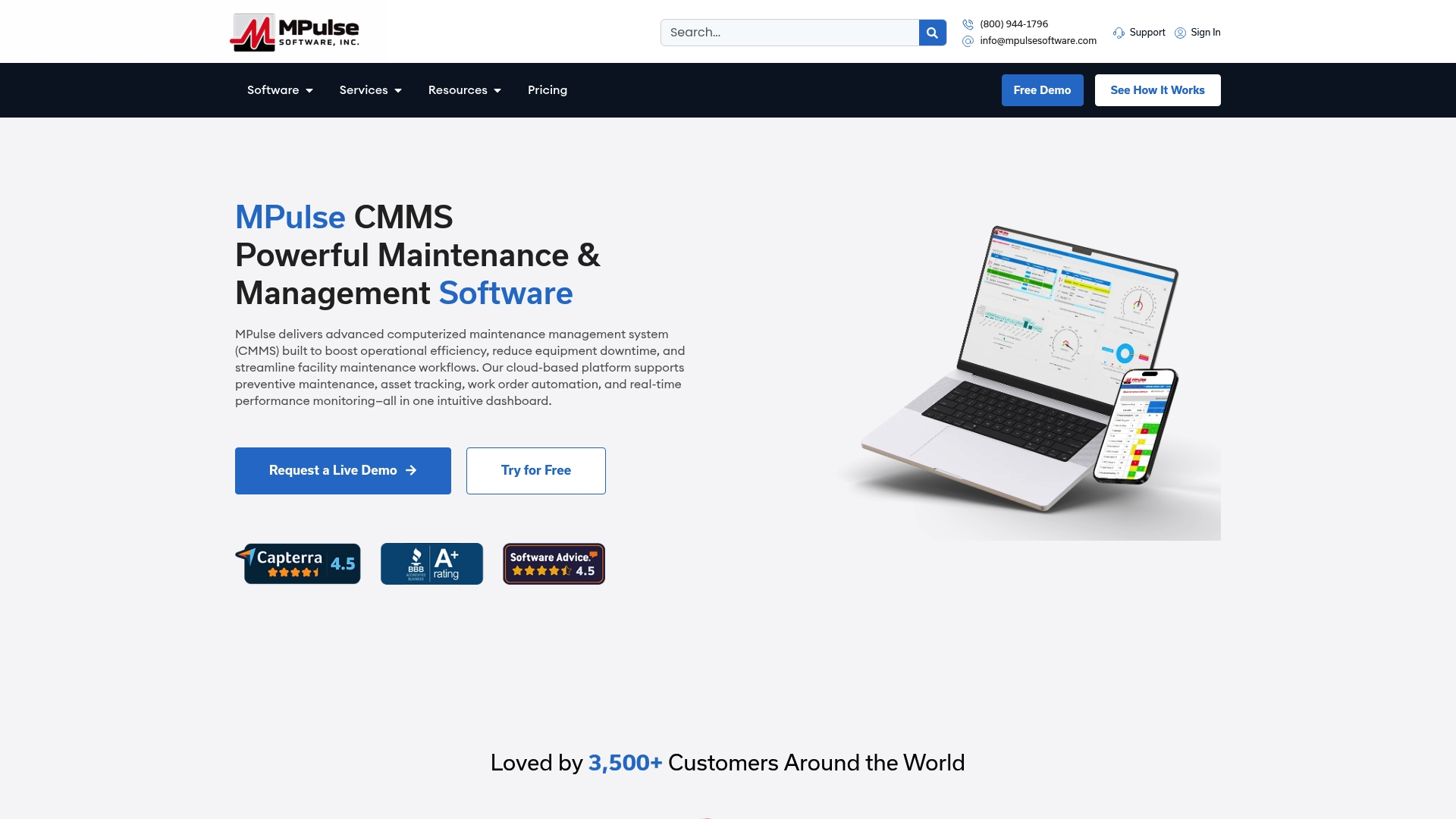
MPulse CMMS captures work order data, failure codes, and asset condition information automatically, feeding accurate inputs into KPI dashboards without relying on manual entry. Role-based views surface the metrics each team member needs, from technician-level work order completion rates to director-level cost and reliability trends. Trusted by over 3,500 customers globally, MPulse has delivered efficiency improvements of up to 40% for facilities that commit to data-driven maintenance. Explore the full capabilities of MPulse CMMS software to see how automated KPI tracking can reduce downtime and extend asset life in your facility.
FAQ
What are maintenance KPIs?
Maintenance KPIs are measurable metrics used to evaluate the performance and efficiency of maintenance operations. Common examples include MTBF, MTTR, PM compliance rate, OEE, and maintenance cost as a percentage of asset replacement value.
How many maintenance KPIs should a facility track?
Facilities should start with 3 to 5 KPIs directly tied to their top operational goals. Tracking 20 or more KPIs leads to analysis paralysis and reduces the team’s ability to act on the data.
What is the difference between leading and lagging maintenance KPIs?
Leading indicators like predictive alerts and PM compliance rate signal future risk before a failure occurs. Lagging indicators like MTBF and equipment downtime measure past performance after events have already happened.
How does a CMMS improve maintenance KPI tracking?
A CMMS automates data collection, standardizes failure codes, and generates real-time KPI dashboards. When integrated with IoT sensors and AI models, it can predict failures weeks in advance and reduce downtime by 30–40%.
Why is data quality critical for accurate maintenance KPIs?
Inconsistent data entry by technicians is the leading cause of inaccurate KPIs, even in facilities using advanced CMMS platforms. Standardized failure codes, mandatory work order fields, and regular data audits are the most effective controls.
Key takeaways
Consistent maintenance KPI tracking, built on clean data and a focused metric set, is the most direct path from reactive maintenance to measurable operational improvement.
| Point | Details |
|---|---|
| Start with 3–5 KPIs | Focus on metrics tied directly to your top operational goal before expanding the set. |
| Data quality drives accuracy | Standardize failure codes and audit technician data entry to keep KPIs reliable. |
| Mix leading and lagging indicators | Combine PM compliance (leading) with MTBF and MTTR (lagging) for a complete performance picture. |
| Assign KPI ownership | Each metric needs a named owner with a defined review cadence to drive action. |
| Automate with CMMS and IoT | Automated data capture eliminates manual entry errors and enables real-time KPI dashboards. |