
TL;DR:
- Effective maintenance subcontractor management involves a formal process of selection, onboarding, scheduling, performance monitoring, and payment. Technology, like CMMS platforms, enhances efficiency, compliance, and documentation for better cost control. Building predictable relationships based on clear communication and documented workflows leads to consistent and successful subcontractor programs.
Maintenance subcontractor management is the structured process of sourcing, onboarding, coordinating, monitoring, and paying external contractors who deliver maintenance services on behalf of a facility or organization. Facility managers who treat this as a formal discipline, rather than an informal arrangement, consistently achieve better cost control, fewer compliance gaps, and higher service quality. Tools like MPulse Software’s CMMS platform, subcontractor management software, and ERP workflow controls have made it possible to run this process with real-time visibility at every stage. Understanding how maintenance subcontractor management works is the first step toward building a program that actually holds up under pressure.
What are the key steps in the subcontractor management process?
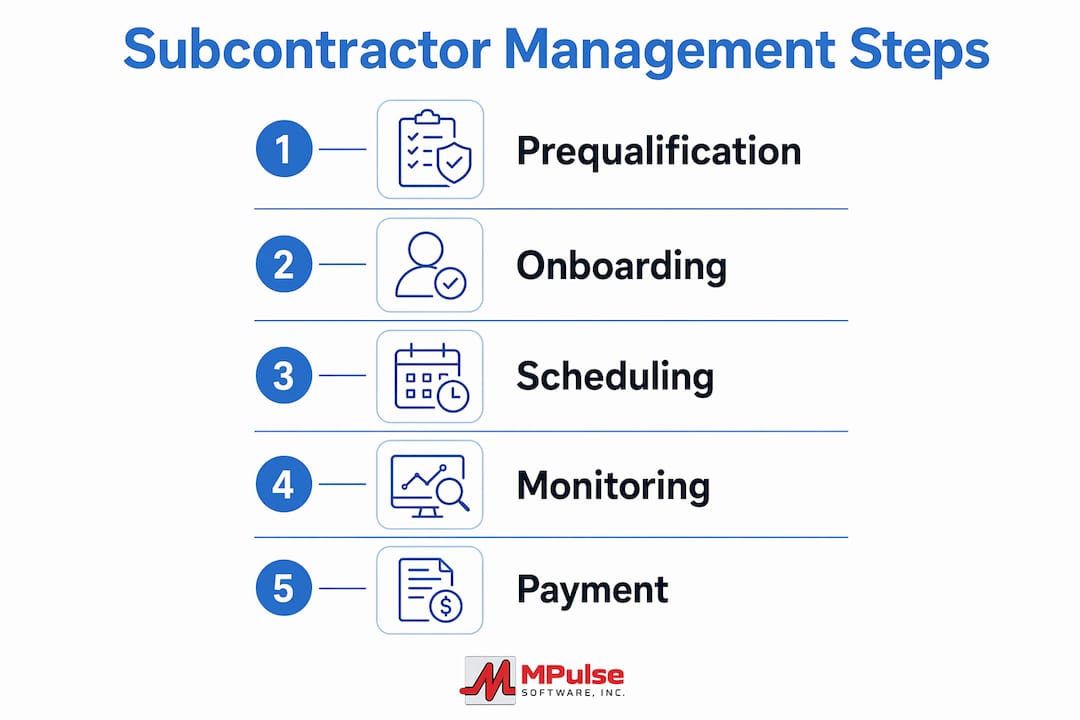
The subcontractor management process follows a defined sequence from sourcing through final payment. Skipping or compressing any stage creates risk that compounds later in the project lifecycle.
1. Prequalification and selection
Prequalification filters out contractors who cannot meet your compliance, insurance, or quality standards before a single bid is submitted. The process typically includes reviewing certificates of insurance, safety records, licensing, and financial stability. Bid leveling adjusts each bid to account for missing scope items, allowing a true cost comparison across all candidates. Without bid leveling, the lowest number on paper often hides the highest total cost.
2. Onboarding
A formal onboarding package sets the tone for the entire working relationship. A sub-trade booklet covering site rules, communication protocols, safety requirements, and invoicing expectations reduces friction and errors from the first day on site. Facilities with formal onboarding materials report fewer disputes over scope and payment terms. Think of it as the operating manual every subcontractor must read before touching your facility.
3. Scheduling and coordination
Rolling look-ahead schedules, updated weekly, give subcontractors clear visibility into upcoming work windows. Daily check-ins confirm crew counts, equipment availability, and any site conditions that could affect the schedule. Contractor maintenance scheduling strategies that integrate with your CMMS reduce the manual coordination burden significantly.

4. Performance monitoring
Performance monitoring requires written documentation, not verbal feedback. Written identification of schedule delays tied to specific milestones motivates faster corrective action than a phone call ever will. Vendor scorecards tracking response time, quality, and schedule adherence give you objective data for renewal or replacement decisions.
5. Payment processing
Standard retainage is set at 10%, often reducing to 5% after 50% project completion. Delayed retainage release damages subcontractor relationships and can trigger disputes. Tying invoice approval to completed quality control checklists keeps the payment process honest on both sides.
Pro Tip: Create a single payment calendar shared with all active subcontractors. Predictable payment dates reduce the number of payment inquiries your team handles each month and signal that your organization is a reliable partner.
How does technology improve subcontractor maintenance workflow management?
Technology converts a paper-heavy, error-prone process into a trackable, auditable system. The right software does not just store records. It enforces the workflow.
CMMS and subcontractor management software
A Computerized Maintenance Management System (CMMS) like MPulse Software centralizes work order creation, subcontractor assignment, scheduling, and completion tracking in one platform. Facility managers can see which contractor is assigned to which asset, what the current status is, and whether the work meets the service level agreement. MPulse Software serves over 3,500 customers globally and reports efficiency improvements of up to 40%, which reflects the operational lift that comes from replacing manual tracking with automated workflows. SLA maintenance tracking becomes measurable rather than assumed when every work order carries a timestamp and a completion record.
Key technology capabilities for subcontractor oversight
- Real-time job tracking: Managers see work order status without calling the subcontractor directly.
- Digital pay applications: Contractors submit invoices through the system, reducing paper and processing delays.
- Compliance checks: Automated alerts flag expired insurance certificates or missing safety documentation before work begins.
- ERP workflow controls: Approval thresholds for high-risk transactions prevent unauthorized spending and equipment dispatch without proper authorization.
- Accounting integration: Syncing with financial systems eliminates duplicate data entry and speeds up payment cycles.
Impact on cost and auditability
| Capability | Manual process | Technology-enabled process |
|---|---|---|
| Invoice approval | Paper-based, 5–10 days | Digital, 1–2 days |
| Compliance tracking | Spreadsheet, often outdated | Automated alerts, real-time |
| Performance data | Anecdotal, inconsistent | Scored, documented, comparable |
| Dispute resolution | Verbal accounts | Timestamped logs, photo evidence |
Vendor management software centralizes contractor sourcing, credentials, dispatching, and compliance auditing, with mature programs reporting cost reductions of 12–18% and 40% fewer emergency repairs. That is a measurable return on a software investment most facilities can justify within the first year.
Pro Tip: Configure your CMMS to require photo documentation before a work order can be marked complete. This single rule eliminates most disputes about whether work was actually performed.
What are common challenges in managing maintenance subcontractors?
Managing maintenance subcontractors effectively means anticipating the problems that derail most programs before they occur.
The most frequent failure points
- Scope creep: Work expands beyond the original agreement without a formal change order, creating billing disputes and budget overruns.
- Incomplete documentation: Verbal instructions and informal approvals leave no paper trail when disputes arise.
- Underperformance: Subcontractors miss milestones without consequence because the general contractor lacks written performance records.
- Payment delays: Slow invoice processing strains subcontractor cash flow and damages the working relationship.
- Single points of failure: Relying on one person to manage all subcontractor communication creates bottlenecks when that person is unavailable.
Best practices that prevent these problems
Daily logs recording crew counts and equipment usage serve as primary legal documentation in contract disputes. Verbal complaints fail in arbitration. Written logs do not. Every facility manager should treat the daily log as a non-negotiable operational habit.
Linking quality control checklists and photo documentation to invoice approval shifts accountability to the subcontractor. They cannot submit an invoice without proving the work meets your standards. This single practice reduces rework and eliminates the most common payment disputes.
“Documented, data-driven communication regarding subcontractor schedule impacts encourages more productive adjustments than informal feedback.” This principle applies equally to facility maintenance as it does to construction project management.
Formal change order processes protect both parties. Any scope change, no matter how small, should require a written change order signed before the additional work begins. Facilities that enforce this consistently report far fewer end-of-contract billing surprises.
Assign a single point of contact on your team for each active subcontractor. This person owns the relationship, tracks performance, and escalates issues through the proper channel. Distributed accountability is no accountability.
How does effective subcontractor management affect cost and efficiency?
The financial case for disciplined subcontractor management is direct. Poor oversight generates costs that are easy to avoid and hard to recover once incurred.
Reactive vs. proactive subcontractor programs
| Metric | Reactive program | Proactive program |
|---|---|---|
| Emergency repair frequency | High, unpredictable | Reduced by up to 40% |
| Rework rate | Frequent, costly | Low, documented QC |
| Invoice processing time | Slow, disputed | Fast, verified |
| Subcontractor retention | Low, high turnover | High, stable relationships |
| Compliance gaps | Common, audit risk | Rare, automated tracking |
Preventive maintenance contracts with qualified subcontractors reduce the frequency of emergency repairs. Emergency repairs cost more per incident and disrupt operations in ways that planned maintenance never does. Competitive bidding with proper bid leveling also drives down baseline costs by ensuring you are comparing equivalent scopes of work.
Vendor scorecards create a feedback loop that improves performance over time. Subcontractors who know they are being scored on response time, quality, and schedule adherence perform better than those operating without any formal accountability structure. The scorecard also gives you objective grounds for contract renewal or replacement decisions, which removes personal bias from what can otherwise be a difficult conversation.
Timely retainage release matters more than most facility managers realize. Subcontractors who receive retainage on schedule are more likely to prioritize your work, return for future contracts, and recommend your organization to other qualified trades. The financial relationship directly shapes the operational relationship.
Facility maintenance software that tracks work order completion, contractor performance, and preventive maintenance schedules gives facility managers the data they need to make these decisions with confidence rather than instinct.
Key Takeaways
Effective maintenance subcontractor management requires a formal, documented workflow covering selection, onboarding, scheduling, performance monitoring, and payment to deliver consistent results and cost control.
| Point | Details |
|---|---|
| Prequalify before you bid | Use bid leveling and compliance checks to compare contractors on equal terms. |
| Onboard with a formal package | A written sub-trade booklet covering site rules and invoicing reduces early disputes. |
| Document everything daily | Daily logs with crew counts and equipment records are your legal defense in disputes. |
| Tie QC to payment | Require completed checklists and photos before approving any invoice. |
| Use technology to track performance | CMMS platforms like MPulse Software centralize scheduling, compliance, and payment data. |
What I have learned from watching subcontractor programs succeed and fail
The programs that work share one trait: they treat subcontractors as managed relationships, not transactional vendors. The ones that fail almost always have the same problem. They assume good intentions will substitute for documented expectations.
I have seen facility teams spend months recovering from a single undocumented scope change that ballooned into a six-figure dispute. The paperwork that would have prevented it would have taken ten minutes. That asymmetry is the core lesson of subcontractor management. The investment in process is always smaller than the cost of the problem it prevents.
Technology helps, but it does not fix a culture that avoids hard conversations. A CMMS gives you the data to have those conversations with facts instead of feelings. When a subcontractor misses a milestone, you show them the timestamped work order, the schedule, and the gap. That conversation ends faster and more productively than one based on memory.
The best subcontractor relationships I have observed are built on predictability. The facility manager pays on time, communicates clearly, and enforces standards consistently. The subcontractor shows up, documents their work, and flags problems early. Neither side is surprised at the end of the project. That outcome does not happen by accident. It is the result of a process that both parties understand and follow from day one.
— Mark
MPulse Software and subcontractor maintenance management
Facility managers who want to move from reactive oversight to a documented, trackable program have a direct path forward with MPulse Software.
MPulse Software’s CMMS platform connects work order management, subcontractor scheduling, compliance tracking, and real-time performance monitoring in one system. Facility teams use it to assign work to external contractors, track completion against SLAs, and generate the documentation needed for invoice approval and audit readiness. The platform integrates with accounting and property management systems, reducing duplicate data entry and speeding up payment cycles. Over 3,500 customers trust MPulse Software to manage their maintenance operations. Start a free trial to see how it fits your subcontractor workflow.
FAQ
What is maintenance subcontractor management?
Maintenance subcontractor management is the formal process of selecting, onboarding, scheduling, monitoring, and paying external contractors who perform maintenance work for a facility. It covers the full lifecycle from bid evaluation through final payment and contract closeout.
How do you choose a subcontractor for maintenance work?
Start with prequalification, reviewing insurance certificates, licenses, safety records, and financial stability. Use bid leveling to adjust each proposal for missing scope items so you are comparing equivalent costs before making a selection.
What is retainage and how does it affect subcontractor relationships?
Retainage is a percentage of payment withheld until project completion, typically set at 10% and often reduced to 5% after 50% completion. Delayed release damages trust and can push qualified subcontractors to deprioritize your work in favor of clients who pay on schedule.
What documentation is most important in subcontractor management?
Daily logs recording crew counts and equipment usage are the most critical records. These logs serve as primary legal documentation in contract disputes and support damage claims when a subcontractor underperforms or abandons work.
How does CMMS software support managing maintenance subcontractors?
A CMMS centralizes work order assignment, scheduling, compliance tracking, and performance documentation for all active subcontractors. Platforms like MPulse Software add real-time status visibility and integration with accounting systems, which reduces invoice processing time and improves audit readiness.