

TL;DR:
- A preventive maintenance contract scope defines specific equipment, tasks, response times, and documentation standards for proactive asset care. Clear scope language helps facility managers control costs, avoid disputes, and ensure accountability, supporting a reliable maintenance program. Using detailed scope with maintenance software improves compliance, enhances asset longevity, and reduces unplanned downtimes.
A preventive maintenance contract scope is a formal framework that defines the exact equipment covered, scheduled tasks to be performed, response time commitments, parts and consumables included, and documentation obligations required for proactive asset care. Facility managers who understand what is a preventive maintenance contract scope gain a critical advantage: they can negotiate agreements that prevent scope creep, control costs, and hold service providers accountable to measurable standards. The industry term for this document is the “scope of work” or “scope of services” within a maintenance contract. Getting it right from the start separates a strategic maintenance program from a reactive, expensive one.
What specific elements are included in a preventive maintenance contract scope?
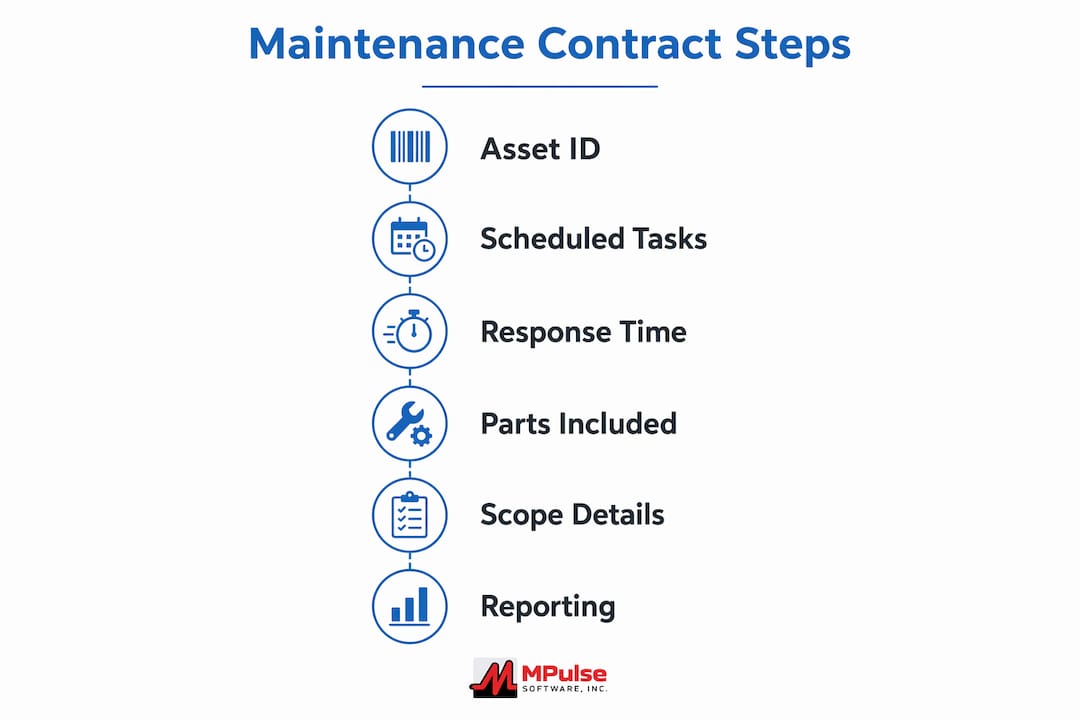
A well-written scope of maintenance contracts covers six core categories. Each one must be explicit, not implied, to avoid disputes and unpaid extra work.
1. Equipment and asset identification
Every covered asset must be listed by name, model number, serial number, and physical location. A contract that says “all HVAC units” invites disagreement. One that says “Carrier AHU-7, serial 4421B, third floor mechanical room” does not. This specificity also supports asset lifecycle management and warranty tracking.
2. Scheduled preventive tasks

The scope must describe exactly what technicians will do during each visit. For a commercial HVAC system, this means periodic inspections, servicing, refrigerant management, and documentation to prevent failures and sustain performance. Generic language like “routine maintenance” is not sufficient. List each task: filter replacement, belt tension checks, coil cleaning, lubrication points, and calibration intervals.
3. Response times and emergency support
The contract must state guaranteed response windows for both standard and emergency calls. A four-hour emergency response commitment is meaningless without a written penalty or escalation clause if the provider misses it.
4. Parts, consumables, and software
Effective maintenance contracts are scoped along four axes: preventive calendar, response targets, parts inclusion, and configuration discipline. Omitting software and configuration management leaves a critical gap, particularly for building automation systems and complex equipment with firmware dependencies.
5. Inclusions and exclusions
Vague scope language drives disputes. A binding scope matrix that explicitly lists what is and is not covered prevents misunderstandings. Repairs, structural work, and consumables above a set threshold should be listed as exclusions if they are not covered.
6. Documentation and reporting
The scope must require written service reports after every visit, maintenance logs accessible to the facility manager, and records that support regulatory compliance and warranty claims.
Pro Tip: Request a sample service report from any prospective provider before signing. If they cannot produce one, their documentation practices will not meet audit or compliance standards.
How does preventive maintenance contract scope differ from service agreements?
The core difference between a maintenance contract and a service agreement is proactivity. Maintenance contracts schedule preventive tasks in advance, shifting risk to the provider. Service agreements react after an incident occurs and bill per event.
| Feature | Preventive maintenance contract | Service agreement |
|---|---|---|
| Focus | Scheduled, proactive care | Reactive, on-demand response |
| Cost structure | Fixed annual or periodic fee | Per-incident billing |
| Risk allocation | Provider assumes maintenance risk | Owner absorbs breakdown costs |
| Visit schedule | Contractually defined visits | Called in when needed |
| Budget predictability | High: costs are fixed in advance | Low: costs vary by incident |
Maintenance contracts provide predictable annual costs and contractually obligated visits. That predictability directly supports capital budgeting and risk management for critical assets. A service agreement, by contrast, gives you no guarantee that a technician will arrive before a failure becomes a shutdown.
“Scope clarity distinguishes a strategic maintenance contract from mere transactional service. It is the mechanism that shifts maintenance risk to the provider and reduces owner liability.” This distinction matters most when assets are critical to operations or regulatory compliance.
Facility managers who treat their maintenance contracts like service agreements, calling for help only after something breaks, pay more over time and accumulate deferred maintenance that shortens asset life.
Common pitfalls and best practices in defining contract scope
Most preventive maintenance contract failures trace back to a small set of avoidable mistakes. Recognizing them before you sign protects your budget and your operations.
-
Using vague language. Terms like “as needed” or “standard maintenance” give providers room to do less than you expect. Every task must be named and scheduled.
-
Skipping escalation clauses. Underpricing and lack of escalation clauses cause most contract failures. Rising labor and parts costs erode provider margins over time, which leads to reduced service quality or contract disputes. Build in annual price adjustment terms tied to a published index.
-
Mixing preventive maintenance with repairs. Maintenance contracts must explicitly differentiate preventive maintenance from repairs and parts supply to avoid billing disputes. If a technician finds a failed bearing during a scheduled visit, is replacement covered? The contract must answer that question before the visit happens.
-
Ignoring contract term structure. One-year auto-renewing contracts with early cancellation notice periods reduce administration and allow competitive benchmarking at renewal. Open-ended contracts with no renewal structure make it harder to renegotiate terms as your asset base changes.
-
Omitting performance metrics. A contract without measurable performance expectations cannot be enforced. Specify uptime targets, completion rates for scheduled visits, and reporting deadlines.
Pro Tip: Build a two-column scope matrix before negotiating any contract. Column one lists every task you expect. Column two marks each as “included,” “excluded,” or “billable separately.” Hand this to every bidder and require them to respond to each line.
How can facility managers apply contract scope to improve efficiency?
A clearly written scope of services does more than define what a vendor will do. It becomes the operational backbone of your facility maintenance plan when you integrate it with your internal scheduling and tracking systems.
-
Schedule and track against the contract. Load every contractually required task into your maintenance management system. When a scheduled visit occurs, close it against the contract line item. This creates a verifiable record of compliance and flags missed visits immediately.
-
Use scope documentation for warranty protection. Documented preventive maintenance is the primary evidence manufacturers require when processing warranty claims. A well-executed scope keeps that evidence current and organized.
-
Align scope with compliance requirements. Regulatory frameworks in healthcare, food processing, and critical infrastructure require documented maintenance records. A contract scope that mandates written reports after every visit produces those records automatically.
-
Treat scope as a living schedule. Facility managers benefit from integrating contract scope with software tools that track completed preventive tasks, maintenance history, and equipment performance. This integration supports resource allocation decisions and identifies assets that need scope adjustments at renewal.
-
Build vendor accountability into the scope. Require monthly or quarterly performance summaries from your provider. Compare actual visit completion rates and task outcomes against the contracted schedule. This data strengthens your negotiating position at renewal and identifies underperforming vendors before they cause a failure.
The operational benefit of a well-defined scope is measurable. Facilities that move from reactive service agreements to structured preventive maintenance contracts report fewer unplanned shutdowns, lower emergency repair costs, and longer asset service lives.
Key takeaways
A preventive maintenance contract scope is the single most important document in a proactive maintenance program. Without explicit task lists, response commitments, and clear inclusions, even a well-intentioned contract will produce disputes and gaps.
| Point | Details |
|---|---|
| Define assets explicitly | List every covered asset by name, model, serial number, and location to prevent disputes. |
| Separate PM from repairs | Clearly distinguish preventive tasks from repairs and parts supply to avoid billing surprises. |
| Include escalation clauses | Add annual price adjustment terms to protect service quality as labor and parts costs rise. |
| Integrate scope with software | Load contract tasks into a CMMS to track compliance, flag missed visits, and support audits. |
| Use scope for compliance | Documented preventive maintenance records satisfy warranty requirements and regulatory audits. |
Why scope clarity is the real differentiator in maintenance contracts
I have reviewed dozens of maintenance contracts over the years, and the pattern is consistent. The contracts that fail do not fail because of bad vendors or bad equipment. They fail because the scope was written to close a deal, not to manage an asset.
Facility managers often focus on price during contract negotiations. That is understandable. But focusing solely on contract price overlooks the strategic value of a disciplined, documented preventive program. A contract priced $5,000 lower than the competition means nothing if it excludes refrigerant management, skips configuration checks, or has no escalation clause.
The contracts I have seen succeed share one trait: every party knew exactly what was expected before the first technician arrived. The scope was specific enough that a new facility manager could pick it up on day one and understand what was covered, what was not, and what the vendor was obligated to deliver. That clarity is not a legal nicety. It is the operational foundation of a reliable maintenance program.
My advice: treat your scope of work as the most important document in the contract, not the pricing schedule. Negotiate the scope first. Let the price follow from what you actually need.
— Mark
MPulse Software and preventive maintenance contract management
Facility managers who want to move from paper-based contract tracking to a system that actually works need a platform built for maintenance complexity.
MPulse Software gives facility managers a centralized system to schedule, track, and document every task defined in their preventive maintenance contracts. The platform supports automated scheduling against contract intervals, technician task completion records, and reporting that satisfies both warranty and compliance requirements. Trusted by over 3,500 customers globally, MPulse has delivered efficiency improvements of up to 40% for maintenance teams managing complex asset portfolios. For facility managers ready to align their contract scope with a facility maintenance software platform built for the job, MPulse provides the tools to make that transition practical and measurable.
FAQ
What is a preventive maintenance contract scope?
A preventive maintenance contract scope defines the specific assets covered, scheduled tasks to be performed, response time commitments, parts and consumables included, and documentation obligations. It is the formal framework that governs what a service provider will do, when, and to which equipment.
What should always be included in a maintenance contract?
A maintenance contract must specify exact covered equipment, preventive tasks, response times, emergency support terms, and details on consumables or parts included. Clear separation of preventive work and repairs avoids unpaid extra work and billing disputes.
How is a preventive maintenance contract different from a service agreement?
A preventive maintenance contract schedules proactive care in advance at a fixed fee, shifting risk to the provider. A service agreement is reactive, billing per incident after a problem occurs, and offers no guaranteed visit schedule.
How often should a preventive maintenance contract be reviewed?
Contract scope should be reviewed at every renewal, typically annually. Asset additions, equipment changes, or new compliance requirements all justify scope amendments before the next contract term begins.
How does software help manage preventive maintenance contract scope?
Maintenance management software like MPulse Software loads contract tasks into a scheduled maintenance system, tracks completion against contract obligations, and generates documentation for warranty and compliance purposes. This removes manual tracking and creates an auditable record of every contracted service event.