

TL;DR:
- A CMMS is crucial for hospitals to manage medical equipment maintenance, ensure compliance, and meet accreditation standards. It provides a unified record of all activities, automates scheduling, and tracks certifications, helping facilities pass audits smoothly. Proper integration and data management make CMMS an essential tool for patient safety and accreditation success.
A Computerized Maintenance Management System (CMMS) is defined as the primary software tool hospitals use to manage medical equipment maintenance, generate audit-ready documentation, and meet accreditation standards set by bodies like the Joint Commission and ISO 13485. The role of CMMS in hospital accreditation goes far beyond scheduling oil changes on HVAC units. It functions as a unified compliance platform that connects clinical engineering, biomedical teams, and facilities management under one verifiable record. Healthcare administrators and compliance officers who treat CMMS as a documentation tool alone miss its full value. When configured correctly, it becomes the backbone of your accreditation strategy.
How does CMMS support hospital accreditation requirements?
A CMMS acts as a single source of truth that unifies clinical engineering, biomedical, and facilities teams to eliminate information silos across hospital departments. That matters because accreditation bodies do not accept fragmented records. They require a complete, traceable history of every maintenance activity tied to every regulated asset.

The Joint Commission, which is the leading hospital accrediting body in the United States, requires evidence-based maintenance frameworks and traceable records as a condition of accreditation. A CMMS satisfies this requirement by automatically logging every work order, inspection, and repair in a time-stamped, searchable database. When an auditor walks in, your team pulls the full history in seconds rather than hunting through paper files or disconnected spreadsheets.
ISO 13485, the international standard for medical device quality management systems, places similar demands on hospitals that manage regulated medical equipment. A CMMS configured to meet ISO 13485 requirements maintains the Safety, Quality, and Maintenance Register that both standards demand. Without that register, accreditation surveys become a liability exercise rather than a confirmation of good practice.
CMMS features that directly meet accreditation standards
Specific CMMS functionalities determine whether a hospital passes or struggles during an accreditation survey. The following capabilities are non-negotiable for compliance-focused facilities.
-
Automated maintenance schedules. A CMMS automates work orders and preventive maintenance schedules based on manufacturer specifications, regulatory intervals, and equipment risk classification. This removes the human error of missed service dates, which is one of the most common accreditation findings.
-
Traceability of all maintenance activities. Hospitals must maintain traceability of calibration, repairs, and preventive maintenance to comply with accreditation standards. A CMMS stores this history in a format auditors can review with one click, eliminating last-minute document preparation.
-
Certification and authorization management. Only technicians with specific certifications are authorized to perform certain medical equipment maintenance tasks. A CMMS manages technical certifications and authorizations to ensure that unqualified personnel never touch regulated equipment. This protects both patient safety and institutional liability.
-
Regulatory compliance documentation. A CMMS generates reports aligned with HIPAA, Centers for Medicare and Medicaid Services (CMS), and Joint Commission requirements. These reports serve as ready-made evidence packages during surveys.
-
Integration with hospital systems. CMMS integration with Hospital Information Systems (HIS) and Electronic Patient Records (EPR) correlates equipment availability with patient schedules. This interoperability reduces unplanned downtime during active patient care and supports a documented chain of equipment readiness.
The table below shows how specific CMMS features map to accreditation requirements.
| Accreditation requirement | CMMS feature that addresses it |
|---|---|
| Traceable maintenance history | Automated work order logging with time stamps |
| Qualified technician verification | Certification and authorization management |
| Preventive maintenance intervals | Scheduled PM automation by asset and risk class |
| Audit-ready documentation | One-click compliance report generation |
| Equipment-patient schedule alignment | HIS and EPR system integration |
Pro Tip: Configure your CMMS to flag overdue certifications 30 days before expiration. This gives your team time to schedule recertification before an auditor finds the gap.
How does CMMS improve patient safety and risk management?
Equipment reliability and patient outcomes are directly connected. A ventilator that fails during a procedure, an infusion pump with an uncalibrated sensor, or a sterilizer with a missed service interval all represent patient safety events that also trigger accreditation findings. A CMMS prevents these failures by keeping every asset on a documented maintenance cycle.
Hospitals with effective CMMS management observe fewer emergency repairs and patient safety incidents tied to equipment failures. Fewer emergency repairs mean lower repair costs, less disruption to clinical workflows, and a cleaner accreditation record. The financial and reputational benefits compound over time.
Real-time data is the mechanism that makes this possible. A CMMS with real-time monitoring capabilities gives maintenance teams visibility into asset condition before failure occurs. That shifts the maintenance posture from reactive to preventive, which is exactly what accreditation standards reward.
Risk management during accreditation surveys also depends on documentation depth. The following areas represent the highest-risk gaps that CMMS tracking closes:
- Missed PM intervals on life-critical equipment such as defibrillators, ventilators, and surgical lasers
- Undocumented repairs performed by uncertified technicians, which create liability exposure
- Calibration gaps on diagnostic equipment that affect the accuracy of patient test results
- Facility safety deficiencies such as fire suppression system inspections and electrical panel certifications
- Incomplete incident logs that prevent root cause analysis after equipment-related adverse events
Each of these gaps is a potential citation during a Joint Commission survey. A CMMS closes them systematically rather than relying on individual team members to remember deadlines.
How can hospitals use CMMS to prepare for accreditation surveys?
Strong CMMS adoption improves accreditation readiness by providing up-to-date maintenance logs and compliance evidence that produce smoother audits and faster accreditation outcomes. The preparation process follows a clear sequence that healthcare administrators can execute well before a survey date.
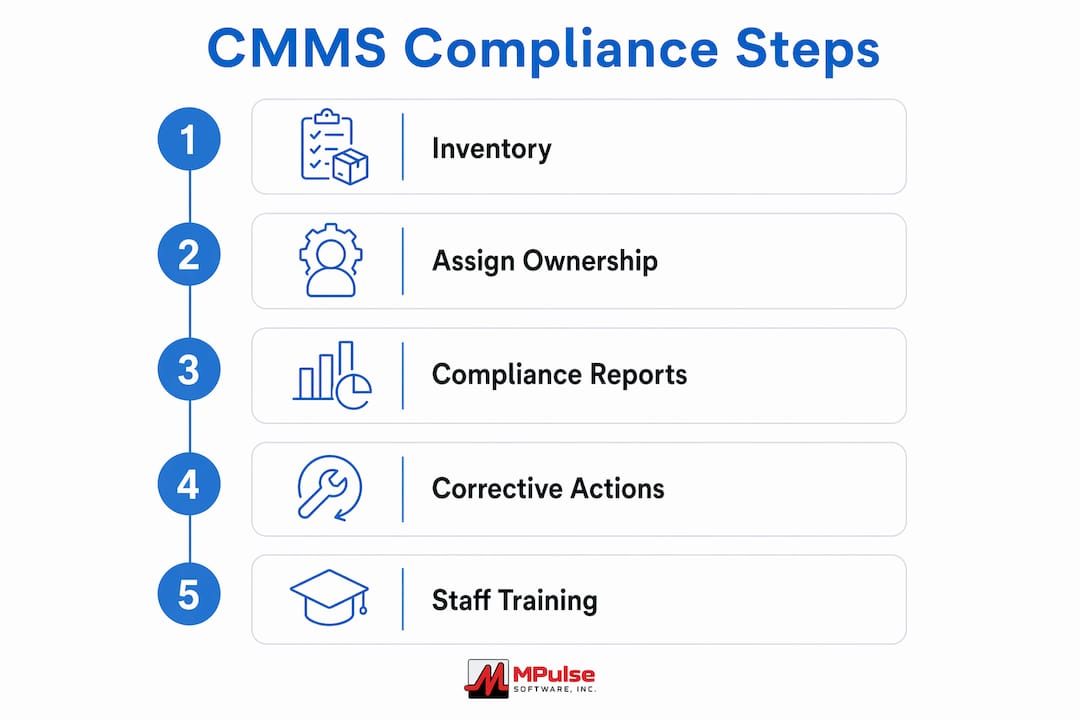
Start with a complete asset inventory. Every regulated piece of equipment must exist in the CMMS with its manufacturer, model, serial number, risk classification, and required maintenance intervals. Gaps in the asset register are the first thing auditors identify.
Assign ownership to every asset. Each piece of equipment needs a responsible technician or team with documented qualifications. Your CMMS should enforce this assignment so that no asset sits in an unmanaged state.
Run a pre-survey compliance report. Most CMMS platforms generate a report showing overdue PMs, expired certifications, and open work orders. Run this report 60 days before your survey date and resolve every finding. This is the closest thing to a practice audit you can conduct internally.
Document corrective actions. When equipment fails or a maintenance gap is discovered, the CMMS must capture the corrective action taken, the technician who performed it, and the date it was completed. Auditors look for this closed-loop documentation as evidence of a functioning quality system.
Train staff on CMMS data entry standards. Inconsistent data entry undermines the credibility of your records. A work order that says “fixed” with no detail is not audit-ready. Establish a standard for what each work order must contain, and enforce it through your CMMS configuration. Resources like CMMS implementation guidance can help teams avoid the most common setup errors that compromise compliance records.
Pro Tip: Schedule a mock accreditation walkthrough using only your CMMS data as the evidence source. If your team cannot answer every auditor question from the system alone, your documentation standards need work.
Key Takeaways
A CMMS is the most direct tool hospitals have for building and maintaining the documentation infrastructure that accreditation bodies require.
| Point | Details |
|---|---|
| Single source of truth | A CMMS unifies clinical engineering, biomedical, and facilities data to eliminate the silos that fail accreditation surveys. |
| Automated compliance tracking | Scheduled PMs, calibration records, and work order logs are generated automatically, removing reliance on manual processes. |
| Technician certification control | CMMS authorization management prevents unqualified personnel from performing regulated maintenance tasks. |
| Pre-survey readiness | Running a compliance report 60 days before a survey gives teams time to close every documentation gap before auditors arrive. |
| Patient safety connection | Fewer missed maintenance intervals mean fewer equipment failures, which directly reduces patient safety incidents and accreditation risk. |
Why CMMS integration is the accreditation gap most hospitals overlook
Hospitals often invest in CMMS software and then configure it to serve only one department. The biomedical team uses it for medical equipment. Facilities uses a separate system or a spreadsheet. Clinical engineering keeps its own records. This fragmentation is the single most common reason hospitals receive accreditation findings related to maintenance documentation.
I have seen facilities with genuinely good maintenance programs fail surveys because the auditor could not get a unified picture of the hospital’s compliance posture. The records existed. They just lived in three different places with no common format. A CMMS only delivers its full accreditation value when it serves as the single platform of record for every department that touches regulated assets.
The integration challenge is real. Connecting a CMMS to an existing HIS or EPR system requires IT coordination, data mapping, and staff training. But the alternative is a fragmented record that creates audit risk every time a surveyor asks for a complete maintenance history. The CMMS features that matter most for accreditation are not the most visible ones. They are the interoperability functions that pull data from every department into one verifiable record.
The future of CMMS in healthcare accreditation points toward real-time condition monitoring and predictive maintenance. Hospitals that build that capability now will face accreditation surveys with a level of documentation depth that current standards have not yet fully caught up to. That is a defensible position to be in.
— Mark
MPulse Software and your hospital’s accreditation goals
Healthcare administrators who need a CMMS built for compliance-intensive environments have a clear option in MPulse Software. MPulse serves over 3,500 customers globally and delivers preventive maintenance automation that keeps every asset on schedule, every record audit-ready, and every technician assignment tied to verified credentials.
MPulse Software’s platform integrates with existing hospital systems, generates Joint Commission-aligned compliance reports, and gives administrators a real-time view of their facility’s maintenance posture. Teams using MPulse report efficiency improvements of up to 40%, which translates directly into fewer accreditation gaps and faster survey outcomes. Explore MPulse CMMS software to see how it maps to your facility’s accreditation requirements, or start with a free trial to test it against your current documentation workflow.
FAQ
What is the role of CMMS in hospital accreditation?
A CMMS manages and documents all maintenance activities for regulated hospital equipment, generating the traceable records that accreditation bodies like the Joint Commission require during surveys. It functions as the central compliance platform connecting clinical engineering, biomedical, and facilities teams.
Which accreditation standards does a CMMS help hospitals meet?
A CMMS supports compliance with Joint Commission standards, ISO 13485 medical device quality requirements, CMS Conditions of Participation, and HIPAA facility management obligations by automating documentation and maintenance scheduling.
How does CMMS reduce risk during a Joint Commission survey?
A CMMS closes the most common survey findings by tracking PM intervals, managing technician certifications, and logging every corrective action in a searchable, time-stamped record that auditors can verify on site.
Can a CMMS integrate with existing hospital information systems?
Yes. A CMMS configured for healthcare integrates with Hospital Information Systems and Electronic Patient Records to correlate equipment availability with patient schedules, reducing downtime and supporting a documented chain of equipment readiness.
How far in advance should hospitals use CMMS to prepare for accreditation?
Running a full compliance report 60 days before a scheduled survey gives maintenance teams enough time to close open work orders, renew expired certifications, and resolve any PM gaps before auditors arrive.