

Finding computerized maintenance management software that unifies work orders, asset tracking, and preventive scheduling often wastes hours on limited trials. Most alternatives hide pricing, demand sales calls for custom quotes, or require IT resources for integration and customization. This review helps maintenance managers and operations teams pick a platform with clear features and pricing that match their compliance and workflow needs.
Table of Contents
MPulse CMMS
At a Glance
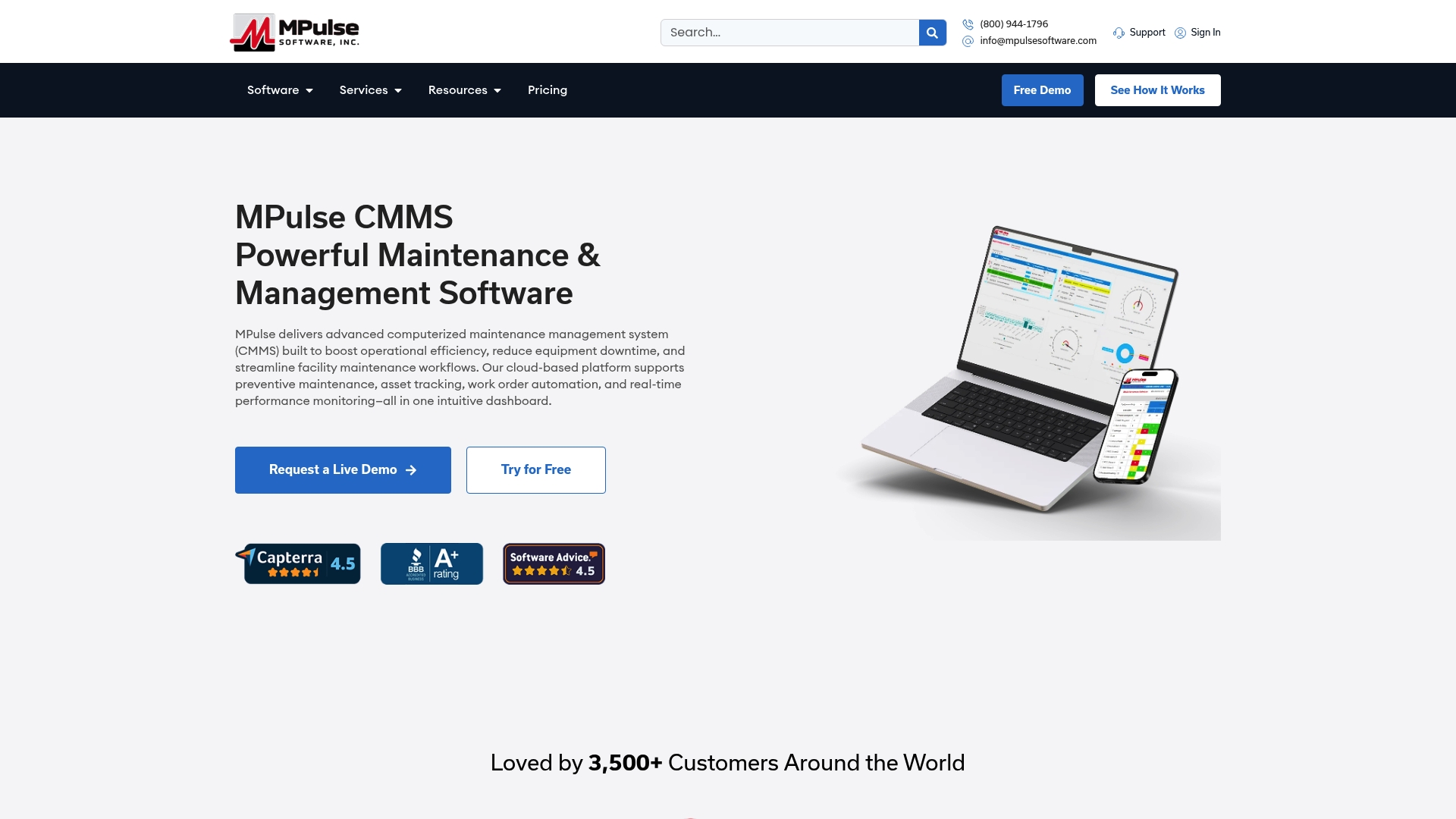
MPulse Software’s marketing materials state the platform is trusted by over 3,500 customers globally. The product pairs preventive maintenance automation with real-time performance monitoring to target unplanned downtime and inefficient maintenance workflows. That combination positions the product for teams needing stronger audit readiness and clearer maintenance schedules.
Core Features
Work order management includes real time tracking and prioritization, while preventive maintenance scheduling automates recurring tasks and notifications. Asset management tracks lifecycle and condition data, and parts inventory supports automatic reordering to reduce stockouts. Graphical reporting and customizable dashboards translate sensor and ERP inputs into maintenance KPIs.
Key Differentiator
Flexible, industry specific features run on a scalable platform with broad integration options and personalized support. The product adapts workflows to manufacturing, healthcare, education, and power generation requirements. Personalized training and configuration services shorten the path from purchase to operational use.
Pros
Highly configurable workflows let you model standard operating procedures and regulatory checklists without developer work. Mobile and offline access keep technicians productive in areas with poor connectivity. Strong integration with ERP systems and industrial sensors brings parts, purchasing, and condition data into maintenance decisions. Customer support and training services target adoption and help complex deployments progress.
Cons
- Complex deployments may require dedicated IT resources or consulting support.
Notable Integrations
- Dynamics 365
- Dynamics GP
- NetSuite
- Sage
- PeopleSoft
- Oracle
- SAP
- Ignition by Inductive Automation
- Disruptive Technologies
- Redzone
Who It’s For
Maintenance teams in manufacturing, healthcare, government, education, and power generation will find the feature set relevant. Teams that must document compliance and support audits will benefit from the reporting and scheduling tools. Organizations planning to connect ERP records and sensor telemetry will get the most value.
Unique Value Proposition
An intuitive calendar interface combined with preventive maintenance automation reduces scheduling conflicts and clarifies technician assignments. The vendor advertises established track records of up to 40% efficiency improvements for clients who complete recommended configurations. That efficiency claim explains why customers focused on lowering unplanned downtime adopt the product.
Real World Use Case
A hospital system uses MPulse CMMS to manage critical equipment maintenance and to automate work orders across multiple facilities. The system centralizes asset histories and compliance paperwork for audits. Technicians receive mobile assignments and complete procedures with documented checklists.
Pricing
Pricing is not published online. The vendor requests that buyers contact sales for a tailored quote that matches deployment scale and required modules. Expect tiered pricing based on users, integrations, and services.
Website: https://mpulsesoftware.com
eMaint
At a Glance
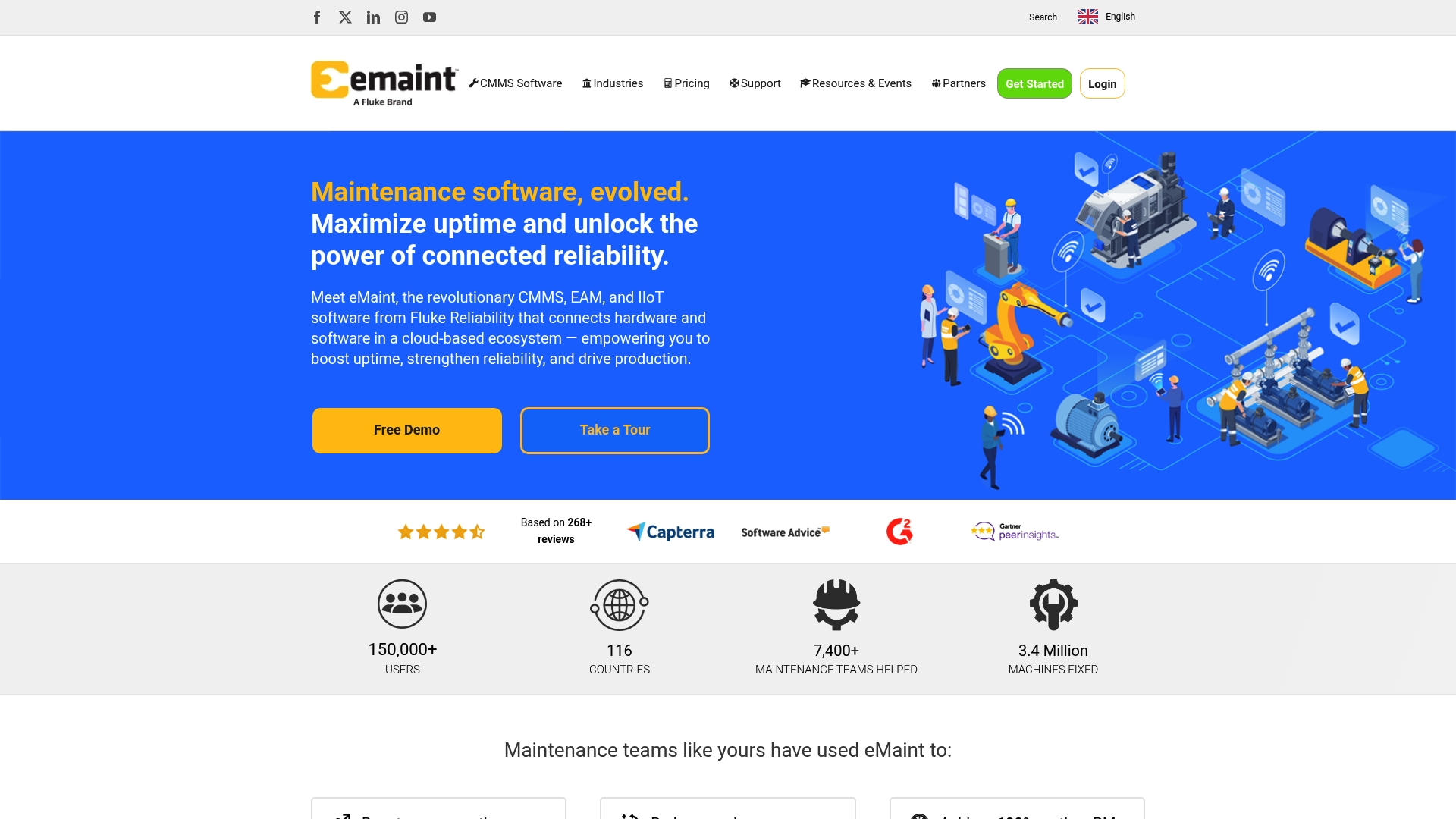
eMaint reports over 150,000 users in more than 116 countries, and the vendor advertises an average 4.5-star rating from 268+ reviews. The product pairs cloud based CMMS, EAM, and IIoT connectivity to tie sensors and maintenance data together. That combination targets reliability teams that must predict failures and manage parts across many sites.
Core Features
The platform delivers asset management with an organized hierarchy and lifecycle tracking, and it includes work order management with drag and drop scheduling. It provides spare parts inventory controls and enterprise reporting for analytics across locations. Multi site management and sensor integrations support preventive and predictive maintenance workflows.
Key Differentiator
eMaint connects hardware and software into a single cloud ecosystem to drive predictive maintenance from live device data. The vendor emphasizes sensor and enterprise system integration over simple ticketing. Compared with MPulse Software, eMaint leans heavier toward IIoT device feeds and enterprise scale deployments.
Pros
eMaint offers broad asset functionality and strong mobile support that lets field technicians work offline and update tasks from the floor. The platform supports spare parts tracking and enterprise reporting that helps managers spot failure patterns across locations. Integration with sensors and ERP systems expands predictive maintenance capabilities and suits teams managing multiple plants or compliance regimes.
Cons
-
Complexity for very small teams. The system includes enterprise features that can overwhelm simple operations.
-
Cost transparency is limited. Public pricing is not detailed, which can hide total implementation costs.
-
Learning curve for full feature use. Administrators face setup time to get asset hierarchies and reports right.
When It May Not Fit
Small single site shops with minimal preventive work may find the feature set excessive. Tight budget teams that need clear public pricing could prefer a simpler, lower cost tool. If you only need basic ticketing and a single parts list, eMaint is not the best match.
Who It’s For
Maintenance managers and operations teams at medium to large industrial or facilities organizations will benefit most. The product suits groups with multiple sites, plans for sensor integration, or a mandate to reduce unplanned downtime. Teams that require enterprise reporting and lifecycle tracking will see the most value.
Real World Use Case
According to the company, a manufacturing plant reduced equipment downtime from 80% to 95%, decreased reactive work by 90%, and extended asset lifespan using eMaint’s predictive features and sensor integrations. That case shows how live device data plus scheduled work orders can shift teams from reactive repairs to condition based maintenance.
Pricing
Public pricing is not listed on the vendor site and the listed offering reads “See Pricing.” Prospective buyers must contact sales for tier details and implementation estimates. Smaller teams should budget for setup and training when estimating total cost.
Website: https://emaint.com
Key Differentiator
Limble prioritizes quick technician adoption through an easy-to-use interface combined with built in automation for routine maintenance. That focus shortens ramp time for field staff and increases the frequency of completed digital work orders. Integrations with sensors and ERP systems let teams act on condition data without heavy IT involvement.
Fiix CMMS
At a Glance
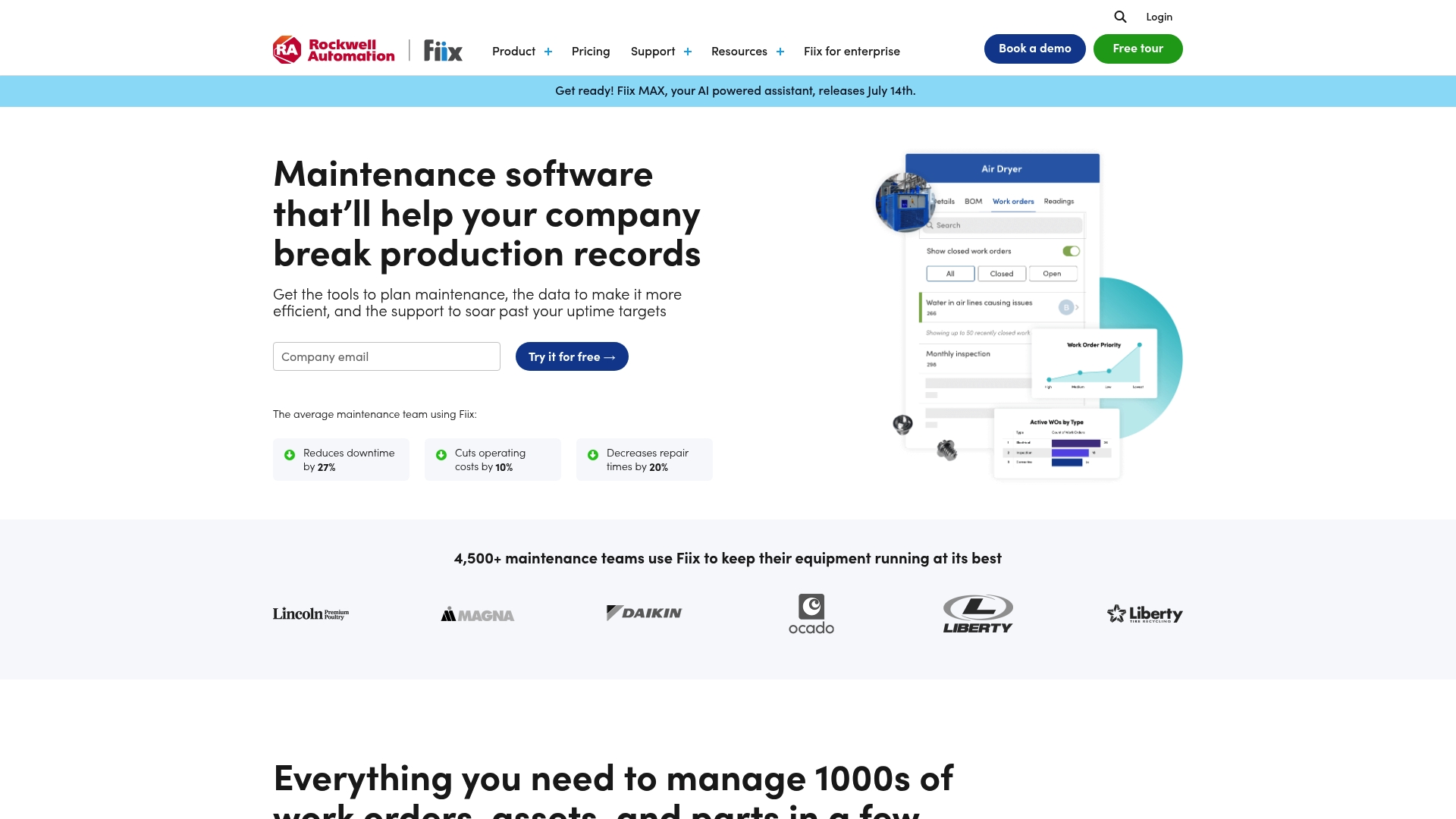
Fiix offers a free plan and paid tiers starting at $45/user/month. The platform includes Fiix Foresight, an AI powered insights module for predictive maintenance. It also supports mobile maintenance and wide industrial integrations for telemetry and enterprise systems.
Core Features
Fiix delivers work order management with creation, tracking, and completion workflows that fit front line technicians. The product also covers asset tracking, parts and supplies management, inventory control, and analytics for maintenance decision-making. The platform exposes APIs and pre built connectors to link sensors, control systems, and ERP data to maintenance records.
Key Differentiator
Fiix focuses on integrating industrial telemetry with maintenance workflows, connecting SCADA, PLCs, and sensors directly to work orders. That connectivity pairs with AI insights to convert device signals into maintenance triggers and priority scoring. The combined approach favors teams that want condition based signals feeding planned work.
Pros
The interface reads clearly for technicians and planners, which reduces training friction for common tasks. Extensive connector options let Fiix pull live data from SCADA, PLCs, and sensors so technicians act on equipment signals. The vendor advertises SOC 2 compliance and hosts data on AWS, which speaks to enterprise security controls and backups.
Cons
- Complexity with deep customization: Configuring advanced workflows across many assets may require specialist help or professional services.
- Unclear enterprise pricing: Pricing beyond the free plan and published tiers is not fully detailed and may vary by deployment size.
- Extra costs for advanced features: Some AI insights and integrations may incur additional fees or require custom setup.
When It May Not Fit
If your team needs a minimal, out of the box tool with no customization, Fiix may feel heavyweight. Organizations with tight fixed budgets may find pricing unpredictable for large deployments. If you lack internal IT support for integrations, the connector setup could add project time.
Notable Integrations
- SCADA systems for telemetry collection and alarm context.
- PLCs to capture device status and event data.
- ERP systems for parts, purchase orders, and financial reconciliation.
- Sensors for condition monitoring and automated triggers.
- Manufacturing execution systems for production and maintenance alignment.
Who It’s For
Maintenance managers and operations leaders at manufacturing, heavy industry, and resource extraction firms will find this product relevant. Teams that plan to tie equipment telemetry to maintenance actions and use AI for predictive workflows will get the most value. It suits organizations that can invest in integrations and occasional professional services.
Real World Use Case
The vendor advertises Rambler Metals & Mining increased wrench time by 15% and reduced equipment downtime significantly using Fiix. That example shows how tying work orders to condition signals can shift crews toward productive tasks. For a plant with many critical assets, those gains translate to less unplanned stoppage and clearer maintenance schedules.
Pricing
Free for basic features. Paid tiers start at $45/user/month for Basic and $75/user/month for Professional, with custom pricing for Enterprise. Large deployments typically require a tailored quote based on integrations and advanced features.
Website: https://fiixsoftware.com
Comparison of alternatives
MPulse Software delivers customizable preventive maintenance solutions tailored to industry-specific needs, enhanced by an expansive integration portfolio. Competitors like eMaint and Fiix address broader enterprise demands and focus heavily on predictive maintenance technology deployments.
Predictive Maintenance Insights
eMaint and Fiix stand out in predictive technology adoption. eMaint integrates with IIoT infrastructure, allowing multi-site enterprises to collect telemetry from distributed operations and apply predictive algorithms for maintenance optimization. Fiix further enhances this approach with integrations to SCADA systems coupled with AI-powered future readiness scoring, making it an excellent choice for heavy-duty industrial environments requiring automated decision-making frameworks.
Cost Transparency and Adoption
Fiix differentiates itself with its free-tier offerings and transparent pricing structure starting at $45/user/month. This contrasts with eMaint, whose pricing remains opaque requiring tailored quotes. Facilities seeking predictable cost frameworks to analyze entry-points and growth phases may find Fiix more approachable for initial evaluation and scaling.
Best fit
- Facilities prioritizing audit readiness and preventive scheduling for regulatory compliance will benefit most from MPulse Software.
- Enterprises operating across dispersed locations that require aggregated IIoT data should consider eMaint.
- Large industrial settings aiming to integrate SCADA telemetry and implement AI-driven predictive maintenance workflows excel with Fiix.
- Smaller companies or startups exploring CMMS functionality can leverage Fiix’s free-tier to assess baseline needs.
Our pick
MPulse Software’s alignment toward configurable workflows tailored for distinct industries and its preventive maintenance automation make it the premier choice for managing compliance-oriented environments. However, for facilities with extensive multi-plant operations or advancing into predictive maintenance paradigms, alternatives like eMaint and Fiix offer differentiated value propositions better suited to those conditions.
To aid in selecting the most suitable computerized maintenance management software, the following table compares the options based on key decision criteria:
| Product | Key Features | Target Audience | Pricing | Limitation |
|---|---|---|---|---|
| MPulse Software | Real-time tracking, preventive maintenance, audit readiness, ERP integration | Maintenance teams in manufacturing, healthcare, education, and power generation | Price not published | May require dedicated IT resources for complex deployments |
| eMaint | Predictive maintenance with IIoT and enterprise reporting | Maintenance teams in medium to large industrial or facilities organizations | Price not published | Complexity and limited cost transparency |
| Fiix CMMS | Integrated AI insights and sensor connectivity | Maintenance managers in manufacturing and heavy industry | Free basic, $45/user/month+ | Requires IT support for advanced features and integrations |
Addressing Unplanned Downtime with an Alternative to Snapfix.com
Maintenance teams seeking reliable snapfix.com alternatives face challenges with unplanned downtime and inefficient workflows. MPulse Software focuses on preventive maintenance automation paired with real-time performance monitoring to tackle these issues head-on. Its intuitive calendar interface reduces scheduling conflicts and improves technician assignments, which directly supports operational efficiency improvements of up to 40%.
For maintenance managers and operations teams that require clear audit readiness and customized services for compliance, MPulse Software offers scalable integration across industries like manufacturing and healthcare. Learn how your team can enhance preventive maintenance and reduce costly downtime by exploring MPulse Software. Start by scheduling preventive tasks and see the impact on equipment reliability.
FAQ
Why should I consider MPulse Software for preventive maintenance automation?
MPulse Software offers effective preventive maintenance automation, which helps reduce unplanned downtime. This feature is vital for teams that need to document compliance and manage maintenance schedules clearly. Consider using MPulse Software to ensure a more organized workflow and improved audit readiness.
How does eMaint’s IIoT connectivity compare to MPulse Software?
eMaint excels in connecting hardware and software within a cloud ecosystem, enhancing its predictive maintenance capabilities from live device data. While eMaint is ideal for organizations looking to capture real-time sensor data across multiple sites, MPulse Software is better suited for teams requiring strong preventive maintenance scheduling and straightforward reporting features.
What does the asset management feature in MPulse Software include?
Asset management in MPulse Software allows for comprehensive tracking of lifecycle and condition data. This feature supports teams in monitoring the performance of their assets over time effectively. Use this capability to streamline your asset maintenance strategies and ensure optimal operation.
Can MPulse Software help small teams manage multiple sites?
MPulse Software is primarily designed for maintenance teams in larger organizations, which may present challenges for very small teams or single-site operations. If you plan to scale up and need robust reporting and scheduling tools, MPulse Software can support that growth effectively when you expand your maintenance strategy.
How much does MPulse Software cost?
Pricing for MPulse Software is not publicly detailed and requires potential users to contact sales for a tailored quote. This approach allows organizations to receive pricing that reflects their specific needs and requirements, including deployment scale and necessary modules.