
TL;DR:
- Effective hospital work order workflows depend on automation, including AI prioritization, mobile apps, and tiered SLAs. These systems improve compliance, reduce costs, and protect patient safety by ensuring timely maintenance and proper documentation. Implementing integrated, automated processes leads to higher PM completion rates and better survey readiness.
A hospital work order compliance workflow is a structured, automated process that manages maintenance tasks and guarantees adherence to healthcare regulations, including Joint Commission Environment of Care (EC) standards and CMS Conditions of Participation. Without a formalized system, hospitals face regulatory citations, patient safety risks, and significant financial losses. Each hour an unresolved work order lingers costs a hospital approximately $1,200 in operational drag from downtime and staff overtime. That figure makes compliance automation in healthcare not a luxury but a financial and safety imperative. MPulse Software is one platform built specifically to address this challenge, trusted by over 3,500 customers globally.
What does an effective hospital work order compliance workflow require?
An effective hospital work order compliance workflow depends on five core components working together: AI priority scoring, mobile technician applications, tiered service level agreement (SLA) frameworks, preventive maintenance triggers, and a centralized computerized maintenance management system (CMMS). Each component addresses a specific failure point in traditional, paper-based or siloed hospital maintenance workflows. Together, they create a system where no request falls through the cracks and every action is documented for audit purposes.

Core infrastructure components
The foundation of any compliant workflow is a CMMS that integrates with your asset database, regulatory documentation library, and department request portals. Without that integration, technicians work from incomplete information and compliance officers lack the audit trails regulators expect. NFPA 99 and Joint Commission EC chapters both require documented evidence of completed maintenance, not just verbal confirmation.
- AI priority scoring: Automatically ranks incoming requests by urgency, asset criticality, and regulatory deadline. AI-driven priority scoring can reduce supervisor triage time by up to 75% and speed resolution by 68%. That means fewer bottlenecks and faster response to life-safety equipment failures.
- Mobile technician apps: Field staff receive, update, and close work orders from any location. Mobile-first workflows reduce technician idle time by over 50% and eliminate transcription errors that create compliance gaps.
- Tiered SLA frameworks: Define response and resolution windows by work order category. Critical life-safety issues get a two-hour window; routine requests get 48 hours. Real-time dashboards flag any order approaching its deadline.
- Preventive maintenance triggers: Automatically generate scheduled work orders based on asset age, usage hours, or IoT sensor readings. This keeps PM completion rates high and reduces surprise failures.
- Audit trail documentation: Every status change, technician note, and photo upload is time-stamped and stored. Compliance officers can pull survey-ready reports without manual data assembly.
Pro Tip: Link your CMMS asset database to your equipment warranty records. When a preventive maintenance trigger fires, technicians can immediately see whether a repair falls under warranty, saving labor costs and preventing unauthorized modifications that void coverage.
The table below compares manual work order routing against AI-driven routing across four critical dimensions.
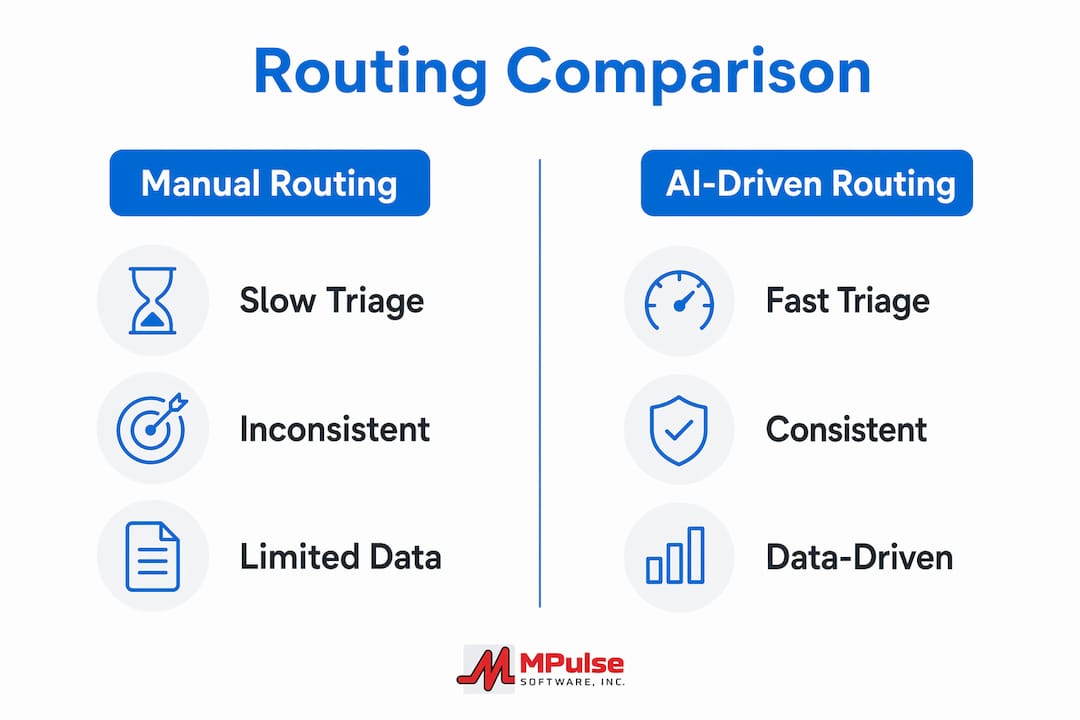
| Feature category | Manual routing | AI-driven routing |
|---|---|---|
| Triage speed | Hours, dependent on supervisor availability | Seconds, based on preset rules |
| Compliance documentation | Incomplete, prone to gaps | Automatic, time-stamped |
| SLA adherence | Reactive, tracked after the fact | Proactive, with real-time alerts |
| Audit readiness | Requires manual report assembly | Generated on demand |
How to implement an automated hospital work order compliance workflow
Implementation follows a five-step sequence. Skipping steps or running them in parallel creates the same siloed problems the workflow is designed to fix.
-
Centralize request intake. Collect work orders from nursing, facilities, biomedical engineering, and housekeeping through a single portal. Unified intake systems eliminate shadow systems and close the liability gaps that arise when requests travel by phone, text, or sticky note. Assign each request a unique ID the moment it enters the system.
-
Deploy AI-driven priority scoring and auto-dispatch. Once a request is logged, the system scores it against asset criticality, regulatory category, and current technician workload. The highest-priority orders go to the nearest available qualified technician automatically. No supervisor intervention is needed for routine routing decisions.
-
Equip technicians with mobile-first work order apps. Apps should support offline capability for basement mechanical rooms and shielded imaging suites where connectivity drops. Technicians complete digital checklists, attach photos, and capture parts used before closing the order. This data feeds directly into the compliance record.
-
Configure tiered SLAs with real-time monitoring and escalation. Set response and resolution thresholds by work order category. When an order approaches its deadline without closure, the system automatically escalates to a supervisor and logs the delay. Automated SLA frameworks with real-time dashboards achieve zero missed compliance windows and produce audit-ready reporting without manual effort.
-
Integrate preventive maintenance triggers linked to asset history and IoT data. Connect your CMMS to IoT sensors on critical equipment such as HVAC units, medical gas systems, and sterilizers. When a sensor reading exceeds a defined threshold, the system generates a work order before the equipment fails. Hospitals using this approach and integrated CMMS scheduling achieve up to 97% PM completion rates and zero maintenance-related Joint Commission findings.
Pro Tip: Run a 30-day parallel operation period where both your old process and the new system run simultaneously. This surfaces edge cases, such as requests that arrive by fax or phone, that your intake portal did not account for.
| Step | Responsible role | Expected outcome |
|---|---|---|
| Centralize intake | Facilities director | Single source of truth for all requests |
| AI priority scoring | CMMS administrator | Faster dispatch, fewer missed urgencies |
| Mobile technician apps | Maintenance supervisor | Accurate, real-time field documentation |
| SLA configuration | Compliance officer | Zero missed regulatory deadlines |
| IoT-linked PM triggers | Biomedical engineering | Reduced equipment failures, higher PM rates |
For a deeper look at the preventive maintenance side of this process, the hospital preventive maintenance guide from MPulse Software covers scheduling logic and compliance impact in detail.
What challenges arise in hospital work order compliance workflows?
The most common failure in hospital maintenance workflows is manual dispatch lag. When a supervisor must personally review and assign every incoming request, high-volume periods create backlogs that push compliance deadlines past their limits. A single missed response window on a life-safety system can trigger a Joint Commission finding.
Four additional challenges consistently undermine compliance performance:
- Siloed communication channels: Requests arriving by phone, email, and paper never enter the CMMS. They exist outside the audit trail and create liability gaps that surface only during surveys.
- Incomplete audit trails: Technicians who close orders verbally without digital documentation leave compliance officers with no evidence of completion. Regulators require documented proof, not assurances.
- Compliance reporting delays: Manual report assembly for Joint Commission or CMS surveys can take weeks. Teams pull data from spreadsheets, paper logs, and email threads, introducing errors and omissions.
- Backlog growth without predictive analytics: Without data on asset failure patterns, maintenance teams react to breakdowns rather than preventing them. Backlogs grow faster than teams can resolve them.
“Modern hospital work order management is fundamentally a patient safety function. Unresolved requests represent direct compliance risks, not just operational inconveniences. Every open work order on a life-safety system is a potential survey finding and a potential patient harm event.”
The financial consequences compound quickly. At $1,200 per hour of operational drag per unresolved order, a backlog of 20 open requests costs a hospital $24,000 per hour in combined downtime and overtime. Predictive analytics and structured work order management address this by identifying which assets are most likely to fail next, allowing teams to prioritize before a breakdown occurs.
Real-time SLA dashboards give compliance officers continuous visibility into open orders, approaching deadlines, and technician workloads. Automated escalation triggers remove the human delay from the process. When a work order crosses 80% of its allowed response window without closure, the system alerts the supervisor and logs the escalation automatically.
How do you measure and sustain compliance performance over time?
Sustained compliance requires tracking the right metrics, not just resolution counts. The key performance indicators that matter most to Joint Commission and CMS surveyors are PM completion rates, SLA adherence by category, backlog trend over time, and technician utilization rates.
- PM completion rate: Target 95% or higher. Hospitals using automated scheduling achieve up to 97% PM compliance. Anything below 90% signals a scheduling or staffing gap that regulators will notice.
- SLA adherence by category: Track separately for life-safety, clinical support, and general facility requests. A single category falling below threshold often points to a staffing or routing problem in one department.
- Backlog trend: A growing backlog over consecutive months indicates demand is outpacing capacity. Use this data to justify staffing additions or capital equipment replacements before a survey.
- Technician utilization: Measures productive time versus idle time. Low utilization paired with a growing backlog points to routing inefficiency, not a staffing shortage.
Pro Tip: Export your SLA adherence and PM completion data monthly and share it with department heads. When clinical leaders see the compliance data tied to their units, they become advocates for maintenance funding rather than obstacles to it.
Automated reporting tools can produce survey-ready compliance documentation in hours instead of weeks. That speed matters most in the 30 days before a scheduled survey and during unannounced inspections. Compliance officers who rely on manual report assembly routinely discover gaps only after a surveyor has already flagged them.
| KPI | Target threshold | Action if below threshold |
|---|---|---|
| PM completion rate | 95% or higher | Review scheduling logic and technician capacity |
| SLA adherence | 100% for life-safety | Audit routing rules and escalation triggers |
| Backlog trend | Flat or declining | Assess staffing levels and work order volume |
| Technician utilization | 75–85% productive time | Review dispatch logic and idle time causes |
Live dashboards aligned with NFPA 99, Joint Commission EC chapters, and CMS Conditions of Participation give supervisors and department heads continuous visibility without waiting for monthly reports. For guidance on integrating CMMS with accreditation requirements, MPulse Software publishes a detailed compliance guide covering audit preparation and documentation standards.
Key Takeaways
A hospital work order compliance workflow succeeds when it combines centralized intake, AI-driven dispatch, mobile documentation, tiered SLAs, and automated preventive maintenance into a single, auditable system.
| Point | Details |
|---|---|
| Centralize all intake | Eliminate shadow systems by routing every request through one CMMS portal from day one. |
| Use AI priority scoring | Automated triage cuts supervisor workload and speeds resolution by up to 68%. |
| Document everything digitally | Time-stamped mobile records are the only audit trail regulators will accept. |
| Monitor SLA adherence continuously | Real-time dashboards prevent missed compliance windows before they become survey findings. |
| Measure PM completion rates | Target 95% or higher; automated scheduling makes 97% achievable and sustainable. |
The case for treating work orders as patient safety events
The framing I see most often in hospital facilities management is operational: work orders are tasks to close, backlogs are productivity problems, and compliance is a reporting exercise. That framing is wrong, and it costs hospitals money and accreditation points every year.
Every open work order on a life-safety system is a patient safety event in progress. A delayed repair on a medical gas alarm, a missed PM on a fire suppression system, or a broken HVAC unit in an isolation room are not facilities inconveniences. They are direct risks to patients and staff. The moment facilities teams and compliance officers internalize that framing, the urgency around workflow design changes completely.
The technology argument is settled. Manual processes cannot produce the audit trail depth, the SLA consistency, or the PM completion rates that Joint Commission and CMS now expect. Hospitals that deployed integrated CMMS platforms with automated scheduling report full cost recovery within 14 months, with labor efficiency gains appearing in the first eight weeks. The ROI is not theoretical.
What I find underappreciated is the capital planning benefit. When your work order data is clean and structured, you can show administration exactly which assets are generating the most corrective maintenance hours, what those hours cost, and when replacement becomes cheaper than repair. That data changes budget conversations. Facilities leaders who bring structured work order analytics to capital planning meetings get funded. Those who bring anecdotes do not.
The hospitals that will struggle in the next five years are those still running hybrid systems, where some requests enter a CMMS and others travel by phone or email. The liability gap in those hybrid systems is real, and surveyors are increasingly sophisticated about finding it.
— Mark
How MPulse Software supports hospital compliance workflows
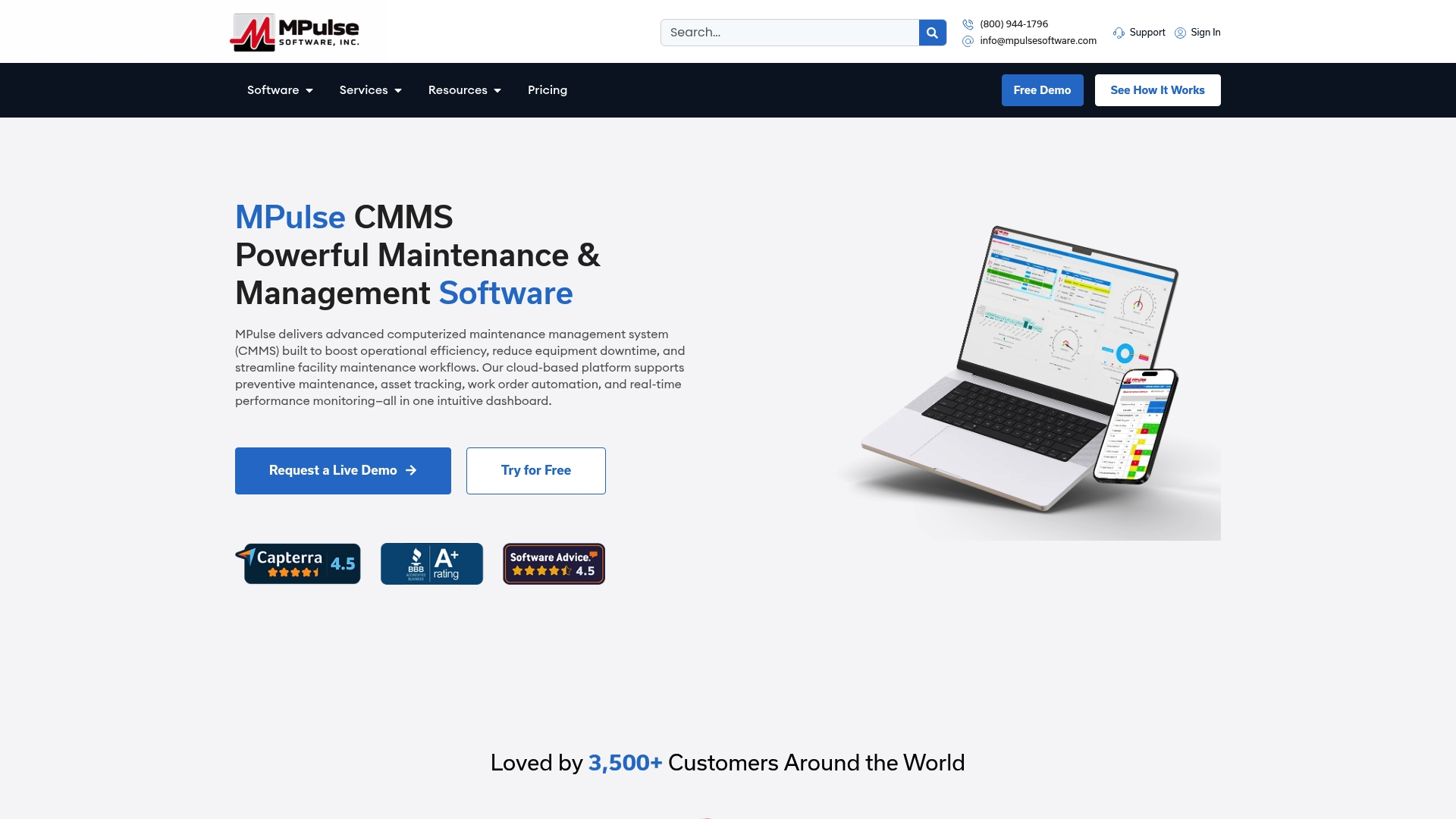
MPulse Software gives healthcare facilities teams the tools to build and sustain a fully documented, audit-ready maintenance operation. The platform combines automated preventive maintenance scheduling, AI-driven work order prioritization, mobile technician applications, and real-time SLA monitoring in one system. Customers report efficiency improvements of up to 40%, and the platform’s compliance reporting features produce survey-ready documentation without manual data assembly. MPulse Software serves over 3,500 customers globally, including facilities with strict Joint Commission and CMS requirements. Explore the full capability set on the MPulse CMMS platform page, or review how real-time IoT monitoring integrates with preventive maintenance triggers to keep critical hospital equipment compliant year-round.
FAQ
What is a hospital work order compliance workflow?
A hospital work order compliance workflow is a structured, automated process for managing maintenance requests while maintaining documented adherence to Joint Commission, CMS, and NFPA 99 standards. It connects intake, dispatch, field documentation, and reporting into a single auditable system.
How does a CMMS improve hospital compliance?
A CMMS centralizes all work order data, automates preventive maintenance scheduling, and generates audit-ready reports on demand. Hospitals using integrated CMMS platforms achieve up to 97% PM completion rates and eliminate maintenance-related survey findings.
What are the biggest risks of manual work order management in hospitals?
Manual systems create incomplete audit trails, missed SLA deadlines, and compliance reporting gaps that surface during Joint Commission or CMS surveys. Each unresolved work order costs approximately $1,200 per hour in operational drag.
How long does it take to see ROI from automated work order management?
Most mid-size hospitals recover the full cost of a modernized work order system within 14 months, with labor efficiency gains visible in the first eight weeks and compliance cost reductions appearing by month six.
Which compliance standards govern hospital work order documentation?
Joint Commission Environment of Care chapters, CMS Conditions of Participation, and NFPA 99 all require documented evidence of completed maintenance tasks. Automated CMMS reporting produces the time-stamped records these standards require.