

TL;DR:
- A school HVAC maintenance schedule involves regular inspections, servicing, and documentation to ensure system reliability and compliance. Predictive analytics enhances this process by detecting early failure signs, cutting costs, and reducing emergency repairs. Automated CMMS platforms streamline tasks, improve accountability, and help meet OSHA’s 2026 regulatory requirements.
A school HVAC maintenance schedule is a structured, periodic plan of inspections, servicing, and documentation designed to keep heating, cooling, and ventilation systems running reliably throughout the academic year. The industry term for this practice is a preventive maintenance program, and it covers everything from monthly filter checks to annual efficiency audits. OSHA’s 2026 Heat Illness Prevention rule now requires documented HVAC maintenance schedules in all occupied school spaces, with penalties reaching $156,259 per violation. That regulatory pressure, combined with rising energy costs and the real risk of summer system failures, makes a well-structured HVAC service plan for schools a non-negotiable operational priority.
What are the essential tasks in a school HVAC maintenance schedule?
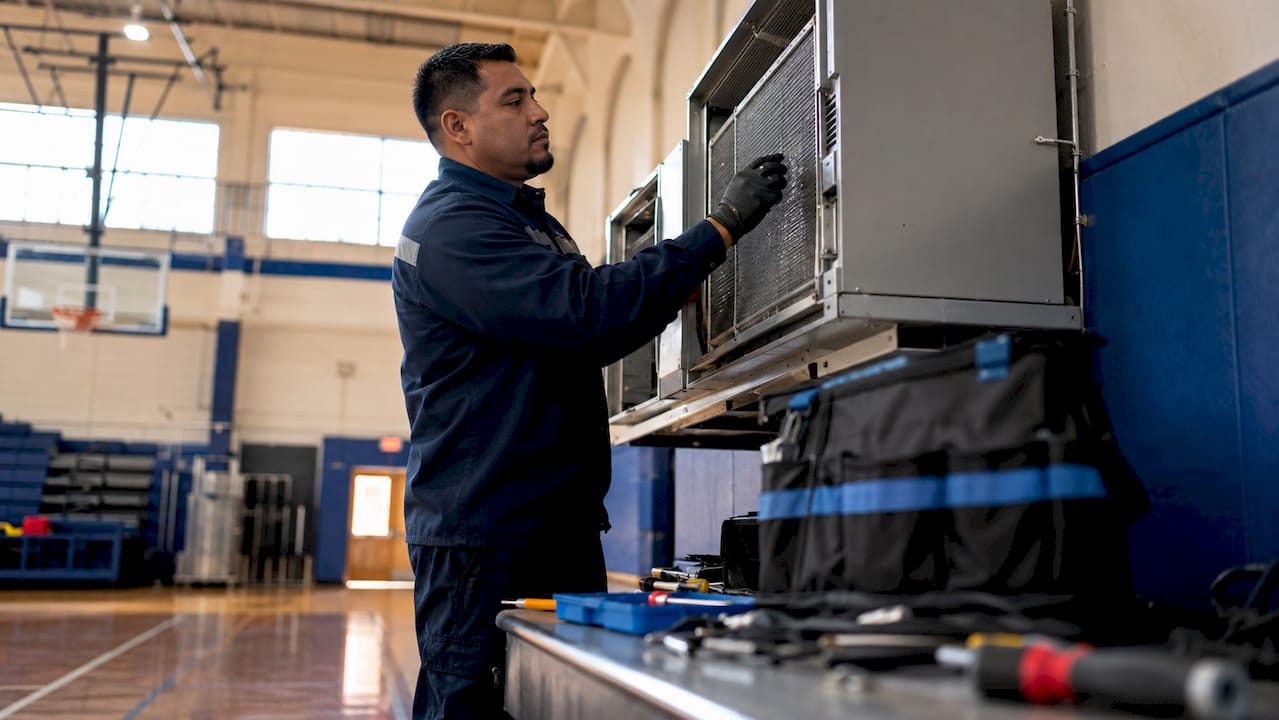
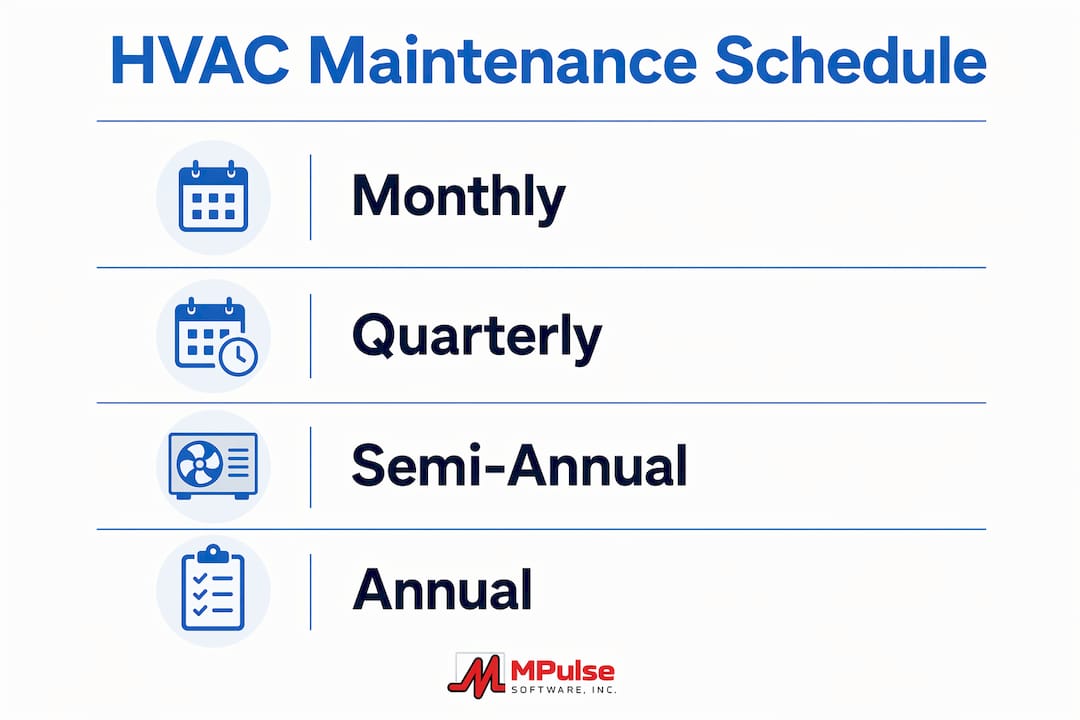
The core of any educational facility HVAC upkeep program is a tiered task structure organized by frequency. Each tier addresses a different level of system risk, and skipping any tier compounds the risk in the next.
Monthly tasks center on filter inspection and replacement. Filter replacement intervals range from monthly to every three months depending on the filter’s MERV rating and building conditions such as occupancy density and dust levels. A school gymnasium or shop classroom demands more frequent changes than an administrative office. Documenting each filter swap creates a paper trail that supports compliance audits.
Quarterly tasks move deeper into the system:
- Coil inspection and cleaning to prevent heat transfer loss
- Condensate drain line flushing to stop mold growth and water damage
- Ductwork visual checks for leaks, blockages, or signs of pest intrusion
- Thermostat and control calibration checks
- Belt and motor inspections on air handling units
Semi-annual servicing is the backbone of a sound HVAC service plan for schools. Professional full servicing should occur in spring and fall to prepare systems for cooling and heating seasons respectively. Spring service focuses on refrigerant charge, condenser coil cleaning, and cooling capacity testing. Fall service covers heat exchanger inspection, burner cleaning, and combustion analysis. Both visits include safety checks and calibration of all controls.
Annual evaluations close the loop. A comprehensive annual assessment covers system efficiency ratings, indoor air quality measurements, refrigerant leak testing, and a full compliance audit against current standards.
| Frequency | Core tasks | Documentation required |
|---|---|---|
| Monthly | Filter inspection and replacement | Filter log with date, MERV rating, and condition |
| Quarterly | Coil cleaning, drain flush, duct check, belt inspection | Inspection report per unit |
| Semi-annual | Full professional service, calibration, safety testing | Technician sign-off, service report |
| Annual | Efficiency audit, IAQ testing, compliance review | Full system assessment report |
Every task at every tier requires a written record. Without documentation, the work effectively did not happen from a compliance standpoint.
How can predictive analytics improve your HVAC maintenance program?
Predictive analytics is the practice of using sensor data and AI algorithms to detect early signs of equipment failure before a breakdown occurs. In the context of school heating system maintenance, this means monitoring performance signatures such as refrigerant pressure trends, motor current draw, and supply air temperature deviations continuously rather than waiting for a scheduled inspection.
The detection window is the key advantage. AI-driven platforms identify pre-failure conditions 3–6 weeks before an actual failure occurs. That window converts what would have been an emergency repair into a planned work order. For schools, this matters most in late spring, when systems ramp up for summer cooling and failures are most likely to surface.
The financial case is direct. Deploying AI-driven HVAC monitoring produces maintenance cost reductions of 18–30% and energy cost savings of up to 19% across monitored buildings. Those are not marginal gains. A district running 10 school buildings can redirect a significant portion of its emergency repair budget toward instructional programs.
The operational case is equally strong:
- Fewer unplanned shutdowns during the school day
- Reduced reliance on reactive, overtime-rate repair calls
- Automated work order generation when a threshold is crossed
- Continuous OSHA compliance documentation without manual assembly
- Data-backed capital request proposals for equipment replacement
Summer HVAC failures at large schools have cost over $200,000 in combined repair and disruption expenses. Predictive monitoring eliminates most of that risk by catching degradation weeks before the system fails during peak load.
Pro Tip: Reallocate the first year of emergency repair savings into funding a predictive analytics pilot on your highest-risk buildings. The ROI typically justifies district-wide rollout within two years.
What tools support an efficient school HVAC maintenance schedule?
The right tools determine whether a maintenance schedule stays on paper or gets executed consistently. Facility managers in educational institutions have three broad categories to choose from, each with distinct capabilities.
Manual tracking relies on paper logs, spreadsheets, and calendar reminders. It works for very small campuses with one or two buildings and a single technician. The failure mode is human. Missed entries, lost records, and no automatic alerts mean compliance gaps accumulate silently.
Basic digital scheduling tools add calendar-based work order generation and digital checklists. They reduce missed tasks and improve accountability. They do not integrate with equipment sensors, so they cannot detect emerging failures between scheduled visits.
Integrated CMMS platforms with condition monitoring represent the current standard for multi-building school districts. These platforms connect sensor data directly to the scheduling engine. When a monitored parameter crosses a threshold, the system generates a work order automatically. Automated maintenance tracking produces audit-ready reports and temperature logs with zero manual assembly.
| Tool category | Work order automation | Condition monitoring | Audit-ready reports |
|---|---|---|---|
| Manual tracking | No | No | Manual only |
| Basic digital scheduling | Yes (calendar-based) | No | Partial |
| Integrated CMMS with IIoT | Yes (condition-triggered) | Yes | Automatic |
MPulse Software serves over 3,500 customers globally and delivers up to 40% efficiency improvements through its preventive maintenance automation and real-time monitoring integration. Its calendar interface ties scheduled maintenance tasks directly to equipment records, so nothing falls through the cracks between seasonal service visits.
Pro Tip: Choose software that exports compliance documentation in a format your state education department accepts. Generating audit-ready reports automatically removes the single biggest administrative burden from your team.
How to implement a school HVAC maintenance schedule in your facility
A structured rollout prevents the common failure mode: a schedule that looks complete on paper but collapses within 60 days because responsibilities are unclear and no one owns the data.
-
Assess your current system condition. Walk every mechanical room and document the age, model, and last known service date for each unit. Identify systems that are overdue for inspection or operating outside normal parameters. This baseline determines where to start and what to prioritize.
-
Build your schedule around manufacturer specs and industry standards. Use the tiered framework from the previous section as your template. Adjust filter inspection frequency based on actual MERV ratings and occupancy patterns in each building zone. Align semi-annual service visits with your school calendar so technicians access systems during low-occupancy periods.
-
Assign clear ownership for every task. Each inspection item needs a named responsible party, a due date, and a sign-off requirement. Shared responsibility is no responsibility. Use digital checklists so completion is logged in real time rather than reconstructed from memory at audit time.
-
Schedule seasonal deep inspections in spring and fall. Spring service prepares cooling systems before the first heat wave. Fall service confirms heating systems before the first cold snap. Both visits should include a review of the previous season’s performance data to catch trends before they become failures. Resources like winterizing your HVAC system provide practical checklists for cold-season preparation.
-
Use performance data to adjust your schedule. A system running in a high-dust vocational building needs more frequent filter changes than the same model in a library. Review equipment performance logs quarterly and revise task frequencies when the data supports it. This is how a static schedule becomes a living program.
-
Train your team and maintain engagement. A schedule is only as good as the people executing it. Run brief quarterly reviews with your maintenance staff to address recurring issues, share what the data shows, and update procedures. Staff who understand why a task matters complete it more consistently than staff who are just following a list.
Understanding how facilities management supports student outcomes gives facility managers a stronger internal case for budget and staffing when presenting HVAC program proposals to school leadership.
Key takeaways
A structured school HVAC maintenance schedule built on monthly, quarterly, semi-annual, and annual tasks, supported by predictive analytics and a CMMS platform, is the most reliable way to prevent costly failures and maintain regulatory compliance.
| Point | Details |
|---|---|
| Tiered task structure | Monthly, quarterly, semi-annual, and annual tasks each address a distinct level of system risk. |
| Documentation is compliance | Every inspection and service visit requires a written record to satisfy OSHA and audit requirements. |
| Predictive analytics cuts costs | AI monitoring reduces maintenance costs by 18–30% and catches failures 3–6 weeks in advance. |
| CMMS automates accountability | Integrated platforms generate work orders and audit-ready reports without manual effort. |
| Seasonal timing is critical | Spring and fall professional service visits prevent peak-season failures and protect school operations. |
What I’ve learned about HVAC schedules that most guides won’t tell you
The hardest part of running an effective HVAC program in a school district is not the technical side. It is the institutional inertia. Facility managers often inherit systems that have been serviced reactively for years, and the budget conversations reflect that history. Leadership sees HVAC as a cost center until a $200,000 summer failure forces a reckoning.
The shift I have seen work consistently is moving from anecdotal failure reporting to data-driven capital proposals. When you walk into a budget meeting with sensor trend data showing a compressor degrading over 14 weeks, you get a replacement approved. When you walk in with “it’s been making a noise,” you get a band-aid repair. Predictive analytics gives facility managers the language that administrators and school boards respond to: numbers, timelines, and avoided costs.
The other thing most guides understate is the compliance exposure. OSHA’s 2026 requirements are not theoretical. The penalty range for undocumented HVAC maintenance is severe enough to fund several years of a proper preventive maintenance program. Framing your schedule as a compliance requirement, not just a best practice, changes how quickly it gets resourced.
My honest recommendation: start with the basics, document everything from day one, and build the case for predictive monitoring with your first year of data. The technology pays for itself. The documentation protects you. And the schedule, when followed, keeps students and staff in buildings that actually work.
— Mark
MPulse Software for school HVAC preventive maintenance
MPulse Software gives facility managers in educational institutions a purpose-built platform for managing every layer of a preventive maintenance program, from automated work order generation to real-time condition monitoring and compliance reporting.
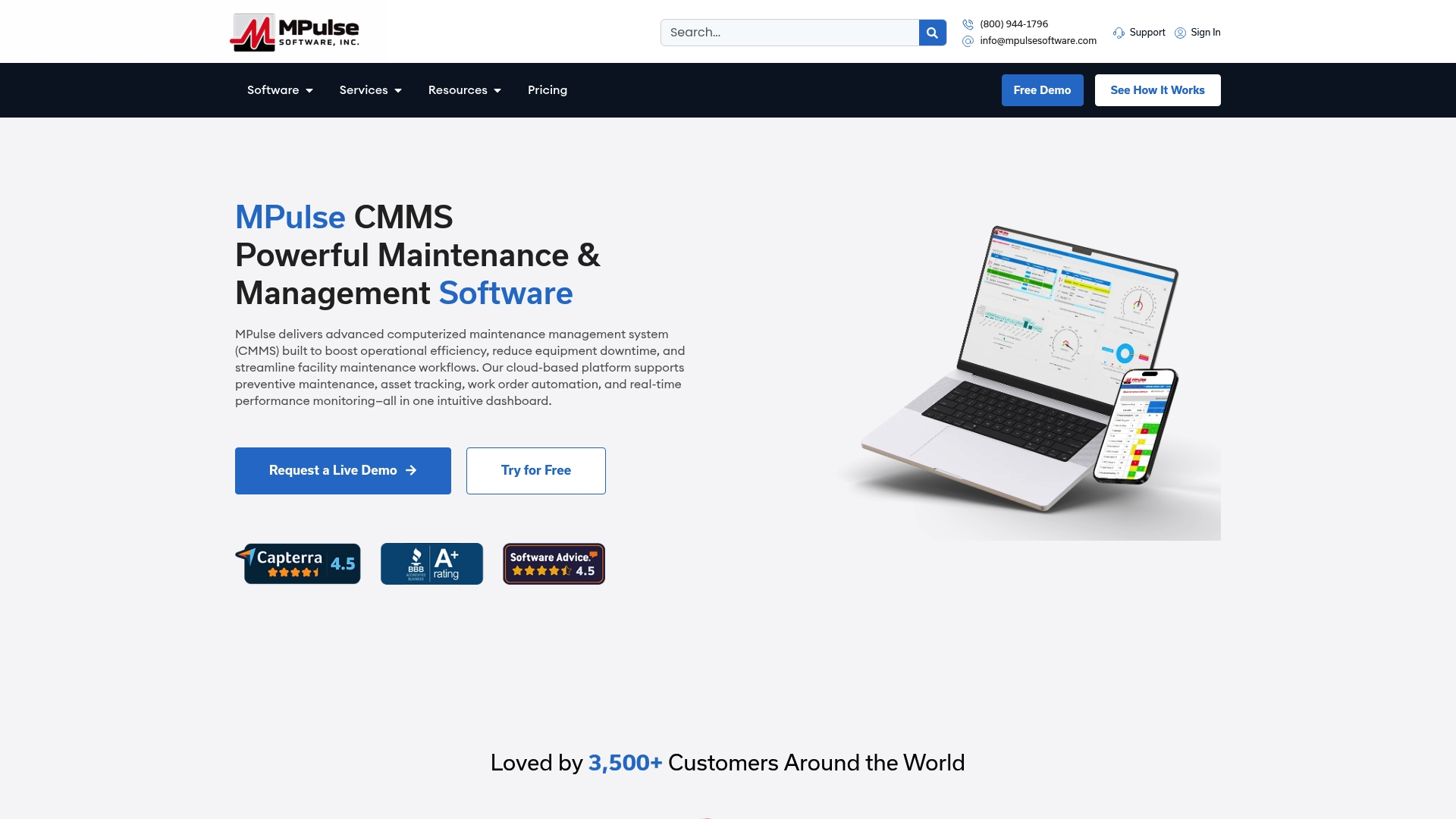
MPulse Software connects your HVAC inspection schedule directly to equipment records, triggers work orders when sensor thresholds are crossed, and produces audit-ready documentation without manual assembly. For districts managing multiple buildings and complex compliance requirements, that automation removes the administrative burden that causes most schedules to break down. Learn more about building a preventive maintenance program that keeps your systems running and your facilities compliant year-round.
FAQ
What is a school HVAC maintenance program?
A school HVAC maintenance program is a structured preventive maintenance plan covering regular inspections, filter replacements, professional servicing, and compliance documentation for all heating, cooling, and ventilation systems in a school facility.
How often should school HVAC filters be inspected?
Filter inspection frequency ranges from monthly to every three months, depending on the filter’s MERV rating and building conditions such as occupancy density and dust levels.
What does semi-annual HVAC servicing include for schools?
Semi-annual servicing covers spring cooling preparation, including refrigerant charge and condenser cleaning, and fall heating preparation, including heat exchanger inspection, burner cleaning, and combustion analysis.
How much can predictive analytics reduce HVAC maintenance costs?
AI-driven predictive monitoring reduces maintenance costs by 18–30% and delivers energy savings of up to 19%, while catching pre-failure conditions 3–6 weeks before a breakdown occurs.
What are the OSHA compliance requirements for school HVAC maintenance?
OSHA’s 2026 Heat Illness Prevention rule requires documented HVAC maintenance schedules and temperature monitoring in all occupied school spaces, with penalties ranging from $15,625 to $156,259 per violation.