TL;DR:
- Real-time maintenance alerts from equipment sensors and a CMMS reduce repair times and prevent clinical disruptions.
- They enable rapid response, generate detailed audit trails, and improve asset uptime for safer healthcare operations.
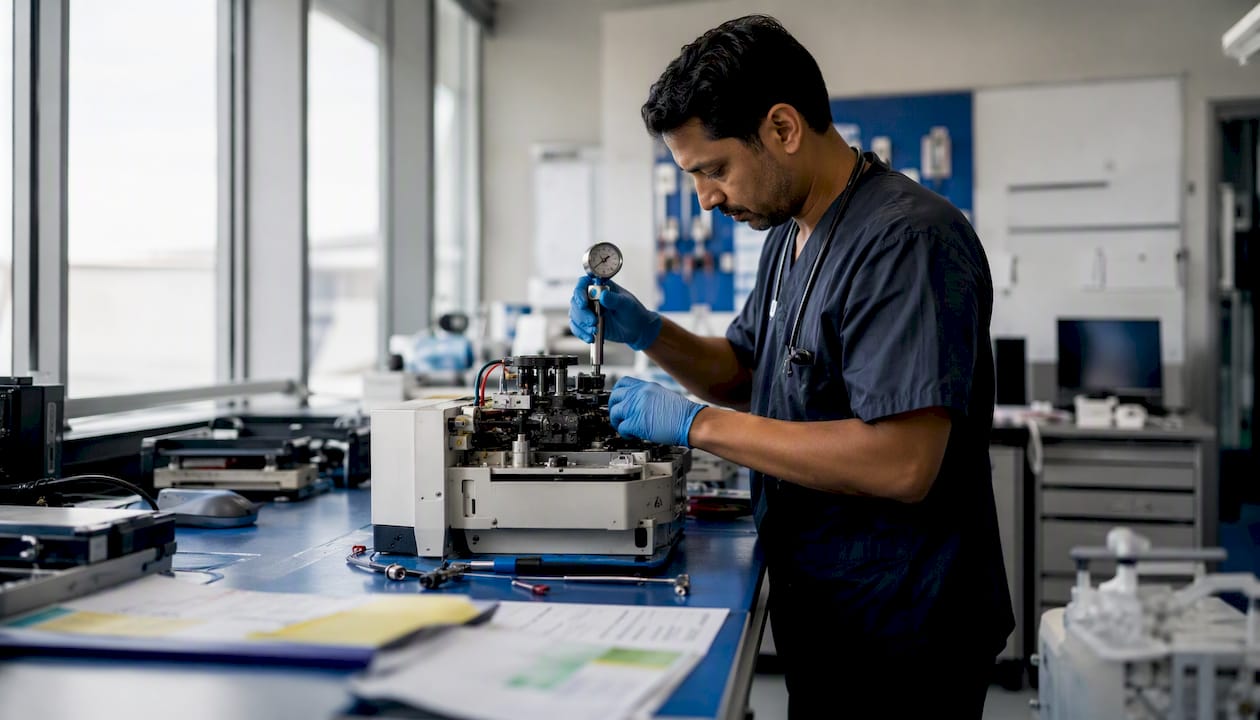
Real-time maintenance alerts from equipment sensors and a CMMS shorten detection-to-repair cycles from hours to minutes, preventing clinical interruptions and direct patient harm before they occur. According to WHO-related data cited by HCO News, unsafe care contributes to more than 3 million patient deaths annually, and roughly 1 in 10 patients are harmed during healthcare delivery. Operational failures — a missed HVAC threshold in an OR, a delayed sterilizer repair — are major contributors to that number.
The core protective mechanism works through five elements:
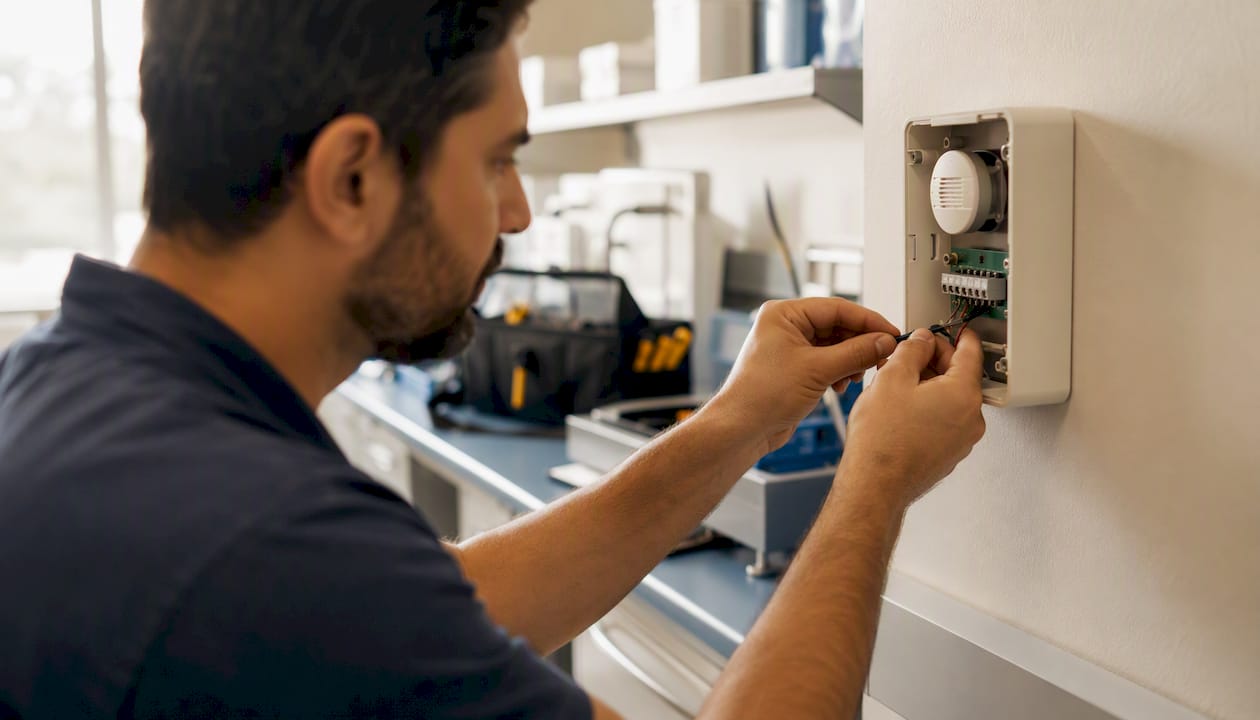
- Continuous monitoring: Sensors track temperature, pressure, vibration, and electrical load across critical assets 24/7.
- Automated escalation: A CMMS or EAM ingests sensor telemetry and triggers alerts when readings cross defined thresholds.
- Risk-based prioritization: Asset criticality scores route life-safety alerts ahead of lower-priority work.
- Mobile technician dispatch: Work orders reach field staff instantly via mobile devices, with full service history and barcode access.
- Timestamped documentation: Every alert, acknowledgment, and repair closure creates an audit-ready evidence chain for Joint Commission standard EC.02.04.01 and CMS surveys.
MPulse Software operationalizes all five elements through its IIoT and real-time monitoring connectors and automated work-order workflows.
Table of Contents
- Operational outcomes: faster response, higher uptime, and compliance readiness
- What your team must plan for before going live
- How MPulse CMMS operationalizes real-time alerts for patient safety
- Key Takeaways
- The case for acting this quarter, not next fiscal year
- Useful sources and MPulse resources
- MPulse Software: built for healthcare facility teams
- FAQ
Operational outcomes: faster response, higher uptime, and compliance readiness
Real-time alerts reduce mean time to repair (MTTR), improve critical-asset availability, and produce an audit-ready documentation trail that survives Joint Commission and CMS review. The table below maps benefit categories to their patient-safety implications.
| Operational Benefit | Patient-Safety Connection |
|---|---|
| Reduced MTTR on life-safety assets | Shorter downtime for ORs, ICUs, and sterile processing |
| Fewer unplanned room closures | Fewer canceled procedures and diverted patients |
| Predictive parts ordering | No repair delays from missing components |
| Automated compliance documentation | Audit evidence present at survey time, reducing citation risk |
| Staff productivity gains | Technicians spend time on repairs, not on manual log reviews |
MPulse Software customers report efficiency improvements up to 40%, a figure that translates directly into faster response times and higher asset uptime across the facility. Condition-based monitoring, when integrated with a CMMS, can detect anomalies hours or weeks before they produce clinical impact — shifting teams from reactive firefighting to planned, lower-risk repairs.
What your team must plan for before going live
Success depends equally on technical integration and disciplined change management. Neither alone is sufficient.
Technical checklist:
- Complete an asset inventory with criticality classifications (life-safety, mission-critical, non-critical).
- Select and place sensors appropriate to each asset class (temperature, vibration, pressure, moisture, electrical load).
- Map CMMS integration points: API connectors, BACnet/Modbus gateways, or direct IIoT telemetry feeds.
- Configure alert routing and escalation logic, including on-call schedules and supervisor escalation windows.
- Provision technicians with mobile devices and train them on mobile work-order workflows.
- Confirm parts and inventory readiness for the asset classes in the pilot scope.
- Build documentation workflows that capture timestamped evidence for every alert-to-closure cycle.
Pro Tip: Run a parallel-validation window of two to four weeks where your existing monitoring system and the new sensor-to-CMMS integration operate simultaneously. This surfaces threshold calibration issues before cutover and gives clinical engineering a confidence baseline.
A realistic pilot timeline runs 8–12 weeks: weeks 1–3 for asset inventory and sensor installation, weeks 4–6 for CMMS configuration and integration testing, weeks 7–10 for parallel validation, and weeks 11–12 for cutover and KPI baselining. Assign clear ownership across clinical engineering, IT, and facilities from day one.
How MPulse CMMS operationalizes real-time alerts for patient safety
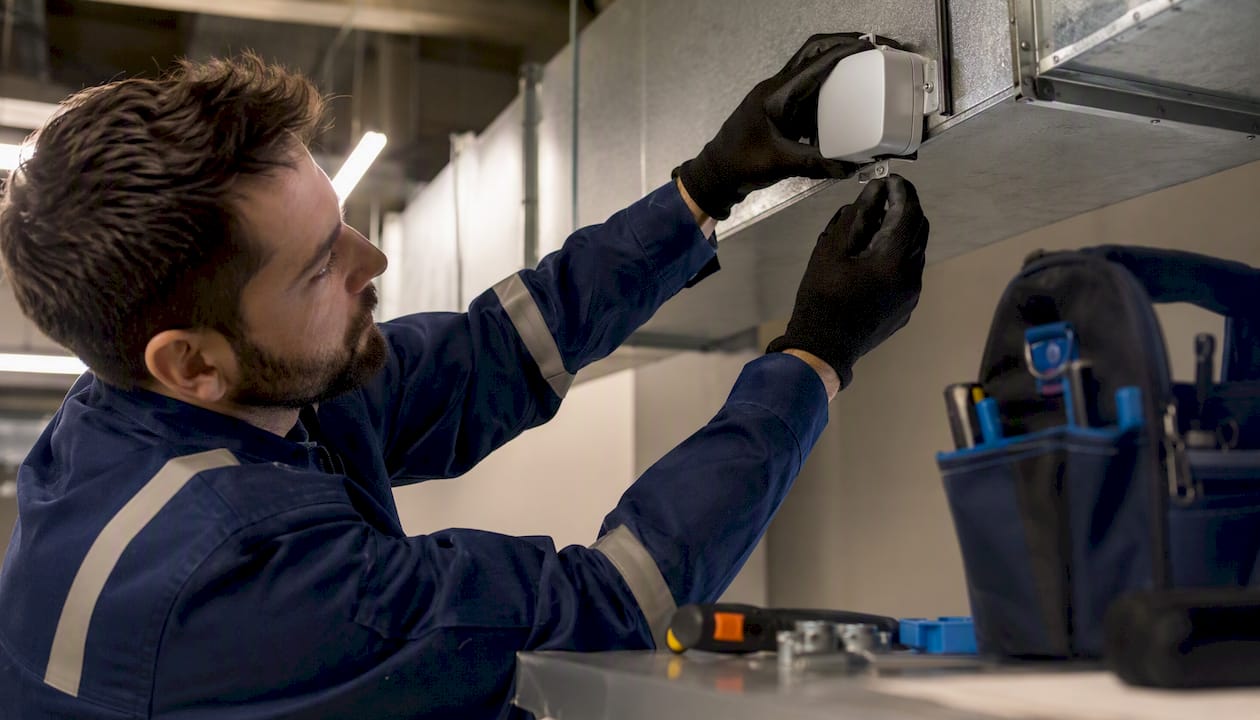
MPulse Software provides the core functions needed to close the loop from sensor signal to documented repair. Its IIoT and real-time monitoring connectors ingest telemetry from building automation systems, medical equipment sensors, and third-party IoT platforms, then trigger automated work orders without manual intervention.
Key capabilities relevant to healthcare facilities:
- Timestamped audit trails: Every event in the alert-to-closure chain is recorded and exportable for Joint Commission and CMS compliance evidence.
Trusted by approximately 3,500 customers and with reported significant efficiency improvements, MPulse Software gives healthcare facility teams the documentation depth and mobile speed that compliance surveys and patient-safety programs both require.
Key Takeaways
Real-time maintenance alerts from sensors integrated with a CMMS are the most direct operational tool available to healthcare facility teams for preventing patient harm caused by equipment and building-system failures.
| Point | Details |
|---|---|
| Detection speed is the safety lever | Alerts that reach technicians in minutes, not hours, prevent clinical interruptions before they affect patients. |
| Risk scoring determines response order | Assign criticality classifications to every asset so life-safety alerts always route ahead of lower-priority work. |
| Room closure costs are significant | Closing a single patient room for emergency repairs can cost upwards of $20,000 per hour in lost throughput. |
| Six KPIs prove safety impact | Track MTTA, MTTR, uptime %, alert-to-work-order rate, planned repair ratio, and audit-complete rate. |
| MPulse Software closes the loop | MPulse CMMS connects IIoT sensors to automated work orders, mobile dispatch, and timestamped audit trails for compliance. |
The case for acting this quarter, not next fiscal year
The facilities that wait for a sentinel event to justify sensor-to-CMMS investment are making a costly bet. Pick one or two critical asset classes — OR HVAC and vaccine refrigeration are the highest-leverage starting points for most acute-care facilities — and run a focused 8–12 week pilot with clear KPI targets. Measure MTTR and uptime before and after. The data will make the case for scaling far more persuasively than any vendor presentation.
The cross-functional team you need is smaller than most leaders assume: a clinical engineering lead, an IT contact for API access, a facilities supervisor, and a CMMS implementation partner. Asset criticality ranking takes a single working session when you use an existing equipment inventory as the starting point.
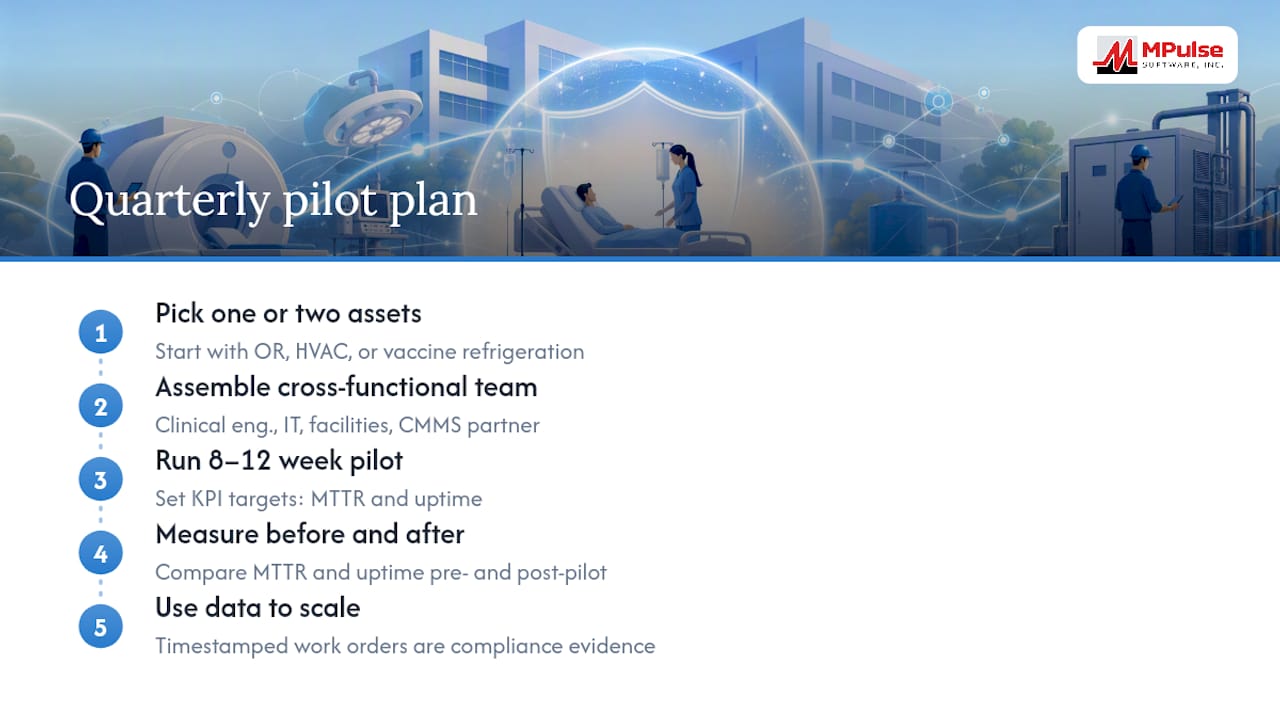
Audit readiness is not a separate workstream. Every timestamped work order your team closes during the pilot is a compliance document. By the time your next Joint Commission survey arrives, you will have months of closed-loop evidence rather than a manual log assembled the week before. That shift alone changes the survey experience for your entire team.
Useful sources and MPulse resources
- How Integrated CMMS and EAM Systems Are Safeguarding Patients and Simplifying Compliance – HCO News
- MPulse Software
- IIoT and Real-Time Monitoring| MPulse CMMS
- How Maintenance Alerts Prevent Breakdowns: A Facility Guide
- CMMS and Hospital Accreditation: A Compliance Guide
- Powerful Maintenance Software | MPulse CMMS Software
MPulse Software: built for healthcare facility teams
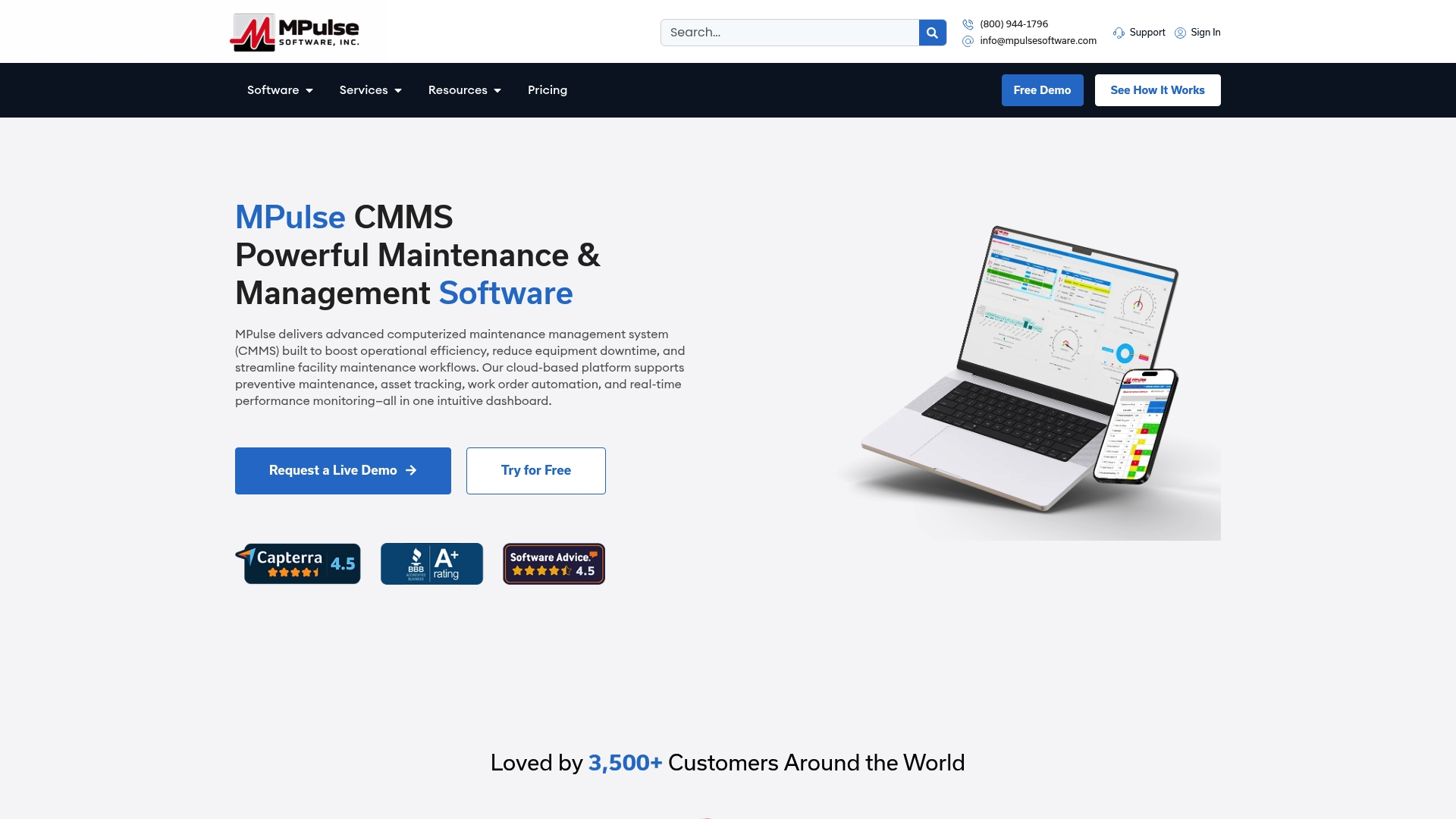
Healthcare facility teams managing life-safety assets under Joint Commission and CMS scrutiny need more than a work-order system. MPulse Software connects IIoT sensor telemetry to automated work orders, mobile technician dispatch, and timestamped audit trails in a single platform. With approximately 3,500 customers and reported efficiency improvements up to 40%, MPulse delivers the documentation depth compliance surveys demand and the response speed patient safety requires. Whether your priority is reducing MTTR on OR HVAC systems, closing vaccine refrigeration alerts before excursions become reportable events, or building an audit-ready evidence chain for your next survey, MPulse is configured for that work. See what MPulse CMMS can do for your facility and take the first step toward a sensor-to-closure workflow your compliance team will rely on.
FAQ
How do real-time maintenance alerts protect patients?
Sensor alerts routed through a CMMS generate work orders within minutes of detecting a fault, allowing technicians to repair life-safety equipment before failures affect clinical operations or patient care.
What assets should healthcare facilities monitor first?
OR HVAC systems, sterilizers, vaccine refrigeration units, and ICU environmental controls carry the highest patient-safety risk and deliver the clearest ROI from real-time monitoring.
How does a CMMS support Joint Commission compliance?
A CMMS records every alert, work order, and repair closure with timestamps, creating the documented PM evidence required for Joint Commission standards and CMS surveys. MPulse Software exports this evidence chain directly for survey preparation.
What is a realistic timeline for a sensor-to-CMMS pilot?
An 8–12 week pilot covers asset inventory, sensor installation, CMMS integration, parallel validation, and cutover — with KPI baselining completed by week 12.
What KPIs should facility managers track to prove safety impact?
Track mean time to acknowledge (MTTA), mean time to repair (MTTR), critical-asset uptime percentage, alert-to-work-order conversion rate, and audit-complete rate as the core set.