

TL;DR:
- Maintenance scheduling optimization is a systematic process that plans maintenance tasks to maximize asset reliability and control costs. It depends on understanding asset criticality, workforce skills, parts management, production schedules, and budgets to create effective schedules. Modern software combines automation, real-time data, and scenario planning to improve reliability and reduce downtime.
Maintenance scheduling optimization is defined as the systematic process of planning, coordinating, and sequencing maintenance tasks to maximize asset reliability while controlling labor, parts, and downtime costs. In practice, this means balancing equipment criticality, workforce availability, parts inventory, production demands, and cost constraints simultaneously. The industry term for this discipline is maintenance planning and scheduling optimization, and it sits at the core of any mature maintenance management strategy. Facility managers and operations specialists who apply it consistently reduce unplanned failures, extend asset life, and free technicians to work on the right tasks at the right time. MPulse Software serves over 3,500 customers globally using exactly this approach.
What are the key factors that influence maintenance scheduling optimization?
Scheduling optimization does not start with software. It starts with understanding what drives your maintenance decisions in the first place. Five factors consistently shape every effective schedule.
- Equipment criticality and failure risk. Not every asset deserves the same attention. A failed HVAC chiller in a hospital causes immediate patient risk. A broken break room refrigerator does not. Ranking assets by criticality lets schedulers allocate time and labor where failures hurt most.
- Workforce skills and availability. Assigning a general technician to a high-voltage electrical task wastes time and creates safety risk. Effective scheduling matches task requirements to certified skill sets and accounts for shift patterns, vacation, and contractor availability.
- Parts and inventory management. A work order scheduled without the required parts is a wasted trip. Linking your parts inventory to your scheduling system prevents technicians from arriving on-site without what they need.
- Production schedules and operational priorities. Maintenance windows must align with production downtime, not compete with it. Coordinating with operations teams prevents scheduling conflicts that force last-minute rescheduling.
- Cost constraints and budget cycles. Labor overtime, emergency parts procurement, and expedited shipping all inflate maintenance costs. A well-structured schedule keeps spending predictable and within approved budgets.
Pro Tip: Build a criticality ranking matrix for your top 20 assets before touching your scheduling software. Assign each asset a score based on failure consequence, repair cost, and mean time to repair. Use that score to set default scheduling priority in your CMMS.
How do modern maintenance scheduling techniques and software improve optimization?
Modern scheduling has moved well beyond paper calendars and spreadsheets. Today’s techniques combine multiple data sources, automation, and probabilistic thinking to produce schedules that hold up under real-world uncertainty.
- Computerized Maintenance Management Systems (CMMS) automate task generation. A CMMS like MPulse Software generates preventive maintenance work orders automatically based on calendar intervals, meter readings, or condition triggers. Automated preventive scheduling standardizes task frequency and intervals, improving reliability and reducing downtime across the asset fleet.
- Predictive and condition-based triggers replace fixed intervals. Calendar-based scheduling assumes every asset degrades at the same rate. Condition-based maintenance uses sensor data, vibration analysis, oil sampling, and thermal imaging to trigger work orders only when an asset actually needs attention. This cuts unnecessary maintenance labor and reduces the risk of over-servicing.
- Real-time asset data and reliability analytics sharpen decisions. Integrating IIoT sensors with your scheduling platform gives schedulers live visibility into asset health. When a bearing temperature exceeds its threshold at 2 a.m., the system logs the event and queues a work order for the morning shift. No manual inspection required.
- Scenario-based optimization frameworks handle uncertainty. A scenario-based predictive framework evaluates maintenance schedules against a range of possible future asset usage and degradation outcomes, not just a single forecast. This approach integrates calendar limits, usage triggers, and condition-monitoring signals into one unified decision model. The result is a schedule that performs well across multiple possible futures, not just the one you planned for.
- Centralized scheduling platforms provide real-time visibility. Cloud-based scheduling software connects call centers, field technicians, and inventory management in one system. Schedulers see open work orders, technician locations, and parts availability on a single screen. That visibility eliminates the phone calls and spreadsheet updates that consume hours of coordinator time each week.
Modern maintenance scheduling is evolving to unify calendar limits, usage triggers, and condition-monitoring signals into single frameworks that account for uncertain future outcomes, replacing the single-point forecasts that most facilities still rely on.
What are the tangible benefits of optimizing maintenance scheduling?
The benefits of maintenance scheduling are measurable and appear across multiple operational dimensions. Facility managers who implement structured scheduling programs consistently report improvements in four areas.
- Reduced unplanned downtime. Proactive scheduling catches developing failures before they cause production stops. Every hour of planned maintenance typically costs a fraction of an equivalent emergency repair, when you factor in overtime labor, expedited parts, and lost production.
- Lower maintenance and labor costs. Efficient scheduling eliminates duplicate trips, reduces overtime, and prevents technicians from waiting on parts. Grouping related tasks on the same asset during a single shutdown window cuts total labor hours significantly.
- Extended asset lifespan. Assets maintained on a consistent, condition-appropriate schedule degrade more slowly. Lubrication done on time, filters replaced before they clog, and belts tensioned before they slip all add years to equipment life.
- Improved compliance and audit readiness. Regulated industries including food processing, pharmaceuticals, and healthcare require documented proof that maintenance occurred on schedule. A scheduling system with built-in compliance tracking, paired with tools like ExpiryEdge for deadline and expiration management, keeps audit records current without manual effort.
- Higher technician productivity. Technicians who receive clear, pre-planned work orders with attached procedures, parts lists, and safety instructions complete tasks faster and with fewer errors. Maintenance scheduling software acts as a single source of truth that connects field service data with maintenance execution, reducing repair times and improving compliance tracking.
MPulse Software customers report efficiency improvements of up to 40%, a figure that reflects the combined effect of reduced downtime, better labor utilization, and fewer emergency repairs.
What best practices should facility managers apply for scheduling optimization?
Effective maintenance planning requires more than buying software. The practices below separate facilities that sustain improvements from those that revert to reactive maintenance within six months.
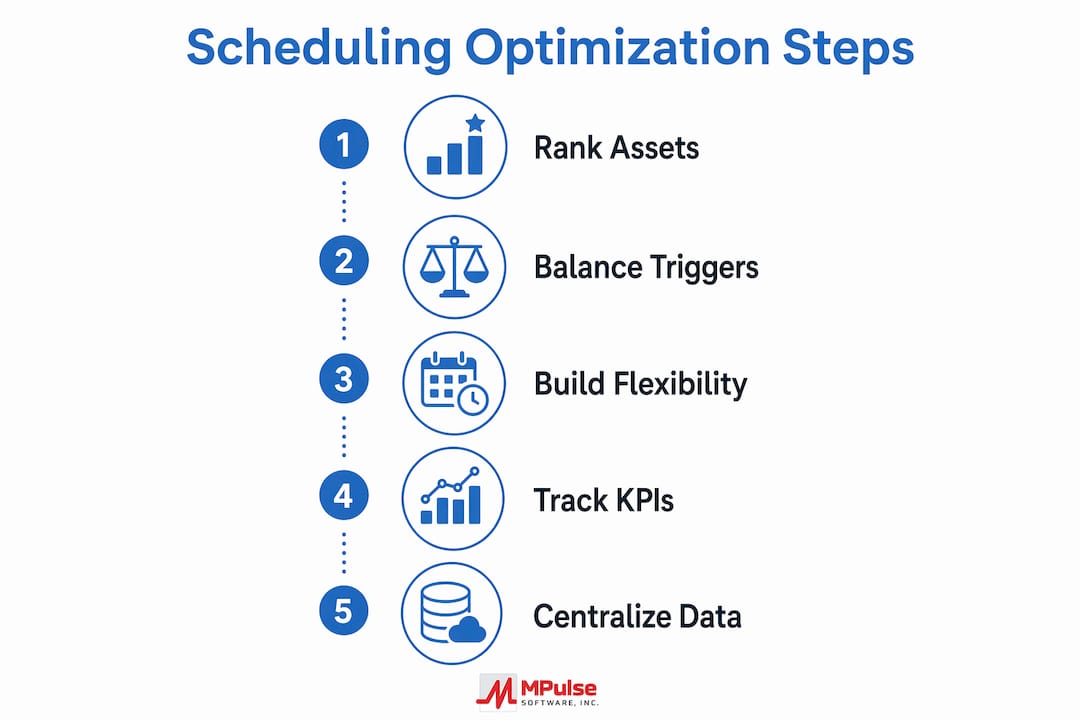
Prioritize critical assets first
Start your scheduling program with the assets whose failure causes the most operational damage. Use a Failure Mode and Effects Analysis (FMEA) or a simple criticality matrix to rank assets. Schedule those assets for preventive or condition-based maintenance before addressing lower-priority equipment.

Balance multiple scheduling triggers
No single trigger type works for every asset. Calendar-based intervals work well for lubrication and filter changes. Usage-based triggers work better for high-cycle equipment like compressors and conveyors. Condition-monitoring triggers work best for assets with measurable degradation signals. A mature facility maintenance program uses all three trigger types, assigned by asset class.
Build flexibility into every schedule
Rigid schedules break under real-world conditions. Production delays, emergency repairs, and technician absences all disrupt planned work. Build buffer time into weekly schedules, typically 15–20% of total available hours, to absorb disruptions without cascading delays into the following week.
Track KPIs and adjust continuously
Tracking maintenance KPIs such as schedule compliance rate, mean time between failures, and cost per work order drives continuous improvement. Review these metrics monthly. A schedule compliance rate below 80% signals that your schedule is either too aggressive or that your parts and labor planning needs adjustment.
Pro Tip: Set a monthly scheduling review meeting with your lead technicians. They know which assets are trending toward failure before the sensors do. Their field observations are the cheapest predictive maintenance tool you have.
Centralize all scheduling data in one system
Spreadsheets, whiteboards, and paper logs create information gaps. A centralized CMMS gives every stakeholder, from the storeroom to the C-suite, the same view of scheduled work, open work orders, and asset history. That shared visibility eliminates the coordination failures that cause most scheduling breakdowns. Reviewing contractor scheduling strategies alongside internal planning also helps facilities that rely on outside labor maintain consistent scheduling discipline.
Key takeaways
Maintenance scheduling optimization delivers the greatest returns when it combines asset criticality ranking, multiple trigger types, and centralized software to keep schedules accurate, flexible, and continuously improving.
| Point | Details |
|---|---|
| Define criticality first | Rank assets by failure consequence before building any schedule. |
| Use multiple trigger types | Combine calendar, usage, and condition-based triggers by asset class for accuracy. |
| Centralize scheduling data | A CMMS eliminates information gaps and gives all teams a shared view of work status. |
| Track schedule compliance | A compliance rate below 80% signals a planning or resource gap that needs correction. |
| Build in buffer time | Reserve 15–20% of available hours weekly to absorb disruptions without cascading delays. |
Why the “perfect schedule” mindset is holding facilities back
I have worked with facility teams that spend weeks building detailed annual maintenance schedules, only to watch them collapse by the end of the first month. The problem is not the schedule itself. The problem is treating the schedule as a fixed document rather than a living system.
The facilities that sustain real improvements treat their schedule as a decision framework, not a to-do list. They set priorities, define triggers, and then let the data adjust the timing. When a sensor shows a bearing running hot, they pull the work order forward. When production needs a machine through the weekend, they push non-critical tasks back. That flexibility is not a failure of planning. It is the point of planning.
The shift toward scenario-based optimization reflects this reality at a technical level. Modern frameworks evaluate schedules against a distribution of possible future outcomes rather than a single deterministic forecast. That is a more honest way to plan. Real assets do not degrade on a fixed curve, and real facilities do not operate on a fixed production schedule.
The other thing I have seen consistently: facilities that invest in scheduling software but skip the KPI tracking step get about half the benefit. The software automates the work. The KPIs tell you whether the work is the right work. You need both.
— Mark
How MPulse Software supports maintenance scheduling optimization
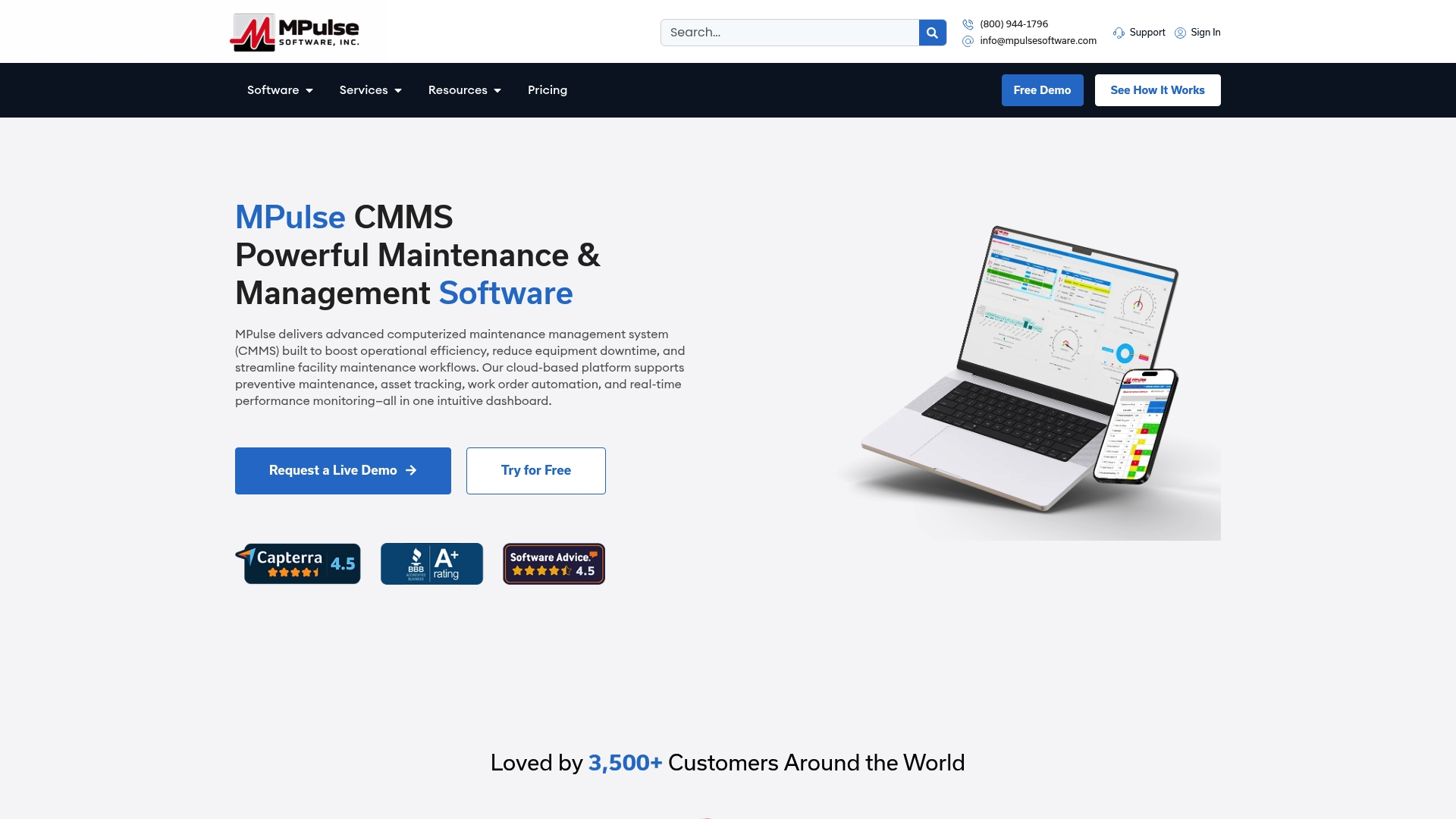
MPulse Software gives facility managers and operations specialists a CMMS built specifically for the scheduling challenges described throughout this article. The platform automates preventive maintenance work orders, supports calendar, usage, and condition-based triggers, and provides real-time visibility into asset status, technician assignments, and parts availability. Its intuitive calendar interface makes it easy to see scheduled work across days, weeks, and months without digging through spreadsheets.
MPulse Software is trusted by over 3,500 customers globally and has delivered documented efficiency improvements of up to 40%. Teams in regulated industries rely on its compliance tracking to stay audit-ready without manual documentation. To see how the platform handles your specific scheduling requirements, visit the MPulse CMMS software page for a demo or free trial.
FAQ
What is maintenance scheduling optimization?
Maintenance scheduling optimization is the process of planning and sequencing maintenance tasks to maximize asset reliability while controlling labor, parts, and downtime costs. It balances equipment criticality, workforce availability, inventory, production demands, and budget constraints simultaneously.
How does a CMMS improve maintenance scheduling?
A CMMS automates work order generation, tracks asset history, and connects parts inventory with scheduling data. This reduces manual coordination, prevents missed tasks, and gives schedulers real-time visibility into technician workloads and asset status.
What triggers should I use for preventive maintenance scheduling?
The three main triggers are calendar-based intervals, usage-based thresholds, and condition-monitoring signals. Assigning the right trigger type by asset class, rather than applying one method to all equipment, produces more accurate and cost-effective schedules.
How do I measure whether my maintenance schedule is working?
Track schedule compliance rate, mean time between failures, and cost per work order monthly. A schedule compliance rate below 80% typically indicates a resource planning gap or an overly aggressive schedule that needs adjustment.
What is scenario-based maintenance scheduling?
Scenario-based scheduling evaluates a maintenance plan against a range of possible future asset usage and degradation outcomes rather than a single forecast. This approach, supported by unified calendar, usage, and condition-monitoring data, produces schedules that remain effective even when real-world conditions differ from initial assumptions.