
Thorough maintenance documentation is the fastest, lowest-cost way to cut unplanned downtime, defend audits, and convert technician knowledge into institutional intelligence. Teams with disciplined recordkeeping report MTBF improvements of 15–30% and reductions in mean time to repair (MTTR) by 20–40%, because technicians spend time fixing, not diagnosing. The benefits extend well beyond reliability metrics.
Key business outcomes of strong documentation:
- Unplanned downtime significantly reduced when predictive programs have structured historical records to learn from
- MTTR noticeably shortened through faster diagnosis using prior fault history
- Audit and litigation defense strengthened by timestamped, photo-backed digital records
- Equipment resale value improved for assets with complete service histories
Facility managers, reliability engineers, planners, and safety and compliance teams all benefit directly. So do operations directors who need defensible KPIs and accurate capital budgets.
Pro Tip: Every work-order closeout should capture root cause and the next recommended action, not just “completed.” That one habit turns a compliance record into a continuous improvement asset.
Table of Contents
- Why maintenance documentation matters: definition and scope
- What documents every facility should be capturing
- How good documentation translates into measurable business results
- How to make your documentation actually useful
- How CMMS and digital tools improve documentation quality
- Common obstacles that wreck documentation quality and how to fix them
- What high-quality documentation actually looks like
- Key Takeaways
- The documentation gap most facilities are still ignoring
- MPulse Software makes documentation the default, not the exception
- Useful sources and further reading
- FAQ
Why maintenance documentation matters: definition and scope
Maintenance documentation is the complete set of records that describe what work was performed on an asset, when, by whom, why, and with what outcome. That scope covers work orders, inspection reports, standard operating procedures, equipment manuals, failure analyses, test results, photographs, and timestamps tied to a specific asset in your system.
The distinction between raw data and formal records matters here. A sensor log streaming vibration readings is data. A work order that links those readings to a specific bearing, records the technician’s diagnosis, lists the parts replaced, and notes a follow-up inspection date is a maintenance record. One feeds a dashboard; the other feeds decisions.
Ownership typically follows the work. Technicians create and close work orders. Planners review and approve them. Reliability engineers own failure analyses and trend reports. Vendors supply manuals and commissioning records. When ownership is unclear, records go missing or stay incomplete.
What documents every facility should be capturing
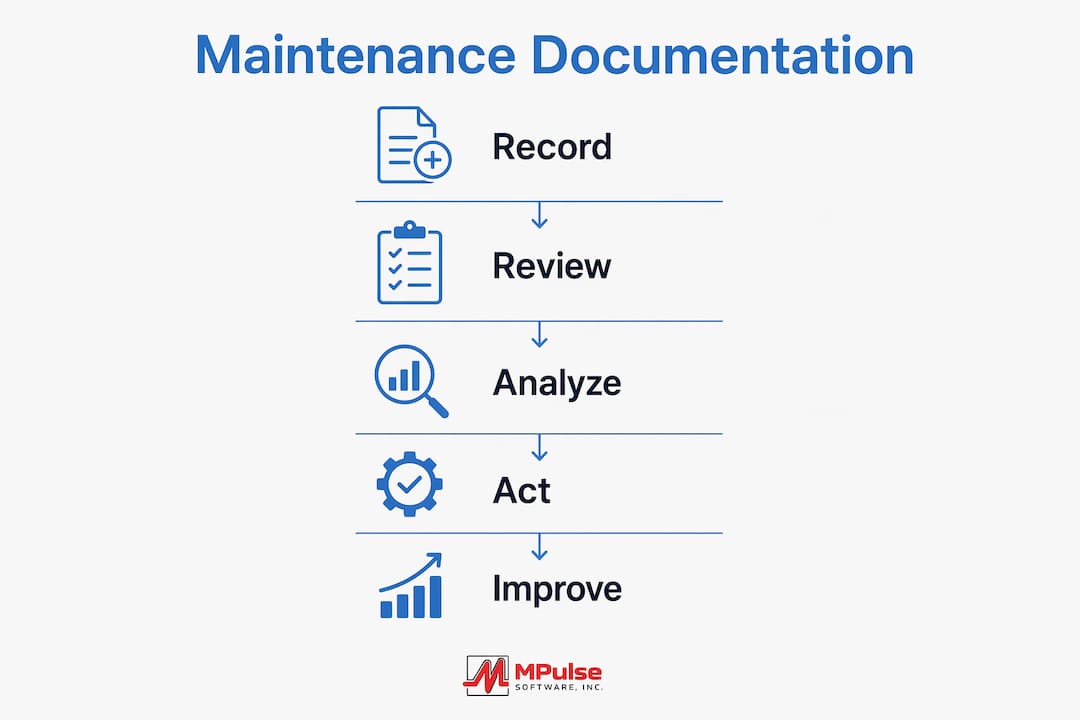
A complete documentation program covers more than work orders. Each asset class needs a defined set of records, and gaps in any category create blind spots. Here is the checklist:
- Work orders and closure notes: Record asset ID, fault description, root cause, parts used (with part numbers and quantities), labor hours, technician name, corrective actions taken, and any follow-up work required. Photos of the fault condition and the repaired state belong here too.
- Inspection reports and condition logs: Vibration readings, oil analysis results, thermography images, and ultrasound data. These trend logs are what enable early-warning signals when fields are standardized across inspections.
- SOPs and maintenance instructions: Step-by-step procedures for each maintenance task, including safety precautions, required tools, and acceptance criteria. Version-controlled so technicians always work from the current revision.
- Failure reports and root cause analyses: Structured records of what failed, why it failed, and what systemic change prevents recurrence. These are the records that turn a single incident into fleet-wide learning.
- Asset master records, manuals, warranties, and parts history: Manufacturer documentation, commissioning test results, warranty terms, and the full parts replacement history tied to the asset’s serial number.
On retention: DOT and fleet-related records carry specific regulatory minimums, while best practice for most asset classes is to retain the full service history for the life of the asset plus several years after disposal. That window covers warranty disputes, litigation risk, and resale due diligence.
How good documentation translates into measurable business results
Documentation’s value shows up in KPIs, balance sheets, and courtrooms. The table below maps each benefit to its business impact.

| Benefit | Mechanism | Typical Impact |
|---|---|---|
| MTBF improvement | Historical records feed failure-pattern analysis and PM interval optimization | 15–30% improvement within 12 months |
| MTTR reduction | Technicians access prior fault history and resolution steps immediately | 20–40% faster repairs |
| Unplanned downtime reduction | Predictive models trained on structured historical data catch failures earlier | 30–50% reduction in unplanned downtime |
| Equipment resale premium | Complete service history verified at point of sale | 5–10% higher resale value |
| Audit and litigation defense | Timestamped digital records with photos and signatures are materially more defensible | Faster audit clearance; reduced negligence exposure |
| KPI reliability (fleet/multi-site) | Consistent fields make uptime, cost-per-unit, and PM/reactive ratios accurate | KPIs become actionable, not estimates |
The legal dimension deserves specific attention. In litigation or post-incident investigations, legal teams request maintenance files first. A single missing oil-change record has been used as evidence of negligence. Digital entries with timestamps, photos, and technician signatures are significantly more defensible than paper records, which carry high loss and misfile rates.
Use-case examples make the business case concrete. A pharmaceutical manufacturer facing an FDA inspection needs traceable, time-stamped records for every PM on critical equipment. A fleet operator needs driver vehicle inspection reports (DVIRs) and service records that satisfy DOT minimums and support a repair-versus-replace decision. A manufacturing line manager needs failure reports that show whether a recurring motor fault is a parts quality issue or an installation error. In each case, the records are what convert a maintenance event into an organizational decision.
For compliance-heavy environments, preventive maintenance documentation also reduces liability exposure by demonstrating that scheduled work was completed on time and to standard.
How to make your documentation actually useful
The most common documentation failure is not missing records. It is records that exist but contain too little information to act on. Studies of CMMS data show that 40–60% of work-order closeouts lack sufficient detail for future reference. The fix is standardization, not more paperwork.
Minimum fields for a work-order closeout:
- Asset ID and location (standardized naming, not free text)
- Fault description (what the technician observed, not just the work requested)
- Root cause (the underlying reason for the failure, not the symptom)
- Parts used (part number, quantity, supplier)
- Labor hours and technician name
- Corrective action taken
- Follow-up actions required and due dates
- Photos (fault condition before repair, repaired state after)
- Timestamp (auto-generated by the system, not manually entered)
Standardizing equipment IDs and naming conventions across every record is what makes trend analysis possible. If one technician logs a fault under “Pump-101” and another logs it under “P101-CW,” those records never connect in a query.
Governance matters as much as the fields themselves. Assign a planner or reliability engineer to review closed work orders weekly. Set an escalation rule: any closeout missing root cause or follow-up actions gets returned to the technician within 24 hours. For SOPs, establish a change-control process so revisions are dated, approved, and distributed before the old version is retired. Tracking SLA compliance within your documentation system gives managers a clear view of whether contracted and internal service standards are being met.
Pro Tip: Use required fields in your CMMS to enforce minimum closeout standards. A technician cannot close a work order without entering root cause and follow-up actions. That single configuration change eliminates the most common documentation gap without adding training overhead.
How CMMS and digital tools improve documentation quality
A paper-based or spreadsheet-driven documentation system has a structural ceiling. Records get lost, photos stay on personal phones, and there is no audit trail for who changed what and when. A CMMS removes those ceilings by making good documentation the path of least resistance.

The features that matter most for documentation quality are specific. Asset master records link every work order, inspection, and part to a single equipment profile. Work-order templates enforce minimum fields at the point of entry. Mobile input with photo capture and GPS timestamps means technicians document at the machine, not hours later at a desk. Barcode scanning ties a scan to an asset record instantly, eliminating ID transcription errors. Audit trails log every edit with a user ID and timestamp, which is what makes records legally defensible.
Automation reduces the administrative burden that drives technician resistance. Scheduled preventive maintenance work orders generate automatically, pre-populated with the asset ID, SOP reference, and required fields. Required-field enforcement means incomplete records cannot be submitted. Auto-assignment routes work orders to the right technician based on skill, shift, or location.
Integration with IIoT sensors and ERP systems enriches records further. Real-time monitoring feeds can trigger condition-based work orders when a sensor reading crosses a threshold, with the reading automatically attached to the work order as context. ERP integration pulls parts costs and labor rates into the record, making cost-per-repair calculations accurate without manual entry.
For a documentation-focused CMMS rollout, start with a pilot scope of 20–30 assets, define required fields before go-live, train technicians on mobile entry in a single session, and run a documentation quality audit at 30 and 90 days. The resource planning dashboard in a well-configured CMMS gives planners a live view of documentation completeness alongside workload and parts availability.
Common obstacles that wreck documentation quality and how to fix them
Documentation programs fail for predictable reasons. Recognizing the pattern early makes the fix straightforward.
- Thin closeouts: Technicians write “repaired” or “fixed leak” and move to the next job. Fix: enforce required fields in the CMMS and return incomplete records within 24 hours with specific feedback on what is missing.
- Missing photos and timestamps: Photos stay on personal phones; timestamps are entered manually and rounded. Fix: mobile CMMS apps with built-in camera integration and auto-timestamp eliminate both problems at the source.
- Inconsistent asset IDs: Free-text asset descriptions make records unsearchable and trend analysis impossible. Fix: load a standardized asset master before rollout and lock the ID field to a dropdown or barcode scan.
- Data trapped in email or vendor PDFs: Commissioning reports, warranty documents, and vendor service records sit in inboxes or shared drives, disconnected from the asset record. Fix: attach all vendor documents to the asset master in the CMMS at commissioning.
- Technician resistance: Documentation feels like extra work with no visible payoff. The biggest hurdle is cultural: moving documentation from an administrative burden to a strategic advantage requires visible feedback loops where records demonstrably save time or money.
Governance KPIs to track documentation quality: closeout completion rate (target: 100%), root cause capture rate (target: 95%+), average time to close a work order, and photo attachment rate. Review these monthly and share results with the maintenance team. When technicians see that a root cause they documented six months ago prevented a repeat failure, the cultural argument makes itself.
For situations where documentation gaps create safety risk, knowing when to escalate to emergency maintenance is part of a complete governance framework.
What high-quality documentation actually looks like
The difference between a low-value and a high-value maintenance record is not length. It is specificity and actionability.
Low-value closeout: “Fixed leak. Pump running.”
High-value closeout: “Shell side lower quadrant, tube #14. Erosion caused by process fluid velocity exceeding design spec. Replaced spool section (P/N 4421-B, qty 1). Pump returned to service at 14:32. Follow-up: schedule ultrasonic thickness inspection on adjacent tubes within 30 days. Photo attached.”
The second record answers every question a planner, reliability engineer, or auditor would ask. It also feeds the next PM interval decision, the spare parts order, and the failure trend report. That is what actionable records look like: location, root cause, parts, follow-up, and evidence.
A quality control checklist for any closeout: Does it identify the specific location and component? Does it state a root cause, not just a symptom? Does it list parts by part number and quantity? Does it include a photo of the fault and the repair? Does it specify the next action and a due date? If any answer is no, the record is incomplete.
Maintenance alerts tied to condition thresholds are most effective when the underlying records are detailed enough to set meaningful baselines. A 12-month record of consistent, structured data is what separates a team running on intuition from one running on evidence.
Key Takeaways
Maintenance documentation is the foundation of operational efficiency and compliance: teams that capture root cause, standardize fields, and enforce governance see measurable gains in reliability, audit readiness, and asset value within 12 months.
| Point | Details |
|---|---|
| MTBF and MTTR gains are measurable | Disciplined documentation yields 15–30% MTBF improvement and 20–40% faster repairs within 12 months. |
| Downtime reduction requires structured history | Predictive programs cut unplanned downtime significantly only when historical records are complete and consistent. |
| Resale and legal value are real | Complete service histories command a 5–10% equipment resale premium and materially strengthen audit and litigation defense. |
| Standardize fields before anything else | 40–60% of work-order closeouts lack sufficient detail; required fields in a CMMS fix this without adding training burden. |
| MPulse Software addresses the full documentation gap | MPulse CMMS enforces required fields, mobile photo capture, audit trails, and IIoT integration to make compliant documentation the default workflow. |
The documentation gap most facilities are still ignoring
The pattern that shows up repeatedly in maintenance operations is not a technology problem. Facilities have CMMS platforms. They have inspection forms. They have SOPs filed somewhere. What they lack is the discipline to treat documentation as a live operational asset rather than a compliance checkbox filled in after the fact.
The real cost of thin documentation is invisible until it is not. A repeat failure on a pump that was “fixed” three times in 18 months, with no root cause recorded each time, is not bad luck. It is a documentation failure that compounded into a capital expense. The records that could have identified the failure mode, triggered a design change, or justified a replacement decision simply did not exist in a usable form.
The facilities that close this gap fastest are not the ones that mandate more paperwork. They are the ones that make good documentation easier than bad documentation, through required fields, mobile entry, and fast feedback loops that show technicians how their records are being used. When a planner references a closeout note from six months ago to avoid a repeat failure, and tells the technician who wrote it, the cultural argument for documentation is won.
The maintenance management goals that matter most — lower downtime, better audit outcomes, accurate KPIs — all trace back to record quality. Start there.
MPulse Software makes documentation the default, not the exception
Facilities that struggle with documentation quality usually share one problem: their tools make good recordkeeping harder than it needs to be. MPulse Software is built to close that gap directly.
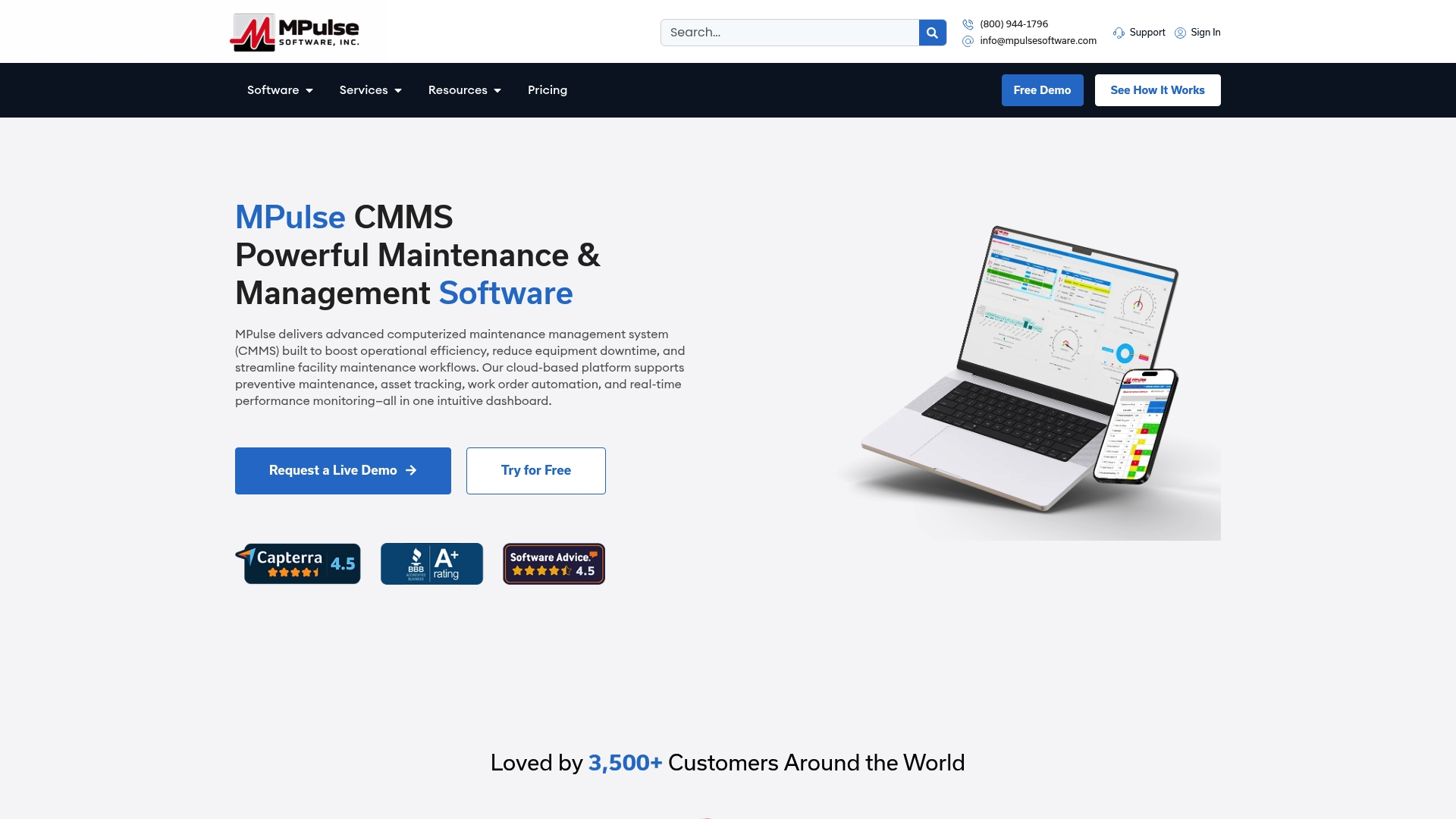
MPulse CMMS gives facility managers and maintenance teams the specific capabilities that turn documentation from a burden into a built-in workflow. Required fields prevent incomplete work-order closeouts. Mobile entry with photo capture and auto-timestamps means technicians document at the machine, not hours later. Audit trails log every change with a user ID, making records legally defensible. Asset master records link every work order, inspection report, and parts transaction to a single equipment profile, so your full service history is always one search away.
For compliance-heavy environments — pharmaceutical, food processing, fleet operations, manufacturing — MPulse supports the traceability and regulatory recordkeeping those industries require. Over 3,500 customers trust MPulse, with documented efficiency improvements of up to 40%.
Schedule a demo of MPulse CMMS to see how required fields, mobile documentation, and audit-ready records work in practice for facilities like yours.
Useful sources and further reading
These resources support deeper reading on maintenance documentation standards, compliance requirements, and implementation guidance:
- NIST AMS 100-34 — NIST’s manufacturing systems publication covering measurement, data standards, and operational documentation frameworks for industrial facilities.
- SMRP Body of Knowledge — The Society for Maintenance and Reliability Professionals publishes standards and best practices for maintenance management, including documentation and recordkeeping.
- SafetyCulture: Maintenance Documentation Guide — Practical overview of documentation types, standardization, and digital capture for maintenance teams.
- Dovient: Maintenance Documentation Done Right — Covers MTBF/MTTR improvement data, cultural change, and documentation governance.
- Dovient: Maintenance Documentation Standards — Minimum field requirements, actionability criteria, and closeout quality guidance.
- Heavy Equipment Maintenance History Tracking — Covers resale value, retention requirements, and predictive maintenance data dependencies.
- Torque by Ryder: Fleet Recordkeeping Best Practices — Fleet-specific guidance on documentation quality and KPI reliability.
- MPulse Software: Preventive Maintenance — Explains how PM scheduling and documentation work together to reduce liability and improve compliance.
FAQ
Why is documentation important in maintenance?
Maintenance documentation creates a traceable record of every repair, inspection, and failure, giving teams the historical context to diagnose faster, prevent repeat failures, and demonstrate compliance during audits or legal proceedings. Without it, even well-maintained equipment can fail compliance checks or repeat the same faults indefinitely.
What are the three most important types of maintenance documentation?
Work orders with detailed closeout notes, inspection and condition-monitoring reports, and failure analyses with root cause records are the three most operationally critical document types. Together they cover what was done, what was observed, and why failures occurred.
Why are maintenance records important for compliance and audits?
Regulators and legal teams request maintenance files first during inspections and post-incident investigations. Digital records with timestamps, photos, and technician signatures are significantly more defensible than paper records, and a single missing entry can be used as evidence of negligence.
How long should maintenance records be retained?
Best practice is to retain the full service history for the life of the asset plus several years after disposal to cover warranty disputes, litigation risk, and resale due diligence. DOT-regulated fleet records carry specific regulatory minimums that must be met regardless of asset lifecycle.
How does a CMMS improve maintenance documentation quality?
A CMMS enforces required fields so incomplete records cannot be submitted, auto-generates timestamps and links photos to specific assets, and maintains an audit trail of every change. MPulse Software adds mobile entry and IIoT integration so technicians document at the machine and sensor data attaches automatically to the relevant work order.