

TL;DR:
- A manufacturing maintenance audit systematically reviews maintenance practices to identify gaps and ensure compliance. It involves assessing schedules, documentation, safety, and equipment condition through structured steps and digital tools. Conducting regular, evidence-based audits improves operational reliability, reduces downtime, and ensures regulatory adherence.
What is a manufacturing maintenance audit?
A manufacturing maintenance audit is a systematic, scheduled review of how well your maintenance practices, processes, and documentation align with operational goals, safety requirements, and industry standards. Think of it as a structured health check for your entire maintenance program, not just the machines on the floor. It examines whether the right assets are being maintained, in the right way, at the right time.
The audit goes beyond inspecting machines to evaluate work order systems, technician training records, spare parts inventory, safety protocols, and how data flows between departments. Its primary objective is to identify gaps, inefficiencies, and compliance risks before they translate into unplanned downtime or regulatory violations.
A well-executed maintenance audit covers these core elements:
- Maintenance schedules: Are preventive tasks planned and completed on time?
- OEM compliance: Do maintenance activities follow Original Equipment Manufacturer standards?
- Documentation accuracy: Are work orders, inspection logs, and repair records complete and current?
- Safety protocols: Are lockout/tagout procedures and personal protective equipment requirements followed?
- Technician qualifications: Do team members hold the certifications required for their assigned tasks?
- Performance metrics: Are key indicators like mean time between failures (MTBF) and mean time to repair (MTTR) tracked and reviewed?
- Spare parts inventory: Are critical components stocked at appropriate levels to prevent delays?
MPulse Software supports this process by centralizing maintenance data, automating work order tracking, and generating the reports auditors rely on to assess program performance.
What are the main types of manufacturing maintenance audits?
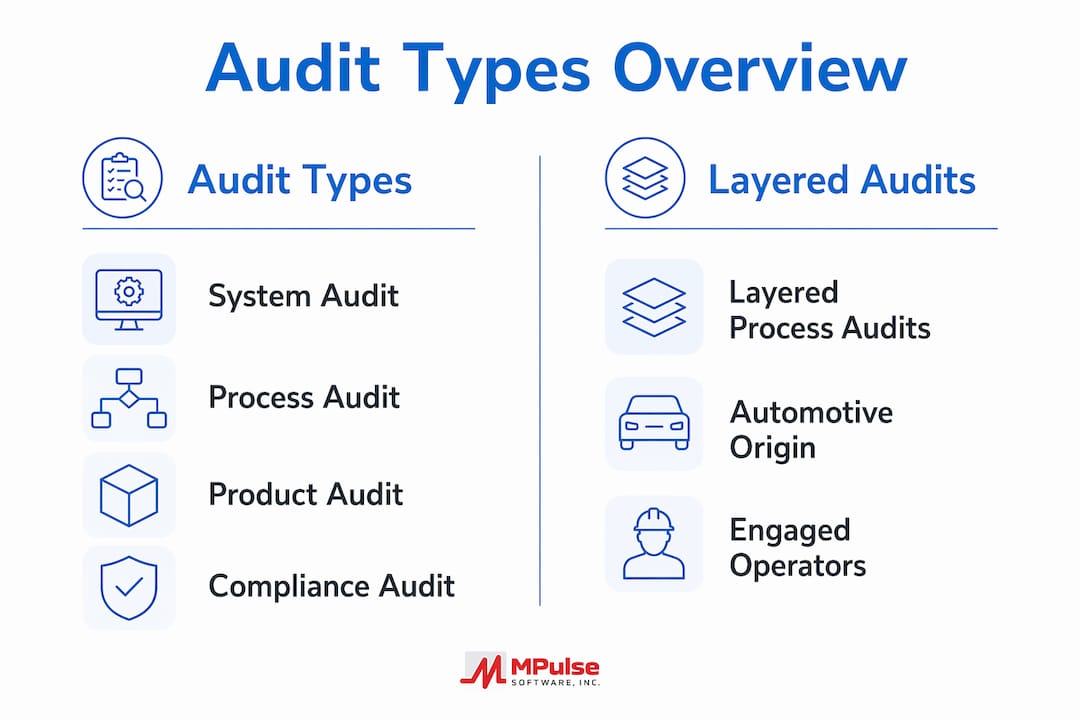
Manufacturing audits fall into four primary categories, each targeting a different layer of operations. Understanding which type applies to your situation determines the scope, team composition, and checklist you will use.
- System audits examine the overall quality management framework, including policies, procedures, organizational structure, and resource allocation. They answer whether the maintenance management system itself is sound.
- Process audits focus on specific production or maintenance procedures, verifying that operators follow documented work instructions, machines are calibrated correctly, and materials and tools are used as specified. A process audit is particularly effective for catching deviations before they produce defective output or equipment damage.
- Product audits inspect finished goods against defined quality specifications. While less directly tied to maintenance, they often surface equipment-related quality failures that point back to maintenance gaps.
- Compliance audits verify adherence to regulatory requirements, industry standards such as ISO 9001, and customer-specific mandates. These are especially critical in sectors governed by EPA regulations or FDA oversight.
Layered Process Audits (LPAs) deserve separate attention. Originally developed for the automotive industry, LPAs engage multiple organizational levels, from frontline supervisors to plant managers, in performing regular, focused checks on the same process. The layered structure catches deviations early, before they escalate into defects or safety incidents. LPAs work well as a continuous verification method between full-scale periodic audits.
How to conduct a manufacturing maintenance audit step by step
A structured 5–7 step framework gives your audit consistency and defensible documentation. Skipping steps, particularly the follow-up phase, is the most common reason audits fail to produce lasting improvement.
-
Define scope and objectives. Decide which assets, departments, or processes the audit will cover. Set measurable goals, such as verifying PM completion rates or assessing compliance with a specific regulatory standard. A narrow, well-defined scope produces more actionable findings than a broad sweep.
-
Assemble the audit team. Include a mix of internal expertise: a maintenance manager, a reliability engineer, and at least one technician familiar with the equipment being reviewed. For compliance audits, consider adding a quality or safety representative.
-
Collect data and documentation. Gather work order histories, maintenance logs, equipment manuals, training records, and spare parts data before setting foot on the floor. NIST research confirms that data from multiple sources, including Maintenance Work Orders and equipment-generated sensor data, provides the most complete picture of asset health.
-
Conduct field inspections and interviews. Walk the production floor, observe maintenance tasks in progress, and interview technicians. Compare what you see against documented procedures. Discrepancies between written standards and actual practice are where most audit findings originate.
-
Document findings. Record every observation with supporting evidence: photos, data exports, work order records. Categorize findings by severity, distinguishing critical compliance gaps from lower-priority improvement opportunities.
-
Develop corrective actions. Assign a responsible owner, a due date, and a verification method to every finding. Vague action items with no accountability rarely get resolved.
-
Conduct follow-up evaluations. Effective audits require scheduled follow-ups to confirm corrective actions were implemented and are holding. Without this step, the audit becomes a report that sits in a drawer.
Pro Tip: Use your CMMS to generate pre-audit data packages automatically. MPulse Software can pull work order completion rates, overdue PM tasks, and parts consumption history into a single report, cutting documentation prep time significantly and giving auditors verified data from day one.
Modern audits also benefit from IIoT-connected sensors and digital diagnostics. As manufacturing processes grow more complex, timely data from IIoT sources gives auditors real-time visibility into equipment health that manual inspections alone cannot provide. Platforms like MPulse Software integrate with real-time monitoring tools to surface this data during the audit process.

What should your maintenance audit checklist include?
A thorough maintenance audit checklist covers far more than equipment condition. Each area below represents a distinct failure mode if left unexamined.
- Maintenance schedules: Verify that preventive maintenance tasks are scheduled at OEM-recommended intervals and that completion rates are documented.
- Work order systems: Confirm that work orders are created, prioritized, assigned, and closed with complete records, including labor hours and parts used.
- Spare parts inventory: Check that critical spare parts are stocked, properly labeled, and stored correctly. Stockouts of key components are a leading cause of extended downtime.
- Technician qualifications: Review certifications, training completion records, and task authorization levels. MPulse Software’s personnel qualification tracking makes this verification straightforward during an audit.
- Safety protocols: Assess adherence to lockout/tagout (LOTO) procedures, hazardous material handling, and personal protective equipment requirements.
- Equipment condition: Inspect physical asset condition against baseline standards, noting wear, corrosion, leaks, or vibration anomalies.
- Documentation completeness: Confirm that equipment manuals, calibration records, and inspection logs are current, accessible, and stored in a retrievable format.
- OEM compliance: Verify that maintenance tasks match manufacturer specifications for lubrication, torque settings, filter replacement intervals, and calibration.
| Checklist Area | What auditors evaluate |
|---|---|
| Maintenance schedules | PM task frequency, completion rates, overdue work orders |
| Work order systems | Creation, assignment, closure, and documentation quality |
| Spare parts inventory | Stock levels, storage conditions, reorder triggers |
| Technician qualifications | Certifications, training records, task authorization |
| Safety protocols | LOTO compliance, PPE use, hazard communication |
| Equipment condition | Physical inspection against baseline and OEM specs |
| Documentation | Accuracy, completeness, and accessibility of records |
| OEM compliance | Adherence to manufacturer maintenance specifications |
Digital tools change how this checklist gets used in practice. Rather than paper forms that get lost or transcribed manually, a CMMS like MPulse Software allows auditors to log findings directly against asset records, attach photos, and trigger corrective work orders in real time.
Why manufacturing maintenance audits matter for performance and compliance
Maintenance is often managed by habit rather than deliberate strategy. Audits replace that habit-driven approach with hard metrics, giving maintenance managers the evidence they need to justify technology investments, staffing changes, or process redesigns.
The operational benefits are concrete:
- Reduced unplanned downtime: Audits surface deferred maintenance and procedural gaps before they cause failures. Moving from reactive to planned maintenance practices extends asset lifespan and protects production schedules.
- Regulatory compliance: A compliance audit verifies alignment with EPA regulations, OSHA requirements, and industry-specific standards. Documented audit trails demonstrate due diligence during external inspections.
- Cost control: Identifying over-maintained or under-maintained assets lets you reallocate resources where they produce the most value. Excess PM tasks on low-criticality equipment waste labor; deferred tasks on critical assets create expensive failures.
- Data-driven decision-making: Audit findings feed directly into maintenance planning. MPulse CMMS customers have reported up to 40% efficiency improvements by using audit-driven data to refine their maintenance programs.
- Continuous improvement: Audits create a feedback loop. Each cycle builds on the last, progressively closing gaps and raising the baseline performance of the maintenance program.
The shift from reactive to proactive maintenance is the most measurable outcome of a well-run audit program. Quantitative metrics from audits give reliability professionals the evidence to make that case to plant leadership.
What does a successful maintenance audit look like in practice?
A published case study from the Czech Republic illustrates the structured approach well. Researchers applied a 130-criteria audit methodology across ten maintenance management areas, using expert review of documentation and manager interviews to score each criterion as a percentage of fulfillment. The resulting SWOT analysis identified specific weaknesses in real maintenance processes compared to world-class benchmarks, and the findings directly informed a targeted improvement roadmap. The value was not in the audit score itself but in the gap analysis it produced.

This approach translates directly to manufacturing plants of any size. A facility running a manufacturing maintenance software platform can replicate this methodology by pulling asset performance data, PM completion rates, and work order closure times into a structured scoring framework. The audit then becomes a comparison between current performance and a defined standard, with gaps ranked by operational impact.
The most successful audits share three characteristics. First, findings are specific and evidence-based, not general observations. Second, corrective actions have named owners and firm deadlines. Third, follow-up verification is scheduled before the audit team disbands. Plants that treat the audit report as the end of the process consistently see the same findings resurface in the next cycle.
Key Takeaways
A manufacturing maintenance audit is most effective when it combines structured field inspection, verified documentation review, and a disciplined corrective action process with scheduled follow-up.
| Point | Details |
|---|---|
| Audit scope matters | Define which assets and processes are in scope before collecting data or entering the floor. |
| Four core audit types | System, process, product, and compliance audits each target a different layer of operations. |
| Seven-step framework | Follow the full cycle from scope definition through follow-up verification to sustain improvements. |
| Checklist coverage | Evaluate schedules, work orders, spare parts, qualifications, safety, and OEM compliance together. |
| CMMS accelerates audits | Digital platforms like MPulse Software centralize the data auditors need and automate corrective action tracking. |
FAQ
What is a manufacturing maintenance audit?
A manufacturing maintenance audit is a systematic review of maintenance practices, documentation, and asset care to verify alignment with operational goals, safety standards, and regulatory requirements. It identifies gaps and inefficiencies before they cause downtime or compliance failures.
What are the four types of manufacturing audits?
The four main types are system audits, process audits, product audits, and compliance audits. Each focuses on a different aspect of operations, from overall management systems to specific procedures, finished product quality, or regulatory conformity.
How do you conduct a manufacturing process audit?
A manufacturing process audit follows a structured framework: define scope, assemble the audit team, collect documentation, conduct field inspections and interviews, document findings, assign corrective actions with owners and deadlines, and schedule follow-up verification to confirm improvements hold.
What are the seven steps in the audit process?
The seven steps are defining scope and objectives, assembling the audit team, collecting data and documentation, conducting field inspections and interviews, documenting findings, developing corrective actions, and performing follow-up evaluations to verify implementation.
Which industries are hardest to audit for maintenance compliance?
Highly regulated industries such as pharmaceuticals, aerospace, and chemical processing present the greatest audit complexity because they combine strict regulatory requirements, precise equipment calibration standards, and extensive documentation obligations across every maintenance activity.