

Unplanned downtime is one of the most expensive problems a facility manager faces, and poor shift scheduling is often the root cause. Industrial facilities average 326 downtime hours annually, yet most teams still rely on reactive approaches that leave technicians scrambling between shifts. This shift-based maintenance scheduling guide gives you a structured path from scattered, reactive work orders to a coordinated system where every shift knows exactly what to do, who is doing it, and what the next team needs to pick up. The result is less downtime, better wrench time, and a maintenance team that is not perpetually burned out.
Table of Contents
- Key Takeaways
- The shift-based maintenance scheduling guide: what to do first
- Designing and implementing your shift schedule
- Common challenges and how to address them
- Measuring success and improving over time
- My perspective on shift-based scheduling after years in the field
- How MPulse CMMS supports your shift scheduling goals
- FAQ
Key Takeaways
| Point | Details |
|---|---|
| Prepare before you schedule | Gather workload data, technician skill sets, and facility hours before building any shift structure. |
| Match tasks to shift capacity | Align high-focus work to peak-alertness hours and distribute planned maintenance evenly across shifts. |
| Structured handovers prevent incidents | Face-to-face, location-based handover protocols with documented permits reduce critical information loss. |
| Wrench time is your core metric | Target 70-80% planned work per shift and use parts kitting to reduce storeroom travel time. |
| Digital tools close the loop | CMMS analytics and mobile work orders give you real-time visibility into schedule compliance and technician output. |
The shift-based maintenance scheduling guide: what to do first
Before you design a single shift, you need an accurate picture of what your facility actually demands. Scheduling without this data produces schedules that look good on paper but collapse within two weeks.
Start by documenting your facility’s operational hours and production cycles. A 24/7 continuous process plant has different scheduling requirements than a manufacturing facility running two eight-hour shifts. Understanding peak production windows tells you which hours carry the highest maintenance risk and where you cannot afford equipment failures.

Next, compile your maintenance workload data. This means pulling work order history, identifying recurring failures, and categorizing tasks by priority, skill requirement, and estimated duration. Without this baseline, you will either overload certain shifts or leave others with nothing meaningful to do.
You also need to assess your technician pool honestly:
- Skill coverage: Which technicians hold certifications for electrical, mechanical, or specialized equipment work?
- Shift preferences: Some technicians perform better on nights; others deteriorate quickly. Factoring in preferences reduces turnover.
- Availability patterns: Account for known absences, training schedules, and union contract constraints.
On the tools side, a CMMS platform, scheduling templates, and parts kitting processes form the foundation of effective shift-based planning. Automated scheduling software and mobile CMMS significantly reduce errors and labor in shift planning and execution. Parts kitting, where a planner pre-stages all components needed for a job before the shift starts, is particularly effective at cutting storeroom travel time.
Pro Tip: Review your equipment inventory data before finalizing shift assignments. Knowing which assets are most failure-prone tells you where to concentrate your highest-skilled technicians during peak production hours.
Finally, account for human factors. Rotating shifts moving forward in time reduce fatigue better than backward rotations, and allowing at least 11 hours between shifts lowers fatigue-related incidents. These are not soft considerations. They directly affect whether your technicians can perform precision work safely.
Designing and implementing your shift schedule
With your data in hand, you can build a schedule that actually holds up under real operating conditions. The process has a logical sequence.
-
Choose your shift model. Common models include fixed shifts (A, B, C designations with set start times), rotating shifts (technicians cycle through days, evenings, and nights), and the DuPont schedule (a 12-hour rotating model that gives workers extended time off in exchange for longer shifts). The DuPont model works well in facilities needing continuous coverage because it maintains four crews with built-in redundancy.
-
Map tasks to shifts by priority and complexity. High-focus, high-risk work such as electrical inspections or precision alignment should land in the first half of day shifts when alertness is highest. Routine lubrication, filter changes, and inspections can be distributed across all shifts without significant risk.
-
Build in preventive maintenance blocks. Planned maintenance achieves wrench times 20-30 percentage points higher than unplanned work. Reserve dedicated time blocks within each shift for scheduled preventive maintenance tasks rather than treating them as fill-in work.
-
Assign planners to support technicians. A planner-to-technician ratio of 1:15-20 is critical for achieving high wrench times. Planners pre-stage parts, secure permits, and remove obstacles before the technician ever touches the equipment.
-
Design your handover protocol. Every shift transition is a risk point. Face-to-face handover at the work location with structured checklists and permit-to-work reviews significantly reduces high-risk errors. A five-minute verbal briefing at a desk does not meet this standard.
-
Integrate shift swapping controls. Allow technicians to swap shifts within defined rules, but require supervisor approval and skill verification before any swap is confirmed. Uncontrolled swapping creates coverage gaps and skill mismatches.
Beyond structure, parts kitting deserves special attention. Travel and waiting reduce wrench time by 20-30% per shift. When planners pre-kit parts for the next shift’s work orders, technicians spend time turning wrenches rather than walking to storerooms. This single tactic can add meaningful hours of productive maintenance time per week across a mid-sized facility.
Pro Tip: Use your CMMS calendar view to visualize task distribution across shifts before publishing the schedule. Imbalances that are invisible in a spreadsheet become obvious when you see them mapped against shift hours.
Key shift scheduling best practices to carry forward:
- Rotate forward, not backward, through shift sequences
- Assign your most complex work orders to shifts with your highest-skilled technicians on duty
- Never schedule critical tasks in the final two hours of a night shift without a second technician present
- Document every deviation from the planned schedule for later analysis
See also: Best Practices for Scheduled Maintenance.
Common challenges and how to address them
Even well-designed schedules run into problems. Knowing what to expect lets you respond without losing schedule integrity.
Technician fatigue on night shifts is the most underestimated risk in shift-based maintenance. Night shift workers produce 34-54% less melatonin, raising cardiovascular disease risk by 30-40%. Experts recommend front-loading high-focus tasks before 2 AM and allowing short naps early in the shift to maintain alertness. If your schedule consistently pushes complex work into the 3-5 AM window, you are accepting elevated error rates.
Unexpected absences create immediate workload spikes. The solution is not to simply redistribute the absent technician’s work orders to whoever is available. Instead, maintain a tiered task priority list for each shift so supervisors know which work orders to defer and which to reassign based on current skill coverage.
Handover failures are a persistent source of rework and safety incidents. When an outgoing technician fails to communicate the status of an in-progress repair, the incoming team either duplicates work or misses a critical step.
Structured shift handovers with documented permit reviews are not administrative overhead. They are the mechanism that keeps your maintenance system from resetting to zero at every shift change.
Schedule compliance drift happens gradually. Technicians begin skipping steps, planners stop updating work orders in real time, and within a month the schedule reflects what you planned rather than what actually happened. Digital work order management with mobile tools that allow technicians to log time and receive instructions from the floor is the most effective countermeasure. Real-time visibility lets supervisors catch drift before it becomes a pattern.
Balancing planned versus reactive work is an ongoing tension. Most facilities should target 70-80% planned maintenance as a share of total technician hours. If reactive work is consuming more than 30% of shift capacity, the schedule is not protecting enough time for preventive tasks. Reviewing work order types weekly gives you an early signal before the ratio deteriorates further.
Measuring success and improving over time
A schedule is only as good as your ability to verify whether it is working. These are the metrics that matter most.
| KPI | What it measures | Target |
|---|---|---|
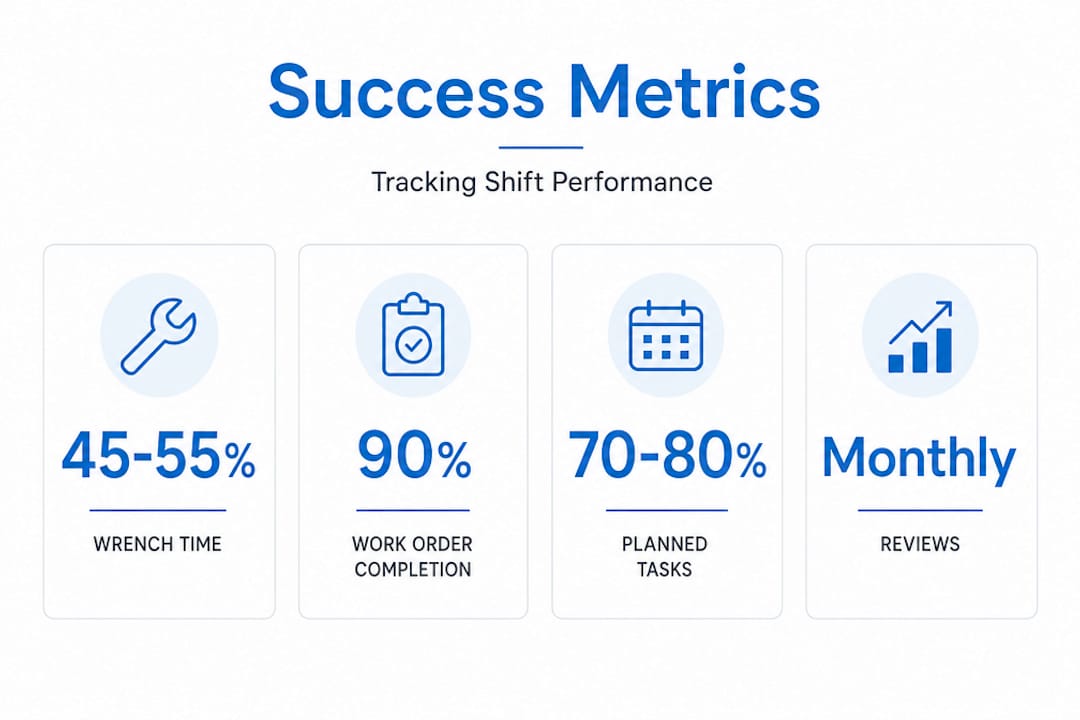
| Wrench time | Percentage of shift hours spent on direct maintenance work | 45-55% average; above 55% is exceptional |
| PM compliance rate | Percentage of preventive maintenance tasks completed on schedule | 90% or higher |
| Unplanned downtime incidents | Number of unscheduled equipment failures per month | Reduce month-over-month |
| Technician utilization | Planned hours versus actual hours worked per technician | Within 10% variance |
| Handover completion rate | Percentage of shifts with fully documented handovers | 100% |
Well-planned maintenance schedules yield wrench times averaging 45-55%, while most facilities without structured scheduling linger around 25-35%. That gap represents hours of productive maintenance time lost every single shift.
Beyond the numbers, gather qualitative feedback from technicians regularly. Shift satisfaction surveys, brief post-shift debriefs, and open channels for reporting scheduling problems give you information that no dashboard captures. Technicians know when a schedule is unrealistic long before the KPIs confirm it.
Pro Tip: Schedule a formal review of your shift structure every 90 days. Operational demands change, technician rosters shift, and equipment ages. A schedule built for last year’s facility may be actively working against this year’s production requirements.
Effective scheduling balances operational demands with human factors like fatigue and social needs to sustain long-term workforce productivity. If your KPIs are improving but turnover is rising, the schedule may be optimized for equipment at the expense of the people maintaining it. Both matter.
Use your CMMS analytics to run monthly reports on work order completion rates by shift, technician utilization, and PM compliance. These reports tell you which shifts are consistently underperforming and where to focus your next scheduling adjustment cycle.
My perspective on shift-based scheduling after years in the field
I have seen facilities invest heavily in scheduling software and still produce dysfunctional shift plans. The problem is almost never the tool. It is the assumption that a well-structured schedule runs itself.
In my experience, the single biggest mistake maintenance planners make is overcomplicating the schedule at the design stage. They build elaborate rotating systems with multiple skill tiers and conditional task assignments, and then wonder why supervisors ignore it by week three. A schedule that is 80% right and actually followed beats a perfect schedule that nobody uses.
What I have learned is that human factors deserve the same rigor as equipment criticality. When a facility manager tells me their night shift is underperforming, my first question is about fatigue management, not work order volume. The biology is real. Ignoring it means accepting preventable errors.
I also believe the planning role is chronically undervalued. Quality of maintenance job planning has the greatest leverage on wrench time. A dedicated planner who pre-stages parts, confirms permits, and clears obstacles before a technician arrives at the job site is worth more to your schedule than any software feature. If your planners are also doing reactive coordination, you have a structural problem that technology alone will not fix.
My advice: start with fewer, better-defined shifts. Add complexity only when you have data showing that simplicity is the constraint.
— Mark
How MPulse CMMS supports your shift scheduling goals
Managing shift-based maintenance at scale requires more than spreadsheets and good intentions. MPulse CMMS software gives facility managers and maintenance planners a centralized platform to automate preventive maintenance scheduling, manage work orders across shifts, and track real-time performance against the KPIs that matter.

MPulse’s intuitive calendar interface makes it straightforward to visualize task distribution across shifts, identify gaps before they become problems, and adjust assignments without rebuilding the entire schedule. The platform’s work order management tools support structured handovers by keeping job status, permit documentation, and technician notes in one accessible location. For facilities with compliance requirements, MPulse’s implementation services help configure the system to match your specific operational structure from day one. With over 3,500 customers globally and documented efficiency improvements of up to 40%, MPulse is built for the operational realities that facility managers face every shift.
FAQ
What is shift-based maintenance scheduling?
Shift-based maintenance scheduling is the practice of organizing maintenance tasks, technician assignments, and work order priorities across defined shift periods to maintain continuous coverage and minimize unplanned downtime.
How do I choose between fixed and rotating shift models?
Fixed shifts work well when technicians specialize in specific equipment or areas. Rotating shifts provide broader skill coverage and reduce the fatigue accumulation that comes from permanent night shift assignments, making them better suited for 24/7 facilities.
What wrench time should I target for my maintenance shifts?
Target 45-55% wrench time as a baseline, with above 55% considered exceptional. Most facilities without structured scheduling average only 25-35% wrench time, leaving significant room for improvement through better planning and parts kitting.
How often should I review and update the shift schedule?
Review your shift schedule formally every 90 days, and conduct lighter monthly checks using CMMS work order completion data. Operational changes, technician turnover, and equipment aging all affect whether the current schedule remains appropriate.
Why do shift handovers fail and how can I fix them?
Handovers fail when they rely on verbal summaries at a central location rather than structured, documented reviews at the work site. Implementing permit-to-work handover protocols with physical sign-off requirements is the most reliable way to prevent critical information loss between shifts.
Recommended
- Service Delivery Policies: Credit and Notification Requirements
- Powerful Maintenance Software | MPulse CMMS Software
- Application Hosting Services | MPulse Software
- Equipment Inventory Software | MPulse Software