

TL;DR:
- A recurring maintenance service plan schedules asset upkeep to reduce unplanned failures and control costs.
- Effective plans depend on accurate asset data, clear KPIs, and CMMS automation for scalability and reliability.
A recurring maintenance service plan is a formal, scheduled agreement that defines which assets get serviced, at what intervals, by whom, and at what cost — with the explicit goal of reducing unplanned downtime and converting reactive repair spend into predictable operating expenses. For industrial and enterprise operations teams, it is the operational backbone of any serious preventive maintenance program. MPulse Software customers using structured recurring plans have documented efficiency improvements up to 40%, a figure that reflects fewer emergency work orders, better parts availability, and higher schedule compliance. The step-by-step design process, CMMS configuration guidance, and KPI framework follow in the sections below.
Table of Contents
- What does a recurring maintenance service plan include?
- What are the measurable benefits of recurring maintenance plans?
- How do you design a recurring maintenance service plan?
- Which maintenance approaches fit inside a recurring plan?
- What KPIs should you track in a recurring maintenance program?
- How does a CMMS support recurring maintenance automation?
- How do you budget for a recurring maintenance plan?
- What does a 90-day pilot rollout look like?
- What pitfalls should you avoid in recurring maintenance plans?
- Key Takeaways
- Why recurring plans succeed when managers commit to data and process
- MPulse CMMS makes recurring maintenance plans practical to run
- Useful sources and further reading
- FAQ
What does a recurring maintenance service plan include?
Energy Star’s Operations and Maintenance Service Contracts guidance recommends that every facility O&M service plan list each piece of equipment, the maintenance tasks, the frequency, and the estimated time per task — so owners can reconcile PM visit records against invoices without disputes. That framework translates directly to industrial settings.
A complete recurring plan covers six elements:
- Asset inventory with criticality tags: Equipment ID, make, model, age, location, and a criticality rating (critical, important, non-critical) that drives scheduling priority.
- Defined tasks and SOPs: Step-by-step procedures per asset or asset class, including safety lockout/tagout steps and acceptance criteria.
- Frequency and triggers: Time-based (monthly, quarterly, annual), usage-based (runtime hours, cycle counts), or condition-based (sensor thresholds). Recurring maintenance contracts commit to scheduled visits at defined intervals in exchange for predictable payment and priority service.
- Parts, materials, and labor estimates: A bill of materials per task and a time-per-task estimate. Including time estimates makes invoice reconciliation straightforward and limits out-of-scope billing disputes.
- Roles, approvals, and recordkeeping: Who performs each task (in-house technician vs. contractor), who approves completed work, and where records are stored.
- Contract terms: Visit counts, response-time guarantees, out-of-scope rules, and auto-renewal or termination clauses.
Pro Tip: Require your service provider to submit a written O&M service plan and schedule as part of the contract, not after signing. Both parties should contribute to the plan before work begins.
What are the measurable benefits of recurring maintenance plans?
Recurring plans deliver four outcomes that matter to operations and finance leadership: reduced unplanned downtime, longer asset service life, predictable maintenance spend, and improved safety and compliance posture.
Preventive maintenance maintains equipment efficiency, uptime, and return on investment by correcting issues before they become failures — the core mechanism behind every well-run recurring program. When unplanned failures drop, mean time between failures (MTBF) rises and capital replacement timelines extend, deferring significant capex.
Recurring plans convert unpredictable reactive repair costs into a fixed operating expense line. That shift alone makes annual budgeting more accurate and gives finance leadership confidence in maintenance forecasts.
From a compliance standpoint, documented service records produced by a recurring plan are the fastest path to audit readiness. Regulated industries — food processing, pharmaceuticals, utilities — rely on this paper trail to satisfy OSHA, EPA, and FDA inspection requirements. The lessons from a reactive maintenance strategy are clear: reactive spend is always more expensive per incident than planned maintenance, and the variance makes budgeting nearly impossible.
How do you design a recurring maintenance service plan?
Follow these six steps to build a defensible plan that pilots quickly and scales across your asset population.
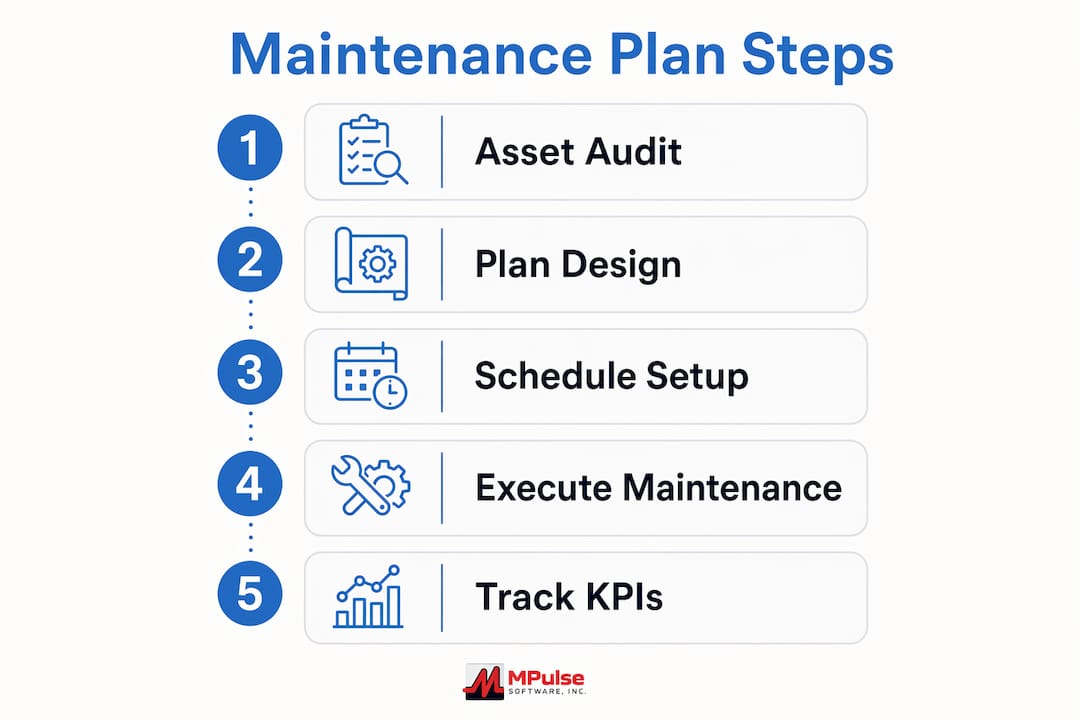
- Perform an asset audit and criticality ranking. Capture equipment ID, manufacturer, model, installation date, runtime hours, and known failure modes. A thorough asset audit before contract scoping prevents inflated pricing because providers can only price accurately when scope is well defined.
- Map failure modes to maintenance tasks. Use manufacturer recommendations, historical work-order data, and condition triggers to assign specific tasks to each asset.
- Set frequencies using a matrix. Time-based intervals (monthly, quarterly, annual) suit most assets. Usage-based triggers fit compressors and generators with defined runtime limits. Condition-based triggers suit mission-critical pumps and motors with sensor feeds.
- Estimate resources. Calculate time per task, parts cost, and skill level required. Build a simple workload summary to identify crew capacity gaps before the pilot.
- Define pilot KPIs and success criteria. Select planned work percentage, MTTR, wrench time, and backlog as your primary measures. Set a threshold for each before the pilot begins.
- Run a small-scale pilot. Start with 3–10 assets or a single production line. Measure for 8–12 weeks, then iterate before full rollout.
| Design Step | Key Output | Common Pitfall |
|---|---|---|
| Asset audit | Criticality-ranked equipment list | Missing assets or outdated data |
| Failure mode mapping | Task list per asset | Relying only on manufacturer defaults |
| Frequency matrix | Schedule by interval type | Over-scheduling low-criticality assets |
| Resource estimate | Workload and cost summary | Omitting parts cost from labor estimate |
| KPI definition | Pilot scorecard | No baseline data for comparison |
| Pilot | Validated plan for scale-up | Piloting too many assets at once |
Which maintenance approaches fit inside a recurring plan?
Three methods are commonly bundled inside recurring plans, and the right mix depends on asset criticality and the cost of failure.
Preventive (time-based) maintenance runs on a fixed calendar: monthly filter changes, quarterly lubrication routes, annual HVAC tune-ups. It suits low-to-medium criticality assets where the cost of a missed service is manageable.
Predictive (condition-based) maintenance uses sensor data, vibration analysis, or thermal imaging to trigger work orders only when a threshold is crossed. Mission-critical pumps, motors, and compressors are the primary candidates. MPulse Software’s condition-based maintenance features connect IoT sensor feeds directly to automated work-order generation, eliminating manual monitoring.
Corrective maintenance handles failures that slip through. A well-designed recurring plan budgets for a residual corrective workload — typically a small fraction of total work orders — rather than treating every repair as a surprise.
Recurring service contracts across HVAC, electrical, fire safety, and plumbing commonly bundle scheduled visits with priority response for corrective calls, giving operations teams a single vendor relationship that covers both planned and emergency needs.
What KPIs should you track in a recurring maintenance program?
Planned work percentage is the single most important early indicator. When it rises, the plan is working. When it stagnates below 70%, the asset data or frequencies need adjustment.

| KPI | Formula | Sample Target |
|---|---|---|
| Planned work % | Planned work orders relative to total work orders | ≥ 70% |
| MTTR | Total repair time ÷ number of repairs | ≤ 4 hours (production assets) |
| MTBF | Operating time ÷ number of failures | Trending upward quarter over quarter |
| Wrench time | Productive labor time relative to total shift time | — |
| Schedule compliance | Completed PMs on time relative to scheduled PMs | ≥ 85% |
| Backlog (weeks) | Open work orders ÷ weekly crew capacity | ≤ 2 weeks |
Tracking planned vs. unplanned work ratio matters most in the first 90 days because it reveals whether the plan’s frequencies are realistic or whether the crew is still firefighting. A rising planned work percentage is the clearest early signal that the program will scale.
How does a CMMS support recurring maintenance automation?
A CMMS turns a paper-based recurring plan into an automated, auditable workflow. The core capabilities that matter most:
- Preventive maintenance automation: Auto-generates work orders on time, usage, or condition triggers without manual scheduling.
- Calendar interface: A visual maintenance calendar shows upcoming PMs, crew assignments, and conflicts at a glance, reducing missed visits.
- Parts and spare management: Links bill-of-materials to each PM task so parts are reserved before the work order opens.
- Mobile crew access: Technicians close work orders, attach photos, and log time from the floor, keeping records current in real time.
- Reporting and KPI dashboards: Planned vs. unplanned ratios, MTTR trends, and schedule compliance reports feed directly into budget reviews.
- Integrations: IoT/condition-monitoring feeds, ERP/inventory systems, and contractor portals connect the CMMS to the broader operational stack.
MPulse Software serves a large customer base and has documented significant efficiency improvements — results that reflect the compounding effect of automation replacing manual scheduling, reminder chasing, and paper-based recordkeeping. Teams that get more from their CMMS typically configure PM automation in the first 30 days and layer in reporting dashboards before the pilot ends.
How do you budget for a recurring maintenance plan?
The cost elements to capture are: planned maintenance labor, contractor visit fees, parts and consumables, CMMS subscription, crew training, and pilot overhead.
A simple ROI calculation:
Net benefit = (Annualized downtime avoided value + Extended asset life value) − Recurring plan annual cost. If the avoided downtime value alone exceeds the plan cost, the ROI case is closed before asset life extension is even counted.
Service agreement pricing commonly uses tiers: a base tier covers scheduled visits, a mid tier adds priority response, and a premium tier includes discounted corrective repairs. Choosing the right tier affects whether maintenance spend sits in capex or opex, which matters for how finance classifies the budget line. CMMS reporting supports actual-vs.-budget reconciliation by pulling labor hours, parts consumption, and contractor invoices into a single cost report. For practical guidance on building that report, MPulse’s CMMS budgeting tools walk through the process step by step.
What does a 90-day pilot rollout look like?
Pre-pilot tasks (before Week 1): Complete asset audit, draft SOPs for pilot assets, configure CMMS with asset records and PM triggers, stock critical spare parts, and train crew on work-order procedures.
Weeks 1–4: Activate PM schedules, collect baseline KPIs (planned work %, MTTR, backlog), and identify any data gaps in asset records.
Weeks 5–8: Run the pilot, close work orders, and track schedule compliance weekly. Flag any assets generating excessive corrective calls for frequency adjustment.
Weeks 9–12: Evaluate KPIs against success criteria, optimize frequencies, and prepare a scale-up recommendation for leadership.
Go/no-go criteria before full rollout:
- Schedule compliance ≥ 85%
- Planned work percentage trending above 70%
- Backlog ≤ 2 weeks
- Contractor performance meeting response-time SLAs
- Stakeholder sign-off on revised frequencies and resource plan
What pitfalls should you avoid in recurring maintenance plans?
The most common failure mode is incomplete asset data. Providers price recurring contracts based on scope; gaps in the asset list produce either inflated quotes or out-of-scope charges once work begins.
Other predictable mistakes:
- Over-scheduling: Setting monthly frequencies for low-criticality assets wastes labor and inflates costs without improving reliability.
- Ignoring consumables: Parts and consumables are often omitted from initial estimates, causing budget overruns in the first quarter.
- Vague contractor scopes: Contracts without explicit task lists and exclusions generate disputes over what is and is not covered.
Pro Tip: Lock auto-renewal and termination terms into the contract before signing. A 30-day written notice requirement protects you from being locked into a provider whose performance has declined.
The best recurring plans are living documents. Review frequencies, task lists, and contractor performance at least annually — and adjust based on actual failure data, not assumptions made at contract signing.
Key Takeaways
A recurring maintenance service plan reduces unplanned downtime, controls costs, and scales reliably when built on accurate asset data, clear KPIs, and CMMS automation.
| Point | Details |
|---|---|
| Audit assets first | Incomplete asset data is the leading cause of inflated contractor pricing and out-of-scope charges. |
| Pilot before scaling | Run a 90-day pilot on 3–10 assets and hit ≥ 85% schedule compliance before expanding. |
| Track planned work % | This single KPI is the clearest early signal that a recurring plan will deliver sustained ROI. |
| Automate with a CMMS | PM automation, calendar scheduling, and integrated reporting are the most scalable levers for sustaining the plan. |
| MPulse Software | Trusted by customers with documented efficiency improvements of up to 40% through preventive maintenance automation. |
Why recurring plans succeed when managers commit to data and process
Most recurring maintenance programs that underperform share one root cause: they were designed around assumptions rather than data. Frequencies were set by gut feel, asset lists were pulled from memory, and KPIs were never defined before the pilot began. The result is a plan that looks complete on paper but generates the same firefighting it was supposed to prevent.
The operations teams that see real gains treat the asset audit as non-negotiable, set measurable success criteria before the first work order opens, and use their CMMS to hold the plan accountable week over week. MPulse Software’s continuous improvement services exist precisely for this reason — to give teams a structured path from initial configuration to a fully optimized recurring program. A small, well-measured pilot with clear KPIs will tell you more in 90 days than a year of reactive maintenance ever could.
MPulse CMMS makes recurring maintenance plans practical to run
Fewer missed PMs, less manual scheduling, and a clear audit trail — that is what maintenance teams gain when they move a recurring plan into MPulse Software’s CMMS. The platform’s preventive maintenance automation, visual calendar interface, and parts management features handle the operational complexity that makes recurring plans hard to sustain manually.
MPulse Software serves many customers across industries with compliance requirements, and teams using the platform have documented efficiency improvements of up to 40%. Whether you are configuring your first recurring plan or scaling an existing program, MPulse’s ongoing continuous improvement services provide the structured support to get there. Ready to see how it works for your operation? Request a demo and connect with a maintenance specialist today.
Useful sources and further reading
- Energy Star — Operations and Maintenance Service Contracts: The authoritative U.S. government framework for facility O&M service plans, including sample plan structure and contractor requirements.
- Honeywell — The Benefits of Preventive Maintenance: Industry analysis on how preventive maintenance improves uptime, efficiency, and ROI, with guidance on tailored plan design.
- FieldServiceManager — Recurring Maintenance Contract Setup: Practical guidance on structuring recurring service contracts across trades, including visit cadence and pricing models.
- Deelo — What Are Service Agreements?: Explains how service agreements create predictable revenue and how tiered pricing structures work for recurring contracts.
- MPulse Software — What Is Preventive Maintenance?: Educational resource explaining preventive maintenance concepts and how MPulse CMMS supports structured PM programs.
FAQ
What is a recurring maintenance service plan?
A recurring maintenance service plan is a formal agreement that schedules specific maintenance tasks, at defined intervals, for a named set of assets — with the goal of reducing unplanned failures and making maintenance costs predictable.
How often should recurring maintenance visits be scheduled?
Frequency depends on asset criticality and failure risk: monthly for high-use or high-criticality equipment, quarterly for mid-tier assets, and annually for low-criticality systems. Usage-based and condition-based triggers can supplement fixed intervals.
What KPI matters most in the first 90 days of a recurring plan?
Planned work percentage is the most telling early metric. A rising ratio of planned to unplanned work orders confirms that the plan’s frequencies and asset data are accurate enough to sustain the program.
How does a CMMS automate a recurring maintenance service plan?
A CMMS auto-generates work orders on time, usage, or condition triggers; manages parts reservations; tracks schedule compliance; and produces KPI reports — replacing the manual coordination that causes most recurring plans to drift. MPulse Software’s preventive maintenance automation handles all of these functions in a single platform.
What is the difference between a recurring maintenance plan and a warranty?
A recurring maintenance plan covers scheduled, preventive services (inspections, lubrication, filter changes) to keep equipment running efficiently. A warranty covers repair or replacement costs when a component fails unexpectedly due to a defect — the two serve different purposes and are often held simultaneously.