

TL;DR:
- Poor data quality and reactive maintenance are the leading asset management mistakes facility teams make, causing costly downtime and inefficiencies. Fixing these issues involves centralizing records, scheduling preventive maintenance, and tracking key performance indicators regularly. Implementing a CMMS like MPulse can streamline asset management processes and improve operational reliability within 30 to 90 days.
The seven most common asset management mistakes facility teams make are: maintaining poor data quality, relying on reactive-only maintenance, running weak inventory control, skipping a preventive maintenance strategy, building a flawed asset hierarchy, operating siloed systems with no integrations, and tracking insufficient KPIs. Each has a direct fix:
- Poor data quality → Centralize all asset records in a single digital system
- Reactive-only maintenance → Schedule preventive maintenance by asset criticality
- Weak inventory control → Implement a critical spare parts strategy with min/max levels
- No PM strategy → Build a PM calendar based on manufacturer specs and failure history
- Flawed asset hierarchy/tagging → Enforce a consistent naming convention and barcode every asset
- Siloed systems → Integrate your CMMS with ERP, sensors, and procurement platforms
- Insufficient KPIs → Track uptime, MTTR, PM compliance rate, and backlog weekly
If three or more of these apply to your operation, the sections below give you the corrective steps and a 30–90 day plan to fix them.
Table of Contents
- Why these mistakes cost you more than you think
- The most common asset management mistakes, explained with fixes
- How a CMMS prevents these mistakes — and pitfalls to avoid during implementation
- Your 30–90 day action plan
- Typical costs and ROI when fixing asset management errors
- KPIs and dashboards that show you are making progress
- Key Takeaways
- What maintenance leaders often get wrong about the first 90 days
- MPulse CMMS cuts through the most common pitfalls
- FAQ
Why these mistakes cost you more than you think
These errors drive unplanned downtime, inflated labor costs, and compliance exposure. The financial impact is measurable: Many asset management decision-makers cite eliminating data errors as a top challenge and primary business driver. Poor data is not a back-office problem; it delays every maintenance decision downstream.
Consider a mid-size manufacturing facility running on spreadsheets. A critical pump fails on a Friday night. The maintenance team cannot confirm whether a replacement seal is in stock because inventory records are three weeks out of date. They place an emergency order, pay expedite fees, and lose a full production shift. The root cause was not the pump. It was poor asset tracking and no PM schedule to catch seal wear before failure.
The most common asset management mistakes, explained with fixes
1. Poor data quality and inconsistent records
Spreadsheets and paper logs are the most frequent root cause of inaccurate asset records. Missing serial numbers, duplicate entries, and untracked software licenses all create cost leakage and audit risk.
Corrective steps:
- Audit all existing asset records and flag duplicates, blanks, and inconsistencies
- Establish mandatory data fields: asset ID, location, manufacturer, install date, warranty expiration
- Migrate records to a centralized CMMS
- Assign data ownership to a named role, not a team
- Schedule a quarterly data review
Pro Tip: Don’t forget digital assets. Software licenses and cloud subscriptions need the same tracking discipline as physical equipment — missed renewals and compliance gaps carry real budget consequences.
2. Reactive-only maintenance

Running equipment to failure consistently costs more than planned maintenance. Emergency repairs carry premium labor rates, expedited parts costs, and production losses that dwarf the price of a scheduled PM visit.
Corrective steps:
- Rank assets by criticality (production impact, safety risk, replacement cost)
- Build a PM schedule for your top 20 most critical assets first
- Set PM triggers by calendar interval, runtime hours, or condition threshold
- Track PM compliance weekly; target 85% or higher as a baseline
- Review failure history quarterly to refine PM frequency
3. Weak inventory control
Carrying too much stock ties up capital. Carrying too little causes emergency orders. Most facilities do both simultaneously because they lack a structured spare parts strategy.
Corrective steps:
- Baseline current inventory: count, value, and location of every part
- Classify parts by criticality (critical, important, standard)
- Set min/max levels for critical spares and automate reorder triggers
- Eliminate obsolete stock through a formal disposition process
- Track spare parts turns monthly to measure improvement
Pro Tip: Link your inventory records to specific assets in your CMMS. When a PM work order is generated, the system can automatically check parts availability before the technician shows up.
4. No preventive maintenance strategy
A PM program without a documented strategy degrades quickly. Technicians skip tasks, intervals drift, and the program reverts to reactive behavior within months.
Corrective steps:
- Document PM tasks for each asset class using manufacturer specs
- Assign labor hours and required parts to each PM task
- Use a PM scheduling tool to automate work order generation
- Review PM completion rates and adjust intervals based on actual failure data
5. Flawed asset hierarchy and tagging
Without a consistent naming convention and physical tagging system, technicians waste time locating assets, work orders get assigned to the wrong equipment, and reporting becomes unreliable.
Corrective steps:
- Define a standard asset hierarchy: site → building → system → asset
- Create a naming convention and apply it to all new and existing records
- Barcode or QR-code every physical asset
- Link each tag to the corresponding CMMS record
- Validate the hierarchy during your next scheduled PM cycle
6. Siloed systems with no integrations
When your CMMS, ERP, purchasing system, and sensor data live in separate platforms with no connection, your team makes decisions on incomplete information. Decentralized systems are a top operational failure leading to duplication and poor coordination.
Corrective steps:
- Map your current data flows: what system owns what data
- Identify the two or three integrations with the highest operational impact (ERP for parts costs, sensors for condition data)
- Prioritize API-based integrations over manual data exports
- Test integrations in a pilot environment before full deployment
7. Insufficient KPIs and reporting
Without defined metrics, you cannot tell whether your maintenance program is improving or declining. Many teams track work order counts but miss the metrics that actually predict failures and costs.
Corrective steps:
- Define your core KPI set (see Section 7 for the full list)
- Set a reporting cadence: daily for critical alerts, weekly for PM compliance, monthly for cost trends
- Build a dashboard with at least four views: health summary, trend charts, top assets by downtime, inventory alerts
- Review KPIs in a standing weekly maintenance meeting
8. Incomplete documentation, training, and change management
New systems fail when the people using them are not trained and when leadership does not actively manage the transition. This is the most common reason CMMS implementations underdeliver.
Corrective steps:
- Document standard operating procedures for every major workflow before go-live
- Train all users before the system goes live, not after
- Assign a change champion in each department
- Collect feedback in the first 30 days and address gaps immediately
How a CMMS prevents these mistakes — and pitfalls to avoid during implementation
A CMMS addresses every mistake above through centralized asset records, automated PM scheduling, integrated inventory control, real-time dashboards, and compliance documentation. The technology is proven. The implementation is where most teams stumble.
Common CMMS implementation pitfalls:
- Bad data migration: Importing dirty data from spreadsheets replicates your existing problems in a new system. Clean data before migration, not after.
- Missing stakeholder buy-in: Technicians who distrust the system will work around it. Involve them in configuration decisions early.
- Unclear asset hierarchy: Deploying a CMMS without a defined hierarchy makes reporting meaningless from day one.
- Over-customizing on day one: Start with standard workflows. Customize only after you understand how your team actually uses the system.
- Skipping training: A CMMS is only as effective as the people operating it. Budget training time as a line item, not an afterthought.
MPulse Software is trusted by thousands of customers and has delivered notable efficiency improvements and cost reductions. Its asset management features include PM automation, barcode scanning, inventory control, ERP integration, and compliance recordkeeping — all in one platform. For teams managing complex onboarding processes, structured onboarding workflows can significantly reduce early implementation friction.
Your 30–90 day action plan
| Phase | Priority Actions | Owner |
|---|---|---|
| Days 1–30 | Audit asset records; define asset hierarchy; baseline inventory; identify top 20 critical assets | Maintenance Lead |
| Days 31–60 | Clean and migrate data to CMMS; build PM schedule for critical assets; set min/max inventory levels | Reliability Engineer + Inventory Manager |
| Days 61–90 | Go live on PM workflows; activate KPI dashboard; conduct user training; review first PM compliance report | All roles + IT |
Quick wins in the first 30 days:
- Locate and document your three most critical spare parts
- Schedule PMs for your five highest-risk assets
- Reduce emergency work orders by 10% through one targeted PM intervention
- Establish a weekly KPI review meeting
Typical costs and ROI when fixing asset management errors
| Cost Bucket | Description |
|---|---|
| Software/subscription | Annual CMMS license or SaaS fee |
| Implementation and data migration | Labor hours for data cleanup, configuration, and testing |
| Training | Staff time and any vendor-provided training resources |
| Hardware | Barcode scanners, IoT sensors, mobile devices |
| Integration | IT labor and API licensing for ERP or sensor connections |
Sample conservative ROI scenario: A facility reducing reactive maintenance by 20%, saving 15 labor hours per week, and cutting emergency parts spend by 15% typically recovers implementation costs within 12–18 months. The primary sensitivity drivers are PM compliance improvement rate, mean time between failures (MTBF), and fully loaded labor cost per hour. Asset lifecycle tracking also extends equipment life, reducing capital replacement spend over a 3–5 year horizon.
Manual data processes compound costs: organizations relying on multiple personnel to process data requests can redirect significant labor capacity once automation handles routine reporting.
KPIs and dashboards that show you are making progress
| KPI | Reporting Frequency | What It Tells You |
|---|---|---|
| Uptime/availability | Daily | Overall equipment reliability |
| MTTR (mean time to repair) | Weekly | Repair efficiency and parts readiness |
| MTBF (mean time between failures) | Monthly | PM program effectiveness |
| PM compliance rate | Weekly | Whether scheduled work is getting done (target at least 85% as a baseline) |
| Emergency vs. scheduled work ratio | Weekly | Reactive vs. proactive balance |
| Maintenance backlog (hours) | Weekly | Workload capacity and scheduling gaps |
| Spare parts turns | Monthly | Inventory efficiency |
| Cost per production unit impacted by downtime | Monthly | Financial impact of failures |
A rising PM compliance rate combined with a falling MTTR signals that your preventive program is working. If PM compliance improves but MTTR stays flat, the bottleneck has shifted to parts availability or technician skill gaps. Use these signals to direct your next corrective action, not just to report progress upward.
CMMS industry trends consistently show that facilities tracking at least five of these KPIs outperform those tracking two or fewer on both uptime and cost metrics.
Key Takeaways
The most impactful way to reduce unplanned downtime and operating costs is to fix data quality first, then build a PM program around your most critical assets, and track PM compliance and MTTR weekly to confirm progress.
| Point | Details |
|---|---|
| Fix data quality first | Centralize asset records before deploying any new process or system. |
| PM compliance drives ROI | Target 85% PM compliance as a baseline; track it weekly to catch drift early. |
| Inventory control prevents emergencies | Set min/max levels for critical spares and link them to CMMS work orders. |
| KPIs must be tracked weekly | PM compliance, MTTR, and emergency work order ratio are the three metrics that show progress fastest. |
| MPulse Software accelerates the fix | MPulse CMMS centralizes records, automates PM scheduling, and delivers real-time dashboards trusted by 3,500+ customers with up to 40% efficiency gains. |
What maintenance leaders often get wrong about the first 90 days
Most leaders underestimate how much of the first 90 days is a data problem, not a technology problem. The CMMS is ready on day one. The asset records are not. Facilities that invest the first 30 days in data cleanup and hierarchy definition consistently outperform those that rush to go live. By week four, you should see your first PM compliance report. By month three, MTTR should be trending down and emergency work orders should be declining. Those two signals tell you whether the program is working before any financial reporting cycle confirms it.
MPulse CMMS cuts through the most common pitfalls
Fixing asset management errors is faster when your platform is built for it. MPulse Software delivers centralized asset records, automated PM scheduling, and integrated inventory control in a single system designed for facility and maintenance teams. Thousands of customers rely on it, with documented notable efficiency improvements.
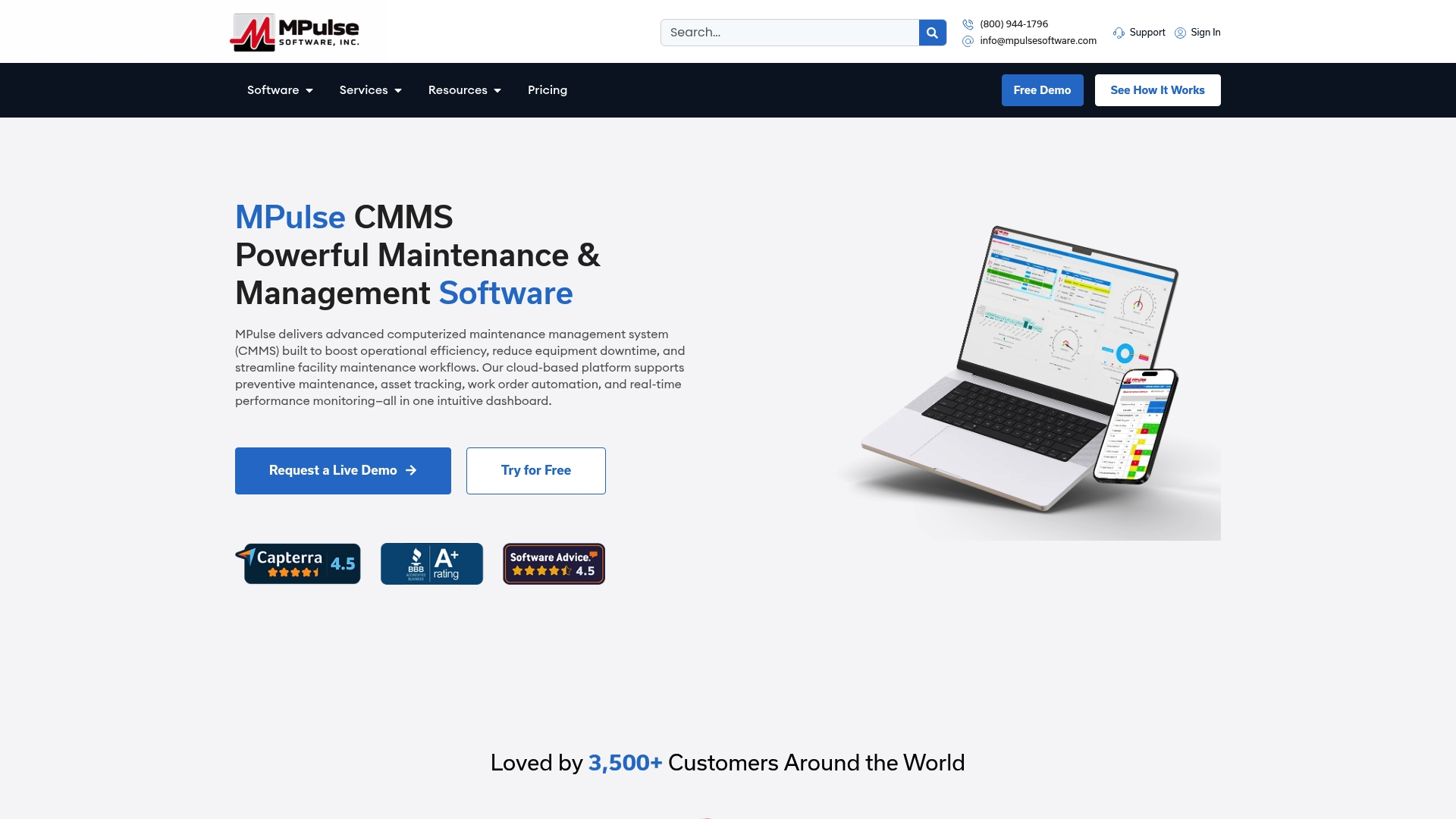
Getting started with MPulse is straightforward. Before your demo, complete three steps: export and clean your existing asset list, define your asset hierarchy down to the equipment level, and identify your top 10 critical assets for the first PM pilot. That preparation means your first 30 days in the system produce real results, not configuration delays.
Request a demo of MPulse CMMS to see how the platform maps to your specific operation and get a scoped implementation plan from the MPulse team.
FAQ
What are the most common asset management mistakes in facilities?
The top mistakes are poor data quality, reactive-only maintenance, weak inventory control, missing PM strategies, flawed asset tagging, siloed systems, and insufficient KPI tracking. Each has a direct corrective action that can be started within 30 days.
How does a CMMS prevent asset management errors?
A CMMS centralizes asset records, automates PM scheduling, controls inventory with min/max alerts, integrates with ERP and sensor systems, and provides real-time dashboards — eliminating the manual processes that cause most errors.
What KPIs should facility managers track first?
Start with PM compliance rate (target at least 85% as a baseline), MTTR, and the ratio of emergency to scheduled work orders. These three metrics show the fastest movement in the first 30–90 days and directly reflect whether your corrective actions are working.
How long does it take to see ROI after fixing these mistakes?
A conservative scenario, reducing reactive maintenance by 20% and saving 15 labor hours per week, typically produces payback within 12–18 months. The main drivers are PM compliance improvement rate, MTBF, and fully loaded labor cost per hour.
What is the biggest CMMS implementation mistake to avoid?
Migrating dirty data from spreadsheets into a new CMMS replicates existing problems at scale. Clean and validate asset records before migration, not after, to avoid building a flawed foundation in your new system.