

TL;DR:
- Facility maintenance contracts define how services are delivered, who bears financial risk, and how performance is measured. Choosing the right model based on operational needs and budget prevents costly compliance issues and unplanned downtime. Clear scope, risk, and accountability in contracts lead to better long-term facility management outcomes.
Facility maintenance contracts are formal agreements that define how maintenance services are delivered, who bears financial risk, and how supplier performance is measured. The three primary ways to categorize these agreements are by service scope, supplier arrangement, and financial structure. Choosing the wrong model costs organizations more than just money. It creates compliance gaps, unplanned downtime, and supplier management headaches that compound over time. This guide breaks down every major contract type so facility managers can match the right structure to their operational needs, budget tolerance, and in-house capabilities.

1. What are the main types of facility maintenance contracts by service scope?
Contract maintenance types divide into five core models based on how many suppliers are involved and how services are grouped. Each model suits a different level of facility complexity and management capacity.
| Contract Model | Suppliers | Client Involvement | Best For |
|---|---|---|---|
| Total FM (TFM) | 1 | Low | Large, complex facilities |
| Bundled Services | 2–4 | Medium | Mid-size multi-service sites |
| Single-Service | Multiple | High | Specialized or simple facilities |
| Managing Agent | Multiple | Medium | Organizations lacking in-house expertise |
| Integrated FM (IFM) | 1 primary | Low to medium | Multi-site portfolios |
Total Facilities Management (TFM) places all services under one supplier. The client deals with a single point of contact for everything from HVAC to cleaning. This model reduces administrative load but creates dependency on one vendor’s performance.
Bundled Services Contracts group two to four related service categories under one agreement. A common example is combining mechanical, electrical, and plumbing (MEP) services. This model balances simplicity with some supplier competition.
Single-Service Contracts give each service its own separate agreement. A facility manager might hold separate contracts for pest control, landscaping, and fire safety. This approach offers maximum control but demands significant management time. For specialized services like pest control scheduling, a dedicated single-service contract often produces better outcomes than bundling.
Managing Agent Model uses a third-party agent to oversee multiple specialist suppliers on the client’s behalf. The agent handles procurement, performance monitoring, and coordination. This works well for organizations that lack in-house facilities expertise.
Integrated FM (IFM) coordinates all services through one primary supplier who subcontracts as needed. Unlike TFM, the client retains more strategic oversight. IFM suits multi-site portfolios where consistency across locations matters.
Pro Tip: Effective contract selection depends on balancing operational needs, financial risk, and supplier capabilities. Map your current service complexity before choosing a model.
2. How do financial risk and payment structures shape maintenance agreements?
The financial model within a facility maintenance agreement determines who absorbs cost overruns, how predictable your budget is, and where hidden expenses appear. Three structures dominate the market.
Comprehensive (All-Inclusive) Contracts fix an annual fee covering labor, parts, and consumables. Comprehensive contracts transfer most financial risk to the contractor, giving clients high budget predictability. This model suits organizations that prioritize cost certainty over potential savings.
Labour-Only Contracts cover technician time but leave the client responsible for spare parts. Labour-only models lower the initial contract fee but expose the budget to high spare parts costs. Parts markups from contractors can erode those initial savings quickly, particularly for MEP-heavy facilities.
Reactive Ad-Hoc Contracts charge only when a fault occurs. There is no fixed fee and no scheduled maintenance. Budget predictability is low, and costs spike during equipment failures. This model works only for low-criticality assets where downtime carries minimal operational consequence.
| Financial Model | Budget Predictability | Client Risk Level | Best Use Case |
|---|---|---|---|
| Comprehensive | High | Low | Critical systems, compliance-heavy sites |
| Labour-Only | Medium | Medium to High | Sites with in-house parts procurement |
| Reactive Ad-Hoc | Low | High | Non-critical, low-use assets |
Decision-makers should weigh long-term parts and consumables costs carefully before choosing a labour-only structure. The apparent savings at contract signing often disappear within the first year of operation.
Pro Tip: Request a full breakdown of parts pricing schedules before signing any labour-only contract. Uncontrolled parts markups are the most common source of budget overruns in this model.
3. What specialized contract types exist based on service approach?
Beyond the broad models above, facility maintenance service contracts take several specialized forms based on how maintenance work is triggered, priced, and measured. Understanding these forms helps you write tighter scopes of work and set clearer supplier expectations.
-
Fixed Price / Lump Sum Contracts set a single agreed price for a defined scope. There are no variables. The contractor absorbs cost fluctuations within that scope. This model works well when the scope of work is well understood and unlikely to change.
-
Scheduled Maintenance Contracts define a set number of preventive maintenance visits per period. Reactive repairs are billed separately as needed. This structure balances planned care with cost control and is common for HVAC, elevators, and fire suppression systems.
-
Performance-Based Contracts link supplier payments to specific outcomes or KPIs. Payments depend on meeting KPIs such as system uptime percentages and response times. This model incentivizes quality but requires robust measurement systems to enforce.
-
Risk-Based Contracts focus on managing the probability and cost of equipment failure. Suppliers take on financial exposure for failures above a defined threshold. These contracts suit high-value assets where failure carries significant operational or safety consequences.
-
Annual Maintenance Contracts (AMCs) provide a fixed scope and duration, typically renewed each year. AMCs can be comprehensive, labour-only, or limited depending on the agreement. They are the most common contract form across commercial real estate and manufacturing.
-
Corrective Maintenance Contracts cover only repair work after a fault occurs. There is no preventive element. These are essentially formalized reactive agreements with agreed response times and labor rates.
-
Full-Coverage Contracts combine preventive, corrective, and emergency response under one agreement. They represent the highest level of service commitment and typically carry the highest fixed fee.
Service Level Agreements (SLAs) integrate with all of these contract types. A what is service-level agreement in maintenance contracts context: an SLA defines the performance standards the supplier must meet, such as response times, completion rates, and uptime targets. Without a well-drafted SLA, even a comprehensive contract leaves performance expectations open to interpretation.
4. How to choose the right facility maintenance contract for your organization
Selecting the right contract structure starts with an honest assessment of your facility’s complexity, your team’s management capacity, and your financial risk tolerance.
-
Assess facility size and complexity. A single-site office building with standard MEP systems suits a bundled or AMC structure. A multi-site manufacturing portfolio with compliance requirements needs TFM or IFM. Match contract complexity to operational reality.
-
Evaluate in-house capability. If your team can manage multiple supplier relationships and track individual SLAs, single-service contracts give you maximum control. If not, a managing agent or TFM model reduces that burden.
-
Define your financial risk tolerance. Organizations with tight capital budgets benefit from comprehensive fixed-fee contracts. Those with strong procurement teams and parts sourcing capability may find labour-only contracts cost-effective.
-
Prioritize preventive maintenance for critical assets. Reactive contracts on critical systems create unplanned downtime and emergency repair costs that far exceed the savings from lower contract fees.
-
Separate Hard FM from Soft FM. Hard FM and Soft FM have fundamentally different cost drivers. Hard FM covers capital-intensive, compliance-heavy services like electrical and structural. Soft FM covers labor-intensive services like cleaning and landscaping. Mixing them under one contract masks cost variances and complicates performance management.
-
Build SLA requirements into the contract from day one. Define response times, completion rates, and escalation paths before signing. Retrofitting SLAs into an existing contract is difficult and often leads to disputes.
-
Plan for contract flexibility. Facilities change. Equipment ages, headcounts shift, and regulatory requirements evolve. Build review clauses into every agreement so you can adjust scope without full renegotiation.
Key takeaways
The most effective facility maintenance contract aligns service scope, financial risk allocation, and supplier accountability to your organization’s specific operational needs and management capacity.
| Point | Details |
|---|---|
| Service scope drives model selection | Choose TFM, Bundled, or Single-Service based on facility complexity and in-house management capacity. |
| Financial model determines budget risk | Comprehensive contracts offer predictability; labour-only contracts expose budgets to parts cost overruns. |
| SLAs define supplier accountability | Every contract type needs defined KPIs, response times, and escalation paths to be enforceable. |
| Separate Hard FM and Soft FM | Mixing these service types under one contract masks cost variances and creates management complexity. |
| Preventive contracts outperform reactive ones | Scheduled and comprehensive contracts reduce unplanned downtime and extend asset life over time. |
What I’ve learned about picking the wrong contract
The most expensive mistake I see facility managers make is choosing a contract model based on the lowest headline fee rather than total cost of ownership. A labour-only contract on a critical chiller plant looks attractive at signing. Six months later, when the contractor marks up compressor parts at 40% above market rate, that initial saving is gone and the budget is in trouble.
The second mistake is bundling Hard FM and Soft FM services under one agreement. Mixing these service types creates contracts where compliance-heavy technical work and labor-intensive soft services compete for the same management attention. The result is that neither gets managed well.
Performance-based contracts sound ideal in theory. In practice, they only work when you have the data infrastructure to measure KPIs accurately and consistently. Without a CMMS tracking work order completion rates, response times, and asset uptime, you cannot enforce a performance-based agreement. The supplier will always dispute your numbers if you cannot produce auditable records.
Integrating contract management with a CMMS changes this dynamic entirely. When every work order, PM visit, and SLA breach is logged in one system, contract reviews become factual rather than argumentative. You walk into a supplier review with data, not impressions.
The contracts that perform best over time are not the cheapest or the most comprehensive. They are the ones where scope, risk, and accountability are clearly defined and regularly reviewed.
— Mark
How MPulse Software supports facility maintenance contract management
Managing multiple contract types, SLAs, and supplier relationships across a facility portfolio creates real administrative complexity. MPulse Software gives facility managers a centralized platform to track work orders, schedule preventive maintenance, and monitor SLA compliance in one place.
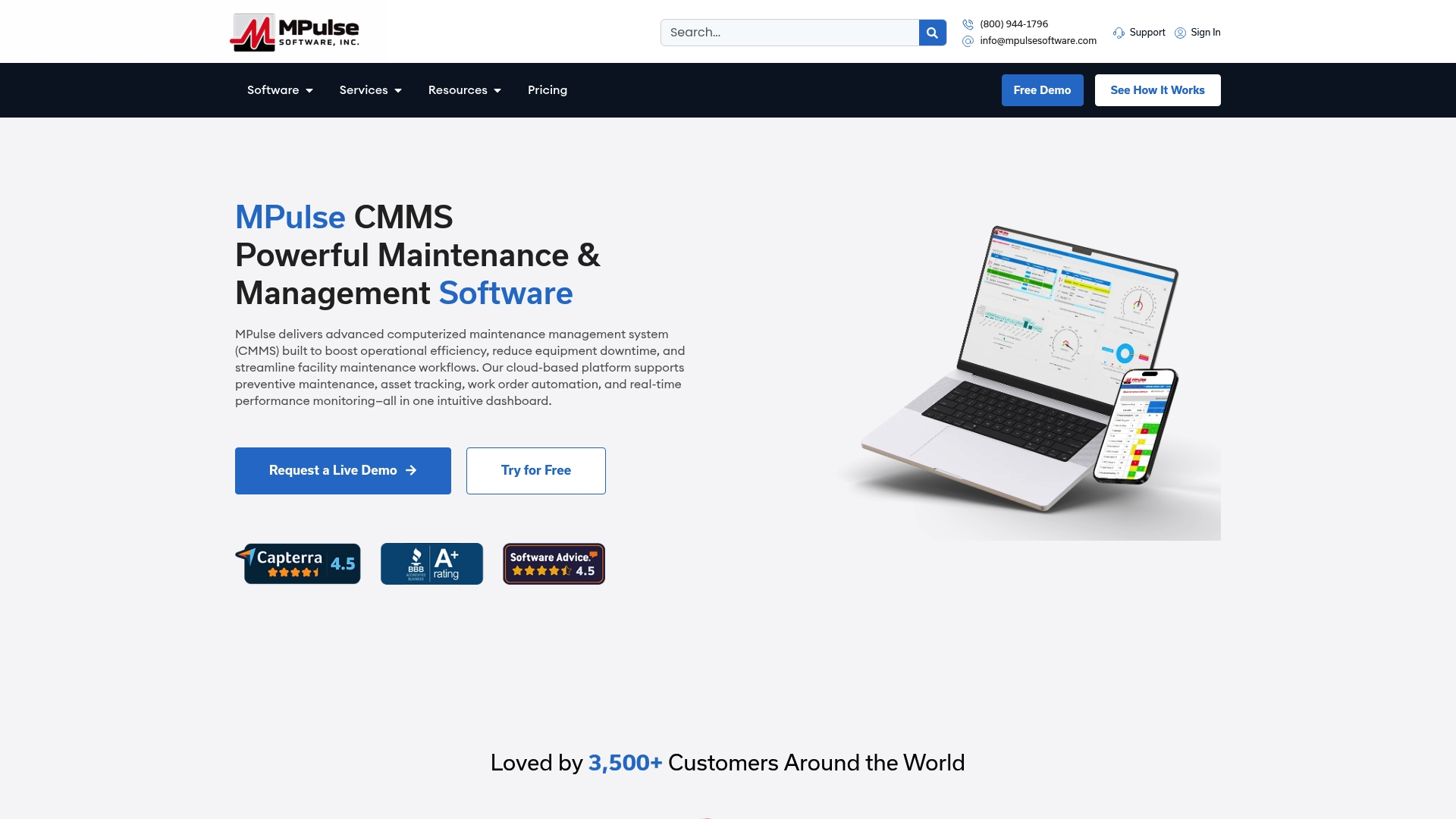
MPulse Software serves over 3,500 customers globally and delivers up to 40% efficiency improvements by replacing manual tracking with automated scheduling and real-time performance data. The platform’s facility maintenance tools support every contract type covered in this article, from scheduled AMCs to performance-based agreements. Whether you manage a single site or a multi-site portfolio, MPulse Software gives you the audit trail and reporting capability to hold suppliers accountable. Start a free trial to see how the platform fits your contract management workflow.
FAQ
What is a contract maintenance agreement?
A contract maintenance agreement is a formal document between a facility owner and a service provider that defines the scope, frequency, cost, and performance standards for maintenance work. It can cover preventive, corrective, or full-coverage services depending on the agreed terms.
What is a service-level agreement in maintenance contracts?
A service-level agreement (SLA) in a maintenance contract defines the performance standards a supplier must meet, including response times, completion rates, and system uptime targets. SLAs make contract performance measurable and enforceable.
What is the difference between Total FM and Integrated FM?
Total FM places all services under one supplier with minimal client involvement. Integrated FM also uses one primary supplier but the client retains more strategic oversight, making it better suited to organizations that want coordination without full outsourcing.
When should a facility manager choose a comprehensive contract over a labour-only contract?
Comprehensive contracts suit critical systems and compliance-heavy facilities where budget predictability matters most. Labour-only contracts work only when the client has strong in-house parts procurement capability and can control parts costs independently.
How do performance-based contracts work in facility maintenance?
Performance-based contracts tie supplier payments to specific KPIs such as asset uptime and response times. They incentivize quality but require a CMMS or equivalent data system to track and verify performance accurately.