TL;DR:
- Campus maintenance involves inspection, repair, and servicing of buildings to ensure safety and functionality. Properly sequencing preventive, planned, reactive, and emergency work reduces disruptions and extends campus infrastructure lifespan. Technology-driven CMMS platforms unify scheduling, tracking, and reporting to optimize maintenance operations effectively.
Campus facility maintenance is defined as the organized practice of inspecting, repairing, and servicing buildings, systems, and infrastructure to keep educational environments safe and operational. The four primary types of campus facility maintenance are preventive, planned, unplanned/reactive, and emergency maintenance. Each type addresses a distinct operational need, from scheduled HVAC servicing to immediate fire alarm failures. Institutions like UC Davis and the University of Wisconsin-Milwaukee (UWM) have formalized all four types into structured programs that cover electrical, mechanical, plumbing, elevator, and structural systems. Understanding each type gives facility managers the framework to allocate resources, reduce disruptions, and protect the academic mission.
1. What is preventive maintenance on campus and why it matters
Preventive maintenance is scheduled upkeep performed before equipment fails, designed to extend asset life and reduce unplanned breakdowns. On a university campus, this means regularly servicing HVAC units, replacing air filters, inspecting plumbing systems, testing electrical backup power, and checking elevators on a fixed calendar. The goal is to catch small problems before they become expensive failures.
The timing of preventive maintenance on campus follows a predictable pattern. 60–70% of annual preventive volume is completed within an 8–10 week summer window. That concentration exists because summer break removes the occupancy conflicts that make invasive work impossible during the academic year.
Common preventive maintenance tasks on campus include:
- HVAC inspections and filter replacements before fall occupancy
- Plumbing system checks and pipe inspections
- Electrical backup power testing
- Roof and pavement condition assessments
- Elevator servicing and certification
- Pest control treatments in dining halls and residence halls
- Fire suppression system testing
Each building type carries its own preventive schedule. Campus portfolios covering classrooms, research labs, residence halls, athletic facilities, dining halls, and central utilities each have unique systems, codes, and compliance requirements. Treating them as a single unified group produces uneven results. Separate preventive schedules by building type produce better outcomes.
Pro Tip: Use campus analytics to map labor and contractor throughput against the summer window. Scheduling conflicts with graduation, move-in, and exam periods can compress an already tight maintenance window and push deferred work into the academic year.
2. How planned maintenance supports campus infrastructure longevity
Planned maintenance covers scheduled, larger-scale projects that go beyond routine upkeep. Where preventive maintenance handles recurring tasks like filter changes, planned maintenance addresses capital improvements such as roof replacements, full HVAC system upgrades, electrical panel overhauls, and deferred maintenance catch-up projects. The scope is larger, the timelines are longer, and the coordination requirements are more complex.
The key distinction between planned and preventive maintenance is scale and intent. Preventive maintenance keeps existing systems running. Planned maintenance replaces or significantly upgrades those systems before they reach end of life or compliance failure.
Effective planned maintenance programs follow a structured sequence:
- Conduct a facility condition assessment to identify deferred maintenance and capital needs.
- Rank projects by urgency, safety impact, and compliance risk.
- Develop a multi-year capital plan aligned with the academic calendar.
- Schedule invasive work during summer or winter break to avoid disrupting classes.
- Pilot smaller projects first to build internal capacity and contractor relationships.
- Document outcomes and use them to justify larger budget requests.
Budget constraints are a consistent challenge. Phased repair lists starting with small pilots, such as $5,000 or $10,000 projects, allow institutions to maintain progress on urgent infrastructure needs without waiting for full funding approval. This approach limits deferred backlog growth and builds a documented case for larger capital investments. Campuses that apply phased planning maintain momentum even during budget uncertainty.
Coordination with the academic calendar is non-negotiable. Roof replacements, window system overhauls, and major mechanical upgrades cannot happen while classrooms are occupied. Facility directors who plan these projects 12–18 months in advance secure contractor availability and avoid costly schedule conflicts.
3. Understanding unplanned/reactive maintenance and typical campus examples
Unplanned or reactive maintenance is the industry term for repairs that happen in response to an unexpected failure or reported problem. A broken HVAC unit in august, a burst pipe in a residence hall bathroom, or a failed electrical circuit in a laboratory all trigger reactive maintenance. The work was not scheduled. It responds to a condition that already exists.
Reactive maintenance is not a failure of planning. Some equipment failures are statistically unavoidable regardless of how thorough the preventive program is. The question is how quickly and efficiently the team responds.
Typical reactive maintenance examples on campus include:
- HVAC system breakdowns during peak heating or cooling periods
- Plumbing leaks and drain blockages in residence halls and dining facilities
- Electrical faults in classrooms or research labs
- Broken locks, doors, or windows reported by building occupants
- Lighting failures in parking structures or walkways
Operational intake matters as much as the repair itself. UWM separates campus and dorm maintenance requests into distinct portals, each with work order status tracking accessible to the person who submitted the request. That separation reduces routing errors and improves transparency. Facility managers who give occupants visibility into work order status receive fewer follow-up calls and complaints.
UC Davis defines its dispatch process using a first-come, first-served model for standard reactive requests, with a separate classification and dispatch channel for emergencies. That separation prevents high-volume routine requests from crowding out genuinely urgent situations.
4. What qualifies as emergency maintenance and how campuses respond quickly
Emergency maintenance is defined as repairs required immediately to protect human health, animal safety, or prevent significant damage to infrastructure. The defining factor is risk, not inconvenience. A slow drain is reactive. A fire alarm system failure is an emergency.
UC Davis operationalizes this distinction clearly. Emergency maintenance criteria include threats to human or animal health, risks to ongoing teaching and research operations, and conditions that could cause major structural or systems damage if not addressed within hours. These criteria remove ambiguity from the dispatch decision.
Common campus emergency maintenance situations include:
- Fire alarm or suppression system failures
- Elevator entrapments
- Major water main breaks flooding occupied buildings
- Complete loss of heating in winter residence halls
- Critical laboratory utility failures affecting active research
The dispatch process for emergencies bypasses the standard work order queue entirely. Technicians are redirected from lower-priority tasks, contractors are called in outside normal hours, and building occupants are notified immediately. Emergency readiness depends on having clear criteria, trained staff, and a communication protocol that does not require multiple approval layers before a technician is dispatched.
Emergency maintenance volume is a direct indicator of preventive maintenance effectiveness. Campuses with mature preventive programs see fewer emergency calls because the conditions that trigger emergencies, such as aging equipment and deferred inspections, are addressed before they reach crisis level.
“Prioritizing preventive maintenance and integrating technology reduces reactive and emergency calls and improves resource allocation.” — MPulse Software
5. The full scope of campus maintenance services by trade
Campus facility maintenance covers multiple skilled trades: electrical, elevator, fire alarm, mechanical, plumbing, structural, carpentry, pest control, locksmithing, painting, and roofing. Each trade operates within its own compliance framework and requires certified technicians. A facility manager overseeing a large university campus is effectively managing a multi-trade service organization.
Understanding which trades apply to which building types helps with resource planning. Research labs require more frequent electrical and mechanical attention due to specialized equipment loads. Residence halls generate high plumbing and carpentry demand from daily occupancy. Athletic facilities need structural and roofing inspections more often due to weather exposure. Dining facilities require pest control on a defined schedule. F
The breadth of trades also means that no single technician can cover every need. Effective campus maintenance programs define clear trade assignments, cross-train where possible, and maintain contractor relationships for specialized work that exceeds in-house capacity.
6. Comparing maintenance types and choosing the right campus strategy
The four maintenance types are not competing approaches. They are complementary layers of a complete university maintenance program. The goal is to maximize preventive and planned activity so that reactive and emergency volume stays manageable.
| Maintenance Type | Definition | Typical Examples | Timing | Urgency |
|---|---|---|---|---|
| Preventive | Scheduled upkeep to prevent failures | Filter changes, HVAC servicing, elevator inspections | Fixed calendar, summer-heavy | Low to medium |
| Planned | Scheduled capital projects and upgrades | Roof replacement, system overhauls, deferred catch-up | Multi-year capital plan | Medium |
| Reactive/Unplanned | Response to unexpected failures | HVAC breakdown, plumbing leak, electrical fault | As failures occur | Medium to high |
| Emergency | Immediate response to safety or damage risk | Fire alarm failure, elevator entrapment, flooding | Immediate | Critical |
Campus size and building portfolio complexity determine how much weight each type carries. A small liberal arts college with newer buildings can run a lean preventive program and rarely face emergencies. A large research university managing hundreds of buildings across multiple decades of construction needs a fully staffed preventive team, a multi-year capital plan, and a 24-hour emergency dispatch protocol.
Facility maintenance software gives facility managers the visibility to balance all four types in real time. Work order tracking, preventive maintenance scheduling, and reporting dashboards replace the spreadsheets and paper logs that create blind spots in large campus operations.
Pro Tip: When evaluating a CMMS for campus use, prioritize calendar-based preventive scheduling, multi-trade work order routing, and real-time reporting. These three features directly address the summer planning bottleneck and the reactive-to-preventive ratio that most campus programs struggle with.
Key takeaways
Effective campus facility maintenance requires all four maintenance types working together, with preventive and planned work reducing the reactive and emergency load over time.
| Point | Details |
|---|---|
| Preventive maintenance is summer-driven | 60–70% of annual preventive volume occurs in the 8–10 week summer window. |
| Planned maintenance requires phased budgeting | Small pilot projects ($5,000–$10,000) maintain progress when full capital funding is unavailable. |
| Reactive maintenance needs clear intake systems | Separate portals and work order tracking, as used by UWM, reduce routing errors and improve transparency. |
| Emergency criteria must be defined in advance | UC Davis uses risk-based criteria to separate emergency dispatch from standard work order queues. |
| CMMS software ties all four types together | Calendar scheduling, multi-trade routing, and dashboards give facility managers real-time control across all maintenance categories. |
What I’ve learned about campus maintenance that most guides skip
The biggest gap I see in campus maintenance programs is not a lack of effort. It is a lack of sequencing. Teams run hard on reactive work all year, then try to compress preventive and capital work into a summer window that is already crowded with move-in, graduation, and contractor availability conflicts. The result is that preventive work gets deferred, deferred work becomes reactive, and reactive work eventually becomes emergency.
The fix is not more staff. It is earlier planning. Facility directors who lock in their summer maintenance schedule in january, before contractors are booked and before budget cycles close, consistently execute more work with the same resources. The summer window is finite. The teams that plan for it in winter are the ones who actually use it.
The other thing most guides understate is the value of separating building portfolios. Treating a 1960s residence hall the same as a 2015 research lab produces maintenance gaps in both directions. Older buildings need more frequent structural and mechanical attention. Newer buildings need more sophisticated systems monitoring. A single unified maintenance schedule misses both.
Technology makes this separation manageable. A CMMS that lets you assign different preventive schedules to different building types, track work orders by trade and location, and report on completion rates by portfolio gives you the data to defend your budget and improve your program year over year. Without that data, you are managing by memory and institutional knowledge, which leaves when people leave.
— Mark
How MPulse Software supports campus maintenance programs
Campus facility maintenance programs generate thousands of work orders, preventive tasks, and capital project records each year. Managing that volume without a purpose-built system creates the gaps that turn preventive failures into emergencies.
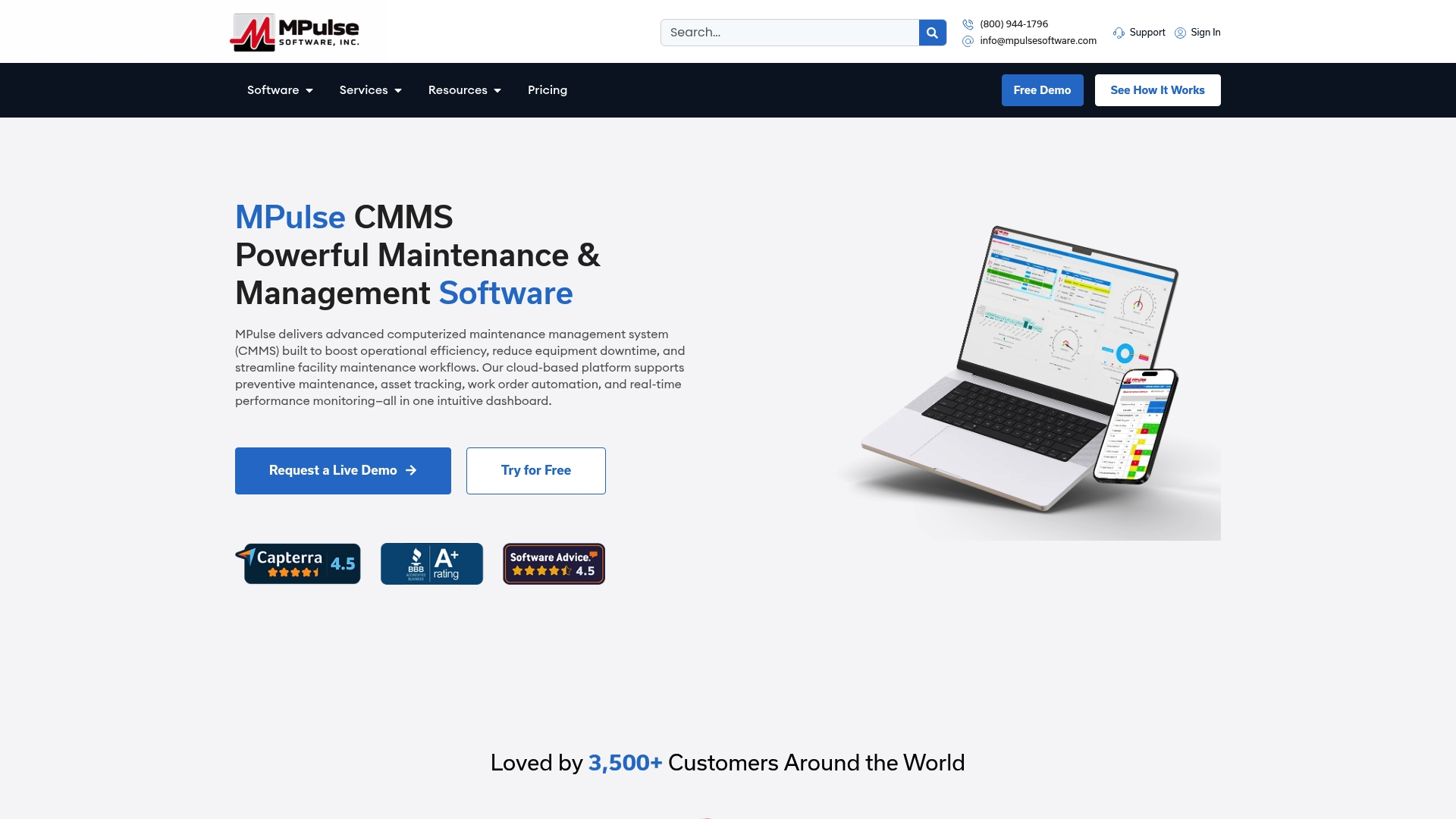
MPulse Software gives facility managers at educational institutions a single platform to schedule preventive maintenance by building type, route reactive work orders to the right trade, and track emergency response times. The platform’s calendar interface maps directly to the summer maintenance window, so teams can plan labor and contractor throughput months in advance. MPulse reports that customers achieve up to 40% efficiency improvements after implementation. With over 3,500 customers globally, MPulse Software brings proven campus maintenance management capability to institutions of every size.
FAQ
What are the four types of campus facility maintenance?
The four types are preventive, planned, unplanned/reactive, and emergency maintenance. Each addresses a different operational need, from scheduled upkeep to immediate safety responses.
How much campus maintenance happens during summer?
60–70% of annual preventive and deferred maintenance is completed during the 8–10 week summer break. That window is the primary opportunity for HVAC servicing, roof work, and capital project execution.
What is the difference between reactive and emergency maintenance?
Reactive maintenance responds to unexpected failures that do not pose immediate safety risks. Emergency maintenance addresses conditions that threaten human health, safety, or cause major infrastructure damage if not resolved immediately.
How do campuses handle budget constraints for planned maintenance?
Phased repair lists starting with small pilot projects allow institutions to maintain progress on deferred infrastructure needs without waiting for full capital funding. This approach limits backlog growth and builds the documentation needed for larger budget requests.
What is a CMMS and how does it help campus facility teams?
A CMMS, or computerized maintenance management system, is software that schedules preventive tasks, routes work orders, and tracks maintenance performance across all building types. It gives facility managers the data needed to reduce reactive work and plan capital projects more effectively.