
TL;DR:
- Effective contractor maintenance scheduling reduces delays by implementing coordinated plans, weekly lookaheads, and written confirmations. Prioritizing assets by criticality and verifying site readiness prevent unplanned downtime and callbacks. Transitioning to a CMMS enhances scheduling accuracy and communication for larger asset portfolios.
Contractor maintenance scheduling strategies are systematic practices that align crew availability, material readiness, and communication to keep maintenance operations running on time. Poor coordination is not a minor inconvenience. 35% of construction delays stem directly from subcontractor scheduling failures, and that figure holds across facility management and industrial maintenance alike. The strategies in this article give facility managers and contractors a repeatable framework for reducing unplanned downtime, improving crew accountability, and getting more out of every scheduled work window.

1. What are the core contractor maintenance scheduling strategies?
Effective maintenance scheduling, known in the industry as planned maintenance coordination, rests on four pillars: communication, verification, prioritization, and a disciplined weekly rhythm. Each pillar addresses a specific failure point that causes delays, rework, or idle crews.
The two-week lookahead
A weekly scheduling rhythm built around a two-week lookahead is the single most reliable way to catch problems before they become stoppages. The current week runs on a rigid dispatch plan. The next two weeks serve as a rolling buffer where you identify labor conflicts, material gaps, and access issues before they affect the live schedule. This approach gives you time to act rather than react.
48-hour confirmation protocol
No crew should leave the yard without a confirmed job. A 48-hour pre-dispatch confirmation cuts no-shows by 60%. That means calling or messaging every trade the day before dispatch to verify they are ready, the site is ready, and parts are on hand. Verbal confirmation is not enough. Written confirmation, whether by text, email, or a CMMS work order acknowledgment, is the standard that holds crews accountable.
Trade coordination meetings
Short, focused trade coordination meetings held at the start of each week align all parties on priorities and flag conflicts early. Keep these meetings under 30 minutes. The goal is not a status report. The goal is identifying any reason a scheduled job cannot proceed and resolving it before the crew mobilizes.
Parts and site readiness verification
No job should proceed without confirming parts are on site and the work area is accessible. A site superintendent or lead technician should walk the job location before dispatch. This single step eliminates the most common cause of callbacks: arriving at a site that is not ready.
Pro Tip: Build a simple pre-dispatch checklist covering parts confirmation, site access, permit status, and crew availability. Run it every time, without exception, for every scheduled job.
2. How scheduling strategies vary by asset criticality and maintenance type
Not every asset deserves the same scheduling attention. The most effective maintenance planning technique is to rank assets by their operational impact before building any schedule.
- Classify assets by criticality. Start with a single master sheet that ranks every asset by what happens if it fails. Equipment whose failure stops production or creates a safety risk goes to the top. Assets with redundancy or low operational impact go to the bottom. This ranking drives every scheduling decision that follows.
- Match the trigger to the asset. Time-based triggers work for assets with predictable wear cycles, such as HVAC filters or lubrication intervals. Usage-based triggers apply to equipment measured in hours or cycles, like compressors or conveyor motors. Condition-based triggers rely on sensor data or inspection findings to schedule maintenance only when indicators show degradation.
- Avoid over-maintenance on low-criticality assets. Scheduling preventive maintenance too frequently on non-critical equipment wastes labor and parts without improving uptime. Rolling weekly schedules integrated in a CMMS help teams adjust frequency dynamically based on actual asset behavior rather than fixed calendar dates.
- Prioritize critical-path assets in your lookahead. When building your two-week lookahead, place critical assets at the top of each week’s plan. If a conflict arises between scheduling a critical asset and a low-priority one, the critical asset wins every time.
- Use inspection history to refine triggers. Assets that consistently pass inspections without findings can shift to longer intervals. Assets that show recurring issues need shorter cycles or a condition-monitoring approach. Let the data drive the interval, not the original manufacturer recommendation alone.
3. What practical techniques optimize subcontractor and crew coordination?
Subcontractor coordination is where most maintenance schedules break down. The fix is not more meetings. It is tighter systems applied consistently.
Share detailed schedules from day one
Early detailed schedule sharing speeds project completion by 2.3 weeks on average. Every trade should receive a full schedule at project kickoff, not just their portion. When subcontractors see how their work connects to other trades, they make better decisions about sequencing and resource allocation.
Tier subcontractors by critical-path impact
Not all subs carry equal schedule risk. Trades on the critical path, such as electrical rough-in or primary mechanical systems, need more protective float and tighter confirmation cycles. Trades with schedule float can absorb minor delays without affecting the overall plan. Assign float buffers based on both logical dependencies and current labor market conditions. Critical-path trades should carry a 5–10% additional float buffer.
Written confirmation after every coordination meeting
Written crew confirmation after verbal trade meetings is the strongest predictor of schedule adherence. Verbal agreement fades. A written record, even a simple email reply, creates accountability and gives you a clear record when disputes arise.
Pro Tip: After every trade coordination meeting, send a brief summary email listing each crew’s confirmed tasks, dates, and any open items. Ask for a reply confirmation. This takes five minutes and prevents days of rework.
The table below compares two coordination approaches by their impact on schedule reliability:
| Coordination approach | Confirmation method | No-show risk | Schedule recovery time |
|---|---|---|---|
| Verbal only | Phone call | High | 1–3 days |
| Written confirmation | Email or CMMS acknowledgment | Low | Same day |
Manage schedule changes immediately
When a delay hits, update the schedule within 24 hours and notify all affected trades. Cascading delays happen because one trade does not know another has slipped. Fast communication stops the cascade before it reaches critical-path work.
4. What role does technology play in maintenance scheduling?
Spreadsheets work until they do not. When your maintenance schedule covers more than a handful of assets or crews, manual tracking creates gaps that cost time and money. Using specialized CMMS software when spreadsheets become cumbersome improves scheduling efficiency and tracking across every maintenance type.
A computerized maintenance management system (CMMS) centralizes scheduling, work order management, and communication in one platform. The core benefits for contractor maintenance scheduling include:
- Scheduling boards and calendar views that show every planned job, crew assignment, and asset status in real time, so conflicts are visible before dispatch.
- Automated work order generation triggered by time, usage, or condition thresholds, removing the manual step of creating recurring jobs.
- Real-time dashboards that show completion rates, open work orders, and overdue tasks, giving facility managers instant visibility into schedule performance.
- Confirmation and notification tools that send automated reminders to crews and subcontractors before scheduled jobs, supporting the 48-hour confirmation protocol without manual follow-up.
- Maintenance history tracking that records every completed job, inspection finding, and parts used, giving you the data to refine asset triggers and scheduling intervals over time.
98% of large projects experience schedule or budget slippage. A CMMS does not eliminate every risk, but it removes the information gaps that turn small delays into major overruns. MPulse Software, trusted by over 3,500 customers globally, reports efficiency improvements of up to 40% for teams that move from manual scheduling to a dedicated planned maintenance platform.
The right time to move from spreadsheets to a CMMS is when you have more than 20 assets to track, more than two active crews, or when you are spending more than two hours per week manually updating schedules. At that point, the cost of the software is less than the cost of the errors it prevents.
Key takeaways
The most effective contractor maintenance scheduling strategy combines a rigid weekly dispatch plan, a rolling two-week lookahead, written confirmation protocols, and asset-criticality ranking to reduce downtime and improve crew accountability.
| Point | Details |
|---|---|
| Use a two-week lookahead | Plan the current week rigidly and use the next two weeks to catch conflicts before they cause stoppages. |
| Require written confirmation | Written crew and subcontractor confirmation after every coordination meeting is the strongest predictor of schedule adherence. |
| Rank assets by criticality | Build your schedule around operational impact, assigning tighter intervals and more float to critical-path assets. |
| Verify before dispatch | A pre-dispatch site walk confirming parts, access, and permits prevents the most common cause of callbacks and idle crews. |
| Move to CMMS when spreadsheets fail | Dedicated scheduling software removes information gaps and supports dynamic schedule adjustments across large asset portfolios. |
Scheduling discipline is harder than it looks
I have spent years watching well-intentioned maintenance teams build solid schedules on monday morning and abandon them by wednesday afternoon. The schedule itself is rarely the problem. The problem is treating it as a static document rather than a living commitment that every crew member and subcontractor has actively agreed to.
The shift that actually changes outcomes is cultural, not technical. When you require written confirmation from every trade after every coordination meeting, you are not just collecting paperwork. You are signaling that the schedule is a contract, not a suggestion. Most teams resist this at first. It feels bureaucratic. But the first time a written confirmation prevents a $15,000 idle-crew day, the resistance disappears.
The other thing I have learned is that schedule optimism is nearly universal. Every project manager believes their plan is realistic. Schedule slippage affects 98% of large projects, which tells you that individual confidence is not a reliable indicator of schedule quality. Building in float buffers is not pessimism. It is the only honest response to that data.
Technology helps, but only after the discipline is in place. A CMMS gives you visibility and automation. It does not give you a team that follows through. Get the confirmation habits and verification protocols working first. Then use software to scale what already works.
— Mark
How MPulse Software supports your maintenance scheduling
Putting these scheduling strategies into practice requires more than a checklist. MPulse Software gives facility managers and contractors the tools to run a disciplined weekly scheduling cycle at scale.
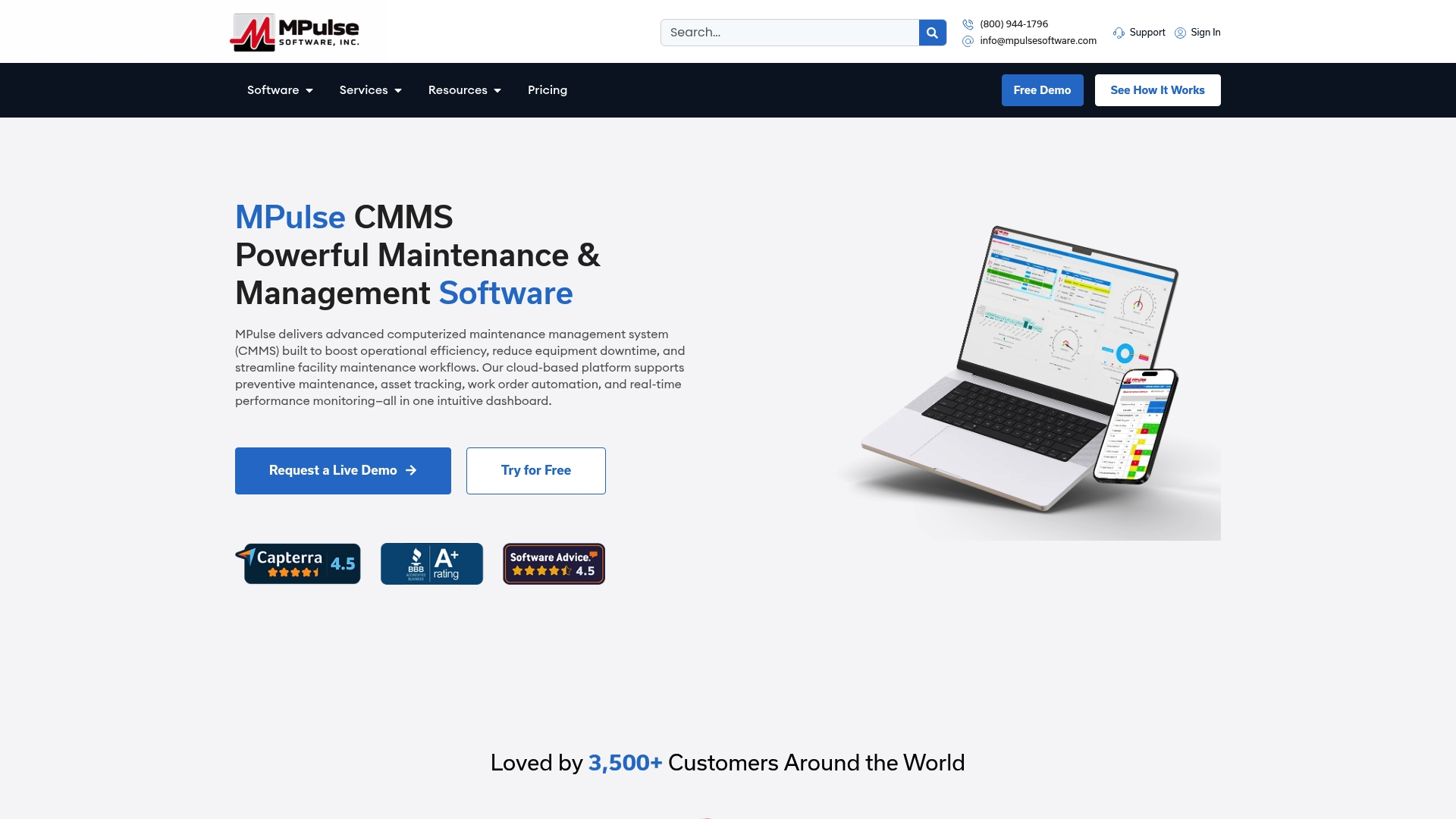
MPulse CMMS combines automated work order generation, real-time scheduling dashboards, and built-in confirmation workflows to support every step of the process described in this article. The platform’s calendar interface makes it easy to manage asset criticality rankings, assign float buffers, and track crew confirmations without manual follow-up. Over 3,500 customers trust MPulse Software to reduce unplanned downtime and improve maintenance coordination across industries with strict compliance requirements. Explore MPulse CMMS features to see how the platform supports your scheduling goals, or start with a free trial to test it against your current workflow.
FAQ
What is a two-week lookahead in maintenance scheduling?
A two-week lookahead is a rolling planning window where the current week runs on a fixed dispatch plan and the next two weeks are used to identify and resolve labor, material, or access conflicts before they affect live work. It is the foundation of proactive contractor work scheduling.
How does a 48-hour confirmation protocol reduce no-shows?
Contacting every crew and subcontractor 48 hours before dispatch to confirm readiness cuts no-shows by 60%. Written confirmation, by email or CMMS acknowledgment, is more effective than verbal confirmation alone.
When should a contractor switch from spreadsheets to a CMMS?
The right time to move to a CMMS is when you manage more than 20 assets, run more than two active crews, or spend more than two hours per week manually updating schedules. At that point, a dedicated scheduled maintenance platform pays for itself in errors prevented.
How do you prioritize assets in a maintenance schedule?
Rank assets by operational impact using a master criticality sheet. Assets whose failure stops production or creates safety risks receive tighter maintenance intervals, more float buffer, and priority placement in the weekly dispatch plan.
What is the most common cause of contractor maintenance delays?
Poor subcontractor coordination is the leading cause, accounting for 35% of construction and maintenance delays. Structured confirmation protocols, written trade agreements, and real-time schedule updates are the most effective countermeasures.