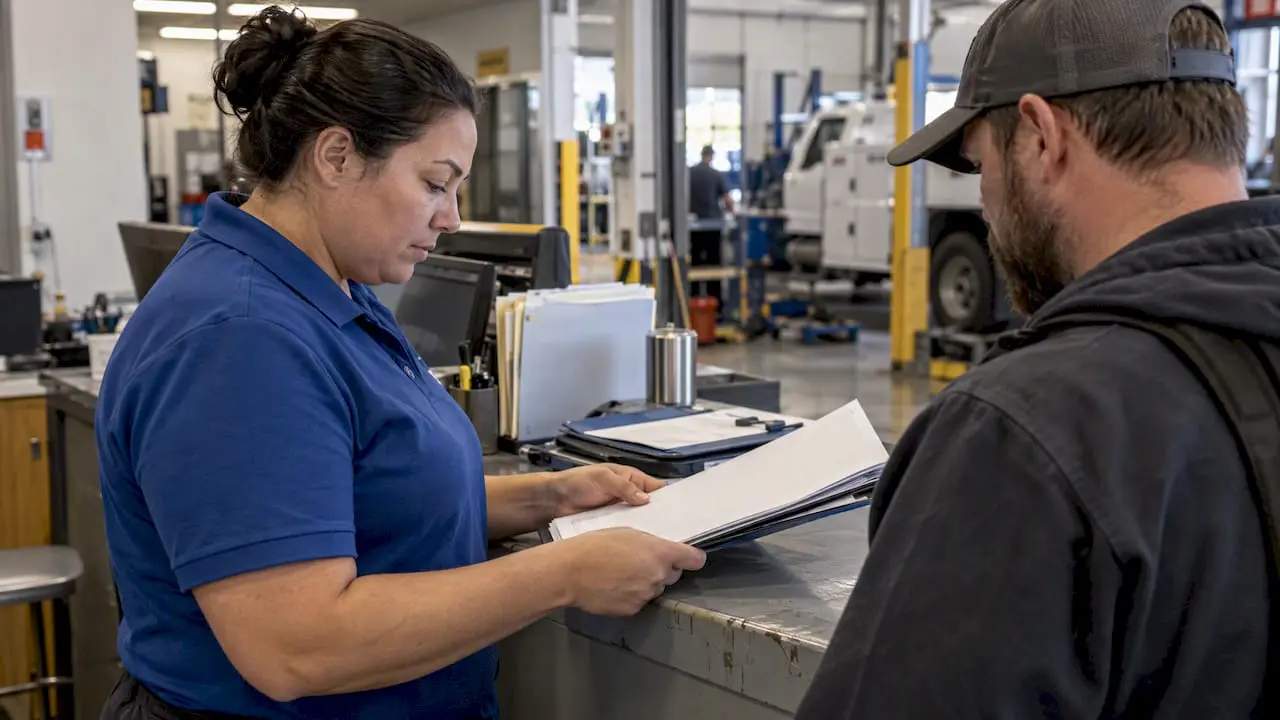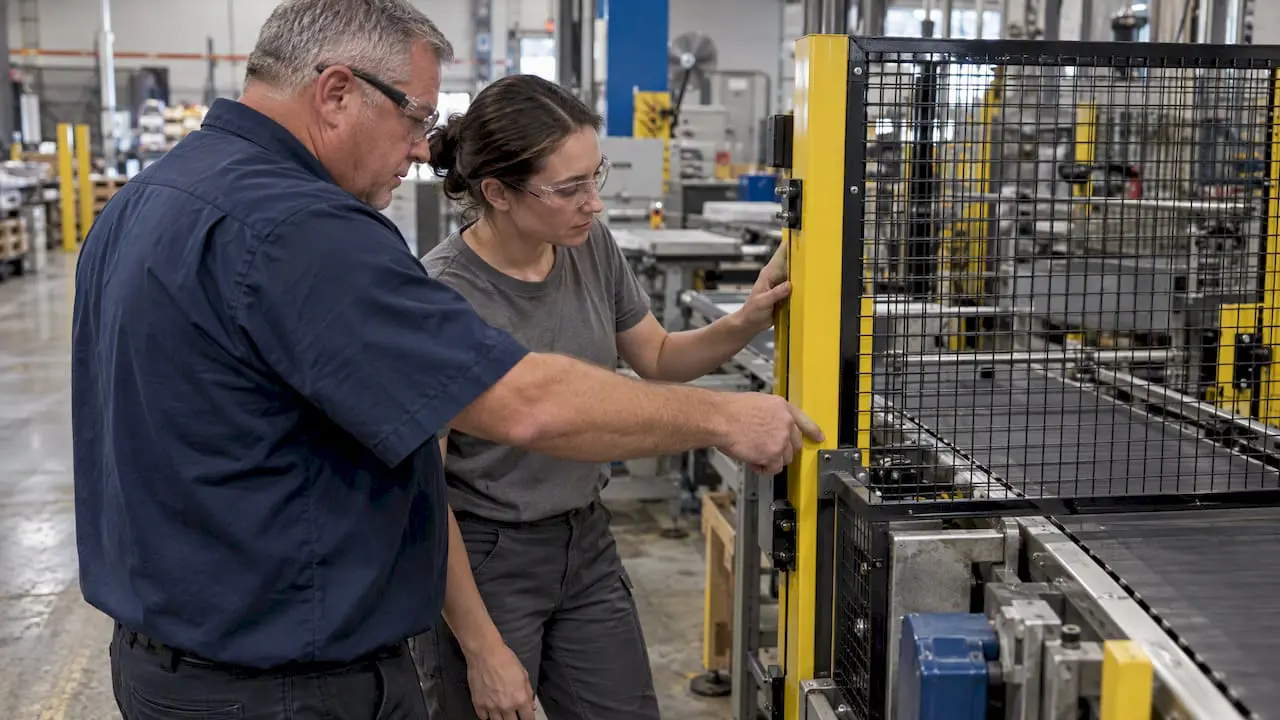
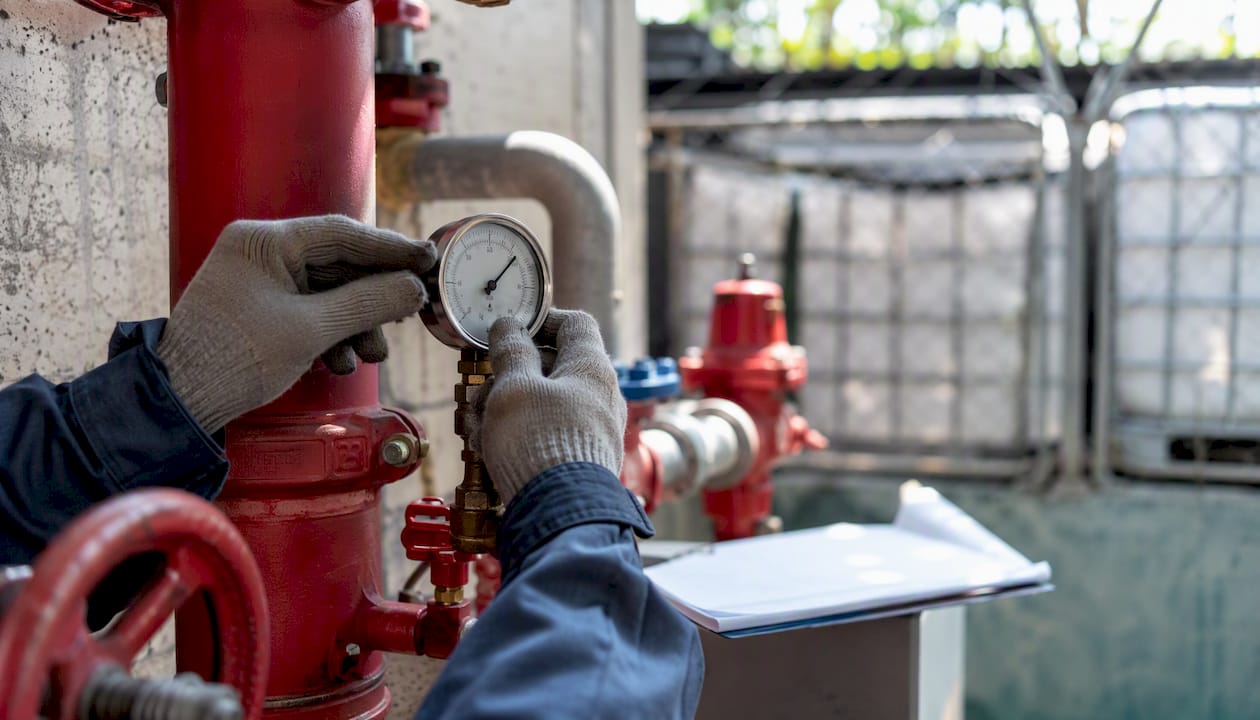
Fire safety maintenance compliance means having documented evidence that every fire protection system in your facility has been inspected, tested, and maintained at the intervals required by the codes your Authority Having Jurisdiction (AHJ) enforces. The goal is not just operational systems — it is retrievable proof that those systems work. If an inspector walks in tomorrow, here is what to do in the next 72 hours:
- Contact your local AHJ (fire marshal’s office) and confirm which edition of NFPA and the International Fire Code they currently enforce.
- Walk every floor and inventory your fire protection systems: sprinklers, alarms, extinguishers, fire doors, emergency lighting, suppression systems, and standpipes.
- Pull the last inspection report for each system and check the date against the required frequency.
- Flag any system with an overdue inspection, an open deficiency, or a missing report as a priority corrective item.
- Gather technician credentials, impairment notifications, and drill logs into a single folder — physical or digital.
If records are missing, note the gap in writing and schedule the overdue inspection immediately. Inspectors respond better to a documented corrective plan than silence.
Key Takeaways
Fire safety maintenance compliance requires documented evidence of completed ITM across every fire protection system, organized and retrievable before an inspector arrives.
| Point | Details |
|---|---|
| Confirm your AHJ’s code edition | Contact your local AHJ and document which NFPA edition they enforce before scheduling any inspection. |
| Inventory all systems and dates | Map every fire protection system to its last inspection date and flag any overdue tasks as immediate priorities. |
| Document impairments within 72 hours | Systems offline longer than approximately 72 hours require written compensatory measures and AHJ notification. |
| Organize records by system and date | Maintain an audit-ready folder with signed reports, contractor credentials, corrective actions, and drill logs. |
| MPulse Software for scalable compliance | MPulse CMMS centralizes scheduling, credential tracking, and audit-ready reporting for multi-system compliance programs. |
Table of Contents
- How fire safety maintenance compliance works in practice
- What U.S. codes and authorities govern fire safety
- Which fire protection systems require regular maintenance
- How to build an auditable fire safety compliance program
- What records to keep and how to stay audit-ready
- Who owns what: roles, responsibilities, and required qualifications
- Typical timelines and cost drivers for a compliance program
- Most common compliance mistakes and how enforcement proceeds
- A deployable monthly, quarterly, and annual compliance checklist
- How CMMS and automation make compliance practical
- What most facility managers get wrong about compliance
- MPulse Software keeps your compliance records audit-ready
- Sources
- FAQ
How fire safety maintenance compliance works in practice
The phrase “fire safety compliance” covers three things simultaneously: physical conformity (systems installed correctly), ongoing maintenance (systems kept in working order), and retrievable documentation (proof that both happened). Facilities that fail audits almost always have working systems and missing paperwork, not broken equipment.
Enforcement comes from multiple directions. Your AHJ — which may be a local fire marshal, a state fire marshal, or in some regulated industries an accreditation body like The Joint Commission — has authority to cite deficiencies, issue corrective orders, and in serious cases order occupancy restrictions. Insurers conduct their own surveys and can adjust premiums or deny claims when maintenance records are absent. Healthcare and federal facilities face additional layers through accreditation surveys that treat fire and life safety documentation as a primary review category.
The consequences of non-compliance range from administrative citations to facility closure. Beyond enforcement, the liability exposure from a fire event in a facility with documented maintenance gaps is substantial. Preventive maintenance is one of the most direct levers for reducing that liability before an incident occurs.
Stat to know: According to NFPA research, failure of fire protection equipment to operate is a contributing factor in a significant share of large-loss fires — and in many of those cases, the equipment had not received required maintenance.
What U.S. codes and authorities govern fire safety
Understanding the regulatory landscape starts with knowing who writes the rules and who enforces them. These are the primary actors.
- NFPA (National Fire Protection Association): NFPA publishes the technical standards that most U.S. jurisdictions adopt as law, including NFPA 25 for water-based systems, NFPA 72 for fire alarms, NFPA 10 for extinguishers, NFPA 96 for commercial kitchen hoods, and NFPA 101 (Life Safety Code) for egress and occupancy requirements. NFPA standards are technical guidance documents — they become enforceable only when a jurisdiction formally adopts them.
- OSHA (Occupational Safety and Health Administration): OSHA’s 29 CFR 1910 Subpart L sets minimum fire protection requirements for general industry workplaces, including extinguisher placement, employee training, and alarm system requirements. OSHA citations carry financial penalties and can trigger follow-up inspections.
- International Fire Code (IFC) / NFPA 1: Many jurisdictions adopt either the IFC (published by the International Code Council) or NFPA 1 (Fire Code) as their operational fire code. Both reference NFPA system-specific standards for ITM (inspection, testing, and maintenance) requirements.
- Authority Having Jurisdiction (AHJ): The AHJ is the organization, office, or individual responsible for enforcing the requirements of a code. AHJs vary significantly in which code edition they have adopted, what report formats they accept, and what credentials they require from inspecting technicians. Your local AHJ is the single most important relationship to establish before running any compliance program.
- Insurers and accreditation bodies: FM Global, insurance carriers, and bodies like The Joint Commission conduct their own surveys and may impose requirements that exceed the local AHJ’s minimum.
The table below maps the primary NFPA standards to the systems they govern.
| NFPA Standard | System Covered | Key Requirement Focus |
|---|---|---|
| NFPA 25 | Sprinklers, standpipes, fire pumps | ITM frequencies from weekly to 5-year internal inspections |
| NFPA 72 | Fire alarm and detection systems | Device-level test intervals; monitored vs. unmonitored cadences |
| NFPA 10 | Portable fire extinguishers | Monthly visual checks, annual maintenance, hydrostatic testing |
| NFPA 96 | Commercial kitchen hoods and suppression | Semiannual inspection and cleaning for cooking operations |
| NFPA 101 | Life safety, egress, emergency lighting | Occupancy rules, means of egress, exit sign testing |
Pro Tip: Before your first inspection cycle, request a written confirmation from your AHJ of the specific code edition they enforce. File that confirmation in your compliance folder — it protects you if a contractor uses the wrong edition’s requirements.
Which fire protection systems require regular maintenance
Every major fire protection system in a commercial facility carries a mandatory inspection, testing, and maintenance (ITM) schedule. The table below summarizes common systems, their standard cadences under NFPA, and who typically performs each task.
| System | Typical Inspection/Test Frequency | Standard Performer |
|---|---|---|
| Sprinkler heads and piping | Monthly visual; quarterly gauges; annual full inspection; 5-year internal | Monthly: in-house staff; Annual/5-year: licensed contractor |
| Fire pump | Weekly churn test; annual full flow test | Weekly: in-house; Annual: licensed contractor |
| Standpipe system | Annual inspection and flow test | Licensed contractor |
| Fire alarm control panel | Quarterly supervisory devices; semiannual batteries; annual full test | Licensed contractor (NICET-certified) |
| Smoke and heat detectors | Semiannual or annual sensitivity test depending on type | Licensed contractor |
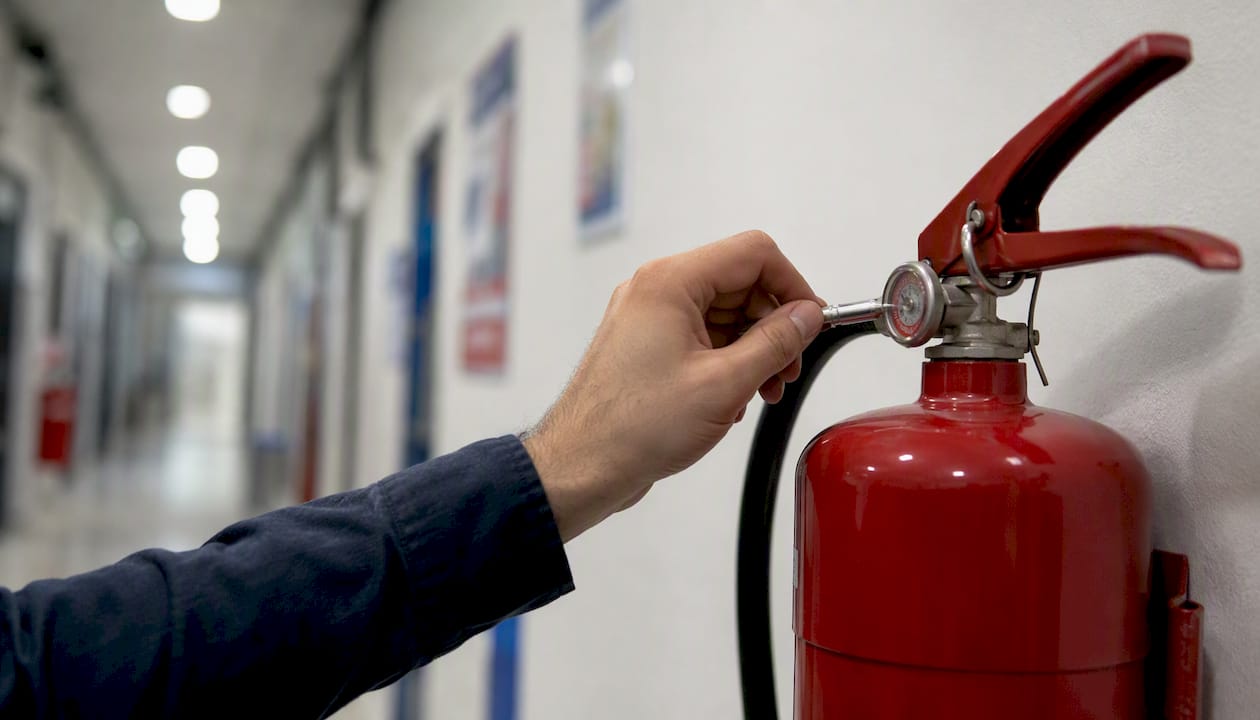
| Portable fire extinguishers | Monthly visual; annual maintenance; 6-year internal; 12-year hydrostatic | Monthly: in-house; Annual+: certified technician |
| Commercial kitchen hood | Semiannual inspection and cleaning (high-volume cooking) | Licensed contractor |
| Fire doors | Annual inspection; monthly operational check | In-house (monthly); Qualified inspector (annual) |
| Emergency lighting and exit signs | Monthly 30-second test; annual 90-minute test | In-house (monthly); Documented by staff |
| Clean-agent suppression systems | Semiannual inspection; annual full test | Licensed contractor |
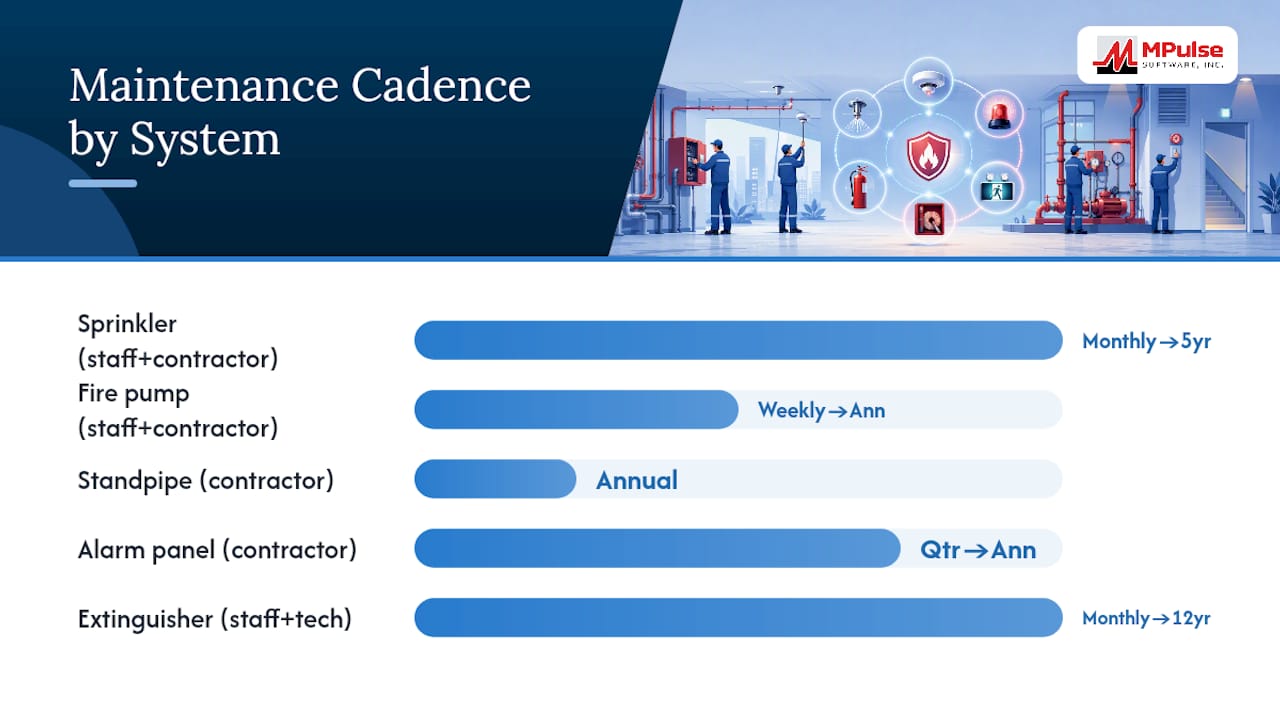
A few cadences deserve special attention. NFPA 25 prescribes sprinkler system ITM frequencies ranging from weekly checks on fire pump pressure gauges up to 5-year internal pipe inspections — the range is wider than most facility managers expect. NFPA 72 differentiates between monitored and unmonitored alarm systems, which can shift some test intervals. NFPA 10 requires monthly visual extinguisher checks by building staff, annual maintenance by a certified technician, internal examinations at 5–6 years depending on extinguisher type, and hydrostatic testing at defined multi-year intervals.
Manufacturer instructions can tighten any of these intervals. When a manufacturer’s published maintenance schedule is more frequent than the NFPA minimum, the manufacturer’s schedule governs.
How to build an auditable fire safety compliance program
A compliance program that survives an AHJ inspection has six repeatable phases. The sequence matters because skipping assessment leads to scheduling the wrong tasks, and skipping documentation makes every completed task invisible to an inspector.
- Assess your baseline. Inventory every fire protection system, confirm the last inspection date for each, and identify open deficiencies from prior reports. This step produces your gap list.
- Confirm your code obligations. Match each system to the applicable NFPA standard and the edition your AHJ enforces. Note any AHJ-specific requirements that exceed the standard minimum.
- Assign ownership and schedule ITM. Assign a named responsible party for every inspection task — in-house staff for monthly visual checks, licensed contractors for annual and multi-year tests. Build a master schedule with due dates and contractor contact information.
- Execute inspections and close deficiencies. Complete scheduled ITM, document results on standardized forms, and initiate corrective work orders for any deficiency within 24 hours of identification. Life-safety system deficiencies require immediate action; administrative items can follow a documented timeline.
- Document and store records. File every inspection report, technician credential, corrective action record, and impairment notification in an organized, retrievable format. See the documentation section below for retention guidance.
- Review and improve. Conduct a quarterly internal review of open deficiencies, missed inspections, and upcoming multi-year tasks. Adjust the schedule and budget as systems age or occupancy changes.
For a practical walkthrough of building a site-specific plan, the fire safety maintenance plan guide from MPulse Software covers the planning steps in detail.
Implementation milestones
- 30 days: Complete system inventory, confirm AHJ code edition, pull all prior inspection reports, and identify overdue tasks.
- 90 days: Execute all overdue inspections, close or formally schedule all open deficiencies, and establish contractor relationships for annual/multi-year tasks.
- 180 days: Full ITM schedule operational, documentation system in place, staff trained on monthly visual checks.
- 365 days: First full annual inspection cycle complete, records reviewed for completeness, program adjusted based on findings.
What records to keep and how to stay audit-ready
Documentation failures cause more compliance citations than equipment failures. The records an AHJ or accreditation surveyor will request fall into predictable categories.
- Inspection, testing, and maintenance reports for every system (signed by the performing technician)
- Technician credentials and contractor licenses at the time of each inspection
- Corrective action records: what was found, what was done, and when it was completed
- System impairment notifications and written compensatory measures
- Acceptance test reports and hydraulic calculations for sprinkler systems
- Fire drill logs (date, time, occupant count, evacuation time, observations)
- Equipment tags (extinguisher, fire door, suppression system)
- AHJ inspection reports and any issued citations with documented responses
Retention windows vary by code and jurisdiction, but a practical baseline is three years for routine annual inspection reports and seven years for acceptance tests, hydraulic calculations, and major system modifications. Some records — original acceptance tests, hydraulic calculations, and system design documents — should be kept for the life of the system.
Minnesota’s health facilities engineering guide recommends a 22-tab documentation organization for fire and life safety records, and notes that surveyors typically review the most recent year of records, with exceptions for tasks that occur on multi-year cycles. That structure translates well to any facility type.
Organize your audit-ready folder with these tabs at minimum: (1) System Inventory, (2) Current Inspection Reports by System, (3) Open Deficiency Log, (4) Corrective Action Records, (5) Contractor Credentials, (6) Impairment Notifications, (7) Drill Logs, (8) AHJ Correspondence.
Pro Tip: Digital records with timestamps and attached technician credentials shorten inspector interviews and reduce citation risk. When a surveyor asks “who performed this test and are they licensed?”, a CMMS-generated report with the credential attached answers the question in seconds.
Many inspection failures trace back to missing or disorganized documentation rather than technical system failures — a point worth sharing with any stakeholder who questions the investment in a structured recordkeeping system.
Who owns what: roles, responsibilities, and required qualifications
Compliance programs fail when ownership is unclear. The role matrix below defines who does what.
- Owner/facility manager: Signs off on the compliance program, approves contractor agreements, receives AHJ inspection reports, and is legally responsible for corrective action timelines. This role does not require a technical license but does require documented oversight.
- Facilities team (in-house staff): Performs monthly visual checks on extinguishers, fire doors, emergency lighting, and sprinkler gauges. Completes and signs the monthly inspection log. Initiates work orders for any observed deficiency. No specialized license required for visual checks, but documented training is expected.
- Licensed contractor: Performs annual, semiannual, and multi-year ITM tasks. Signs inspection reports with their license number. Provides documentation of technician credentials for your file. For fire alarm work, NICET (National Institute for Certification in Engineering Technologies) Level II or higher is a common AHJ expectation; state contractor licensing requirements vary.
- AHJ/inspector: Conducts periodic inspections, issues citations, and approves corrective action plans. The AHJ does not perform maintenance — they verify that you have.
For contractor selection, request proof of state fire protection contractor licensing, NICET certification levels for alarm technicians, and manufacturer-specific certifications for suppression systems. File copies of all credentials with each inspection report. MPulse Software’s personnel qualification tracking feature allows you to attach credentials directly to technician records and flag expiration dates automatically.
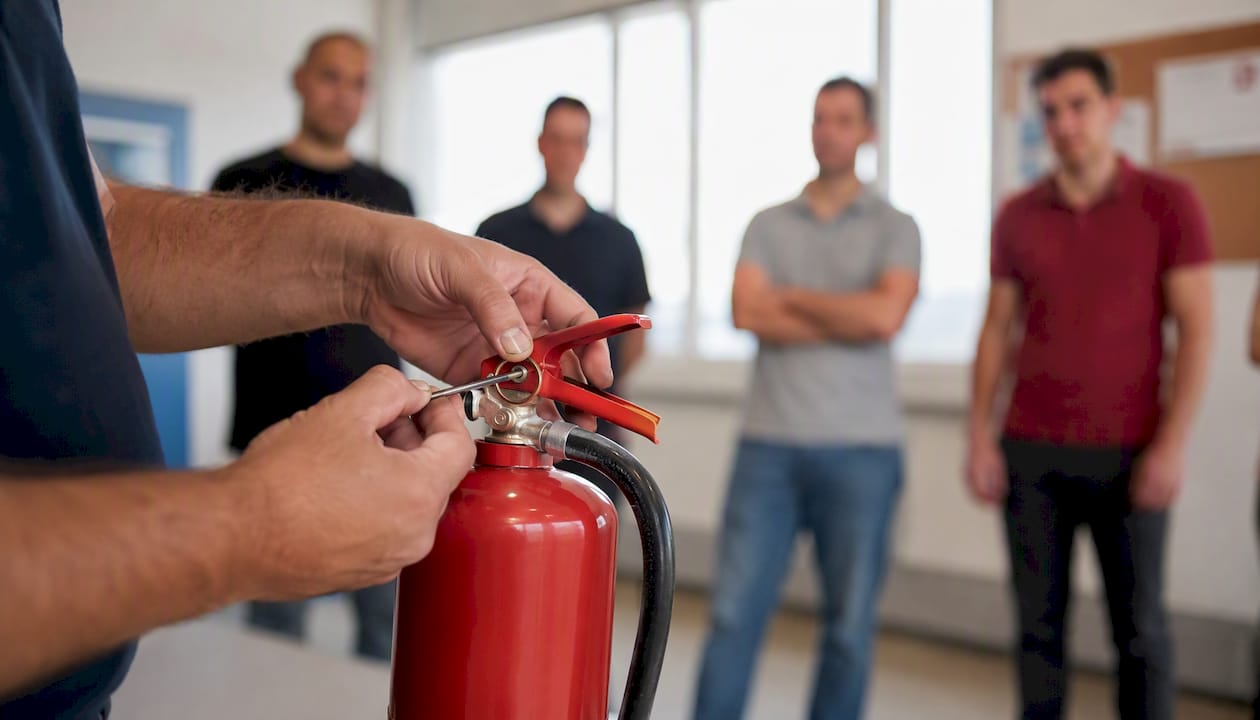
Training cadence: New facilities staff should complete fire protection awareness training within 30 days of hire. Annual refreshers covering monthly check procedures, impairment reporting, and evacuation roles keep skills current. Conduct fire drills at the frequency your occupancy type requires — typically twice per year for most commercial occupancies under NFPA 101.
Pro Tip: Cross-train at least two staff members on every monthly inspection task. Single points of failure in inspection coverage are a common audit gap, especially during staff turnover.
Typical timelines and cost drivers for a compliance program
Setting up a compliance program from scratch takes longer than most facility managers budget for. The timeline depends heavily on portfolio size and the condition of existing records.
- Small facility (single building, under 50,000 sq ft): Baseline inventory and initial gap assessment in 2–4 weeks; full program operational in 60–90 days.
- Medium portfolio (3–10 buildings): Baseline assessment 4–8 weeks; full program 4–6 months.
- Large portfolio (10+ buildings or multi-site): Baseline assessment 2–3 months; full program 6–12 months, often phased by building type or risk level.
Primary cost drivers include contractor labor rates for annual and multi-year inspections, travel charges for remote sites, replacement parts identified during inspections, hydrostatic testing for extinguishers and standpipes, fire pump full-flow test costs (which require water discharge and sometimes utility coordination), and CMMS software subscription or implementation fees.
Systems that have not been inspected in several years frequently produce deficiency lists that require immediate parts and labor.
Most common compliance mistakes and how enforcement proceeds
The mistakes that generate the most citations are predictable and preventable.
- Missing or incomplete documentation: The single most common audit failure. Reports signed without technician license numbers, missing corrective action records, and gaps in the inspection timeline all generate citations.
- Propped-open or damaged fire doors: Fire doors held open by wedges, damaged closers, or missing hardware are immediate life-safety violations. Monthly visual checks catch these before an inspector does.
- Expired extinguisher tags: An extinguisher with an annual tag more than 12 months old is a citation regardless of the unit’s physical condition.
- Missed sprinkler tests: Skipping a quarterly gauge check or an annual inspection creates a documented gap that is difficult to explain during an audit.
- Undocumented impairments: Taking a system offline for repairs without a written impairment notification and compensatory measures plan is a high-severity finding. Impairments lasting longer than approximately 72 hours require documented compensatory measures and coordinated notification with authorities — failure to present such a plan is often an audit-level violation.
- Wrong code edition: Using an older NFPA edition’s inspection intervals when the AHJ has adopted a newer edition is a compliance gap even when the work was completed in good faith.
When an inspector cites a deficiency
- Document the citation in writing, including the specific code section referenced.
- Assess the severity: life-safety deficiencies (impaired suppression, blocked egress) require same-day corrective action; administrative deficiencies can follow a documented timeline.
- Schedule corrective work and assign a named responsible party with a completion date.
- Notify the AHJ if required by the citation or if the corrective timeline exceeds their stated deadline.
- Complete the corrective work, document completion with photos and technician sign-off, and submit evidence to the AHJ.
A deployable monthly, quarterly, and annual compliance checklist
Monthly (building staff)
- Visually inspect all portable fire extinguishers: pressure gauge in green, no physical damage, tag current.
- Check all fire doors: no propping devices, closers functional, latching hardware intact.
- Test emergency lighting units: 30-second activation test, document pass/fail per unit.
- Verify exit signs are illuminated and undamaged.
- Walk sprinkler-protected areas: no obstructions within 18 inches of sprinkler heads, no visible damage to piping or heads.
- Check fire pump pressure gauges (if applicable) and log readings.
- Record all findings on a dated, signed log and submit to the facility manager.
Quarterly (licensed contractor or qualified in-house technician)
- Test fire alarm supervisory devices per NFPA 72 requirements.
- Inspect sprinkler system gauges, control valves, and alarm devices.
- Verify fire pump weekly churn test logs are complete and on file.
- Review open deficiency log and confirm all items have assigned corrective actions.
Annual (licensed contractor required)
- Full fire alarm system test per NFPA 72, including all initiating devices, notification appliances, and control panel functions.
- Full sprinkler system inspection and flow test per NFPA 25.
- Fire extinguisher annual maintenance by certified technician per NFPA 10.
- Kitchen hood inspection and cleaning per NFPA 96 (semiannual for high-volume cooking).
- Fire door annual inspection by a qualified inspector.
- Emergency lighting 90-minute discharge test.
- Fire pump annual full-flow test.
- Review and update system inventory and contractor credential files.
Sample audit-ready folder tabs
- Tab 1 — System Inventory: List of all fire protection systems, locations, and last inspection dates.
- Tab 2 — Current Inspection Reports: Most recent signed report for each system.
- Tab 3 — Open Deficiency Log: All open items with assigned owner and target completion date.
- Tab 4 — Corrective Action Records: Closed deficiencies with completion documentation and photos.
- Tab 5 — Contractor Credentials: License copies and NICET certifications for all performing technicians.
- Tab 6 — Impairment Notifications: Written notifications and compensatory measures for any system taken offline.
- Tab 7 — Drill Logs: Date, time, occupant count, and observations for each drill.
- Tab 8 — AHJ Correspondence: All inspection reports, citations, and written responses.
Pro Tip: When you convert this checklist into CMMS work orders, attach the completed form and any photos directly to the work order record. That attachment becomes your timestamped, inspector-ready evidence without any additional filing step.
How CMMS and automation make compliance practical
Manual compliance programs work for single-building operations, but they break down at scale. The core problem is that fire safety compliance involves dozens of systems, multiple contractors, staggered multi-year intervals, and credential tracking — all of which produce documentation that needs to be retrievable on demand. A CMMS addresses each of those pressure points directly.
Primary automation benefits for fire safety compliance include:
- Centralized scheduling: All ITM tasks for every system and building live in one calendar, with automated reminders sent to assigned technicians and contractors before due dates.
- Credential tracking: Technician and contractor certifications are stored in the system with expiration alerts, so you never assign a task to someone whose license has lapsed.
- Digital tags and photo attachments: Inspection results, equipment tags, and photos attach directly to work orders, creating a complete, timestamped record for each task.
- Audit-ready reporting: Pre-built compliance reports pull all inspection activity for a selected system, building, or date range — the format an AHJ or accreditation surveyor expects.
- Impairment management: Impairment notifications, compensatory measures, and fire watch logs are tracked as linked records, so the full impairment history is retrievable in one place.
CMMS implementation roadmap for fire safety compliance
- Pilot phase (weeks 1–4): Select one building or one system type (e.g., all extinguishers). Import the asset list, configure inspection checklists to match NFPA task items, and assign responsible users.
- Historical records import (weeks 2–6): Scan and attach prior inspection reports to each asset record. This step is the most time-intensive but produces the most immediate audit value.
- Contractor integration (weeks 4–8): Set up contractor profiles with credential records. Configure work order workflows so contractors receive assignments and submit completed reports through the system.
- Fleet rollout (months 2–6): Expand to remaining buildings and systems. Standardize checklist templates across sites.
MPulse Software’s CMMS for fire stations and compliance-focused facilities supports this exact workflow, with scheduled maintenance task configuration, credential tracking, and audit-ready reporting built into the platform. For facilities with monitored systems or critical equipment, MPulse’s IIoT and real-time monitoring integration can feed sensor data directly into the maintenance record, reducing the manual inspection burden for some device types.
Pro Tip: For facilities with smoke control systems or suppression systems that interact with HVAC, coordinate your CMMS impairment records with any air-quality or construction dust assessment work happening on-site — temporary impairments during renovation are a common source of undocumented gaps.
What most facility managers get wrong about compliance
The conventional wisdom says the hard part of fire safety compliance is the inspections. After working with facilities teams across a wide range of building types, the harder part is consistently the documentation discipline — specifically, the gap between “we did the work” and “we can prove we did the work.”
Inspectors do not give credit for completed work that cannot be documented. A sprinkler system that was inspected six months ago by a qualified contractor is a compliance asset only if the signed report, the contractor’s license number, and any corrective actions are on file. Without those, the inspection might as well not have happened from an enforcement standpoint.
The second underestimated area is impairment management. Most facilities have a process for scheduling repairs, but far fewer have a documented impairment notification and compensatory measures process. When a system goes down for more than 72 hours without a written plan, that gap is often treated as a more serious finding than the underlying repair need. The documentation of the compensatory measures is what demonstrates that the facility managed the risk responsibly during the outage.
The third area is code edition awareness. Using an older NFPA edition’s inspection intervals because “that’s what the contractor has always used” is a real and common compliance gap. The AHJ’s adopted edition controls, and it is the facility manager’s responsibility to confirm it.
MPulse Software keeps your compliance records audit-ready
Staying compliant across multiple fire protection systems, staggered inspection cycles, and rotating contractors is a documentation problem as much as a maintenance problem. MPulse Software solves both.
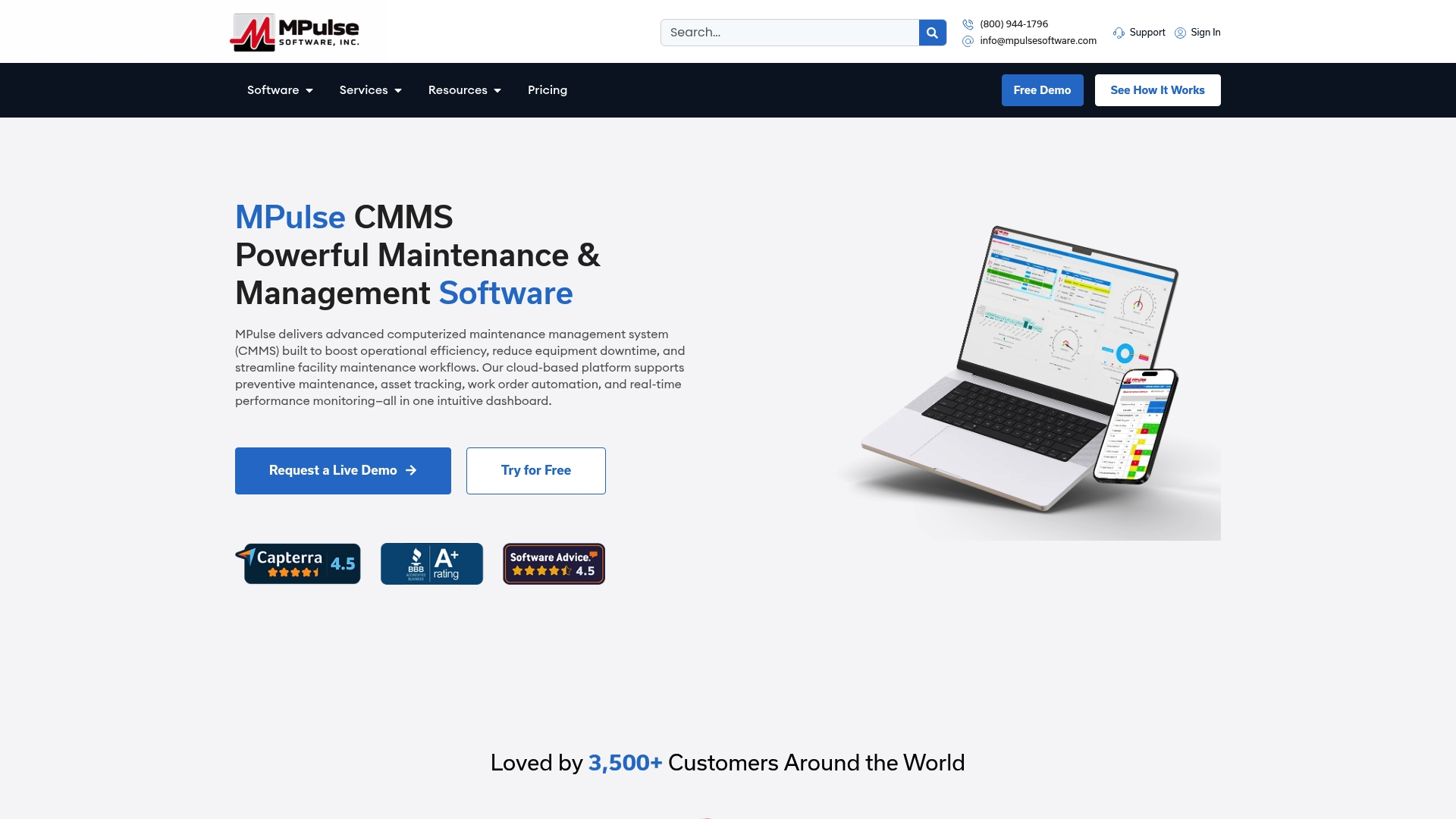
MPulse CMMS gives facility managers a single platform for scheduling every ITM task, tracking contractor credentials with expiration alerts, attaching inspection reports and photos directly to work orders, and generating audit-ready compliance reports on demand. The personnel qualification tracking feature means you always know whether the technician assigned to an annual fire alarm test holds a current NICET certification. The calendar-based scheduling engine sends automated reminders before quarterly, semiannual, and annual tasks come due, so nothing falls through the cracks between inspection cycles.
For fire safety compliance specifically, the value is in the audit-ready record: every inspection, every corrective action, every credential, timestamped and retrievable.
Schedule a demo or start a pilot to see how MPulse fits your compliance program.
Sources
The following primary references support the guidance in this article.
FAQ
What is fire safety maintenance compliance?
Fire safety maintenance compliance is the combination of scheduled inspections, testing, maintenance, and documented evidence that all fire protection systems in a facility meet the requirements of the codes enforced by the Authority Having Jurisdiction.
What are the four golden rules of fire safety?
The four principles most commonly cited are: prevent ignition, detect fire early, contain or suppress fire, and provide safe egress. Maintenance compliance supports all four by keeping detection, suppression, and egress systems operational and documented.
What are the 6-year maintenance requirements for fire extinguishers?
Under NFPA 10, stored-pressure extinguishers require an internal examination (6-year maintenance) at 6-year intervals, performed by a certified technician, in addition to annual maintenance and monthly visual checks.
What is an automated fire safety compliance system?
An automated fire safety compliance system is typically a CMMS platform that schedules ITM tasks, sends reminders before due dates, tracks technician credentials, and generates audit-ready inspection reports — replacing manual spreadsheets and paper logs with a centralized, timestamped digital record. MPulse Software provides this capability for multi-system, multi-site compliance programs.
How often does the AHJ inspect a facility?
Inspection frequency varies by jurisdiction, occupancy type, and facility history, but most commercial occupancies can expect an AHJ inspection annually or following a complaint or incident. High-risk occupancies such as healthcare facilities and assembly venues are typically inspected more frequently.