Campus infrastructure inspections break down into eleven core categories: building/structural, roofing, mechanical/electrical/plumbing (MEP), fire and life-safety, accessibility/ADA, elevators and vertical transportation, site/utilities, grounds, IT/data centers, hazardous materials, and construction/special inspections. Each type feeds a different risk profile, and administrators who track them separately make better capital decisions than those who lump everything into one “maintenance” bucket.
Three moves matter most right now:
- Prioritize this month: fire/life-safety, elevators, and roofing, since these carry the highest liability and the shortest failure-to-injury timeline.
- Frequency rule of thumb: daily/weekly for life-safety systems, annual for structural and envelope, and multi-year for full Facilities Condition Assessment (FCA) resurveys.
- Start collecting now: dated photos, instrument readings, and inspector sign-offs inside your CMMS, since FCA programs typically resurvey 10 to 25 percent of total campus square footage every year, and standards like NFPA and ADA drive the mandatory items on your list.
Key Takeaways
Reliable campus inspection programs classify every asset by risk tier, assign frequency and inspector credentials accordingly, and route every finding into a system that links directly to work orders and capital planning.
| Point | Details |
|---|---|
| Use the eleven-category taxonomy | Classify assets into building/structural, MEP, fire/life-safety, accessibility, and the other eight categories before setting any schedule. |
| Match frequency to risk tier | Daily/weekly checks for life-safety systems, annual for structural and envelope, multi-year for full FCA resurveys. |
| Credential-match every inspector | Licensed trades and AHJ-certified specialists are required wherever code mandates a signature, not just for convenience. |
| Document evidence rigorously | Geotagged photos, measured values, and signed checklists turn a finding into a defensible capital-planning record. |
| Route findings through a CMMS | Platforms like MPulse Software link inspection findings directly to work orders and FCA project entries, cutting manual re-entry. |
Table of Contents
- What Are the Main Types of Campus Infrastructure Inspections?
- How Often Should Campus Inspections Happen?
- Who Should Perform Each Type of Inspection?
- What Methods and Evidence Do Inspections Require?
- How Do Inspection Results Feed Capital Planning?
- Which Codes and Standards Govern Campus Inspections?
- How Do CMMS Platforms Support Inspection Programs?
- What Administrators Consistently Get Wrong About Inspection Programs
- A Faster Path From Inspection Finding to Corrective Action
- Sources
- FAQ
What Are the Main Types of Campus Infrastructure Inspections?
A campus inspection program only works if every asset category has a defined scope, a rationale, and a checklist item someone can actually verify. Here is the taxonomy administrators need to map against their own facilities inventory.
- Building/structural: foundations, load-bearing walls, framing, and envelope integrity. A typical checklist item is checking for foundation cracking or settlement; structural engineers should handle anything beyond hairline surface cracks.
- Roofing: membrane condition, drainage, flashing, and penetrations. Look for ponding water or blistering; specialized roofing contractors are worth the cost once a roof passes 15 years old.
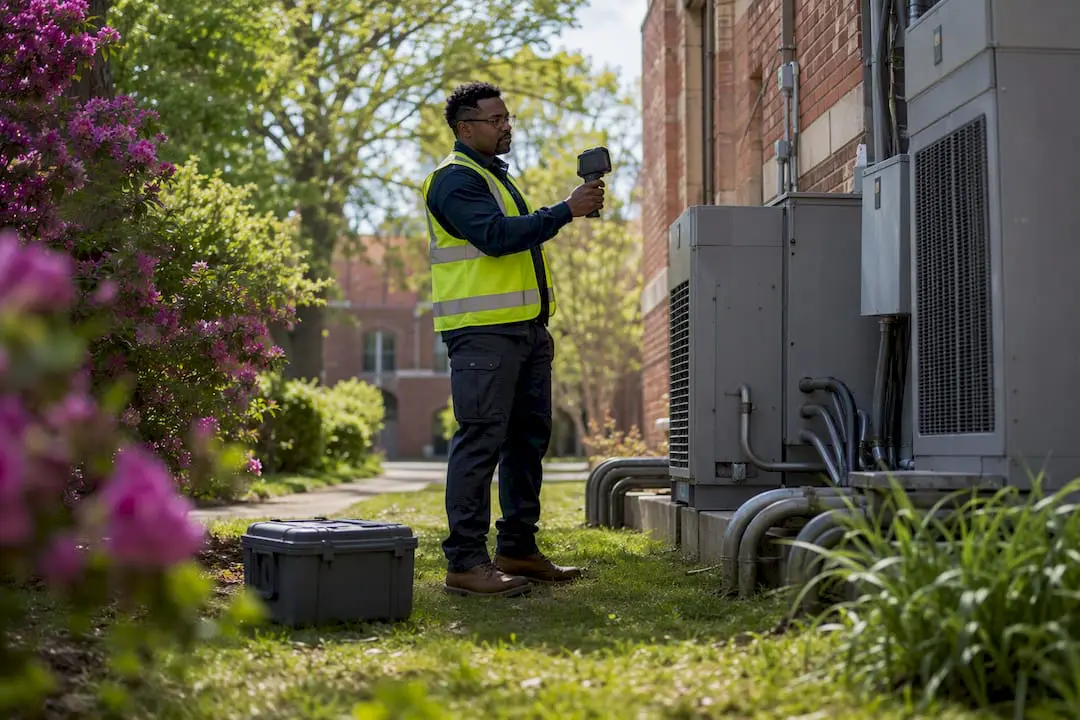
- MEP (mechanical, electrical, plumbing): HVAC performance, panel conditions, pipe corrosion, and backflow prevention. A common item is verifying breaker panel labeling and thermal signatures; licensed electricians and mechanical contractors are required for anything beyond visual checks.
- Fire and life-safety: sprinkler systems, alarm panels, extinguishers, and egress pathways. Checking pull-station accessibility is standard; fire protection contractors certified under NFPA guidance typically run these.
- Accessibility/ADA: ramps, door clearances, signage height, and restroom compliance. A checklist item might be measuring door-opening force; ADA compliance consultants are useful for full-building audits.
- Elevators/vertical transportation: cab leveling, emergency communication, and safety brakes. State-licensed elevator inspectors are legally required in most jurisdictions.
- Site/utilities: water mains, sewer lines, storm drainage, and power distribution. Checking hydrant flow pressure is a common line item; utility contractors handle underground work.
- Grounds/landscape/hardscape: walkways, retaining walls, parking lots, and drainage grading. A trip-hazard sweep of sidewalks is standard for in-house teams.
- IT/data centers: cooling redundancy, UPS battery health, and cable management. This overlaps with security audits, which focus on threat surfaces rather than physical reliability, so administrators should keep the two inspection types distinct.
- Hazardous materials: asbestos, lead paint, and mold. AHERA-certified inspectors are required for any suspected asbestos-containing material.
- Construction/special inspections: concrete pours, rough framing, above-ceiling work, and energy code compliance during active projects. Third-party special inspectors are often mandated by the building code itself.
Each category ties directly into the campus facility maintenance categories most administrators already track, which makes cross-referencing inspection findings with maintenance schedules far easier.
How Often Should Campus Inspections Happen?
Frequency should follow risk, not habit. Group inspection types into four cycles:
- Daily/weekly: fire extinguisher checks, egress path clearance, elevator machine room walk-throughs.
- Monthly/quarterly: HVAC filter and belt inspections, backflow preventer tests, playground and grounds hazard sweeps.
- Annual: structural envelope reviews, roof condition surveys, ADA compliance spot checks, full fire alarm testing.
- Multi-year/FCA cycles: comprehensive condition assessments, typically resurveying 10 to 20 percent of campus buildings annually according to institutions like the University of Texas.
Layer in event-based triggers on top of the calendar: post-incident inspections after water intrusion or storms, pre-occupancy walkthroughs before a building reopens, code-driven reinspections after an AHJ update, and end-of-warranty inspections before a contractor’s liability window closes.
- Tier your assets: critical systems (fire, elevators, electrical switchgear) get the tightest cycle; low-criticality assets (decorative fencing, seasonal irrigation) get the loosest.
- Example timeline: Year 1 inspect fire systems and elevators; Year 2 add roofing and envelope; Year 3 run the full FCA resurvey.
Who Should Perform Each Type of Inspection?
Matching the right inspector to the right system avoids both wasted budget and legal exposure. In-house maintenance staff handle routine visual checks: filter changes, sidewalk sweeps, extinguisher tags. Licensed trades, electricians, plumbers, and elevator inspectors, are required whenever code mandates a credentialed signature, which is nearly always true for elevators and often true for electrical panels.
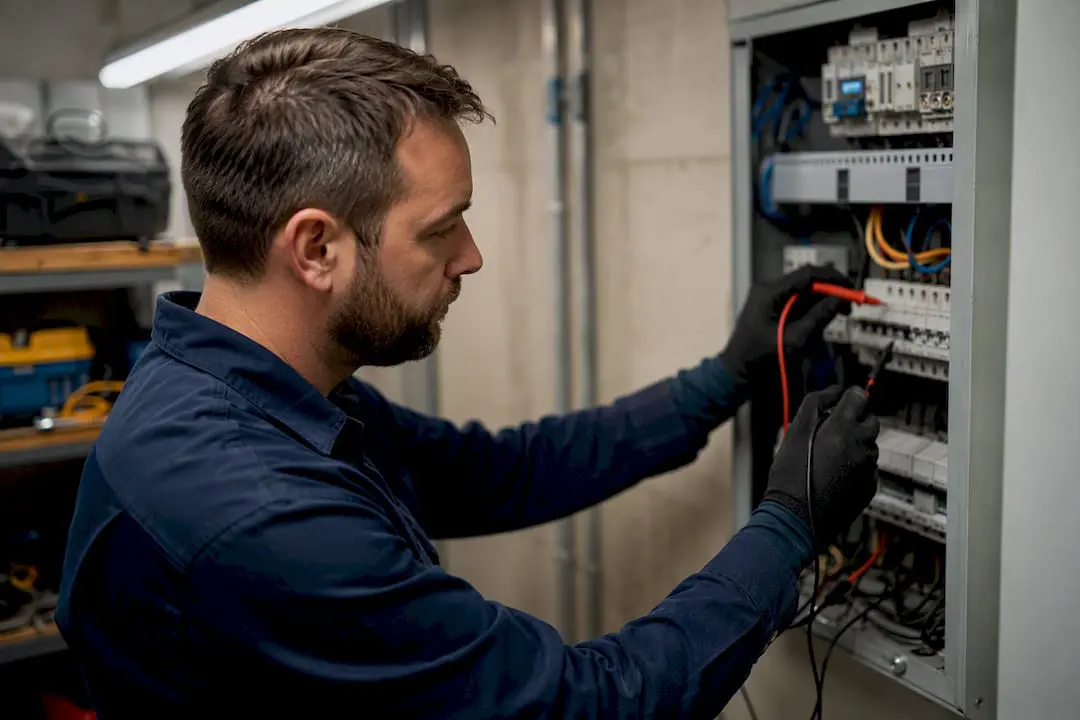
Certified specialists come in for narrow scopes: AHERA-trained asbestos samplers, IAQ professionals for indoor air quality complaints, and NFPA-qualified fire protection technicians. AHJ inspectors get involved for permit closeouts and code-change reinspections, while third-party FCA teams, often multidisciplinary groups of architects and engineers, run the multi-year comprehensive assessments most in-house teams lack the bandwidth to complete, according to Santa Monica College’s assessment documentation.
Before contracting any inspection, check the vendor’s insurance certificate, get scope and deliverables in writing, ask for a sample report, and confirm turnaround time.
Pro Tip: Ask a prospective FCA vendor for a redacted sample report from a comparable-sized campus before signing. If the report lacks measured values or photo documentation, keep looking.
What Methods and Evidence Do Inspections Require?
The method has to match the failure mode you’re trying to catch. Visual inspection catches obvious deterioration; thermal imaging catches electrical hot spots and roof moisture intrusion invisible to the eye. Moisture meters and borescopes get into wall cavities and behind fixtures. Gas detection equipment matters for boiler rooms and confined spaces. Elevator diagnostics, load tests, and IAQ sampling round out the instrumented side of the list.
Every inspection should generate a defined evidence set:
- Geotagged, time-stamped photos linked to the specific asset record.
- Measured values (voltage readings, moisture percentages, pressure readings).
- Instrument calibration logs and any lab reports from sampling.
- Inspector name, license number, and a signed checklist.
Pro Tip: Link every photo ID directly to its asset record in your CMMS instead of storing images in a shared drive. Six months later, nobody remembers which boiler room photo belongs to which building. Tools that support barcode-based asset audits make that linkage far faster in the field.
How Do Inspection Results Feed Capital Planning?
Findings only create value once they move through a defined workflow: inspection happens, the finding gets documented, a severity or condition rating gets assigned, and that rating routes either to a corrective work order or an FCA project entry for the capital budget queue.
- Inspector logs a finding (say, a cracked roof membrane).
- The finding gets rated on a condition scale: excellent, fair, poor, or critical.
- Poor or critical ratings generate either an immediate work order or an FCA capital project entry, depending on cost and scope.
A “poor” roof might get a corrective work order for a patch repair. A “critical” rating on a 30-year-old boiler usually routes straight into the capital renewal queue instead. FCA databases typically separate recurring items, ongoing maintenance needs, from non-recurring deficiencies, one-time capital projects, and review teams sort by system category before compiling the annual funding list. HVAC and electrical systems often dominate that list: one campus FCA found HVAC alone represented nearly 25 percent of deferred renewal recommendations.
Which Codes and Standards Govern Campus Inspections?
Administrators need a defensible answer when leadership or an AHJ asks why an inspection happened on a given schedule. The most commonly cited references: IBC for structural and life-safety code baselines, NFPA standards for fire protection and alarm systems, ADA standards for accessibility, AHERA guidance for asbestos work, and OSHA where worker exposure applies. FCA data structuring commonly follows UNIFORMAT and NIST taxonomies so results compare cleanly across buildings and campuses.
Elevator inspections are almost always mandated by state code rather than institutional preference, and fire alarm testing intervals typically trace directly back to NFPA 72 requirements rather than internal policy.
- Elevator code requirements vary by state, so check your jurisdiction’s adopted elevator safety code before setting an internal cycle.
- Record every AHJ determination in writing. It becomes your evidence trail the next time a code interpretation gets challenged.
How Do CMMS Platforms Support Inspection Programs?
A spreadsheet tracks inspections until a campus hits maybe 20 buildings. After that, most administrators lose visibility into which findings turned into work orders and which just sat there. A CMMS solves that specific failure point.
Look for these capabilities:
- Calendar-based scheduling tied to frequency rules by asset type.
- Mobile checklists with photo capture built in, not bolted on.
- Direct linking between inspection findings and asset records.
- Automated work-order generation when a finding crosses a severity threshold.
- Condition-rating fields that export cleanly into FCA reporting.
- IIoT and sensor integration for condition-based triggers.
A typical workflow: an inspector logs a “poor” roof rating on a mobile checklist, the system auto-generates a corrective work order for the maintenance team, and the same finding populates a recurring FCA project entry for next year’s capital review; no manual re-entry required. MPulse Software is one platform built around that exact chain, and administrators evaluating vendors should ask for a sample report showing the finding-to-work-order path end to end.
- Inspector completes mobile checklist with geotagged photos.
- System flags severity and auto-creates a work order.
- Finding syncs to the FCA database for capital tracking.
What Administrators Consistently Get Wrong About Inspection Programs
Most campus inspection programs fail not from lack of effort, but from treating every asset category with the same frequency and the same rigor. Fire systems and decorative fencing do not deserve equal attention, yet plenty of programs default to an annual “walk the whole campus” model because it feels thorough. It isn’t. It’s a way to spread thin resources across low-risk and high-risk assets equally, which means the high-risk ones get shortchanged.
The bigger blind spot is documentation. A finding that lives in an inspector’s notebook instead of a CMMS record might as well not exist come budget season, since capital committees fund what they can see in the data, not what someone remembers from a walkthrough. Set risk tiers this quarter, and route every finding, even the minor ones, into a system that ties back to your asset records.
A Faster Path From Inspection Finding to Corrective Action
Manual inspection tracking, spreadsheets, shared drives, paper checklists, works until a campus grows past a handful of buildings, and then findings start slipping through the cracks between the inspector’s clipboard and the maintenance queue.
MPulse Software closes that gap by linking every inspection finding directly to a work order and an asset record, so nothing sits unassigned in a notebook while a roof leak gets worse. The platform’s mobile checklists capture photos and instrument readings in the field, then route severity-flagged findings straight to your maintenance team without a re-entry step. For administrators managing an asset lifecycle across dozens of buildings, that traceability matters more than any single feature. Learn more about how preventive maintenance software supports inspection-driven work orders, or visit the MPulse CMMS product page to request a demo and see the workflow on your own asset data.
Sources
- APPENIX C FACILITY CONDITION ASSESSMENT
- Facilities Conditions Assessment (Santa Monica College)
- Facility Condition Assessment (FCA) — UMaeC / University of Michigan
FAQ
What Are the Main Types of Campus Infrastructure Inspections?
The core categories are building/structural, roofing, MEP, fire/life-safety, accessibility, elevators, site/utilities, grounds, IT/data centers, hazardous materials, and construction/special inspections.
What Are the Three Main Types of Facility Inspections?
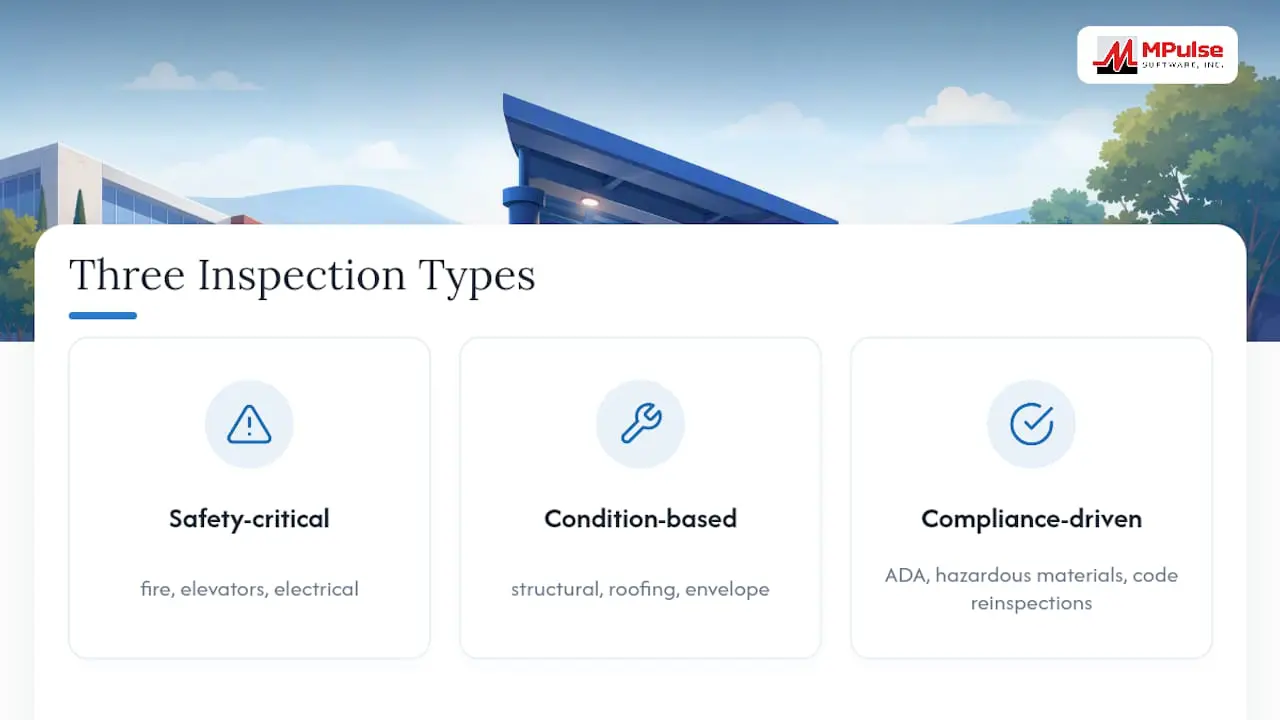
Most programs group inspections into three functional buckets: safety-critical (fire, elevators, electrical), condition-based (structural, roofing, envelope), and compliance-driven (ADA, hazardous materials, code reinspections).
How Often Should Elevator Inspections Happen?
Elevator inspection frequency is set by state code, not institutional preference, and typically requires a licensed elevator inspector rather than in-house staff.
How Do Inspection Findings Turn Into Capital Projects?
A finding gets a severity rating, then routes either to an immediate corrective work order or into the FCA database as a non-recurring capital project for budget prioritization.
Can a CMMS Manage Different Inspection Types in One System?
Yes. Platforms like MPulse Software let administrators schedule, document, and rate inspections by asset category while linking every finding to a work order or FCA entry.