Regular maintenance is required because it’s the only reliable way to ensure an emergency generator will start, carry its required load, and meet NFPA 110 compliance when power is lost. That single fact drives everything else in this guide. Skip the exercises, skip the load bank tests, skip the logs, and you’re not just risking a fine. You’re risking a generator that cranks and does nothing when the building actually needs it.
The evidence behind this isn’t theoretical. Guidance compiled by PNNL on standby generator operations shows preventive and predictive maintenance directly reduce failure rates and lifecycle costs, while NREL research on standby power systems confirms that maintenance spending scales with generator size and run hours, not with how well the unit “looks” on paper. Facility teams that treat maintenance as optional tend to discover the gap at the worst possible moment.
Three reasons drive the requirement, and each one carries real operational weight:
- Reliability during outages. A generator that hasn’t been exercised under load is a guess, not a guarantee.
- Regulatory and compliance risk. NFPA 110 sets testing intervals and documentation standards that hospitals, data centers, and many commercial facilities must meet.
- Lifecycle and cost avoidance. Deferred maintenance turns into premature part failures, emergency service calls, and shortened equipment life.
Key Takeaways
Emergency generator maintenance is required because NFPA 110 compliance, real-world startability, and cost control all depend on documented, load-tested upkeep, not passive ownership.
| Point | Details |
|---|---|
| NFPA 110 sets the baseline | Monthly exercise at 30% nameplate load, semiannual inspection, and annual full-load verification are the core intervals. |
| Battery failure is the top cause | Voltage checks alone miss degrading batteries; periodic load testing catches what visual checks can’t. |
| Documentation is evidence | Incomplete logs are commonly cited by AHJs and accreditation bodies during compliance reviews. |
| Budget for variability | A 300 kW unit under 200 annual hours often runs an amount generally reported for annual O&M, though size and usage shift that range. |
| A CMMS removes the guesswork | MPulse Software automates PM scheduling, test-log capture, and vendor dispatch tied to generator compliance requirements. |
Table of Contents
- Why NFPA 110 Requirements Set the Maintenance Schedule
- What Causes Emergency Generators to Fail
- Why Documentation and Test Logs Matter as Much as the Work Itself
- Who Should Actually Perform Generator Maintenance
- How a CMMS Turns This Requirement Into a Working Program
- What Emergency Generator Maintenance Actually Costs
- A Copyable Generator Maintenance Checklist
- What Twenty Years of Generator Failures Have Taught Facility Teams
- A Simpler Way to Stay Ahead of Generator Maintenance Requirements
- Sources
- FAQ
Why NFPA 110 Requirements Set the Maintenance Schedule
NFPA 110 is the standard most facility managers get measured against, whether their local authority having jurisdiction (AHJ) enforces it directly or references it through building and fire codes. It classifies emergency power supply systems (EPSS) by application, with Level 1 systems (hospitals, life-safety systems) held to the strictest requirements, including a maximum 10-second transfer time in many configurations, according to NFPA’s own overview.
The standard doesn’t just say “test your generator”: it specifies frequency, duration, and load conditions, and it requires written records of every test and maintenance action.
One detail catches a lot of facility teams off guard: monthly exercise runs must reach at least 30% of the generator’s nameplate load, or the exercise doesn’t count as a proper test. If building loads can’t hit that threshold, supplemental load-bank testing becomes necessary to properly load the engine and avoid long-term damage.
Here’s how that translates into a working schedule:
| Interval | Task | What to capture |
|---|---|---|
| Weekly | Visual inspection, fluid levels, battery condition | Oil level, coolant level, battery voltage |
| Monthly | Exercise run under load (30% nameplate minimum) | Load %, run duration, voltage, frequency, oil pressure |
| Semiannual | Full inspection, cooling system check, control panel test | Deficiencies found, corrective actions, technician notes |
| Annual | Full-load or load-bank test, comprehensive service | Full load kW, sustained run time, exhaust temp, fuel condition |
Pro Tip: If your building’s actual electrical load rarely reaches 30% of the generator’s nameplate rating, don’t just let the monthly exercise run light. Rent or schedule a load bank for that test instead. Running a diesel generator under light load repeatedly causes carbon buildup in the exhaust and cylinders, a problem serious enough that it shows up as its own line item in most NFPA 110 compliance guides.
What Causes Emergency Generators to Fail
Most generator failures trace back to a short list of repeat offenders, and maintenance exists specifically to catch each one before it becomes an outage-day surprise.
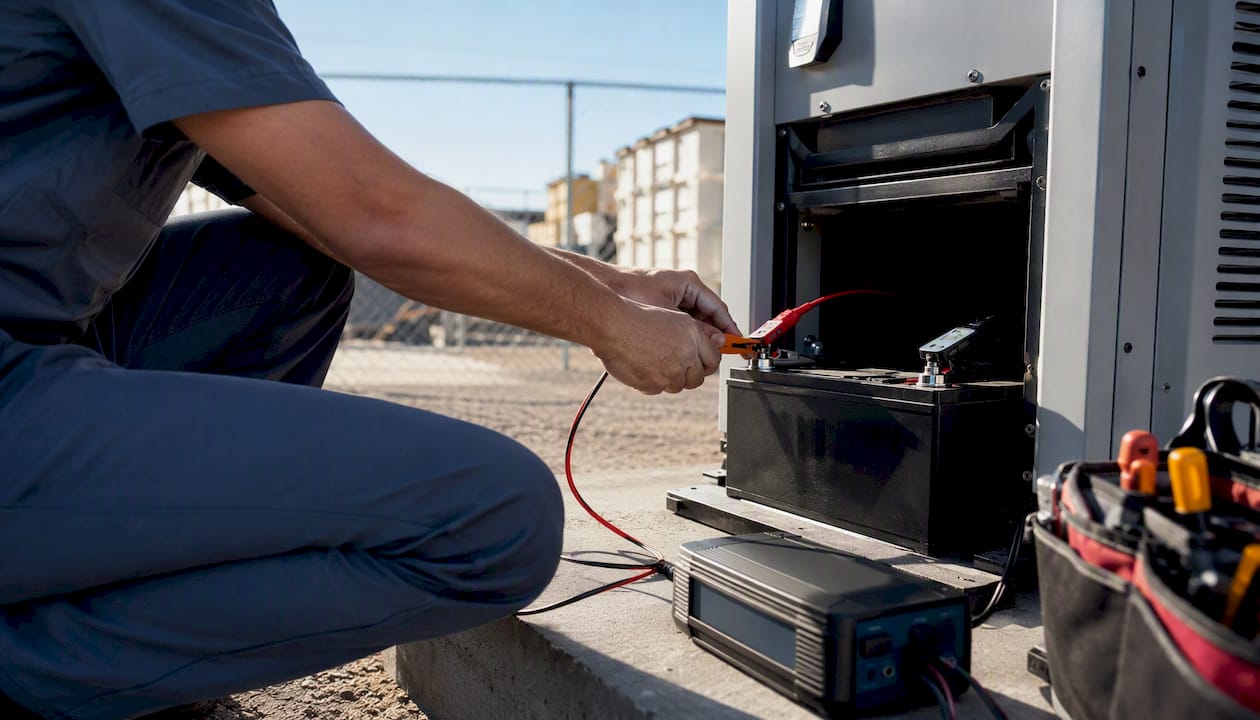
Battery and starting failures top that list by a wide margin. A dead or weak starter battery is the single most common reason a generator won’t start, and voltage checks alone won’t catch a battery that’s degrading, according to the Generac maintenance guide. A periodic load test on the battery, paired with a maintainer or trickle charger between exercises, catches degradation long before a real outage does.
Fuel degradation and contamination creep in quietly, especially on diesel units that sit idle for months. Water intrusion, microbial growth, and fuel aging can clog filters and injectors right when the engine needs to run hardest.
Wet stacking is the direct result of chronic underloading, the same issue the 30% nameplate rule exists to prevent. Unburned fuel and carbon accumulate in the exhaust system, eventually degrading performance and increasing emissions.
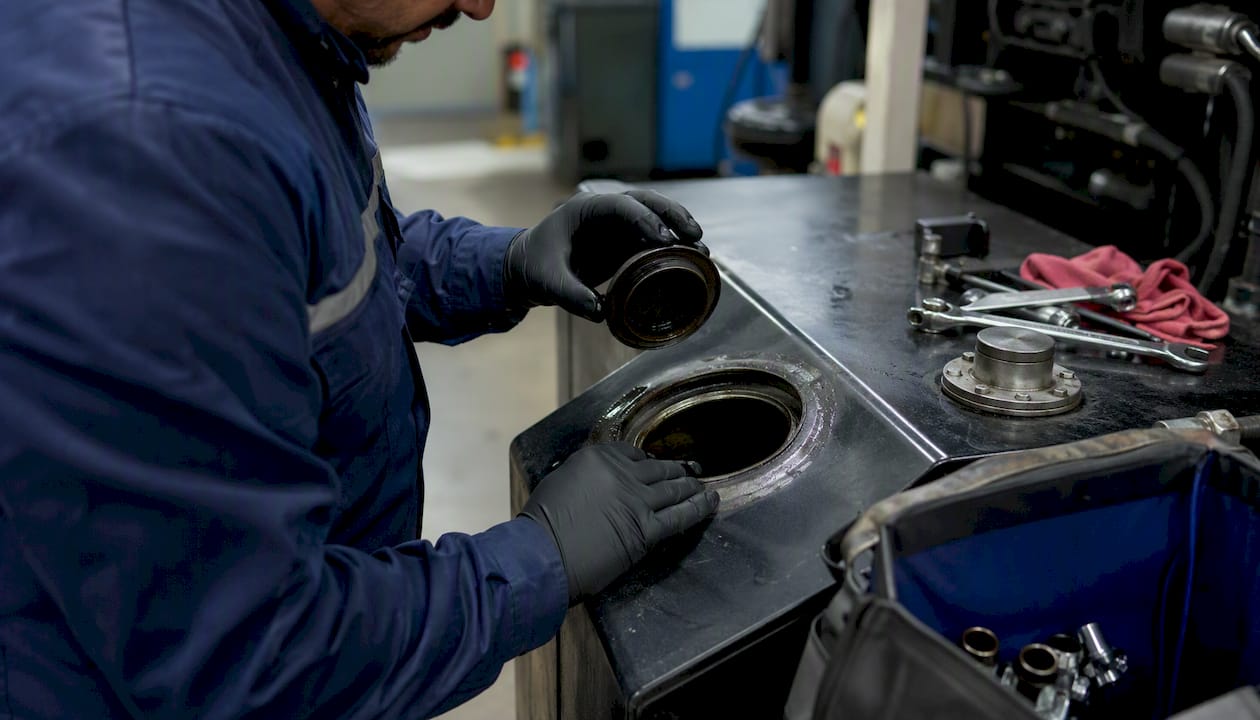
Coolant and lubrication problems show up as overheating or excessive wear, often from a coolant leak or degraded oil that nobody caught during a quick visual check.
Alternator and winding moisture develops in units stored in humid environments or exposed to condensation, and it can cause insulation breakdown that shows up only under full load.
Automatic transfer switch (ATS) failures are easy to overlook because the generator itself might be running fine. A dirty or mechanically stuck ATS still means the building never gets power.
Control and notification faults hide problems until they matter. A generator with a failed alarm module might be running low on fuel or overheating with nobody the wiser.
| Failure mode | Warning sign | Maintenance action |
|---|---|---|
| Battery/starting | Slow crank, corrosion on terminals | Load test battery, check charger |
| Fuel degradation | Discolored fuel, filter clogging | Fuel sampling, polishing, filter replacement |
| Wet stacking | Black exhaust residue, oil dilution | Load-bank testing, run at ≥30% nameplate |
| Coolant/lubrication | Overheating, low oil pressure | Fluid analysis, leak inspection |
| ATS malfunction | Delayed or failed transfer | Manual transfer test, contact cleaning |
| Control faults | Alarm silence, sensor drift | Panel diagnostics, firmware checks |
Why Documentation and Test Logs Matter as Much as the Work Itself
A generator that’s been maintained perfectly but never documented is, from a compliance standpoint, indistinguishable from one that was never touched. When an AHJ, insurance auditor, or accreditation body shows up, the maintenance log is usually the first thing they ask for, not the generator itself.
Complete records should include:
- Date and time of test or service
- Run duration and load carried (kW or % of nameplate)
- Voltage and frequency readings
- Oil pressure and coolant temperature
- Ambient conditions at time of test
- Deficiencies found and corrective action taken
- Technician identification and certification reference
Missing or incomplete test logs are among the most frequently cited compliance gaps that AHJs and accreditation bodies flag, according to compliance guidance published by Facility Compliance Hub, and the exposure extends beyond a citation. In healthcare facilities specifically, incomplete generator records can trigger scrutiny from accreditation surveyors during routine visits, adding regulatory risk on top of the operational risk of an unreliable generator.
Documentation gaps also create liability exposure well after the fact. If a generator fails during a real outage and someone gets hurt or a facility loses critical operations, the maintenance log becomes evidence. A thorough preventive maintenance program with consistent records is one of the strongest protections a facility has against that kind of exposure.
Who Should Actually Perform Generator Maintenance
Not every task on the schedule requires a specialist, but the line between “in-house safe” and “call a professional” matters more than most facility teams realize.
In-house teams can typically handle:
- Visual inspections and fluid level checks
- Battery terminal cleaning and basic voltage checks
- Recording weekly and monthly exercise data
- Reporting anomalies (unusual noise, exhaust color, alarm codes)
Qualified or factory-trained technicians should handle:
- Load-bank testing and full-load annual verification
- Fuel system remediation, including polishing or tank cleaning
- Major component repair or replacement, especially warranty-covered work
- Control system diagnostics and firmware updates
If you’re vetting a service provider, run through these questions before signing a contract:
- Are technicians factory-trained on your specific generator brand and model?
- What NFPA 110 testing experience can they document with references?
- What’s their guaranteed response time (SLA) for emergency call-outs?
- What insurance coverage do they carry for on-site work?
- How do they handle parts sourcing, and what’s the typical lead time?
A few red flags should trigger an immediate second opinion: repeated failed load tests, wet stacking that keeps recurring despite corrective action, battery replacements more than once a year, or logs that don’t match up month to month. Any one of those points to a maintenance program that’s treating symptoms instead of causes.
How a CMMS Turns This Requirement Into a Working Program
Everything covered so far, the NFPA 110 schedule, the failure modes, the documentation demands, adds up to a lot of moving parts for one facility team to track manually. A computerized maintenance management system exists specifically to close that gap.
Three capabilities matter most for generator programs:
- Scheduled PM automation. Recurring work orders trigger automatically for weekly checks, monthly exercises, and annual load-bank tests, so nothing slips because someone forgot a date.
- Test-log capture built for compliance. Digital forms capture load, voltage, frequency, and oil pressure at the point of testing, creating an audit trail that doesn’t depend on a paper clipboard surviving a filing cabinet.
- Inventory and vendor coordination. Spare batteries, filters, and belts stay tracked against reorder points, and vendor dispatch ties directly into the work order when a job needs a factory-trained technician.
Setting up a CMMS for generator maintenance doesn’t need to be complicated:
- Create an asset record for each generator, including nameplate rating and manufacturer specs.
- Build PM task templates mapped directly to NFPA 110 intervals (weekly, monthly, semiannual, annual).
- Design test forms with required fields for load percentage, kW, voltage, and run duration.
- Attach technician certifications and service reports to each completed work order automatically.
Pro Tip: Don’t rely on calendar dates alone. Feed in runtime hours, battery conductance readings, and fuel quality test results as condition-based triggers. That shift from strictly calendar-driven to condition-based predictive maintenance catches degrading components between scheduled visits instead of waiting for the next date on the calendar.
What Emergency Generator Maintenance Actually Costs
Budgeting for generator maintenance gets harder when facility managers don’t know what’s driving the number. A few factors explain most of the variation:
- Generator size (kW rating) and fuel type
- Annual run hours, including exercise time and actual outage use
- Frequency of professional service visits
- Fuel testing and polishing requirements
- Load-bank rental or vendor testing fees
- Emergency call-out and parts replacement costs
For scale, NREL summaries cite a 300 kW generator running under roughly 200 hours per year with annual O&M costs commonly reported within a range seen in some research summaries, though that figure shifts meaningfully with size, run hours, and local labor rates. Treat it as a planning anchor, not a fixed quote.
A workable budgeting approach starts with a rough $/kW baseline for fixed service costs, then layers in variable costs tied to actual run hours and testing frequency. Set aside a contingency line for corrective repairs; deferred maintenance has a way of turning into an unplanned expense exactly when a facility can least afford it. Teams weighing where to invest maintenance dollars across a broader operation may find general operational efficiency frameworks useful for prioritizing spend across competing facility needs.
A Copyable Generator Maintenance Checklist
Use this as a starting template for a maintenance program or CMMS task library.
Weekly:
- Visual inspection of the unit and enclosure
- Check oil and coolant levels
- Verify battery voltage and terminal condition
Monthly:
- Run exercise test at ≥30% nameplate load (or use load bank)
- Record load, voltage, frequency, run duration, oil pressure
- Inspect belts, hoses, and connections
Semiannual:
- Full mechanical inspection, including cooling system
- Test automatic transfer switch under simulated failure
- Review and reconcile maintenance logs
Annual:
- Full-load or load-bank verification test
- Comprehensive fuel quality sampling
- Replace filters, belts, and other scheduled wear parts
Keep a small stock of spares on hand: batteries, oil and fuel filters, belts, and gaskets. For fuel management, schedule periodic quality testing rather than waiting for a visible problem, especially on diesel systems that sit idle between exercises. Every completed task should generate a record with date, technician, load reading, and any deficiency noted, so the checklist doubles as your audit trail.
What Twenty Years of Generator Failures Have Taught Facility Teams
The most avoidable generator failures almost always trace back to two things: a battery nobody load-tested and a log nobody kept current. Facility teams that treat battery care as a real maintenance line item, not an afterthought behind fluid checks, catch the majority of no-start events before they happen. The ones that get burned are usually running on voltage checks alone, which the data consistently shows aren’t reliable indicators of battery health under real starting load.
Documentation gets treated as paperwork until the day it isn’t. The facilities that come through an AHJ audit or an actual outage without a scramble are the ones that logged every test as a habit, not a chore. That’s not a compliance tip. It’s the difference between having proof your program works and hoping nobody asks.
The balance between in-house checks and outside vendors comes down to honesty about capability. Weekly visual checks and battery voltage readings don’t need a certified technician. Load-bank testing and fuel system remediation do. Facilities that blur that line, either by pushing specialist work onto untrained staff or paying for a technician to do a five-minute visual check, end up with either safety gaps or wasted budget. A CMMS doesn’t replace either group’s judgment, but it does remove the human error of a missed date or a lost paper log, which is where most programs actually fail.
A Simpler Way to Stay Ahead of Generator Maintenance Requirements
Everything in the checklist above, the weekly visual checks, the monthly load exercises, the annual verification tests, works best when it’s not riding on someone’s memory or a spreadsheet nobody updates consistently. MPulse CMMS maps directly to that structure: preventive maintenance automation triggers each NFPA-aligned task on schedule, digital test-log capture records load, voltage, and run duration at the point of testing, and integrated work orders route load-bank testing or fuel remediation straight to a qualified vendor without a separate tracking system.
For teams managing multiple generators across several sites, that kind of centralized record turns an audit request from a scramble into a five-minute export. If your current process depends on paper logs or scattered spreadsheets, take a look at what preventive maintenance automation looks like and request a walkthrough of how MPulse handles compliance-driven scheduling for critical equipment like emergency generators.
Sources
- NFPA 110 Emergency Generator Compliance Guide: Complete Requirements for Facility Managers | Facility Compliance Hub
- An Overview of NFPA 110
- Best Practices for Standby Generator Operations and Maintenance
- Guide to Generator Maintenance (white paper)
FAQ
How Many Times a Year Should a Generator Be Serviced?
A working generator needs weekly visual checks, monthly exercise testing under load, semiannual inspections, and at least one annual full-load or load-bank verification test to meet NFPA 110 expectations.
What Is the Most Common Problem With Generators?
Battery and starting failures are the most common cause of a generator not starting, since voltage checks alone often miss a battery that’s losing capacity under real load, according to Generac’s maintenance guidance.
How Much Should Generator Maintenance Cost?
Costs vary by generator size and run hours; NREL data cites roughly $8,000 to $10,500 per year for a 300 kW unit running under 200 hours annually, with larger or heavily used units costing more.
What Does NFPA 110 Require for an Emergency Generator?
NFPA 110 requires regular exercise testing at a minimum of 30% nameplate load, semiannual inspections, annual full-load verification, and written maintenance and test records, with stricter transfer-time requirements for Level 1 systems.
Can a CMMS Help Meet NFPA 110 Documentation Requirements?
Yes. A CMMS platform like MPulse automates test scheduling and captures load, voltage, and run-time data directly on digital forms, creating the audit-ready records NFPA 110 requires.