
The accepted references for structuring an asset hierarchy are ISO 14224 for reliability and maintenance (RM) data taxonomy and ASTM E3257 for asset taxonomy practice. Together they cover both the technical classification of equipment and the broader principle of defining an asset by its own characteristics rather than by who owns it or how it is depreciated. For most facilities teams, the practical path is a CMMS-friendly 4 to 6 level hierarchy: site, area or facility, system, equipment or asset, and component. ISO 14224 defines a more granular nine-level technical taxonomy underneath that, but the equipment unit level is the common reporting level most CMMS platforms use. For the fundamentals, see how equipment maintenance programs are structured.
Your immediate next step is straightforward:
- Define the scope of what counts as a trackable asset in your organization
- Pick a single reporting level everyone will use for maintenance history and KPIs
- Set a naming convention with a fixed ID format before you touch the CMMS
- Prepare an import template with required fields so records land clean the first time
Key Takeaways
A clean asset hierarchy works only when it pairs ISO 14224’s technical taxonomy with ASTM E3257’s ownership-independent classification and enforces both through CMMS-level permissions and templates.
| Point | Details |
|---|---|
| Pick one reporting level | Most organizations report at equipment unit level, ISO 14224’s level 6, rather than tracking every sub-level. |
| Cap your hierarchy at 5 levels | Site, area, system, equipment, and component covers nearly every operational need without added data-entry cost. |
| Classify by characteristics, not ownership | Follow ASTM E3257’s principle: a pump is a pump regardless of what it feeds or who owns it. |
| Lock naming through the CMMS | Enforce ID formats and required attributes with permissions and templates instead of relying on manual discipline. |
| Audit on a schedule | Assign data owners and run recurring checks to catch missing attributes before they break reporting. |
Table of Contents
- What Do Asset Hierarchy Standards Actually Cover?
- What Does a Practical Asset Hierarchy Look Like?
- How Do You Build and Load an ISO-Aligned Hierarchy?
- Why Do Asset Hierarchies Break Down Over Time?
- How MPulse CMMS Puts the Standards Into Practice
- An Editorial Take on Standards-Forward Hierarchy Design
- Sources
- FAQ
What Do Asset Hierarchy Standards Actually Cover?
Three reference documents do the heavy lifting in this space, and each one answers a different question. Knowing which one governs which decision keeps implementation teams from arguing past each other.
ISO 14224 was written for the petroleum, petrochemical, and natural gas industries, but its logic travels well beyond upstream oil and gas. It defines requirements for collecting reliability and maintenance data, organizing that data into equipment taxonomy categories, and structuring a technical hierarchy so different plants, owners, and contractors can exchange failure and maintenance records without translation errors. The standard identifies a multi-level taxonomy where equipment unit, roughly level 6 of nine, is usually the level organizations report against, since anything deeper adds data-collection cost without adding much analytical value for day-to-day maintenance decisions.
ASTM E3257 takes a different angle. It provides a standard practice for asset taxonomy built on innate characteristics and mission contribution, and it explicitly separates classification from legal ownership or financial treatment. A leased chiller and an owned chiller belong in the same taxonomic bucket because they do the same job, not different ones because your balance sheet treats them differently. That distinction matters when finance and operations disagree about what actually constitutes “an asset” during a hierarchy design meeting.
ISO 55000 and its companion standards sit above both. They define an asset management framework, the organizational objectives, policies, and plans that a hierarchy is supposed to serve. Your taxonomy should trace back to something in your asset management plan; if it doesn’t, you’re organizing data for its own sake.
Here’s how the three tend to divide labor in practice:
- Use ISO 14224 when you need consistent RM data categories and a technical taxonomy for failure analysis.
- Use ASTM E3257 when departments disagree on what qualifies as a distinct asset versus a component.
- Use ISO 55000 when you’re aligning the hierarchy to broader management objectives rather than just data collection.
Standardized taxonomy also pays off beyond a single site. ISO 14224 explicitly aims to facilitate data exchange between plants, manufacturers, and contractors, which is a real advantage if your organization operates more than one facility and wants aggregate reliability numbers that actually mean something across locations.
What Does a Practical Asset Hierarchy Look Like?
A workable hierarchy for most maintenance operations has multiple levels and can map onto ISO 14224’s more detailed scheme without forcing your team to track every sub-level ISO defines.
- Site. The physical location, campus, or plant.
- Area or facility. A building, production line, or defined zone within the site.
- System. A functional grouping, such as an HVAC system or a compressed air system.
- Equipment or asset. The unit itself, corresponding roughly to ISO 14224’s level 6 and the level most organizations use for reporting.
- Component. Parts within the equipment that fail independently and get tracked separately, such as a motor, bearing, or control board.
ISA and IEC level concepts for plant hierarchy line up closely with this, which is one reason the five-level model has become close to a default in CMMS implementations rather than a niche choice.
A few worked examples make the mapping concrete:
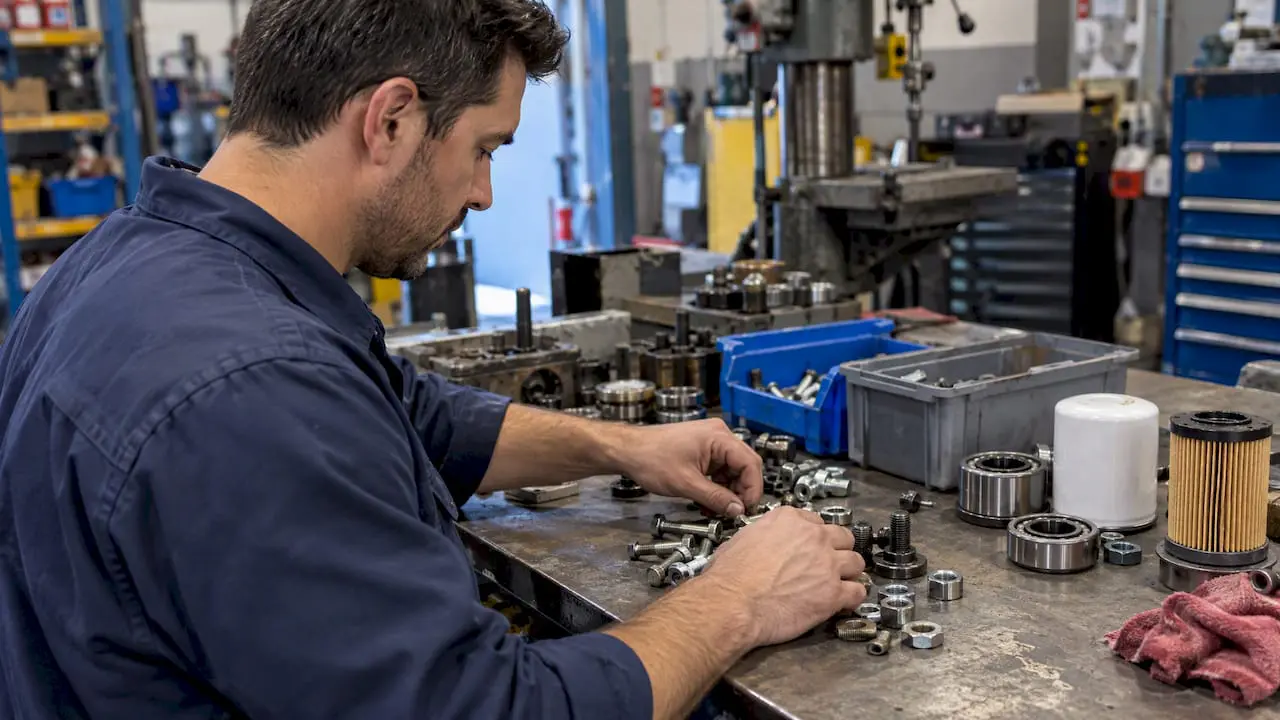
- A pump assembly sits at the equipment level, with the motor, seal, and impeller tracked as components underneath it. The pump is classified as a pump on its own characteristics, not as “compressor accessory,” even if its only job is feeding a compressor. Industry guidance on equipment classification treats this as a core rule: classify by what the thing is, not by what it happens to serve.
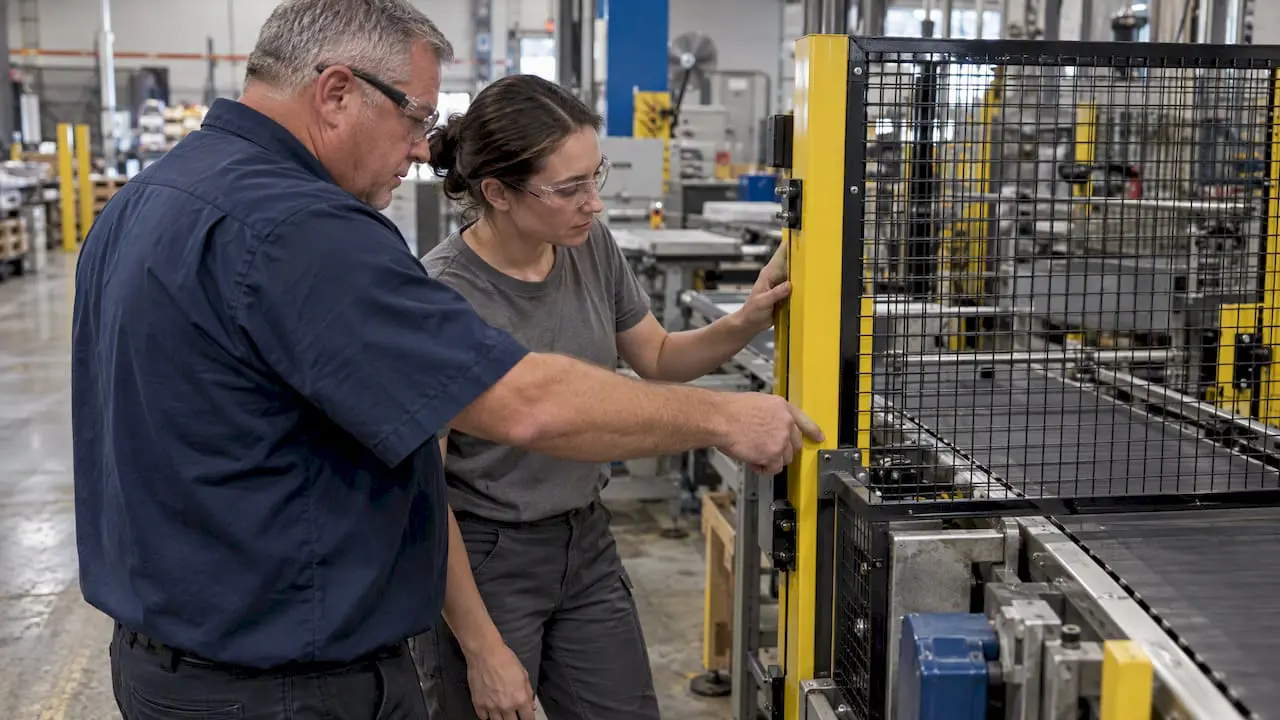
- A motor-driven conveyor becomes a system if it links multiple discrete pieces of equipment (drive motor, gearbox, belt assembly), or a single equipment record if your reporting needs don’t require separating those parts.
- An HVAC unit typically sits at the system level, with the compressor, fan, and filter assemblies as equipment or component records depending on how granular your failure-code tracking needs to be.
Deciding how deep to go comes down to three questions. How complex is the asset? A rooftop unit with three moving parts doesn’t need the same depth as a packaging line with forty. What does it cost to collect and maintain data at that level? Every extra level means more fields somebody has to fill in correctly, every time. And what does your analytics actually require? If nobody is running failure-mode analysis on individual bearings, tracking bearings as separate component records just adds clutter without adding insight.
How Do You Build and Load an ISO-Aligned Hierarchy?
Most implementations that stall do so because teams skip the sequencing and jump straight to importing spreadsheets. A tighter order looks like this.
- Agree on asset definition and scope. Get finance, engineering, and operations in the same room before you classify anything. ASTM E3257’s principle, classify by innate characteristics rather than ownership or cost treatment, gives you a neutral tiebreaker when departments disagree.
- Inventory assets and assign equipment classes. Walk the facility, catalog what exists, and assign each item to an equipment class drawn from your taxonomy reference. Resist the urge to invent one-off classes for edge cases.
- Define levels, naming convention, and unique IDs. A format like
SITE-AREA-SYS-EQ-0001keeps IDs both human-readable and machine-sortable, which matters when your CMMS needs to filter and report by level. - List required attributes tied to ISO 14224 categories. At minimum: equipment class, make and model, failure codes, maintenance actions, and criticality rating. Skipping any of these is the single most common cause of broken reporting later.
- Run a CMMS import checklist. Lock down template columns, validate against your naming convention, and block free-text entry wherever a dropdown or code list will do. Test the import on one pilot area before rolling it out sitewide, following the sequencing AMDS implementation playbooks recommend, hierarchy first, then equipment classes, then work categories and failure codes.
- Establish governance. Assign data owners, set a CMMS permission model that limits who can create or edit top-level records, and schedule a recurring audit cadence with a documented change-control process.
Pro Tip: Run your pilot import in the messiest area of the facility, not the cleanest one. If your template and validation rules survive a chaotic mechanical room, they will survive everywhere else.
Why Do Asset Hierarchies Break Down Over Time?
Most hierarchy failures trace back to a handful of repeat offenders, and nearly all of them are avoidable with a little discipline up front.
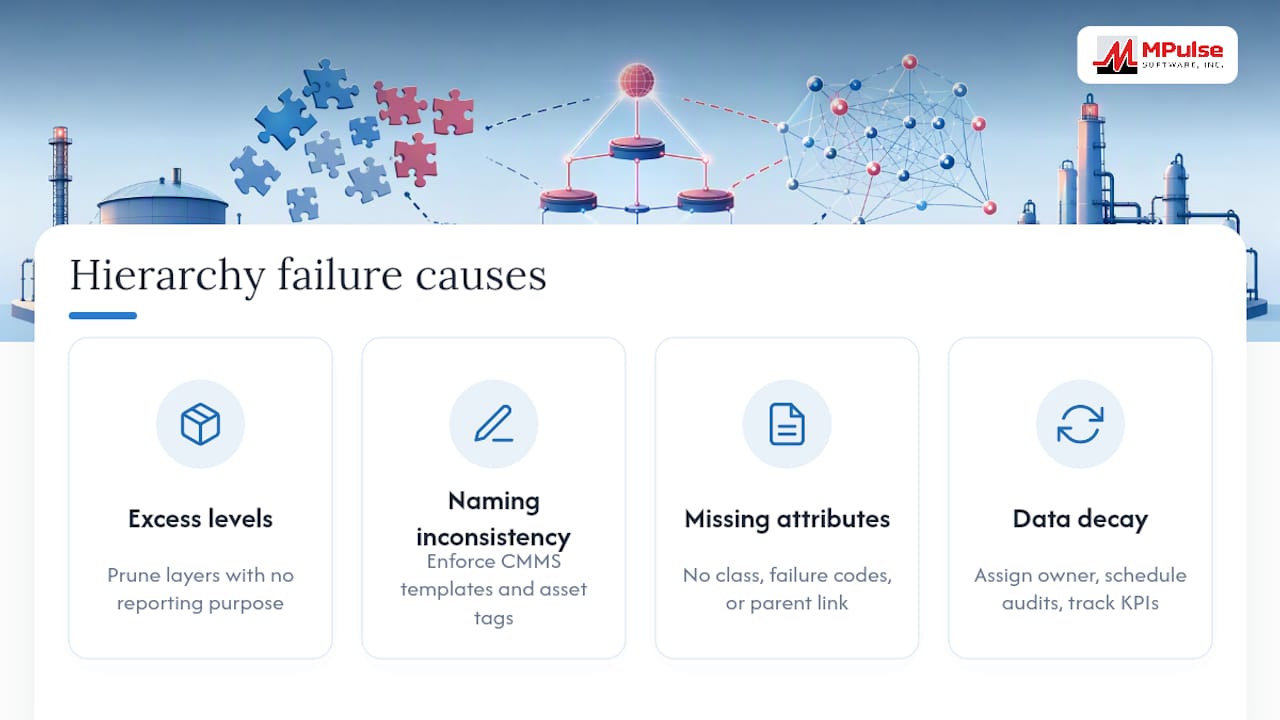
Too many levels. Every additional layer multiplies the number of fields someone has to complete correctly. Prune layers that don’t serve a distinct reporting or maintenance-planning purpose; if nobody ever queries at that level, it shouldn’t exist.
Inconsistent naming. “Pump 1,” “PMP-01,” and “North Pump” referring to the same physical asset across three records is a data-integrity problem, not a cosmetic one. Enforce naming through CMMS field templates and restricted permissions rather than trusting individual technicians to remember the convention, and pair digital IDs with physical asset tags or barcodes so the record and the physical unit never drift apart.
Missing attributes. A record with no equipment class, no failure codes, or no parent link is close to useless for aggregate reliability analysis, even if it technically exists in the system.
Data decay. Hierarchies degrade the moment nobody owns them. Scheduled audits, a named data owner per site or area, and a small set of tracked KPIs (percentage of records with complete attributes, average time to close a data-quality ticket) catch drift before it compounds. For a longer list of the ways this goes wrong in practice, see this breakdown of common asset management mistakes.
Pro Tip: If an audit turns up more than a handful of records missing a required attribute, stop the rollout and fix the template before adding more assets. Backfilling data is always more expensive than getting it right the first time.
How MPulse CMMS Puts the Standards Into Practice
Translating a taxonomy from a whiteboard into daily maintenance work requires software that actually enforces the rules you set, not just software that stores records. MPulse Software builds this enforcement into the platform rather than leaving it to individual discipline.
Role-based permissions restrict who can create or edit top-level hierarchy records, which closes the gap where inconsistent naming usually creeps in. Required-field templates and dropdown-driven attribute capture cut down on free-text entry, the single biggest source of the missing-attribute problem described above. The calendar-based preventive maintenance interface ties scheduled work directly to the equipment and component records in your hierarchy, so a clean taxonomy translates into cleaner preventive maintenance scheduling rather than sitting idle as reference data. Integration support with ERP and sensor systems means hierarchy records can stay connected to real-time monitoring data without a separate reconciliation step.
A hierarchy is only as good as the discipline enforcing it. Software that blocks bad data entry at the point of capture will always outperform a style guide nobody reads.
If you’re evaluating a CMMS for this purpose, prioritize these capabilities:
- Configurable required fields tied to your taxonomy attributes
- Role-based permissions for hierarchy-level record creation
- Barcode or RFID scanning to link physical assets to digital records
- Audit and reporting tools that flag incomplete or orphaned records
Explore the full feature set on the MPulse CMMS software page to see how these capabilities fit your current maintenance structure.
An Editorial Take on Standards-Forward Hierarchy Design
Most asset hierarchy advice online treats ISO 14224 as a checklist to copy wholesale, nine levels and all. That’s the wrong lesson to take from it. ISO 14224 was built for high-fidelity failure data exchange across an entire industry, not for a single facilities team trying to get preventive maintenance scheduling under control. The standard’s real value is the reporting-level convention buried in its middle, level 6, equipment unit, not the exhaustive taxonomy above and below it.
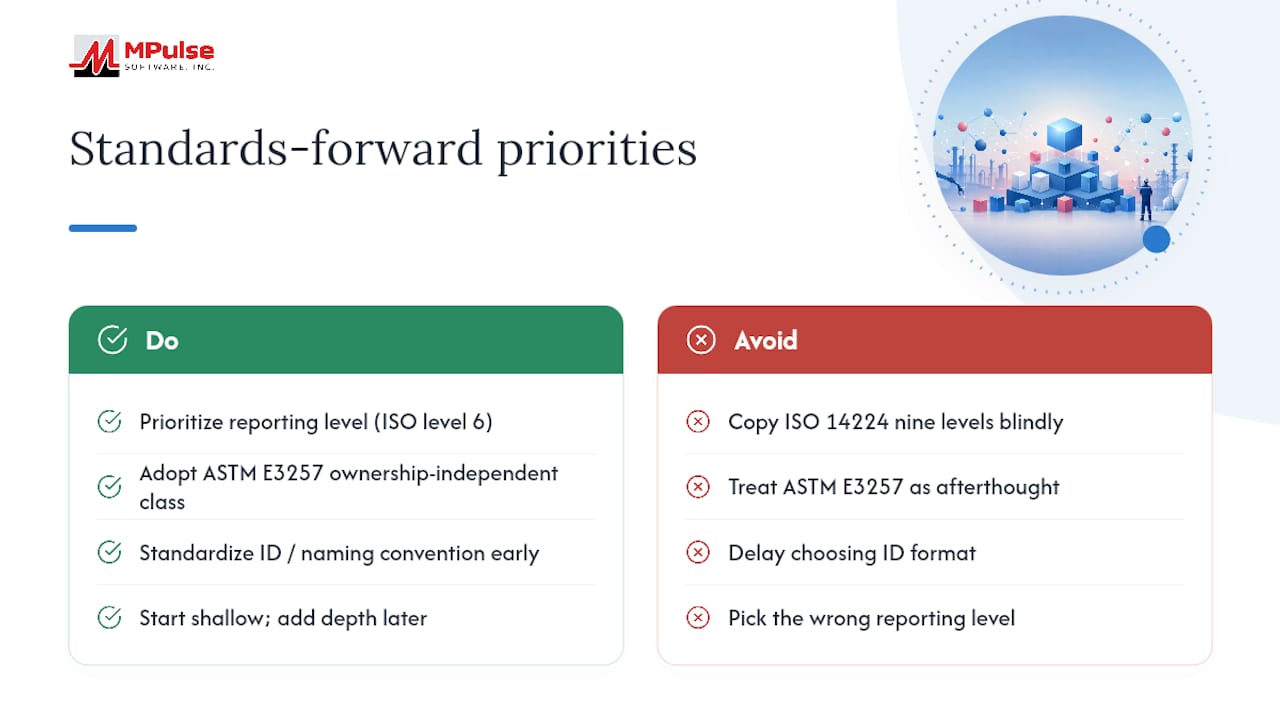
Where conventional advice falls short is treating ASTM E3257 as an afterthought. Its ownership-independent classification principle solves the actual argument that derails most hierarchy projects: whether a leased or fully depreciated asset counts the same as a new one. It does, and settling that early saves weeks of committee debate later.
If you’re starting this quarter, prioritize the reporting level and naming convention over hierarchy depth. Depth can be added later without breaking anything. A wrong reporting level or an inconsistent ID format has to be unwound record by record, and that’s the expensive mistake.
— Mark
FAQ
What Is the ISO Standard for Asset Hierarchy?
ISO 14224 is the primary reference for equipment taxonomy and reliability and maintenance data structure, originally built for oil and gas but widely adapted across other industries. ASTM E3257 complements it by addressing asset taxonomy principles independent of ownership.
What Are Level 1, Level 2, and Level 3 Assets?
In a typical CMMS-friendly hierarchy, level 1 is usually the site, level 2 the area or facility, and level 3 the system, such as an HVAC or compressed air system. ISO 14224’s own technical taxonomy runs deeper, up to nine levels, but most organizations report at the equipment level further down that chain.
What Are the Five P’s of Asset Management?
Definitions of the “five P’s” vary by source and aren’t standardized in ISO 14224, ASTM E3257, or ISO 55000, so treat any specific version you encounter as one framework among several rather than an official standard.
What Are the Four Main Asset Classes?
Asset classification frameworks differ by context, financial asset classes differ from physical equipment taxonomies, and ISO 14224 and ASTM E3257 don’t define a universal “four classes” model. For physical asset hierarchies, classification is better handled through equipment class assignment based on innate characteristics, as ASTM E3257 recommends, rather than a fixed four-category system.