
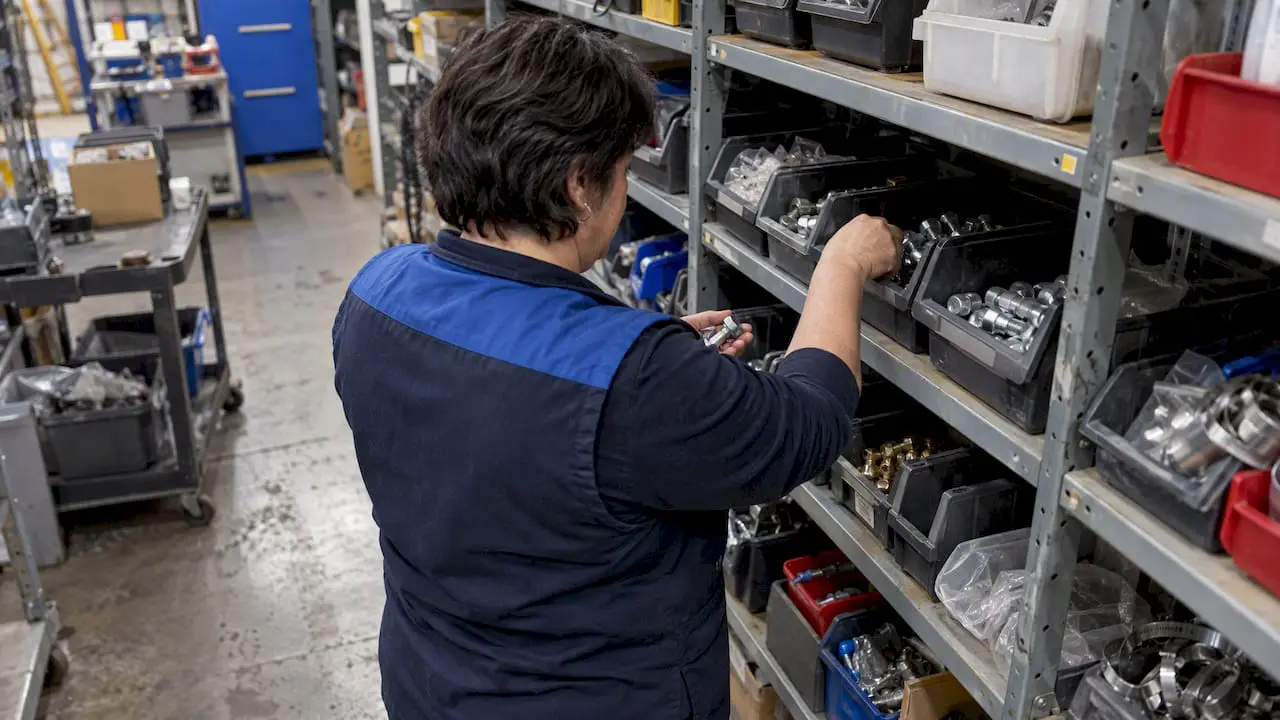
Cycle counting for MRO is a targeted, continuous-count program, usually driven by ABC classification, that keeps storeroom and spare-parts accuracy high without shutting down operations. We recommend pairing ABC-driven counts with CMMS automation for item selection, mobile capture, and variance workflows. Done well, this approach protects wrench time and keeps critical spares available when a line goes down.
TL;DR:
- High-value and safety-critical parts classified as A items should be counted monthly or weekly to ensure accuracy for critical operations.
- Most programs blend ABC classification with geographic or random sampling to optimize count frequency and minimize disruption.
- A pilot program with 50 to 200 SKUs over four to six weeks helps validate methods before full implementation, reducing operational risk.
- Mobile data capture integrated with CMMS speeds up updates, flags variances instantly, and automates corrective actions for efficiency.
- Maintaining a 95% or higher inventory accuracy rate requires consistent rules, proper labeling, staff training, and clear variance investigation procedures.
Table of Contents
- What cycle counting is and why it matters for MRO
- Common cycle counting methods used for MRO
- Designing your MRO cycle-count program: frequency, selection rules, and staffing
- Counting procedure and data capture: practical step-by-step
- Investigating variances and corrective actions
- Integrating cycle counting with CMMS and inventory systems
- Metrics, KPIs, and how to prove ROI from cycle counting
- Common pitfalls and best practices for sustainable accuracy
- Lessons from running pilot programs
- How MPulse CMMS supports faster, more reliable cycle counts
- FAQ
- Sources
What cycle counting is and why it matters for MRO
Cycle counting replaces the annual physical inventory with smaller, scheduled counts spread across the year. Instead of closing a storeroom for days to count everything at once, teams count a subset of items on a rotating basis, verify accuracy, and move on. This method is the accepted replacement for annual physicals because it is less disruptive and lets managers concentrate effort on the items that matter most.
MRO inventory creates its own set of problems. Storerooms often carry thousands of SKUs covering bearings, seals, gaskets, and specialty parts, many of which move rarely but matter enormously when a machine fails. Usage can be inconsistent and poorly logged, especially when technicians grab a part during an emergency repair and the transaction never gets recorded. That hidden usage is exactly what erodes record accuracy over time.
Cycle counting addresses these pressures directly:
- Keeps counts continuous instead of bunching all the disruption into one annual event
- Lets high-value or safety-critical parts get counted more often than slow-moving stock
- Surfaces discrepancies early, before they cause a stockout during a repair
- Reduces emergency purchases that happen when a part everyone assumed was in stock turns out to be missing
Facilities that run cycle counting consistently tend to see fewer surprise shortages and steadier accuracy over the year, a direct improvement over the start-of-year scramble a full physical count usually produces.
Common cycle counting methods used for MRO
Not every part deserves the same counting attention. Several methods exist, and most mature MRO programs combine two or three of them depending on part criticality and storeroom layout.
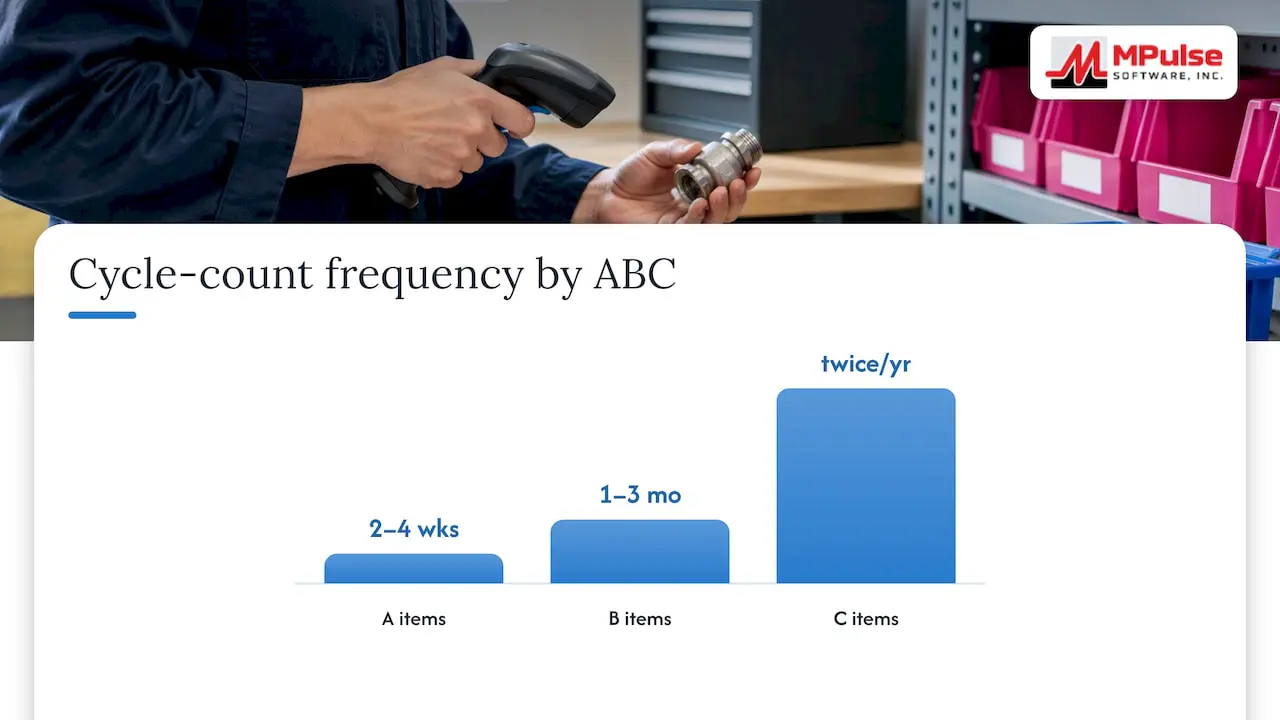
- ABC classification: Rank SKUs by value, criticality, or usage frequency. “A” items, typically high-cost or safety-critical spares, get counted monthly or even weekly. “B” items might get a quarterly count, while “C” items, low-value consumables like fasteners, may only need a semiannual check. Vendor systems commonly support ABC grouping and cycle categories directly in configuration, so the schedule runs itself once set up.
- Random sampling: A fixed number of SKUs gets pulled at random each count cycle, regardless of classification. This works well for spotting systemic accuracy problems across a large population without bias toward any single category.
- Statistical process control (SPC): For large, mixed SKU populations, SPC methods such as P-charts or C-charts can track the percentage of nonconforming SKUs over time and flag when variance patterns drift outside acceptable limits. This adds a statistical lens on top of routine counts rather than replacing them.
- Geographic or location-based counting: Count everything in a defined aisle, bin range, or van stock area on a rotation, regardless of part classification. This suits distributed storerooms or technician van stock where physical location, not part value, drives count logistics.
Most programs blend ABC with either geographic or random counting: ABC sets the frequency, while location-based routing determines the order counts happen in to minimize walking time and avoid disrupting the same area repeatedly.
Pro Tip: Start with ABC alone for the first quarter before layering in SPC or random sampling, so your team learns one discipline well before adding statistical complexity.
Designing your MRO cycle-count program: frequency, selection rules, and staffing
Frequency should follow directly from ABC classification and actual usage data, not a guess. A items might warrant counts every two to four weeks, B items monthly to quarterly, and C items twice a year. Adjust frequency as usage patterns shift, since a part that moves from slow to fast turnover deserves a tighter count schedule.
A pilot keeps the rollout manageable. Select 50 to 200 SKUs across your ABC tiers, run the program for four to six weeks, and use that window to validate your process before expanding storeroom-wide. This limits the disruption if something in the workflow needs adjusting.
Staffing and scheduling decisions matter as much as the counting method itself:
- Assign counts to storeroom staff or a rotating technician, not whoever happens to be free that day
- Schedule counts during low-traffic windows so they do not collide with active work orders or preventive maintenance tasks
- Set a transaction freeze, even a short one, during the actual count to prevent parts from moving mid-count
- Require a second person to approve and close out any count with a variance above a set threshold
Clear rules around freeze periods and approvals prevent the single biggest source of frustration in cycle counting: counts that get invalidated because receiving or a technician pulled stock while the count was underway. A written SOP that spells out who counts what, when, and how variances get escalated removes ambiguity before it becomes a recurring argument.
Counting procedure and data capture: practical step-by-step
A repeatable procedure keeps results consistent regardless of who performs the count. The steps below work for most MRO storerooms.
- Prepare the count: Generate a pick list or count sheet for the scheduled SKUs, confirm no pending receipts are sitting unprocessed, and apply a brief transaction freeze on the items being counted.
- Choose a counting technique: Count by location, walking each bin in sequence, or count by item, pulling every instance of a specific SKU across multiple locations. Location counting is faster for dense storerooms, while item counting suits parts stored in several spots.
- Perform the count and record results: Enter quantities directly into a mobile device at the point of count rather than on paper to transcribe later, which cuts transcription errors significantly.
- Flag discrepancies for recount: When a counted quantity differs from the system record, recount before entering a final variance. A single miscount can trigger an investigation that was never necessary.
- Reconcile and update: Once a variance is confirmed after recount, update the inventory record and log the variance for review rather than letting it disappear into an unremarked adjustment.
Mobile capture deserves particular attention because it closes the loop between counting and system updates. Vendor documentation describes the cycle count flow as selecting items, printing or generating count sheets, entering results, reviewing variances, and updating inventory status, and mobile tools collapse several of those steps into one action at the shelf. Deciding whether to adjust a record or replace it entirely depends on the size of the gap: small variances typically get adjusted in place, while a large, unexplained gap should trigger a hold on the record until root cause is understood.
Investigating variances and corrective actions
A variance is not an accounting problem to patch over. It is a signal that something in the physical or transactional process broke down, and treating it that way is what separates a program that improves accuracy from one that just chases numbers. Research on inventory accuracy monitoring supports using each discrepancy as a signal of process failure rather than purely as a number to correct on the ledger.
A short investigation checklist keeps this consistent:
- Document the exact variance: quantity, location, part number, and date discovered
- Trace recent transactions for that SKU, including receipts, issues, and transfers
- Interview whoever last touched the part, whether that was receiving, a technician, or a storeroom clerk
- Verify against physical evidence like packing slips, work orders, or bin labels before closing the investigation
Most recurring variances trace back to a handful of causes: unrecorded usage during an emergency repair, misreceipts where the wrong SKU got logged, or a part simply shelved in the wrong bin. Fixes usually involve better labeling, a stricter receiving check, or refresher training on transaction entry for whoever pulls parts during off-hours.
Pro Tip: Log every corrective action next to the variance it resolved, so a recurring pattern across months becomes visible instead of buried in separate incident notes.
Closing the loop means documenting what caused the variance and what changed as a result, whether that is a new bin label, a revised receiving step, or added training. Without that record, the same discrepancy tends to resurface within a few cycles.
Integrating cycle counting with CMMS and inventory systems
A CMMS turns cycle counting from a manual scheduling exercise into something that largely runs itself. Instead of a spreadsheet tracking which SKUs are due for a count, the system assigns counts automatically based on ABC category and schedules them around existing maintenance work.
What integration typically automates:
- Scheduled item selection based on ABC code or custom cycle categories, so nobody has to manually pull a count list
- Mobile capture at the point of count, feeding results directly into the inventory record without a separate data entry step
- Immediate variance flagging, so a discrepancy gets surfaced the moment a count is entered rather than during a batch review days later
- Corrective work order triggers, where a confirmed shortage on a critical spare can automatically generate a purchase requisition or hold
Configuring cycle categories and approval statuses inside a CMMS lets a manager set the rules once: which tier gets counted how often, who has to sign off on a variance above a given threshold, and what happens automatically when a count reveals a stockout risk on an A-item. Parts inventory management features built for this purpose let a storeroom supervisor configure those rules directly rather than relying on a parallel spreadsheet process.
As the author of this piece, I have seen storerooms where tying a confirmed variance to an automatic purchasing hold cut the lag between discovering a shortage and ordering a replacement part from days to hours, which matters most on the parts that keep critical equipment running.
Metrics, KPIs, and how to prove ROI from cycle counting
A cycle count program only proves its worth when someone is tracking the right numbers. A few core metrics tell most of the story:
- Inventory accuracy percentage: the share of counted SKUs matching system records exactly
- Variance rate: how often counts turn up a discrepancy, broken out by ABC tier
- Counts per SKU per year: whether A, B, and C items are actually being counted at the frequency the program calls for
- Time to resolution: how long it takes from a flagged variance to a closed, documented corrective action
With consistent cycle counting, accuracy of 95% or higher is attainable, a benchmark worth tracking monthly rather than checking once a year. SPC charts can help detect when accuracy starts drifting below that line before it becomes a visible problem on the shop floor.
The ROI case tends to build itself once these metrics are tracked: fewer emergency freight charges when a part is unexpectedly out of stock, lower working capital tied up in excess safety stock nobody trusted, and fewer stockouts that delay a repair.
Common pitfalls and best practices for sustainable accuracy
Most cycle counting programs that stall out share the same handful of mistakes. Inconsistent counting rules, where one shift counts by location and another by item with no documented standard, produce results nobody can compare month to month. Mixing receiving verification with cycle counting muddies both processes and makes variances harder to trace. Ignoring low-volume but critical SKUs because they “never move” is how a storeroom ends up missing the one bearing that stops a production line.
The fixes are straightforward:
- Write a short SOP covering counting technique, freeze periods, and variance escalation
- Use barcode or RFID scanning wherever possible to cut transcription error
- Assign clear ownership for each storeroom zone or ABC tier
- Run brief refresher training whenever a new technician starts pulling parts
Pro Tip: Pick three quick wins this week: label every bin clearly, assign one person per shift to approve variance recounts, and start counting your A-items on a fixed weekly schedule.
These changes cost little and tend to show up in accuracy numbers within the first month or two of consistent practice.
Lessons from running pilot programs
Every pilot I have watched get off the ground hit the same early resistance: technicians see counting as time away from real repairs, and storeroom staff worry it adds paperwork. Starting small, with 50 to 200 SKUs and a four to six week window, defuses most of that pushback because the commitment feels bounded and the results come fast enough to matter.
The tactic that works best is aligning counts to preventive maintenance windows already on the calendar, so counting rides alongside work that is happening anyway rather than competing with it. Showing the team their own accuracy numbers improving, even slightly, after the first few cycles tends to do more for buy-in than any policy memo.
— Mark
How MPulse CMMS supports faster, more reliable cycle counts
We built MPulse CMMS to take the manual scheduling and paperwork out of cycle counting so your team can focus on resolving what the counts actually find. Our platform automates ABC-based item selection, captures counts on mobile devices at the shelf, and routes variances into an approval workflow instead of a spreadsheet nobody checks.

- Scheduled counts run automatically by ABC tier or custom cycle category
- Mobile capture updates inventory records the moment a count is entered
- Confirmed variances can trigger a corrective work order or purchasing hold
- Configurable approval rules keep oversight on the SKUs that matter most
If you are ready to pilot a tighter cycle count program, our CMMS implementation services can get a 50 to 200 SKU pilot running in weeks, or you can review pricing and plans to see what fits your storeroom now.
FAQ
What is the 80/20 rule for cycle counting?
ABC classification assumes a small share of SKUs, the “A” items, account for most of the inventory value or usage, so they get counted far more often than lower-value “C” items. This lets a limited counting team focus effort where accuracy matters most rather than spreading attention evenly across every SKU.
What is cycle counting in manufacturing?
Cycle counting in manufacturing is the practice of counting a subset of inventory on a rotating schedule throughout the year instead of closing operations for one large annual physical count. It is the accepted replacement for annual physicals because it causes less disruption and lets teams concentrate on higher-value or higher-risk items.
What do MRO and OEM stand for?
MRO stands for Maintenance, Repair, and Operations, referring to the parts and supplies used to keep equipment and facilities running. OEM stands for Original Equipment Manufacturer, the company that originally made a piece of equipment or component.
How to calculate cycle inventory?
Cycle inventory calculation depends on the specific metric: inventory accuracy is the percentage of counted SKUs matching system records, while count frequency is set by ABC tier, usage rate, and criticality rather than a single universal formula. Most CMMS platforms calculate these figures automatically once ABC categories and cycle schedules are configured.
Sources
- Monitoring Inventory Accuracy With Statistical Process Control
- Process a Cycle Count — Oracle documentation