
Maintenance compliance management is the set of inspection, testing, and record-keeping controls that prove your equipment meets regulatory requirements. If you take one action today, make it this: confirm you can retrieve inspection evidence within your auditor’s timeframe, then set a target for your PM compliance rate.
TL;DR:
- Maintaining detailed, retrievable inspection and test records for the entire asset lifecycle is essential, with retention periods spanning months or the entire process duration.
- A compliance program requires written procedures, qualified inspectors, standardized checklists, and an unbroken audit trail from scheduling to corrective actions.
- Monitoring KPIs such as preventive maintenance compliance rate and overdue work orders helps verify ongoing program effectiveness and highlights areas needing attention.
- A CMMS that offers electronic checklists, timestamped completion, audit trails, and qualification tracking improves audit readiness and record accuracy.
- Starting with high-criticality assets and documenting compliance efforts there can demonstrate measurable improvement to auditors faster than broad, shallow coverage.
Table of Contents
- What Maintenance Compliance Management Covers
- Key U.S. Rules and Documentation Expectations
- Operational Building Blocks of a Compliance Program
- Processes and KPIs That Prove the Program Works
- How a CMMS Supports Compliance in Practice
- A Compliance Officer’s Three Priorities
- Where MPulse Fits as You Evaluate Options
- FAQ
- Sources
What Maintenance Compliance Management Covers
Maintenance compliance management spans four linked activities: scheduled inspections, required tests, documented maintenance procedures, and the qualification records that prove the right people performed the work. Each activity needs a record, and each record needs to survive an audit.
The regulations that drive this work vary by industry. Process Safety Management (PSM) rules govern mechanical integrity in chemical and refining operations. The Department of Transportation sets maintenance and inspection standards for commercial vehicles. The FAA governs aircraft maintenance records, and construction regulations set equipment inspection cadences. The common thread is documentation that regulators can verify.
Responsibility for this work typically splits across three roles:
- Maintenance managers own the scheduling, execution, and completion of inspections and repairs.
- Compliance officers or EHS staff interpret regulatory requirements and verify that documentation meets the standard.
- Technicians and contractors generate the evidence: completed checklists, test results, and sign-offs.
When these roles operate from separate spreadsheets, gaps appear exactly where auditors look first.
Key U.S. Rules and Documentation Expectations
Three regulatory sources shape most compliance programs, and each one tells you something specific about what to document and for how long.
Under PSM, OSHA’s 1996 interpretation on mechanical integrity documentation clarifies that employers may record routine and external inspections by noting only the deficiencies found, rather than writing a full narrative for every check. Records may be kept in a computerized database as long as the information stays readily retrievable, and required inspection records must be retained for the life of the process, not for a fixed number of years. The same interpretation permits grouping inspections by process unit instead of by individual piece of equipment, provided the documentation makes clear that an absence of noted findings means the inspection passed.
RAGAGEP (recognized and generally accepted good engineering practices) is the other pillar. OSHA’s 2016 enforcement guidance on RAGAGEP states plainly that employers must select, document, and follow a RAGAGEP source for each covered process, and that inspection and test frequency should follow manufacturer recommendations or good engineering practice unless operating experience justifies a different interval.
Retention requirements get concrete in the eCFR. 29 CFR 1926.1412 sets shift, monthly, and annual inspection cadences for certain equipment with defined retention minimums, while 49 CFR Part 396 requires motor carriers to retain some driver vehicle inspection reports for a few months and periodic inspection records for over a year.
Retention windows are not uniform across regulations: plan for both short-term retrievability, measured in days, and long-term retention that can span months or the entire life of a process, depending on which standard applies to your asset management compliance program.
Operational Building Blocks of a Compliance Program
A compliance-ready maintenance program rests on five components, and skipping any one of them tends to surface during an audit rather than before it.
- Written inspection and test procedures tied explicitly to your selected RAGAGEP source and manufacturer recommendations, not to informal habit.
- A complete asset inventory with criticality ranking, so inspection resources go first to equipment where failure carries the highest safety or regulatory consequence.
- Standardized PM libraries and checklists that capture both positive and negative findings, since OSHA’s grouped-documentation approach only works when “no finding” is unambiguous.
- Work-order workflows that create an unbroken audit trail, from scheduled task through completion to corrective-action closure.
- Qualification and training records for every inspector, since a technically correct inspection performed by an undocumented or unqualified person can still draw a citation.
Pro Tip: Build your PM library to mirror your RAGAGEP document section by section, so every checklist item traces back to a specific cited requirement.
Contractor-submitted evidence deserves its own workflow, since contractor compliance documentation tends to arrive in inconsistent formats unless you standardize intake before the work begins.
Processes and KPIs That Prove the Program Works
Documentation alone does not satisfy an auditor if you cannot show the program is actually running. A handful of KPIs give you that proof and double as an early warning system.
- PM compliance rate, the percentage of scheduled preventive maintenance completed on time, is the single most-watched metric in most regulated maintenance programs.
- Overdue work order percentage flags where scheduling or staffing is falling behind before it becomes a mechanical integrity gap.
- Mean time to corrective action shows how quickly a found deficiency gets resolved, which matters as much to auditors as the finding itself.
- Audit findings closed on time tracks whether your corrective-action process actually closes the loop.
OSHA’s mechanical integrity guidance confirms that grouping inspection records by process unit is acceptable when the documentation is structured so an absence of noted deficiencies clearly implies a pass. Operationalizing that means your checklist design, not just your retention policy, determines whether grouped records will hold up.
Build a quarterly management review around these KPIs, with a defined escalation path when overdue percentages exceed your threshold. For audit readiness specifically, keep an exportable evidence package ready: asset ID, inspection date, inspector qualification, checklist result, and corrective action status, all linked and retrievable without a manual search.
How a CMMS Supports Compliance in Practice
A computerized maintenance management system turns the components above into a repeatable system rather than a collection of folders. The features that matter most for compliance are electronic checklists with timestamped completion, audit trails that record who did what and when, exportable retention that matches your regulatory window, qualification tracking tied to each technician, and calendar-based scheduling that flags overdue work before it becomes a finding.
MPulse CMMS illustrates how these pieces come together: an intuitive calendar interface for scheduling inspections, integration capabilities with ERP and sensor systems for pulling asset condition data into the record, and a customer base that reports efficiency improvements of up to 40 percent, according to MPulse’s own tracking. These are offered as concrete examples of what a compliance-oriented platform looks like in use, not as a ranking against other systems.
Pro Tip: When migrating from paper records, index every legacy checklist by asset ID and date range before you retire the old system, since auditors often ask for both the scheduled check and the completed evidence side by side.
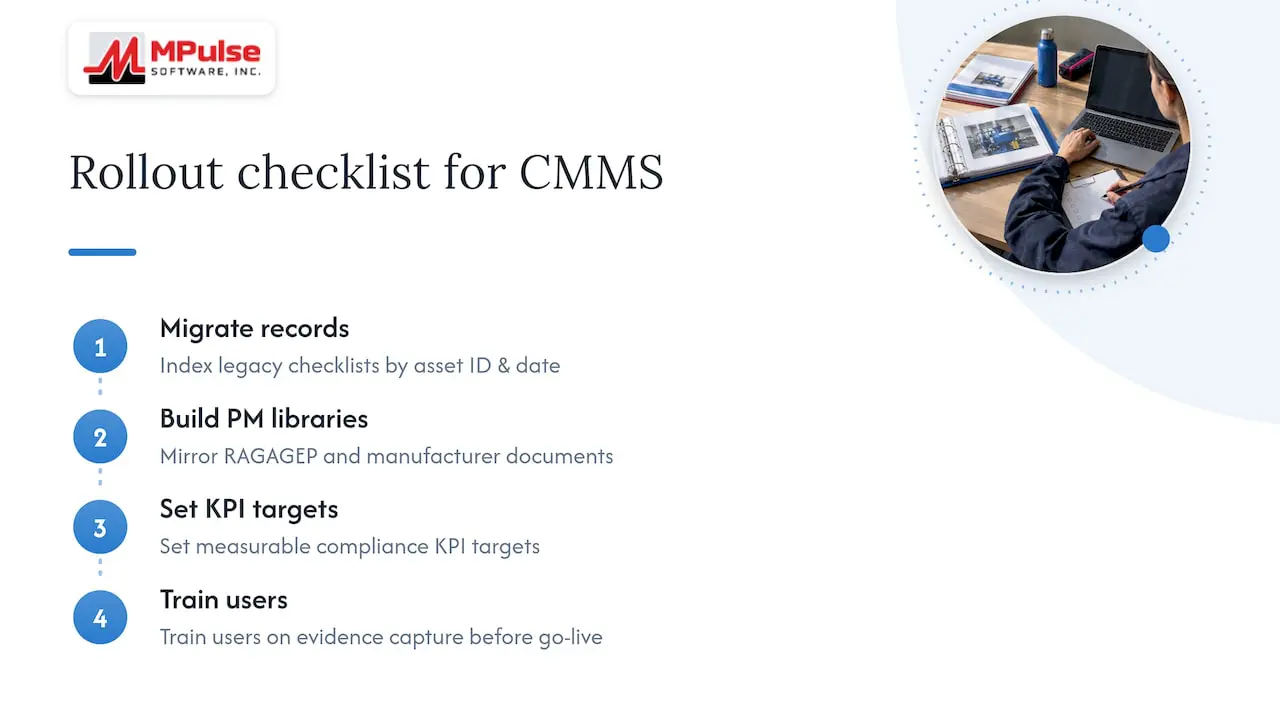
A practical rollout checklist: migrate existing records first, build PM libraries that mirror your RAGAGEP and manufacturer documents, set your KPI targets, then train users on evidence capture before go-live.
A Compliance Officer’s Three Priorities
If resources are limited, retrievability beats exhaustive paperwork every time. An auditor asking for three years of inspection history cares whether you can produce it in minutes, not whether every page is a work of documentation art.
Start with your highest-criticality assets and show measurable KPI improvement there first. A clean PM compliance rate on your most regulated equipment carries more weight than broad but shallow coverage everywhere.
Finally, write down which RAGAGEP source you follow and why. Undocumented engineering judgment, even when correct, is the fastest way to turn a routine audit into a citation.
— Mark
Where MPulse Fits as You Evaluate Options
Choosing the right system comes down to whether it can prove compliance on demand, not just schedule work. We built our CMMS around that requirement: a calendar-based scheduling view, integrations with ERP and sensor systems, and qualification tracking that ties directly to each inspection record.
Before committing, ask any vendor three questions: can you export a full audit package by asset and date range, how are inspector qualifications stored, and what is the retention policy for grouped versus individual equipment records. We walk through exactly that during a pricing and licensing consultation, and our implementation and training services are built to migrate your existing records without losing the chain of custody your auditors expect.
FAQ
What is maintenance compliance?
Maintenance compliance is the practice of performing required inspections, tests, and repairs on schedule and documenting them in a way that satisfies the regulations governing your equipment or process. It covers both the physical maintenance work and the records that prove it happened.
What are the five keys of compliance?
Definitions vary by industry, but a common version centers on written procedures, qualified personnel, scheduled inspections and tests, complete recordkeeping, and a corrective-action process for anything found out of specification. Each of these maps directly to a requirement regulators check during an audit.
What does compliance management mean?
Compliance management is the ongoing process of identifying which regulations apply to your operation, building procedures that satisfy them, and tracking performance against those procedures over time. In maintenance, that means linking inspection schedules, preventive maintenance standards, and documentation into one verifiable system.
What are the three types of compliance?
Maintenance organizations generally deal with regulatory compliance (meeting government standards like OSHA or DOT rules), manufacturer or engineering compliance (following RAGAGEP or original equipment specifications), and internal compliance (meeting your own written procedures and policies). All three get checked together during a thorough audit.
Sources
- Clarification on the documentation of inspections and tests required under the mechanical integrity provisions. | Occupational Safety and Health Administration
- eCFR :: 29 CFR 1926.1412 – Inspections.