
MTBF (mean time between failures) tells you how long a repairable asset runs before it breaks down again. MTTR (mean time to repair) tells you how long the repair takes once it has. MTBF measures reliability, MTTR measures how well your team responds, and you need both to understand why an asset is costing you uptime.
This guide covers the definitions, the formulas, worked examples, the related metric MTTF, what a reasonable MTTR target looks like, and how to track both consistently in a maintenance program.
TL;DR
- MTBF = total operating time ÷ number of failures. A higher number means the asset runs longer between breakdowns.
- MTTR = total repair time ÷ number of failures. A lower number means faster recovery.
- MTBF points to equipment health and preventive maintenance quality. MTTR points to parts availability, technician assignment and repair process.
- Use MTTF instead of MTBF for non-repairable items that are replaced rather than fixed.
- Track both per asset, review MTTR weekly, and let your CMMS capture the timestamps so the numbers are consistent.
Table of Contents
- What MTBF and MTTR each measure
- How to calculate MTBF and MTTR
- Is a higher or lower MTBF better?
- What is MTTF, and how does it differ from MTBF?
- What is a good MTTR?
- How to use MTBF and MTTR together
- How to track MTBF and MTTR consistently
- Our perspective on reliability metrics
- Putting the metrics to work with a CMMS
- See MPulse in your own maintenance program
- FAQ
- Sources
What MTBF and MTTR each measure
MTBF is the average time a repairable asset operates between failure events. Reliable Media’s guide calculates it as total operating time divided by the number of failures. It is a forward-looking number: it helps you judge how likely an asset is to break down in the next period and where preventive work should go.
MTTR is the average time spent restoring an asset after a failure. It is a response number: it shows how quickly your team, your parts room and your approval process turn a breakdown into a running machine.
The two answer different questions:
| MTBF | MTTR | |
|---|---|---|
| Question answered | How often does this asset fail? | How long does each failure last? |
| Formula | Total operating time ÷ failures | Total repair time ÷ failures |
| Better direction | Higher | Lower |
| Mostly influenced by | Design, operating conditions, preventive maintenance, parts quality | Technician skill, parts on hand, diagnostics, work order flow |
| Typical unit | Hours (or days) | Hours (or minutes) |
A useful way to remember it: MTBF is about preventing the event, MTTR is about shortening it.
How to calculate MTBF and MTTR
The formulas
- MTBF = total operating time ÷ number of failures
- MTTR = total repair time ÷ number of failures
Operating time is the time the asset was actually running, not the time it was scheduled. Subtract downtime from scheduled time before you divide.
Worked example: a pump
Reliable Media’s pump example starts with 2,160 scheduled hours and 18 hours of downtime, which leaves 2,142 operating hours. With 3 failures in that period, MTBF is 2,142 ÷ 3 = 714 hours.
Worked example: a 24/7 system
A U.S. Department of Energy technical document hosted on OSTI gives a simpler case. Equipment that ran around the clock for two weeks is up for 336 hours. With 3 failures, MTBF is 336 ÷ 3 = 112 hours per failure.
The same document shows MTTR with a system that had 5 failures and repair times of 2, 1, 5, 3 and 4 hours. Total repair time is 15 hours, so MTTR is 15 ÷ 5 = 3 hours per failure.
What counts as repair time
The definition of repair time is where most teams drift apart. Reliable Media notes that active repair time for MTTR excludes waiting for parts, waiting for a technician to arrive, waiting for approval and post-repair testing. Those delays belong to a different metric, mean down time (MDT).
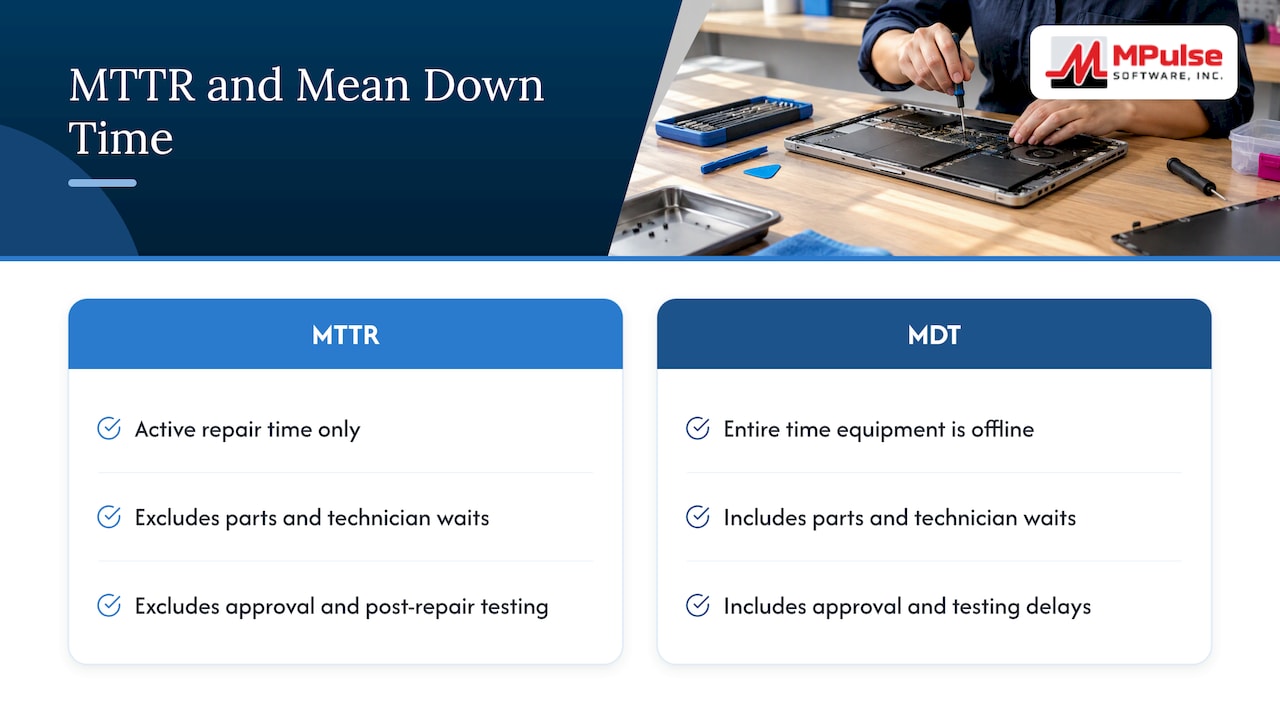
Pick one definition and write it down. If one site counts from the moment a work order is opened and another counts from the moment a wrench touches the asset, the two MTTR figures cannot be compared.
A practical approach recommended in a wind energy CMMS document from OSTI is to record the entire time the equipment was not online, and where possible split it into active maintenance time, waiting for parts, waiting for a technician and administrative delays. With that split you can report MTTR and total downtime from the same records.
Is a higher or lower MTBF better?
Higher is better. A higher MTBF means more operating time between failures, so fewer interruptions to production or building services and fewer emergency work orders. For MTTR, lower is better, because each failure takes less time to resolve.
Two cautions keep the numbers honest:
- MTBF is an average, not a promise. An asset with an MTBF of 714 hours can still fail twice in one week. Look at the individual intervals, not only the mean.
- Compare like with like. A rooftop air handler and a conveyor motor operate under different loads and duty cycles. Compare MTBF across similar equipment, and track each asset against its own history.
What is MTTF, and how does it differ from MTBF?
MTTF is mean time to failure. It applies to items that are not repaired, such as a light bulb, a bearing or a sensor that gets replaced. According to the IEEE Technology Navigator, MTTF quantifies the expected operating time before a non-repairable component experiences its first and only failure, while MTBF applies to repairable systems restored to service after each failure.
The ASTM E3159 guide to general reliability draws the same line: MTTF is the average time to the first failure of a unit, and MTBF covers the full sequence of repair and restoration cycles over a service life period.
In practice:
- Repairable asset (pump, chiller, packaging line): use MTBF and MTTR.
- Replace-on-failure part (filter, belt, lamp): use MTTF to plan replacement intervals and stock levels.
If you want a deeper look at the MTBF side, our article on what mean time between failures means for your team walks through it for maintenance and manufacturing teams.
What is a good MTTR?
There is no single universal figure, because a good MTTR depends on asset criticality and repair complexity. As a reference point, Reliable Media suggests that four hours or less is reasonable for most critical rotating equipment in a manufacturing environment.
When MTTR runs high, the same source points to parts availability, permit wait times and technician assignment as the usual causes. Notice that none of these is about wrench time. They are workflow problems, which is why MTTR responds well to process fixes:
- Parts: keep critical spares stocked and linked to the asset records so a technician knows what is on the shelf before leaving for the job.
- Assignment: route work orders by skill and availability so the right person is dispatched the first time.
- Permits and approvals: standardize the paperwork for recurring jobs so approval is not a wait.
- Diagnostics: keep asset history, manuals and previous repair notes on the work order.
How to use MTBF and MTTR together
Each metric alone can mislead. Read them as a pair:
| MTBF | MTTR | What it usually suggests | Where to look first |
|---|---|---|---|
| High | Low | Healthy asset, efficient response | Maintain the current plan |
| High | High | Rare failures that are slow to fix | Spare parts, repair procedures, training |
| Low | Low | Frequent failures fixed quickly | Root cause, preventive maintenance tasks and intervals |
| Low | High | Frequent, long failures | Highest priority: consider repair versus replacement and review the whole plan |
The low MTBF, low MTTR case deserves attention because it can look fine on a response dashboard. A team that fixes a pump in an hour, ten times a month, is doing excellent repair work on an asset that needs a different preventive strategy.
The two figures also combine into availability, the share of time an asset is ready to run. Improving either one raises it: fewer failures through preventive work, or shorter failures through a faster response. Tracking both tells you which lever is cheaper for each asset.
How to track MTBF and MTTR consistently
Tracking is where most programs stall. Spreadsheets depend on someone remembering to log start and stop times. The numbers become reliable when they come from the same system that issues work orders. NIST’s work on maintenance data standardization lists MTBF, MTBR, MTTR, failure rate and availability among the key reliability metrics used for benchmarking and asset performance analytics, which is a good reason to define them once and collect them the same way everywhere.
A workable routine:
- Define the terms. Decide what counts as a failure, when the repair clock starts and stops, and which delays are excluded from MTTR.
- Record every failure on a work order. Capture asset, failure time, repair start, repair finish and return-to-service time. Add a failure code so you can group causes.
- Track per asset over time. Reliable Media recommends flagging any asset whose MTBF drops by more than 20% in a rolling 12-month window, and comparing similar equipment against each other.
- Review MTTR weekly. The same source advises weekly rather than monthly review, because by the time a pattern appears in a monthly report, hours have already been lost.
- Act on the outliers. Send low-MTBF assets to a preventive maintenance review. Send high-MTTR jobs to a parts and process review.
Data from other systems often feeds this analysis, such as runtime or location data from connected equipment. If you collect it elsewhere, fleet tracking data export practices show how to move that information into the reports where your reliability metrics live.
For a related measure, see our guide to MTBR tracking and mean time between repairs.
Our perspective on reliability metrics
Most teams we talk with do not lack metrics. They lack trustworthy ones. MTBF and MTTR are simple formulas, but the inputs are the hard part: accurate failure times, consistent repair start and stop points, and a clean asset history.
That is why we build MPulse CMMS around the work order. When preventive maintenance is scheduled on an intuitive calendar, parts and inventory are tied to assets, and technicians close out jobs from mobile devices, the data behind MTBF and MTTR is captured as a by-product of the work rather than as extra paperwork.
For compliance-heavy operations in healthcare, education, manufacturing and facilities, the same records double as audit-ready documentation. Our customers, more than 3,500 of them worldwide, have reported efficiency improvements of up to 40%, and in our experience it starts with measuring the right things the same way every time.
Mark
Putting the metrics to work with a CMMS
A computerized maintenance management system turns the routine above into a habit. The capabilities that matter most for MTBF and MTTR are:
- Preventive maintenance automation to raise MTBF by scheduling inspections and servicing before failures occur.
- Work order management with timestamps for request, start and completion, which feed MTTR.
- Asset tracking and history so every failure, repair and part used sits on one record. Our guide to tracking asset history for compliance shows how this supports audits as well.
- Parts and inventory management to cut the wait for spares that inflates repair times. See how teams manage parts inventory alongside maintenance.
- Graphical reporting to trend reliability by asset, location or equipment class.
- Condition-based maintenance and sensor integration to trigger work from actual asset condition.
If you are earlier in the process, automating preventive maintenance tasks is the usual first step toward a better MTBF.
See MPulse in your own maintenance program
MPulse CMMS brings preventive maintenance, work orders, asset history, inventory and reporting into one system, so MTBF and MTTR can be tracked from real records. The Professional plan is $29 per month per user and the Advanced plan is $79 per month per user, with details on the MPulse pricing page. Requesters are unlimited and free, so everyone who reports a problem can do so without adding to the cost.

If you want help with setup, our implementation, training and consulting services cover getting your assets, schedules and reports in place. Add-ons such as the DataLink Integration Adapter connect MPulse to ERP and other systems; you can review them on the add-ons page.
FAQ
What does MTBF actually mean?
MTBF stands for mean time between failures. It is the average operating time between breakdowns of a repairable asset, calculated as total operating time divided by the number of failures. A pump that runs 2,142 hours with 3 failures has an MTBF of 714 hours.
What is considered a good MTTR?
It depends on the asset and its criticality. For most critical rotating equipment in manufacturing, a target of four hours or less is a reasonable reference. If your MTTR is higher, check parts availability, permit wait times and technician assignment first.
Is a higher or lower MTBF better?
Higher is better, because the asset runs longer between failures. Treat it as an average and watch the trend per asset. A sustained drop is a signal to review the preventive maintenance plan for that equipment.
What is the difference between MTTF and MTBF?
MTTF applies to non-repairable items that are replaced after their first and only failure. MTBF applies to repairable assets that return to service after each failure. Use MTTF for parts like filters and lamps, and MTBF for equipment you repair.
How often should MTBF and MTTR be reviewed?
Review MTTR weekly so slow repairs are caught while they can still be corrected. Review MTBF per asset over a rolling 12-month window, and investigate any asset whose MTBF falls by more than 20%.
Sources
- How to Calculate MTBF and MTTR: Methodology and Worked Examples, Reliable Media
- Maintenance KPIs That Actually Matter: 8 Metrics to Track, Reliable Media
- b_TEC technical document, OSTI
- Wind Energy Computerized Maintenance Management System, OSTI
- Standardization of maintenance data for benchmarking, NIST
- Mean Time To Fail (MTTF), IEEE Technology Navigator
- E3159 Standard Guide for General Reliability, ASTM