
Work order priorities work when every level has three things: a name, a written test for what qualifies, and a completion target. Most teams land on four to six levels, ranked first by safety and compliance, then by how much the asset matters to operations, then by how long the work can wait. Without written definitions, the loudest requester sets the queue. In a CMMS, the priority field, the requester form and the calendar enforce those definitions on every request.
This guide shows how US facilities define their levels and codes, how to build a priority matrix, which response targets are realistic, and how to keep the system consistent once requests start arriving.
TL;DR
- Use four to six priority levels. Each needs a name, qualifying criteria and a completion target.
- Rank safety, regulatory and environmental risk first, then asset criticality, then operational impact, then convenience.
- Priority codes are not standardized across the US. Universities, utilities and federal agencies each publish their own, but the structure is similar.
- A two-factor matrix (impact against effort) or a multiplier (priority times asset criticality) turns judgment calls into a repeatable score.
- Review new and escalated requests on a fixed schedule, and let only managers downgrade an emergency.
Table of Contents
- What a work order priority actually does
- Common priority levels and what fits each one
- Priority codes: numbers, letters and why they differ
- Building a work order priority matrix
- Response and completion targets for each level
- How priorities differ by facility type
- Deciding what counts as an emergency
- Keeping priorities consistent over time
- Where a CMMS makes the system hold
- Put your priority levels into MPulse
- FAQ
- Sources
What a work order priority actually does
A priority tells the team two things: how soon work should start and how much it may disrupt everything else. It also tells the requester what to expect. When a tenant, nurse or line operator submits a request, the level they see should match a promise your department can keep.
The problem is rarely a lack of levels. It is vague levels. “High” means one thing to a production supervisor and another to a dean. Strong systems solve this by defining each level by consequence, not by who asked. Is anyone at risk of injury? Does a regulation apply? Will operations stop? Is only comfort or appearance affected?
Common priority levels and what fits each one
The pattern below appears in nearly every published system, even when the labels differ.
| Level | Typical name | What qualifies | Typical target |
|---|---|---|---|
| 1 | Emergency | Threat to life, health, safety or the environment, or a legal obligation at risk | Immediate response, finish within about 24 hours |
| 2 | Urgent | Mission-critical system down or failing, operations at risk | Respond within hours to 72 hours |
| 3 | Routine or priority | Normal repairs that affect users but not safety or operations | One to two weeks |
| 4 | Scheduled or preventive | Planned inspections and recurring maintenance | Within the PM window, often 30 days |
| 5 | Deferred or discretionary | Desirable but not essential work | When resources and budget allow |
These numbers are not universal. They are a consolidation of what the organizations below actually publish.
Examples from published systems
The Pacific Northwest National Laboratory describes a six-level criticality matrix: Emergency for life, health and safety risk, Urgent when continuous facility operation is at risk, Priority for mission support and project deadlines, Routine on a first-come basis, Discretionary, and Deferred for work done only when resources allow.
San Jose State University’s facilities office defines Priority 1 as emergency, safety or regulatory work, such as fire alarms, fire suppression and major water breaks. Priority 2 covers mission-critical systems like server room HVAC, fume hoods, sump pumps and UPS units, where delay would stop operations.
Napa Valley College’s 2026 guidelines put life safety and security at P1, then emergencies affecting student and employee welfare, then building protection, then academic and student support, with convenience work last. Education teams often rank by whom the work supports, which is a useful addition when the mission is teaching.
Arizona State University’s definitions are more operational: Critical work is for failures that impair but do not disable a system, usually handled the same day. Expedited work targets about five days, routine work about 30 days, and scheduled work covers large multi-trade jobs that can take months.
Priority codes: numbers, letters and why they differ
A priority code is the short label stored in the work order record. Teams that search for priority codes usually want a template, but there is no national standard. Here is how published schemes compare.
- Numeric, lower is more urgent. Dartmouth College uses seven codes. Emergency is code 1 with same-day completion expected within 24 hours, urgent is code 2 within 24 hours, and preventive maintenance is code 7, completed within 30 days. It also has a code for events and two routine types.
- Numeric, higher is more urgent. Cornell’s facilities group assigns 50 for emergency, 45 for urgent, 40 for timely and 30 for routine. Examples at 50 include gas smells, elevator entrapment and loss of building water. Leaving gaps between numbers lets a team add levels later without renumbering history.
- Utility style. PG&E’s hydro work management process requires a priority code on every work notification, based on the likelihood and consequence of failure, and treats safety of employees, the public and facilities as the highest priority. Corrective work runs from Priority 1 (emergency or forced outage) to Priority 4 (discretionary). Recurring maintenance is ranked first by external safety, environmental and reliability compliance requirements.
- Calculated priority. The US Army Corps of Engineers’ 2025 circular for civil works facilities multiplies work order priority by asset criticality to produce a score from 1 to 50, with higher values generally getting precedence.
Whichever you choose, pick one direction (low number urgent, or high number urgent) and keep it everywhere. Mixed conventions are a common source of misread work orders.
Building a work order priority matrix
A matrix replaces opinion with a short scoring routine. There are two common designs.
Design 1: consequence by asset criticality
Rate the asset first, once, when it enters your asset register. A boiler serving an operating room, a packaging line that constrains plant output, and a hallway drinking fountain do not carry the same weight. Then rate the problem: safety exposure, compliance exposure, loss of function, or inconvenience.
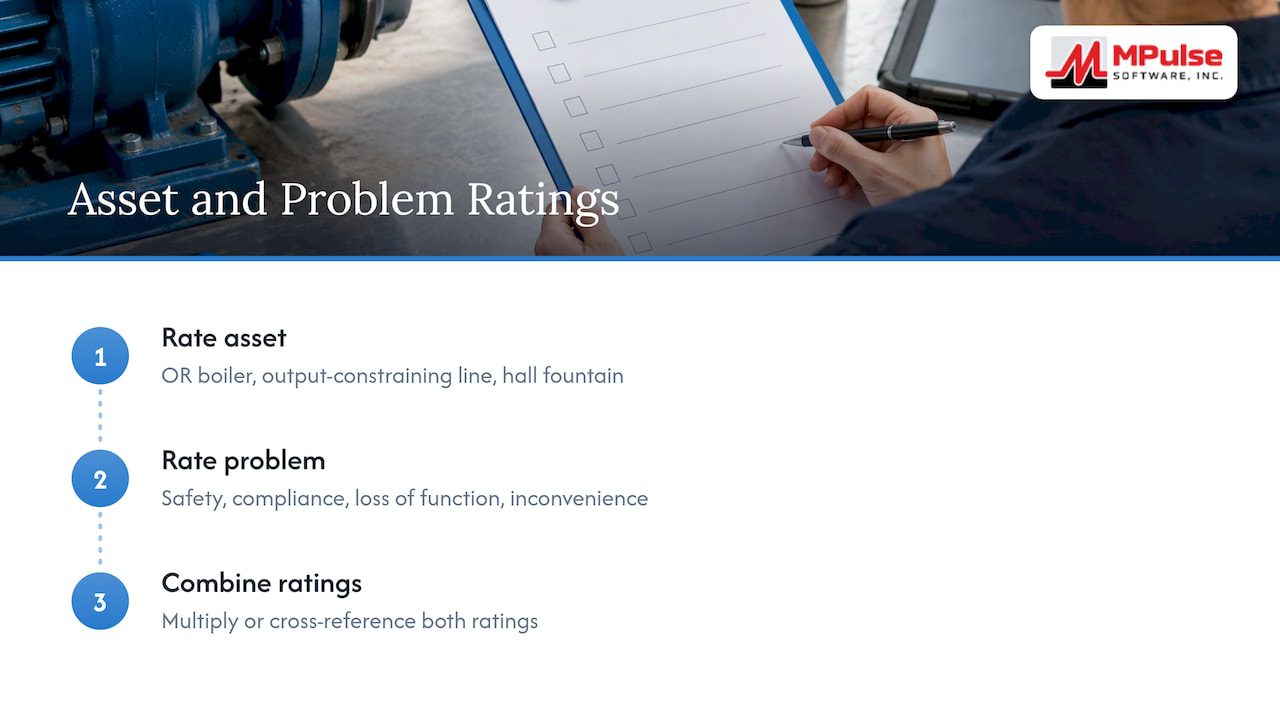
Multiply or cross-reference the two. The Army Corps approach above is exactly this idea. The benefit is that the asset rating is done calmly, not under pressure during a breakdown.
Design 2: business impact by resource intensity
Plant Services recommends scoring requests on business impact and resource intensity. Impact includes constraint-asset downtime minutes, schedule risk, safety and compliance exposure (OSHA and NFPA 70E findings), scrap and rework, and abnormal energy use. Intensity includes labor hours, skill type, parts lead time, permits and outage windows. The four quadrants then give you an action:
- Quick wins: high impact, low intensity. Do these first.
- Constraint focus: high impact, high intensity. Plan resources and an outage window.
- Efficiency projects: lower urgency, high intensity. Schedule and budget them.
- Deferred: low impact, low intensity. Batch them or hold.
This design is helpful for manufacturers because it shows why two urgent jobs are not equally easy to start. A fast fix on a bottleneck machine should jump ahead of a large overhaul that needs a shutdown.
A worked example
Assume a plant has four open requests on Monday morning:
- A leaking compressed air fitting on the bottleneck line. High impact (line slows), low effort (30 minutes, parts on hand). Quick win, do it now.
- A guard missing on a conveyor. Safety exposure overrides the matrix. Emergency, stop the conveyor until it is guarded.
- A gearbox on a secondary line showing rising vibration. High effort (a 12-hour job, parts three days out), moderate impact. Plan it into the next outage window and order parts today.
- Faded floor markings in the warehouse. Low impact and low effort. Batch with other facility tasks.
Notice that safety acted as a gate before any scoring. Most mature systems work this way: a safety or regulatory flag sets the level, and the matrix only sorts the rest.
Response and completion targets for each level
A priority without a time is a label. Published targets give a useful range to calibrate against.
- University of North Texas: emergency is addressed immediately and within 24 hours, urgent within 72 hours, routine within 14 calendar days, scheduled maintenance within 30 days, and deferred work after 30 days. Emergencies that need longer to repair are re-prioritized.
- Cal Poly Pomona: its policy defines six levels. P1 emergency is addressed within 24 hours, with public safety notified after business hours. P2 is within 72 hours, and preventive maintenance is scheduled within 30 days.
- Ohio University: it ties priority to risk assessment codes. The highest code, for a fatal or multiple-injury mishap very likely within 24 hours, needs immediate response, a 24-hour finish and Director of EHS approval. Lower codes become urgent or routine, and only managers may downgrade a work order.
That last rule is worth copying. Downgrades are where priority systems erode, because a busy dispatcher may lower a level to clear a backlog. Restricting who can downgrade protects the definitions.
Target separately for response (someone has looked at it and assigned it) and completion (the work is finished). Measuring only completion hides slow acknowledgment, which is what requesters notice first.
How priorities differ by facility type
The levels share a skeleton, but the criteria that fill them change.
Manufacturing. Production impact drives the second tier. Emergency covers safety, security, environmental compliance and any failure that stops a constraint line. Preventive tasks are usually scheduled well ahead so they do not compete with breakdowns.
Healthcare. Anything that touches patient care environments, life safety systems or regulated spaces sits at the top. Documentation matters as much as speed, so the record of when the request was made, who assigned it and when it was completed must be complete and retrievable.
Education. Campuses rank by occupancy and mission. Napa Valley College’s list shows how heating failures in occupied spaces rank above work that supports a department, and Arizona State gives residence hall and foodservice requests precedence within the same level.
Contractors. Service-level agreements set the clock. Map each client’s contract terms to your levels so that a contracted four-hour response is always an emergency or urgent code, never a free-text note.
Deciding what counts as an emergency
The most expensive error is mislabeling. If everything is urgent, nothing is. Keep the emergency definition narrow and written: imminent threat to people, property or the environment, or a breach of a legal obligation. Fire protection failures, gas leaks, elevator entrapments and loss of building water are typical examples in the published systems above.
Biohazard events are one such category. They call for immediate isolation and specialist response, and a plan that spells out who assesses the situation and what the response targets are, such as building a biohazard response plan, keeps the work order level consistent when the situation is stressful.
For everything below emergency, ask the requester two questions on the form: is anyone at risk, and has work stopped? Those answers set the starting level; a planner confirms it.
Keeping priorities consistent over time
A scheme only holds if people use it the same way. These habits do most of the work:
- Write the definitions on one page and attach them to the request form. A requester who sees examples picks a better level.
- Separate the requested priority from the assigned priority. The requester suggests; a supervisor or planner assigns.
- Hold a short, regular review. A daily or weekly check of new and escalated requests catches mislabeled work before it ages.
- Re-prioritize aging work. A routine job waiting too long may deserve a higher level because it now affects operations.
- Track exceptions. Count how many requests are escalated or downgraded each month. A high number says your definitions need tightening.
- Keep preventive maintenance in the system. Recurring tasks should have their own level and be scheduled ahead, so they are not displaced every time a breakdown arrives.
If you want more detail on assigning requests, our guides on how to prioritize and assign repair requests and on prioritizing maintenance tasks with a matrix go through the routines step by step.
Where a CMMS makes the system hold
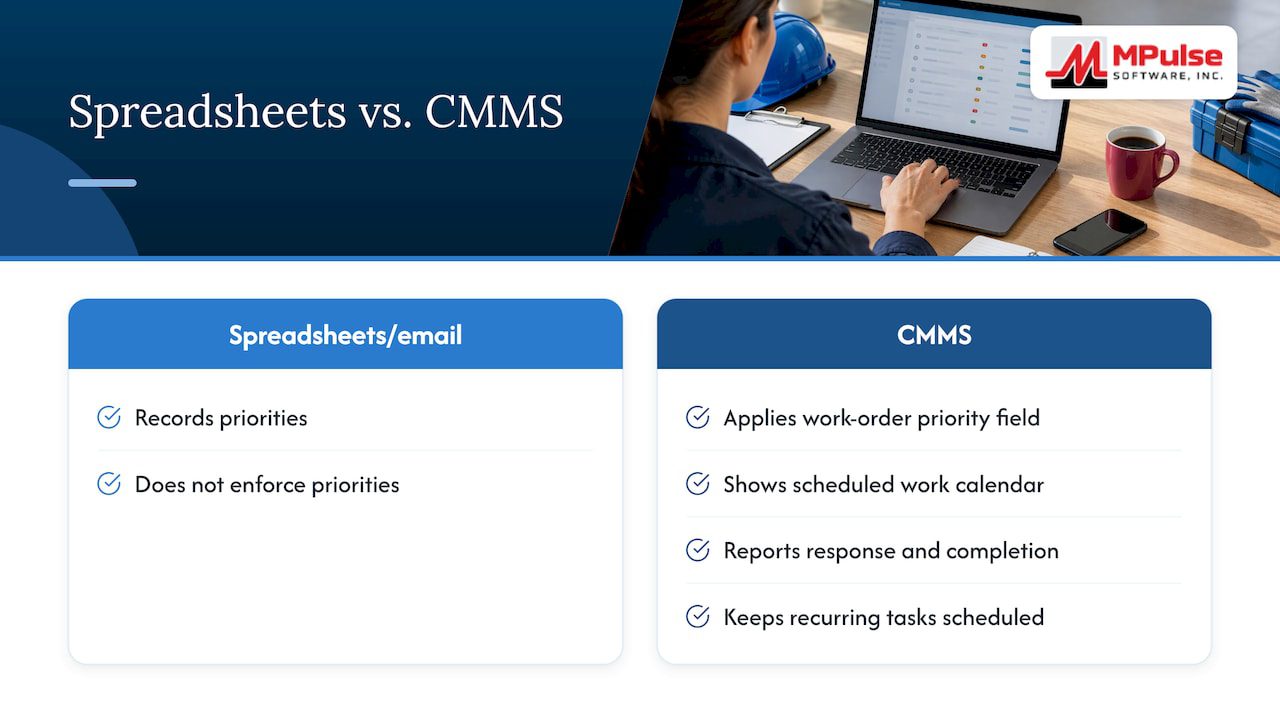
Spreadsheets and email can record priorities, but they do not enforce them. A CMMS can apply a priority field to each work order, show scheduled work on a calendar, and report on response and completion. MPulse’s work order management tools are built for this, and preventive maintenance automation keeps recurring tasks scheduled so they stay in their own level instead of crowding out urgent repairs.
MPulse also offers unlimited free requesters, so anyone in your organization can submit a request without needing a paid seat. That matters for priority discipline because requests arrive through one form with your definitions attached, rather than through hallway conversations and texts.
Perspective
We built MPulse around a simple observation: maintenance teams do not lack urgency, they lack a shared definition of it. When a priority level is only a label, it gets argued over every morning. When it is a written rule tied to a response target, the conversation shifts to resources and planning.
Our platform brings together preventive maintenance automation, an intuitive calendar interface and work order management so that priorities and schedules sit in the same place. Our customers, more than 3,500 organizations worldwide, use it to move from reactive firefighting toward planned work, and our reported results include efficiency improvements of up to 40%.
For compliance-driven teams in healthcare, education and manufacturing, we also offer editions and add-ons suited to formal recordkeeping and multi-site operations. Our advice is to start with four levels, write the criteria down, and let the software enforce them.
Mark
Put your priority levels into MPulse
If you are ready to turn written priority levels into a working queue, MPulse offers the Professional plan at $29 per month per user and the Advanced plan at $79 per month per user. Our CMMS Implementation Services and CMMS Training are also available to help your team set up priorities, request forms and schedules. See the plans and pricing or our services.
FAQ
How many work order priority levels should we have?
Four to six is typical. The published systems above range from four levels at Arizona State to seven at Dartmouth. Fewer levels are easier to apply consistently, so add one only when it changes how and when work is done.
Should preventive maintenance have its own priority?
Yes. Dartmouth uses a separate code for preventive maintenance, and the University of North Texas schedules it within 30 days. A dedicated level keeps planned work visible and prevents it from being treated like an emergency or ignored.
What is the difference between urgent and emergency?
Emergency means an immediate threat to people, property, the environment or a legal obligation. Urgent means a critical system or operation is at risk but there is no imminent danger. Cornell’s examples include gas smells at emergency level, while urgent items can be mitigated the same day.
Who should be allowed to change a priority?
Requesters can suggest a level, but a supervisor or planner should assign it. Ohio University lets only managers downgrade a work order, which is a sound rule because downgrades are the most common way definitions drift.
Sources
- PNNL: An Advanced Maintenance Approach: Reliability Centered Maintenance
- San Jose State University: Work Order Prioritization
- Napa Valley College: Facilities Work Order Prioritization Guidelines
- Arizona State University: Priority definitions
- Dartmouth College: Priority Codes
- Cornell University: Maximo Priority Levels
- PG&E: Hydro Work Management Process
- US Army Corps of Engineers: EC 34-1-1
- Plant Services: A practical framework for maintenance prioritization
- University of North Texas: Work Order Priorities and Response Times
- Cal Poly Pomona: Work order prioritization policy
- Ohio University: Work order priority
- Bio Recovery: Creating a biohazard response plan