For measurable, durable energy savings in schools, start by benchmarking utility data, then fix lighting and HVAC through preventive maintenance and controls. The sequence matters more than any single upgrade.
Top priorities, in order:
- Benchmark 12 months of utility data in ENERGY STAR Portfolio Manager
- Swap to LED lighting and add occupancy controls
- Tune up HVAC systems and set back temperatures during unoccupied hours
- Build preventive maintenance into a CMMS so gains don’t erode
- Apply for utility rebates and DOE technical assistance before spending capital
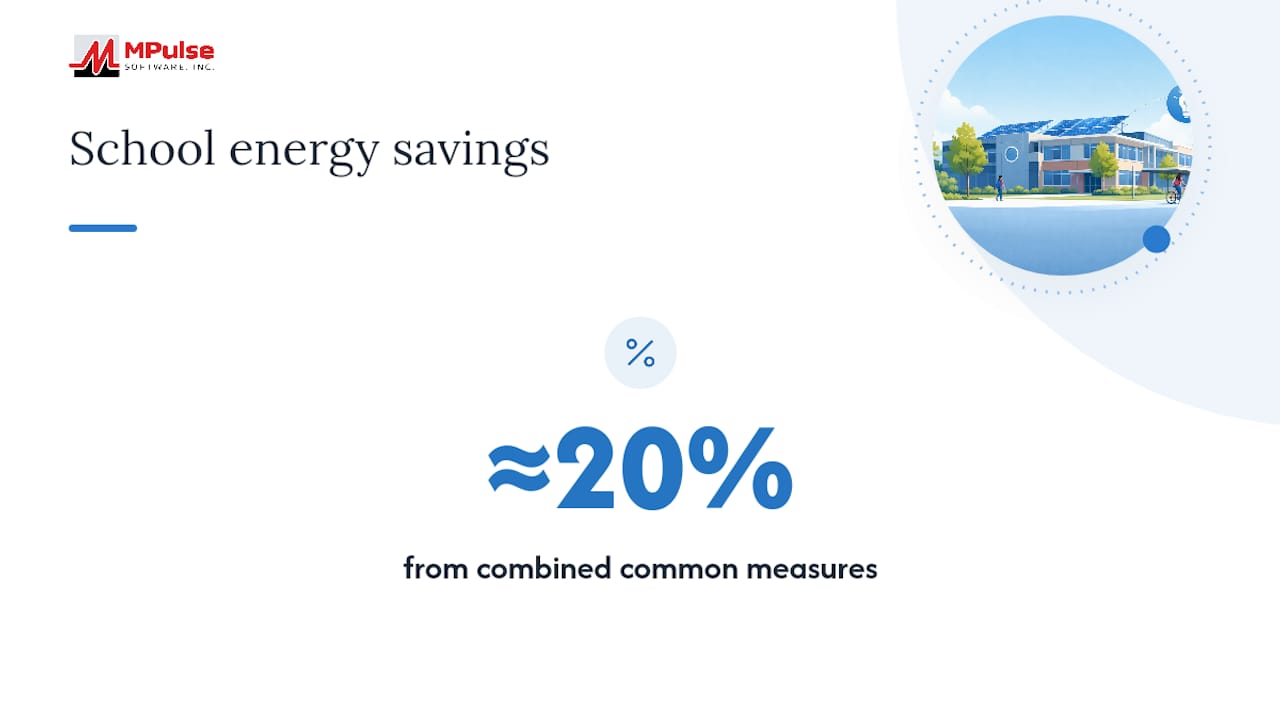
Schools that follow this order commonly cut annual energy costs by roughly 20% through common efficiency measures, according to state program guidance. Your next move: pull last year’s utility bills and open a free Portfolio Manager account, or walk your building with the ENERGY STAR K-12 checklist this week.
Key Takeaways
Sustained energy savings in schools come from sequencing low-cost fixes first, then locking in gains through preventive maintenance tracked in a CMMS.
| Point | Details |
|---|---|
| Benchmark before spending | Set up ENERGY STAR Portfolio Manager with 12 months of utility bills to establish a baseline score. |
| Fix lighting first | LED swaps plus occupancy sensors and daylight dimming deliver the fastest, lowest-cost savings. |
| Maintain HVAC on a schedule | Filter changes, coil cleaning, and calibrated thermostats protect efficiency without new equipment. |
| Seal the envelope before replacing | Weatherstripping and air sealing should come before window or roof capital projects. |
| Automate PM in a CMMS | Scheduled preventive maintenance keeps energy gains from eroding after the first year. |
Table of Contents
- Lighting Upgrades: The Fastest Path to Energy Efficiency, Tips That Pay Off
- HVAC Maintenance and Thermal Comfort Without the Guesswork
- Using Metering and Energy Management Systems to Target Waste
- Sealing the Building Envelope Before You Replace Anything
- Plug Loads, Water Use, and the Behavior Piece Nobody Budgets For
- Why Preventive Maintenance Is What Makes Savings Stick
- Benchmarking and Audits: How to Measure What You’re Actually Saving
- Funding, Rebates, and Where to Find Money for Efficiency Projects
- Efficiency Is Discipline, Not a Project
- Ready to Turn Maintenance Into Measurable Savings?
- Authoritative Resources and Program Links
- Sources
- FAQ
Lighting Upgrades: The Fastest Path to Energy Efficiency, Tips That Pay Off
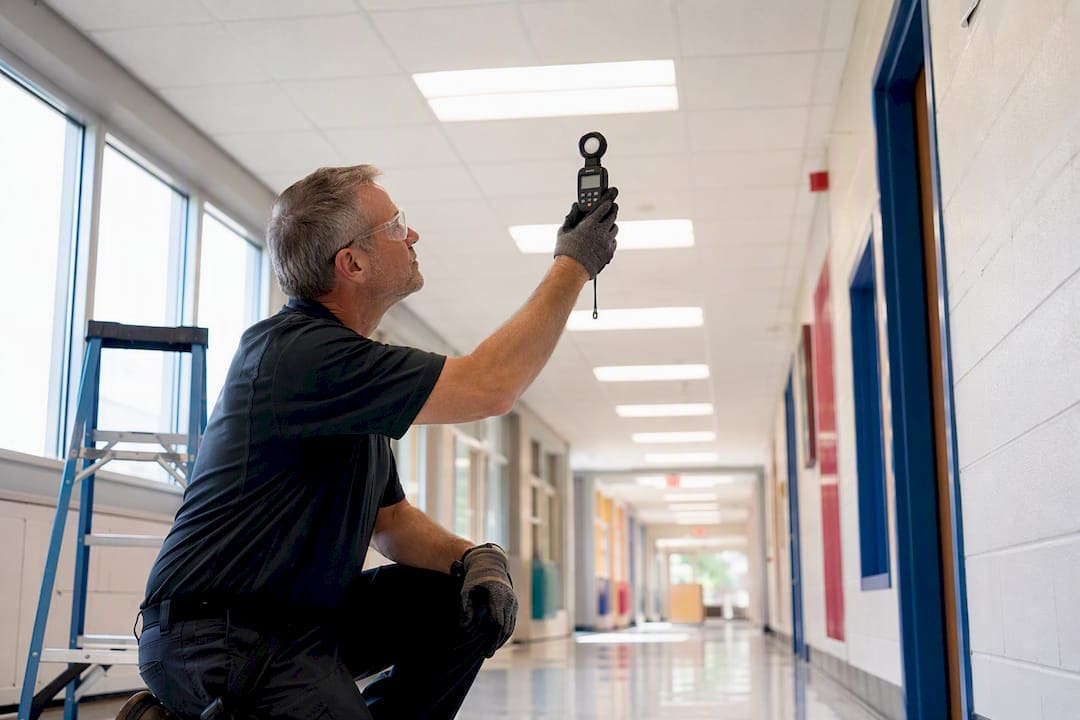
Lighting typically accounts for a large share of a school’s electric bill, and it’s the easiest system to fix without touching a budget line for capital projects. Before spending anything, clean fixtures and lenses, remove unnecessary bulbs in over-lit corridors, and confirm exit lighting isn’t running 24/7 for no reason. These no-cost steps alone can shave measurable kilowatt-hours off a monthly bill, and you can verify the change by comparing two billing cycles.
Controls come next, and where you put them matters:
- Occupancy sensors in classrooms, restrooms, and offices that go dark for hours at a stretch.
- Timers for exterior and parking-lot lighting tied to actual sunset schedules, not a fixed clock.
- Daylight dimming in gyms and cafeterias with large windows, where fixtures often run at full output on sunny afternoons.
Once the quick wins are logged, move to capital retrofits: TLED conversions in older T8 or T12 fixtures typically pay back fast, especially when bundled with a utility rebate application submitted before purchase, not after.
Pro Tip: Photograph fixture types and count them room by room before calling a contractor. A documented inventory speeds up rebate applications and gets you an accurate quote instead of a padded estimate.
HVAC Maintenance and Thermal Comfort Without the Guesswork
HVAC systems in schools often run inefficiently not because they’re outdated, but because basic maintenance slips during busy semesters. A short list of recurring tasks protects both efficiency and comfort:
- Replace or clean filters on a fixed schedule, not just when airflow visibly drops.
- Clean condenser and evaporator coils before peak cooling season.
- Inspect belts, bearings, and combustion components for wear that quietly drags down efficiency.
- Calibrate thermostats and verify sensor placement away from vents or direct sunlight.
Programmable thermostats with occupancy-based setbacks reduce conditioning during nights, weekends, and holiday breaks, though heat pump systems need care here: aggressive setbacks can trigger inefficient backup heat strips, so use a gradual recovery ramp instead of a wide swing.
Before replacing any unit, confirm it’s actually undersized or failing rather than just poorly maintained. Oversized replacement equipment cycles on and off more often, wasting energy and shortening equipment life. Verify results with basic airflow checks, a week of temperature logging, and a quick survey of teacher comfort complaints.
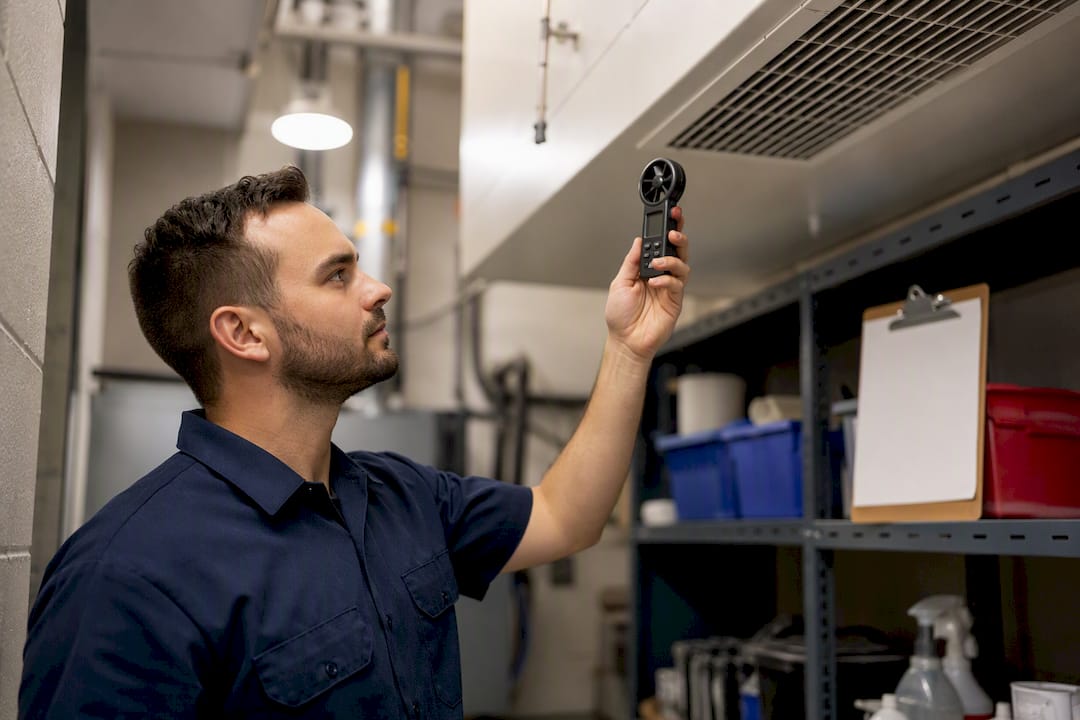
Pro Tip: A documented HVAC maintenance schedule makes the difference between guessing when a coil was last cleaned and knowing it.
Using Metering and Energy Management Systems to Target Waste
Utility interval data tells you when a building uses energy, but not which system is responsible. Submeters and a building automation system (BAS) close that gap. Prioritize submetering in these areas first, since they carry disproportionate load:
- Kitchens (refrigeration, hood exhaust, ovens running on fixed schedules regardless of use)
- Pools (pumps, heaters, and dehumidification running around the clock)
- Athletic field and stadium lighting
- HVAC zones serving gyms, auditoriums, and other high-volume spaces
A full energy management system adds scheduling and automated fault detection, catching a stuck damper or a thermostat overridden by a well-meaning teacher before it runs up a six-figure utility bill unnoticed. Monitoring data also becomes the evidence you need to justify a larger retrofit to a school board that wants numbers, not promises.
Sealing the Building Envelope Before You Replace Anything
A drafty envelope undermines every HVAC dollar you spend. Walk the building looking for daylight around door frames, gaps in attic insulation, and window seals that have hardened and cracked. These checks cost nothing but a flashlight and an hour.
- Fix the cheap items first: weatherstripping, door sweeps, and caulk at obvious gaps.
- Add window treatments (reflective film, insulated shades) in rooms with heavy solar gain.
- Reserve window replacement, roof coatings, and reflective roofing for capital planning, since these carry longer payback periods.
- Document every leak and insulation gap you find. That record becomes the justification for a capital request instead of a vague “the building feels drafty” complaint.
Air seal before you replace equipment. A tightened envelope often lets you right-size HVAC replacements smaller, cutting both equipment cost and future operating expense.
Plug Loads, Water Use, and the Behavior Piece Nobody Budgets For
Computers, printers, vending machines, and lab equipment left running overnight add up to real waste that no capital project fixes. Managed power strips with a master switch, sleep settings enabled fleet-wide, and scheduled shutdowns for computer labs over weekends recover energy that otherwise burns for no one.
- Lower water heater setpoints where code allows, and insulate hot water pipes running through unconditioned spaces.
- Install weather-based irrigation controllers so sports fields don’t get watered during a rainstorm.
- Launch a student-led energy patrol or classroom energy monitor program. Behavior change costs almost nothing and reinforces every technical upgrade you make.
- When replacing any appliance or fixture, check for the ENERGY STAR or WaterSense label before purchase, not after installation.
Why Preventive Maintenance Is What Makes Savings Stick
Energy-efficiency upgrades decay without maintenance behind them. A clogged filter or a slipping belt erases the benefit of a $50,000 lighting retrofit within a year if nobody’s tracking it. Core PM tasks like filter changes, belt inspection, lubrication, and sensor calibration each have a natural cadence, usually seasonal, and skipping that cadence is where savings quietly leak away.
A CMMS turns that cadence into something you can actually manage:
- Schedules recurring PMs automatically instead of relying on a paper checklist someone forgets in March.
- Documents completion with timestamps, useful when a board or auditor asks for proof of maintenance.
- Flags seasonal tasks (coil cleaning before summer, filter swaps before heating season) before they’re overdue.
- Provides analytics that connect PM completion rates to actual energy consumption over a semester.
A district that converts a manual HVAC checklist into scheduled CMMS tasks can typically measure the difference in consumption within a single season, not a school year.
Pro Tip: MPulse Software customers have reported efficiency improvements of up to 40% when preventive maintenance moves from paper to automated scheduling, largely because tasks stop getting skipped during busy stretches.
Benchmarking and Audits: How to Measure What You’re Actually Saving
- Gather 12 months of utility bills and enter square footage, occupancy, and building type into ENERGY STAR Portfolio Manager to generate a baseline score.
- Choose your audit depth: a walk-through catches obvious waste in a day, while an ASHRAE Level 2 audit produces detailed savings estimates and payback calculations for capital planning.
- Use the benchmark to rank measures by return, not by which contractor called first.
- Report your ENERGY STAR score to the board quarterly. A score of 75 or higher qualifies a building for ENERGY STAR certification, a concrete number that resonates with budget committees.
Funding, Rebates, and Where to Find Money for Efficiency Projects
Most schools underuse the funding already available to them. Utility rebate programs, state grants, and performance contracting can offset a large share of project cost when applied for correctly.
- Request a free utility energy audit before committing to any equipment purchase.
- Bundle multiple measures into one project, since many rebate programs set minimum thresholds a single lighting swap won’t meet alone.
- Document your Portfolio Manager baseline and any measured savings from submetering. Funders want evidence, not estimates.
- Contact the DOE’s Efficient and Healthy Schools program for technical assistance before finalizing scope, and loop procurement in early so rebate paperwork doesn’t stall a purchase order.
Staff training also pays off here. Programs through groups like the ESG Training Institute help facilities staff build the sustainability certifications that increasingly matter when applying for state and utility funding.
Efficiency Is Discipline, Not a Project
The mistake most districts make is treating energy efficiency as a series of projects with a ribbon-cutting and an end date. It isn’t. A lighting retrofit or an HVAC tune-up buys you a temporary savings curve that starts flattening the moment maintenance lapses. What separates schools that keep those savings from schools that lose them within two years is whether the work becomes a recurring operational habit.
That’s where a CMMS earns its place, not as software for software’s sake, but as the mechanism that keeps a filter change from becoming an optional task in a busy month. Scheduling seasonal HVAC PMs, coil cleaning before summer, filter swaps before heating season, inside a system that timestamps completion gives you something a spreadsheet never will: a record you can compare against your energy baseline.
A reasonable pilot: pick one building, schedule seasonal PMs in a CMMS, and track energy use and downtime for 90 days against the prior year. The comparison usually tells you everything the sales pitch couldn’t.
Ready to Turn Maintenance Into Measurable Savings?
Every measure covered here, from lighting controls to HVAC setbacks to envelope sealing, depends on maintenance actually happening on schedule. That’s the piece most schools get wrong, not the technology choice. MPulse Software’s CMMS platform automates preventive maintenance scheduling, documents completion for audits and boards, and gives facilities teams the analytics to prove energy savings rather than estimate them. If you’re ready to pilot a 90-day preventive maintenance program, start with the building that’s costing you the most and build from there.
Authoritative Resources and Program Links
- ENERGY STAR K-12 checklist: step-by-step benchmarking and audit actions.
- DOE Efficient and Healthy Schools: technical assistance for schools.
- EnergySmart Schools O&M guide: preventive maintenance and commissioning practices.
- MPulse CMMS: software to schedule and document ongoing energy-saving maintenance.
Sources
- Efficient and Healthy Schools | Department of Energy
- Energy and Water Efficiency Checklist for K – 12 Schools (ENERGY STAR)
- Guide to Operating and Maintaining EnergySmart Schools (EnergySmart Schools O&M guide)
- Saving Energy at School (CoolCalifornia)
FAQ
What are some ways to conserve energy at school?
Start with lighting controls, HVAC setbacks during unoccupied hours, and plug-load management on computers and lab equipment. Pair these with a benchmarking baseline in ENERGY STAR Portfolio Manager so you can measure the results.
What are the best energy-saving tips for a school facility?
The highest-impact tips are benchmarking utility data, upgrading to LED lighting with occupancy sensors, and keeping HVAC systems on a preventive maintenance schedule. State guidance suggests common measures like these can cut school energy costs by around 20%.
What are some low-cost ways to improve energy efficiency?
Clean lighting fixtures, seal air leaks with weatherstripping, calibrate thermostats, and set computer labs to sleep mode overnight. None of these require capital budgets, and most pay back within a single billing cycle.
How often should HVAC systems be serviced for efficiency?
Filters typically need attention monthly to quarterly depending on usage, while coil cleaning and belt inspection should happen at least once before each heating and cooling season. A documented maintenance schedule keeps these tasks from slipping.
Does preventive maintenance actually reduce energy costs?
Yes. Official guidance identifies preventive maintenance and commissioning as top drivers of sustained energy savings, because they stop efficiency gains from eroding once equipment starts to drift out of tune.