Technician route optimization sequences and assigns maintenance work so technicians spend less time driving and more time fixing, which directly reduces travel costs, increases jobs completed per day, and improves both SLA compliance and first-time-fix rates. This is the core role of technician route optimization in maintenance: converting idle windshield time into productive wrench time. Formally, the problem belongs to a family of combinatorial optimization challenges known as the Vehicle Routing Problem (VRP) and its field-service variant, the Technician Routing and Scheduling Problem (TRSP). When integrated with predictive maintenance (PdM) scheduling, research shows that optimized approaches can reduce production downtime by roughly 25% compared to non-optimized PdM methods.
The four immediate operational effects managers see after enabling routing optimization:
- Lower drive time and mileage: Technicians follow geographically clustered sequences rather than crisscrossing territories.
- Higher technician utilization: Fewer hours lost to travel means more billable or productive hours per shift.
- Improved SLA compliance: Time-window constraints are built into the optimizer, so high-priority jobs are anchored first.
- Reduced overtime: Tighter scheduling leaves less slack that accumulates into end-of-day overruns.
Key Takeaways
Technician route optimization reduces drive time, increases jobs per day, and improves SLA compliance when scheduling and routing are solved together using accurate service-time data and a CMMS-integrated workflow.
| Point | Details |
|---|---|
| Measure drive time first | Establish a baseline for drive time, miles, and jobs per day before enabling any optimizer. |
| Cluster PMs geographically | Zone-based PM grouping cuts travel time even before algorithmic routing is applied. |
| Validate service-time data | Accurate job duration estimates are the single most important input for reliable ETAs and schedules. |
| Joint scheduling and routing | Solving maintenance selection and technician routing together reduces travel cost and improves reliability outcomes. |
| MPulse Software as the data foundation | MPulse provides the work-order, asset, parts, and mobile data that a routing optimizer requires, with API integration for routing engine connections. |
Table of Contents
- Why does route optimization matter for maintenance teams?
- How does technician route optimization actually work?
- Why should you solve scheduling and routing together?
- What practical routing techniques work best in maintenance?
- How do you implement route optimization in your maintenance operation?
- What KPIs and ROI metrics should you track after enabling routing?
- What challenges will you face, and how do you overcome them?
- What software features should you require from vendors?
- What does the research show about routing and maintenance optimization?
- How does MPulse Software support route-optimized maintenance?
- A maintenance leader’s perspective on route optimization
- MPulse Software makes your routing pilot easier to start
- Sources
- FAQ
Why does route optimization matter for maintenance teams?
The business case for technician route planning rests on a straightforward equation: every minute a technician spends driving is a minute not spent maintaining or repairing equipment. At scale, that inefficiency compounds into measurable cost and reliability gaps.
Primary benefits and what they mean operationally:
- Reduced drive time and mileage: Geographic clustering of preventive maintenance (PM) visits cuts unnecessary cross-territory travel.
- Lower travel costs: Fewer miles driven reduces fuel consumption, vehicle wear, and fleet operating costs.
- More jobs per technician per day: Even recovering a moderate amount of drive time per technician per day can add one additional job to the daily schedule.
- Improved on-time arrival and SLA compliance: Optimized sequences account for appointment windows, so technicians arrive when expected.
- Higher first-time-fix rate: Skill-based and parts-aware dispatching means the right technician with the right parts arrives the first time.
These benefits translate directly into ROI through three levers. First, labor leverage: each additional job a technician completes per day multiplies revenue or reduces the headcount needed to cover the same workload. Second, fuel and vehicle savings: mileage reductions compound across a fleet over a year. Third, downtime avoidance: faster, better-scheduled maintenance means assets spend less time offline, which carries a production cost value that often exceeds the labor savings alone.
Maintenance optimization frameworks like reliability-centered maintenance (RCM) have long emphasized that the goal is not just doing maintenance, but doing the right maintenance at the right time. Route optimization adds the third dimension: performing it with the right technician, in the right sequence.
KPIs to track from day one:
- Average technician drive time (minutes per day)
- Miles driven per technician per day
- Jobs completed per technician per day
- First-time-fix rate (%)
- On-time arrival rate (%)
- Technician utilization (productive hours / total shift hours)
- Overtime hours per week
- Mean time to repair (MTTR)
- Total downtime avoided (hours)
Setting baseline values for each of these before enabling routing optimization gives you the comparison data needed to quantify ROI and make the business case to leadership.
How does technician route optimization actually work?
Route optimization is not a single algorithm. It is a layered system that takes structured inputs, applies mathematical or heuristic logic to satisfy a set of constraints, and outputs an ordered sequence of jobs with assigned technicians and estimated arrival times.
Algorithm families
The TRSP formalizes the problem of routing technicians to service requests with time windows, required skills, tools, and spare parts. Matheuristic approaches that combine constructive heuristics, Adaptive Large Neighborhood Search (ALNS), and post-optimization can closely match optimal solutions on benchmark instances. The main algorithm families managers will encounter:
- VRP / TRSP: The foundational problem formulations that define feasibility constraints and objective functions.
- Constructive heuristics (k-nearest, savings algorithm): Fast, good-enough starting solutions built by iteratively adding jobs to routes.
- 2-opt and local search: Improvement passes that swap job sequences to reduce total distance or time.
- Metaheuristics (ALNS, simulated annealing, genetic algorithms): Broader search methods that escape local optima; maintenance optimization reviews identify these as particularly promising under Industry 4.0 conditions.
- Machine learning and reinforcement learning: Emerging approaches that learn dispatch policies from historical data and adapt dynamically.
Required inputs
| Input | Description |
|---|---|
| Asset / job location | Geo-coordinates (lat/long) for each work order site |
| Service time estimate | Expected duration at the job site (minutes) |
| Appointment window | Earliest start and latest finish for each job |
| Skill required | Certification or qualification needed for the task |
| Parts required | Components the technician must carry |
| Technician shift | Start time, end time, starting location |
| Travel-time model | Road network or average-speed matrix, ideally with peak traffic |
Algorithm outputs
- Ordered job sequence per technician
- Estimated time of arrival (ETA) for each stop
- Assigned technician ID and skill match confirmation
- Total route distance and duration
- Flagged unassigned jobs (constraint violations)
Pro Tip: Service-time accuracy is the single biggest driver of ETA reliability. An optimizer fed with optimistic service times will produce schedules that collapse by midday.
Real-time Industry 4.0 sensor data enables dynamic re-prioritization: as asset health signals change during the day, the optimizer can re-sequence remaining jobs to address the highest-risk assets first, without waiting for the next morning’s planning cycle.
Why should you solve scheduling and routing together?
Most maintenance operations plan what to maintain separately from how to route technicians to do it. That sequential approach leaves significant efficiency on the table. Joint optimization research shows that combining condition-based maintenance selection with technician routing into a single mixed-integer program reduces travel-related costs and improves decision quality compared to solving the two problems independently.
The concept works like this: instead of first deciding which machines need service this week and then figuring out how to route technicians to them, a joint model selects which maintenance operations to perform, schedules the timing, and sequences the technician routes simultaneously. The result is a plan that clusters at-risk assets geographically, minimizes total travel, and respects both reliability targets and shift constraints.
Managers who integrate PdM scheduling with routing optimization are solving a bi-objective problem: maximize reliability improvement (or minimize expected failure cost) while minimizing service and travel cost. Research on bi-objective maintenance and routing models shows that adaptive neighborhood search algorithms can produce Pareto-efficient solutions, giving managers a menu of trade-offs between reliability and cost rather than a single forced answer.
A practical flow for implementing this looks like:
- Asset health data (IoT sensors, CMMS condition records) feeds a remaining useful life (RUL) or failure-probability model.
- PdM/PM scheduler selects which assets need intervention in the planning window.
- Joint optimizer assigns technicians, sequences routes, and schedules maintenance windows together.
- Route plan is pushed to mobile dispatch for execution.
- Execution feedback (actual job times, outcomes) updates the model.
A reliability-and-cost framework that jointly optimizes maintenance planning and diverse-skilled technician routing for geographically distributed systems produces Pareto solutions that balance reliability gains with service cost reductions, with decision variables covering maintenance start time, maintenance level, team composition, and routes.
The survival-analysis PdM study that reported roughly 25% lower production downtime used Cox proportional hazards, random survival forests, and gradient boosting survival analysis to estimate RUL, then applied simulated annealing to schedule interventions. That combination of statistical modeling and optimization is the template for a joint approach.
What practical routing techniques work best in maintenance?
Theory is useful, but facility managers need tactics they can apply this week. The following techniques deliver routing wins without requiring a full algorithmic overhaul.
High-impact techniques:
- Cluster PMs by geography: Group preventive maintenance visits in the same zone on the same day. Even manual zone-based scheduling cuts drive time before any algorithm is involved.
- Anchor fixed-window jobs first: Schedule customer-committed or SLA-critical appointments before filling in flexible work. The optimizer builds around these anchors.
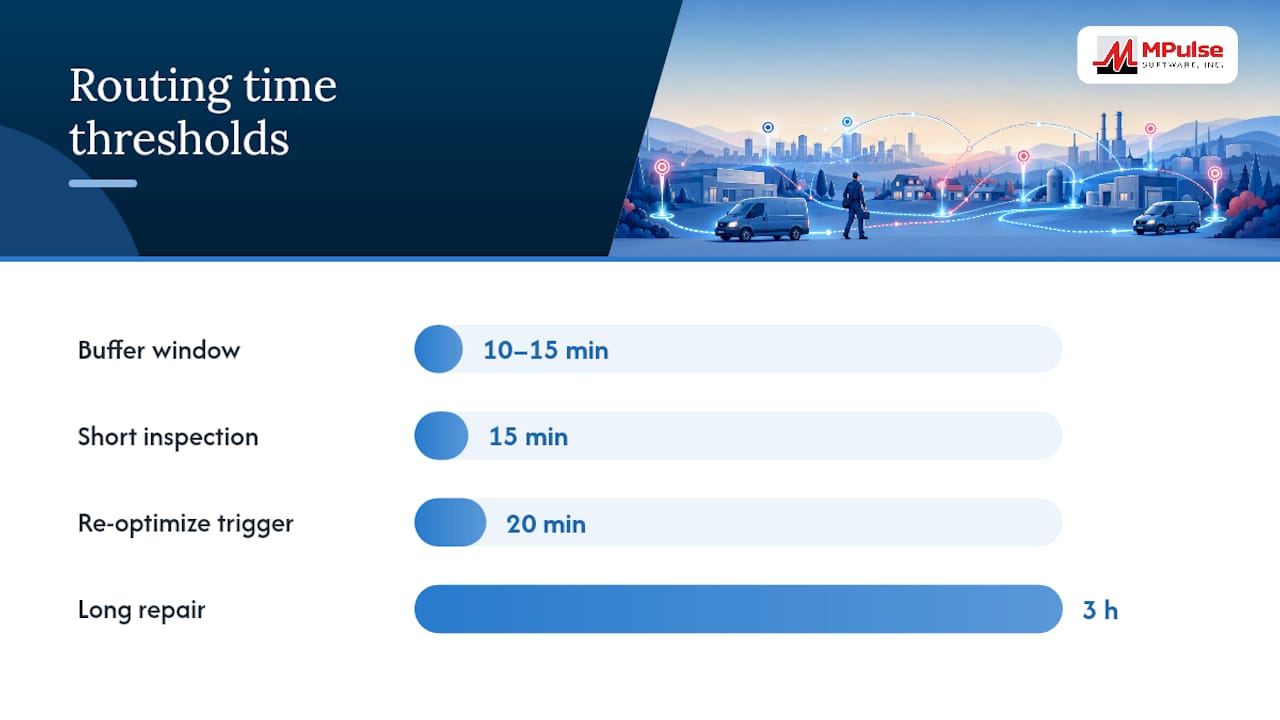
- Sequence by job type and service time: Grouping similar job types reduces setup variability and makes ETAs more predictable. Avoid mixing 15-minute inspections with 3-hour repairs in the same route without buffers.
- Enforce skill-part matching at dispatch: Never assign a job without confirming the technician holds the required certification and has the parts on the truck. A mobile maintenance management system that surfaces this check at dispatch prevents costly return visits.
- Pre-check parts and inventory before dispatch: A parts-availability check the evening before or morning of dispatch eliminates the most common cause of first-visit failures.
- Use buffer windows for variability: Build 10–15 minute buffers between jobs in routes with high service-time variance. Removing buffers to fit one more job often costs two jobs when the schedule collapses.
Static vs. dynamic routing:
Static daily planning works well when most jobs are planned PMs with predictable durations. Build the route the night before, push it to technicians in the morning, and hold it unless an emergency arises. Dynamic real-time re-sequencing is worth the added complexity when your operation has a high proportion of reactive work, when IIoT sensor feeds trigger unplanned interventions during the day, or when traffic variability significantly affects ETAs. Most operations benefit from a hybrid: static planning with a defined re-optimization trigger (for example, any emergency job that displaces more than 20 minutes of scheduled work).
Daily dispatcher checklist:
- Anchor high-priority and fixed-window jobs before filling flexible slots.
- Confirm skill and parts match for every assignment.
- Flag routes where total service time plus estimated drive time exceeds 85% of shift length.
- Re-optimize after any emergency add-on that displaces more than one scheduled job.
- Review previous day’s actual vs. estimated job durations and update service-time records.
Pro Tip: Group jobs by service time within each route. A route that mixes very short and very long jobs creates a “tail effect” where one long job late in the day causes all subsequent jobs to slip. Keeping similar-duration jobs together makes the schedule self-correcting.
How do you implement route optimization in your maintenance operation?
Implementation succeeds or fails on data quality and scope management. A phased pilot approach reduces risk and builds organizational confidence before full rollout.
Minimum data and system checklist
Before running any optimizer, confirm you have:
- Validated geo-coordinates for every asset or service location
- Accurate service-time estimates by job type (from historical CMMS data)
- A current skills matrix mapping each technician to their certifications and qualifications
- Parts-on-truck inventory records or a pre-dispatch parts check process
- Historical job duration data (at least 90 days, by job type)
- A travel-time model (road network API or average-speed matrix with peak-hour adjustments)
Integration requirements
- CMMS work-order API or scheduled export to feed job data to the routing engine
- Mobile dispatch capability so route plans reach technicians in real time
- GPS or telematics feed (optional but strongly recommended for ETA accuracy and re-optimization triggers)
- Inventory or parts management integration to validate parts availability at dispatch
- Technician qualifications database linked to job skill requirements
Contractor scheduling strategies that reduce downtime follow the same data prerequisites, whether the workforce is internal or contracted.
Pilot plan
- Define pilot scope and KPIs (weeks 1–4): Select a single territory or team of 5–10 technicians. Define baseline KPIs: drive time, jobs per day, first-time-fix rate, on-time arrival. Agree on success thresholds.
- Collect and clean data (weeks 2–5): Pull 90 days of job history from your CMMS. Validate coordinates, service times, and skill assignments. Correct obvious outliers.
- Run a controlled pilot (weeks 5–10): Apply routing optimization to the pilot group only. Run the optimized schedule alongside the old method for the first two weeks to build dispatcher confidence.
- Measure KPIs and iterate (weeks 9–12): Compare pilot KPIs to baseline. Adjust service-time buffers, constraint parameters, and zone boundaries based on what the data shows.
- Scale gradually: Expand to additional territories one at a time, carrying forward the parameter settings validated in the pilot.
Quick wins to validate before full rollout:
- Accurate service-time estimates for your top 10 most common job types
- Standardized job templates in your CMMS (consistent skill tags, parts lists, duration estimates)
- Zone-based scheduling for PM visits (even without an algorithm, zones reduce drive time)
- A dispatcher habit of anchoring fixed-window jobs before filling flexible slots
What KPIs and ROI metrics should you track after enabling routing?
Measurement is what separates a successful routing program from an experiment that fades after the pilot. Track operational KPIs daily and roll them into an ROI calculation monthly.
| KPI | Definition | Formula | Target Example |
|---|---|---|---|
| Drive time per tech | Avg. minutes/day spent traveling between jobs | Total drive minutes ÷ technician-days | Reduce by 20% from baseline |
| Miles per tech per day | Avg. miles driven per technician per day | Total miles ÷ technician-days | Reduce by 15–25% from baseline |
| Jobs per tech per day | Avg. completed jobs per technician per shift | Total jobs completed ÷ technician-days | Increase by 1–2 jobs/day |
| First-time-fix rate | % of jobs resolved without a return visit | Jobs fixed first visit ÷ total jobs | Target 85%+ |
| On-time arrival rate | % of jobs started within the appointment window | On-time arrivals ÷ total appointments | Target 90%+ |
| Technician utilization | Productive hours as % of total shift hours | Productive hours ÷ shift hours | Target 85% |
| Overtime hours | Total overtime hours per week across the team | Sum of hours beyond standard shift | Reduce by 25–30% |
| MTTR | Avg. time from work order open to asset restored | Total repair time ÷ number of repairs | Track trend, reduce over time |
ROI calculation examples:
- Labor leverage: If routing adds one job per technician per day across a team of 20 technicians, and each job generates $150 in value (labor rate or revenue equivalent), that is $3,000 per day or roughly $750,000 per year before accounting for weekends and holidays.
- Fuel and vehicle savings: A 20% mileage reduction across a fleet of 20 vehicles driving an average of 80 miles per day at $0.67 per mile saves approximately $43,000 per year.
- Downtime avoidance: Each hour of production downtime avoided carries a cost that varies by facility, but even a conservative $500 per hour figure means preventing 10 hours of downtime per month saves $60,000 annually.
Measure operational KPIs daily using your CMMS and dispatch system. Run the full ROI calculation monthly for the first six months, then quarterly once the program stabilizes. Maintenance scheduling optimization practices that tie KPIs to scheduling decisions make this measurement cycle sustainable.
What challenges will you face, and how do you overcome them?
Adoption challenges are predictable. Knowing them in advance lets you build mitigations into the pilot plan rather than discovering them mid-rollout.
Common challenges and mitigations:
- Poor data quality (wrong coordinates, inaccurate service times): Run a data-cleaning sprint before the pilot. Validate coordinates against satellite imagery for your top 50 assets. Recalculate service-time estimates from 90 days of actual job durations, not planner estimates.
- Parts availability mismatch: Implement a parts pre-check the evening before each dispatch cycle. Flag any job where required parts are not confirmed on the truck or in a nearby storeroom, and reschedule rather than dispatch blind.
- Rigid customer appointment windows: For non-critical jobs, negotiate wider windows (for example, a 4-hour window instead of a 1-hour window) with customers or internal stakeholders. Wider windows give the optimizer more flexibility and produce better overall routes.
- Technician resistance to change: Technicians often resist algorithmic routing because it feels like surveillance or because they distrust the schedule. Address this directly: involve technicians in the pilot design, explain the logic behind the sequence, and share the wins (minutes saved, fewer late days) with the team.
- Unexpected traffic or site delays: Build re-optimization triggers into the dispatcher workflow. When a job runs more than 20 minutes over estimate, the dispatcher re-runs the optimizer for the remaining route rather than letting the delay cascade.
- Infeasible constraints producing unassigned jobs: When the optimizer cannot fit all jobs within constraints, review which constraints are truly hard (regulatory, safety) versus soft (preference-based). Relaxing soft constraints on low-priority jobs frees capacity for critical ones.
Pro Tip: Share early pilot results with technicians in concrete terms: “This week, the optimized routes saved each of you an average of 28 minutes of driving per day.” Technicians who see a direct personal benefit become advocates rather than resistors. That shift in attitude is worth more than any algorithm parameter tuning.
What software features should you require from vendors?
Not all field service or CMMS platforms handle routing with equal depth. When evaluating vendors, require these capabilities before committing.
Feature checklist:
- Multi-vehicle, multi-technician optimization (not just single-route sequencing)
- Skills-aware and parts-aware dispatching that validates matches at assignment time
- Time-window handling with hard and soft constraint differentiation
- Real-time re-optimization triggered by job completion, emergency add-ons, or traffic delays
- Mobile app with turn-by-turn navigation, geotagging, and offline mode for poor-coverage areas
- API access to CMMS work orders for bidirectional data flow
- Telematics integration for live vehicle location and ETA updates
- Configurable constraint parameters (buffer times, skill weights, SLA priority tiers)
Integration prerequisites:
- CMMS work-order API or scheduled export/import
- Parts and inventory sync so parts availability is visible at dispatch
- Technician qualifications database linked to job skill requirements
- GPS or telematics feed for live location and re-optimization triggers
- A method to surface run sheets and ETAs to technicians on mobile devices
On scalability: confirm the vendor’s optimizer handles your territory density and technician count without degrading solution quality or runtime. A solver that works well for 10 technicians may produce poor solutions or time out for 100. Ask for benchmark results at your scale. Also confirm vendor SLA expectations for parameter tuning support during onboarding, because the default constraint settings rarely match your operation’s specific mix of job types and windows.
Advanced CMMS customization capabilities matter here: a platform that allows configurable workflows and integration hooks gives you the flexibility to connect a specialized routing engine without replacing your existing maintenance data infrastructure.
What does the research show about routing and maintenance optimization?
The academic evidence for joint optimization of routing and maintenance scheduling has grown substantially over the past decade, and the practical implications for facility managers are clear.
Joint optimization models that combine condition-based maintenance selection with technician routing reduce travel-related costs and can be formulated as mixed-integer programs. Heuristic approaches build routes by iteratively adding maintenance operations to technician routes, producing solutions that are both computationally tractable and operationally realistic.
The reliability-and-cost framework for diverse-skilled technician routing demonstrates that Pareto solutions give managers a structured way to trade off reliability improvement against service cost, with decision variables covering maintenance start time, maintenance level, team composition, and routes.
The most headline-worthy finding for managers making the business case: a PdM framework integrating survival-analysis RUL estimation with production-aware scheduling and simulated annealing optimization reported roughly 25% lower production downtime compared to non-optimized PdM in validation experiments. The conditions: the framework used Cox proportional hazards, random survival forests, and gradient boosting survival analysis for RUL estimation, combined with a scheduling optimizer that accounts for production constraints.
Maintenance optimization reviews identify metaheuristic search algorithms and reinforcement-learning approaches as the most promising directions for maintenance optimization under Industry 4.0, and flag the need for methods that handle heterogeneous data and multiple objectives simultaneously. The practical implication: platforms that expose configurable metaheuristic parameters or that incorporate ML-based dispatching will outperform simpler solvers as your operation’s data matures.
Real-time Industry 4.0 integration using IoT sensor feeds enables dynamic re-prioritization and re-sequencing of maintenance tasks, directing labor to the highest-impact assets as their health signals change during the day. This is the direction the field is moving, and it is already achievable with current sensor and CMMS technology.
How does MPulse Software support route-optimized maintenance?
A routing optimizer is only as good as the data feeding it. MPulse Software’s CMMS provides the structured maintenance data foundation that route optimization requires, and its integration capabilities allow organizations to connect specialized routing engines without rebuilding their data infrastructure.
MPulse capabilities mapped to routing requirements:
- Work-order and asset data: Every job carries location, skill requirement, estimated duration, and parts list, the exact inputs a routing optimizer needs.
- Calendar scheduling interface: Preventive maintenance schedules are visible in a calendar view, making zone-based clustering and anchor-job planning straightforward for dispatchers.
- Inventory and parts management: Parts availability is tracked at the item level, supporting the pre-dispatch parts check that prevents first-visit failures.
- Mobile work-order execution: Technicians receive and complete work orders on mobile devices, with barcode scanning for parts confirmation and geotagging for arrival verification.
- API and integration capability: MPulse connects to ERP systems, sensor feeds, and third-party routing engines, supporting the bidirectional data flow that a routing-enabled operation requires.
- Reporting and analytics: KPI dashboards track drive time, jobs per day, first-time-fix rate, and utilization, giving managers the measurement infrastructure to quantify routing ROI.
Implementation checklist for a routing-enabled MPulse pilot:
- Export 90 days of work-order history from MPulse, including job type, location, duration, technician, and outcome.
- Validate asset coordinates and service-time estimates against actual job records.
- Configure skill tags and parts lists on your top 20 most common job templates.
- Connect MPulse to your routing engine via API or scheduled export.
- Set up the KPI dashboard to track drive time, jobs per day, and first-time-fix rate from day one of the pilot.
- Enable mobile work-order execution for the pilot technician group.
Preventive maintenance automation through MPulse generates the structured PM schedules that a joint optimizer needs to cluster visits geographically and sequence routes efficiently.
A maintenance leader’s perspective on route optimization
When our team first looked at routing optimization, the honest reaction was skepticism. Dispatchers had been building routes manually for years and believed they knew the territory better than any algorithm. The pilot changed that view quickly.
We started with a group of eight technicians in a single zone. Within the first three weeks, average drive time dropped by 22 minutes per technician per day, and each technician completed one additional job on most days. Those numbers were not projections. They came from the same CMMS data the team had been collecting for two years, finally being used to close the loop.
The change that mattered most was not the algorithm. It was the discipline of validating service-time estimates before the pilot started. Once the schedule was built on accurate durations, the rest followed.
MPulse Software makes your routing pilot easier to start
Facilities that have accurate work-order data, a structured PM schedule, and mobile dispatch already have most of what a routing pilot requires. MPulse Software brings those elements together in one platform, so you are not assembling a data pipeline from scratch before you can test the approach.
MPulse’s maintenance management platform gives dispatchers a calendar-based scheduling interface, technicians a mobile work-order app, and managers a KPI dashboard, all connected through an integration layer that supports routing engine connections. Over 3,500 organizations use MPulse to manage preventive maintenance, track assets, and control parts inventory. The ongoing improvement services team can support your pilot configuration and parameter setup so you reach measurable results faster. Start by requesting a demo to see how MPulse’s data structure maps to your routing requirements.
Sources
- Survival Analysis-Based System for Predictive Maintenance Optimization | SN Computer Science
- Information journal article on real-time adaptability in maintenance (MDPI)
- Maintenance optimization review (ScienceDirect)
- A reliability-and-cost-based framework to optimize maintenance planning and diverse-skilled technician routing for geographically distributed systems
FAQ
How does route optimization work for maintenance technicians?
Route optimization applies algorithms (VRP, TRSP, or heuristics like ALNS) to sequence and assign jobs so technicians travel the shortest feasible distance while respecting time windows, skill requirements, parts availability, and shift constraints. The optimizer takes structured inputs from a CMMS and outputs an ordered job sequence with ETAs for each technician.
How do I optimize my technician routes without a dedicated routing tool?
Start with zone-based scheduling: assign technicians to geographic territories and cluster all PM visits in the same zone on the same day. Anchor fixed-window or SLA-critical jobs first, then fill remaining slots with flexible work in proximity order. This manual approach captures a significant portion of the routing benefit before any algorithm is involved.
What is a route optimization algorithm and how does it apply to maintenance?
A route optimization algorithm is a mathematical or heuristic method that finds the best sequence of stops for one or more technicians given a set of constraints. In maintenance, the constraints include appointment windows, required skills, parts on the truck, and shift length. Algorithms range from simple nearest-neighbor heuristics to metaheuristics like simulated annealing, which the survival-analysis PdM study used to schedule maintenance interventions and reduce downtime by roughly 25%.
Can AI improve maintenance route optimization?
Yes. Reinforcement-learning and machine-learning approaches are increasingly used for dynamic dispatch decisions, learning from historical job data to predict service times and prioritize tasks. Maintenance optimization reviews identify these as among the most promising methods, particularly for operations with heterogeneous job types and multiple competing objectives. IoT sensor integration further enables real-time re-sequencing as asset health changes during the day.

What ROI can a maintenance team realistically expect from route optimization?
ROI depends on baseline inefficiency, but operations that recover 20–30 minutes of drive time per technician per day typically see one additional job per technician per day and measurable reductions in overtime and fuel costs. The labor-leverage effect alone, calculated as extra jobs per technician multiplied by the value per job, often justifies the investment within the first year of a well-executed pilot.