
Audit trail maintenance is the ongoing practice of preserving tamper-evident, time-ordered logs and regularly testing their recoverability. Get that right and you satisfy most compliance and forensic needs at once. The single highest-priority action is not storing more data. It is proving, on a recurring schedule, that the data you already have is intact and restorable when someone actually needs it.
TL;DR:
- Regular testing of data recoverability ensures audit trail integrity and compliance, with a focus on verifying that stored logs are intact and restorable.
- Maintaining a normalized, correlated set of logs across application, database, operating system, network, and SIEM sources is critical for effective forensic reconstruction and intrusion detection.
- Implementing cryptographic hash chains, immutable storage, and synchronized timestamps makes logs tamper-evident and supports reliable integrity verification.
- Retention policies should match the strictest regulatory requirements, with scheduled restore drills and manual overrides for legal holds to prevent accidental data loss.
- Automated, timestamped maintenance records simplify audit readiness by capturing all technician actions and system events, reducing reconstruction effort during audits.
Table of Contents
- What Counts as an Audit Trail Maintenance Program
- Why Audit Trail Maintenance Matters Beyond Compliance
- Setting Retention Periods and Handling Legal Holds
- Integrity Controls That Make Logs Tamper-Evident
- Building a Review Rhythm That Actually Gets Followed
- Choosing Tools Without Locking Into One Vendor’s Assumptions
- Your Audit Trail Maintenance Runbook
- How MPulse Software Keeps Maintenance Records Audit-Ready
- Where to Put Your Effort First
- Get Your Maintenance Records Audit-Ready
- Sources
- FAQ
What Counts as an Audit Trail Maintenance Program
An audit trail is a chronological record that lets someone reconstruct exactly what happened on a system. The NIST glossary defines it as records capable of reconstructing system activity by capturing who performed an action, what the action was, when it occurred, and where it took place. A mature record also captures the before and after state of whatever changed, which is what turns a log entry into evidence rather than a guess.
Maintenance means keeping several distinct log sources healthy and correlated, not just one database table. The main categories worth tracking are:
- Application logs: user actions inside business software, like a work order status change or an approval.
- Database unified audit trails: native DB-level records of queries, schema changes, and privileged access.
- Operating system logs: auditd on Linux or Windows Event Log, covering logins, file access, and privilege escalation.
- Network logs: firewall, VPN, and proxy records showing connection attempts and data flows.
- SIEM aggregation: a centralized platform correlating events across all the above in near real time.
At minimum, normalize every record to include actor identity, action type, timestamp, source system, and affected object. Skip normalization and you end up with five log formats that cannot be searched together during an actual investigation.
Why Audit Trail Maintenance Matters Beyond Compliance
Regulators want evidence, but that is only one reason to keep this discipline tight. A well-maintained record set does several jobs simultaneously, and most organizations only notice the gaps when it is too late to fix them.
- Regulatory evidence: auditors need proof of who touched what, and a broken chain of custody can invalidate an otherwise clean compliance posture.
- Forensic reconstruction: after a breach or an unexplained outage, logs are often the only way to determine the actual sequence of events.
- Intrusion detection: unusual access patterns, like a service account logging in at 3 a.m., surface faster when logs are centralized and monitored.
- Change auditing: knowing exactly which technician modified a maintenance schedule, and when, resolves disputes before they escalate.
- Vendor verification: contractors and third-party integrators leave a trail too, which matters when a piece of outsourced work fails inspection.
The HIPAA Security Rule requires organizations handling electronic health information to build audit controls directly into their security program, not bolt them on afterward, according to HHS guidance. That requirement reflects a broader pattern across regulated industries: audit trails are treated as a control, not a byproduct of running the software.
Setting Retention Periods and Handling Legal Holds
Retention decisions trip up more compliance programs than any technical control. The safest rule of thumb: when multiple regulations or contracts apply to the same data, retain it for the length of the strictest one. A manufacturer under both SOX financial-reporting obligations and a customer contract specifying seven-year retention keeps records for seven years, not the shorter SOX minimum. The same logic applies when PCI DSS, HIPAA, or industry-specific rules overlap.
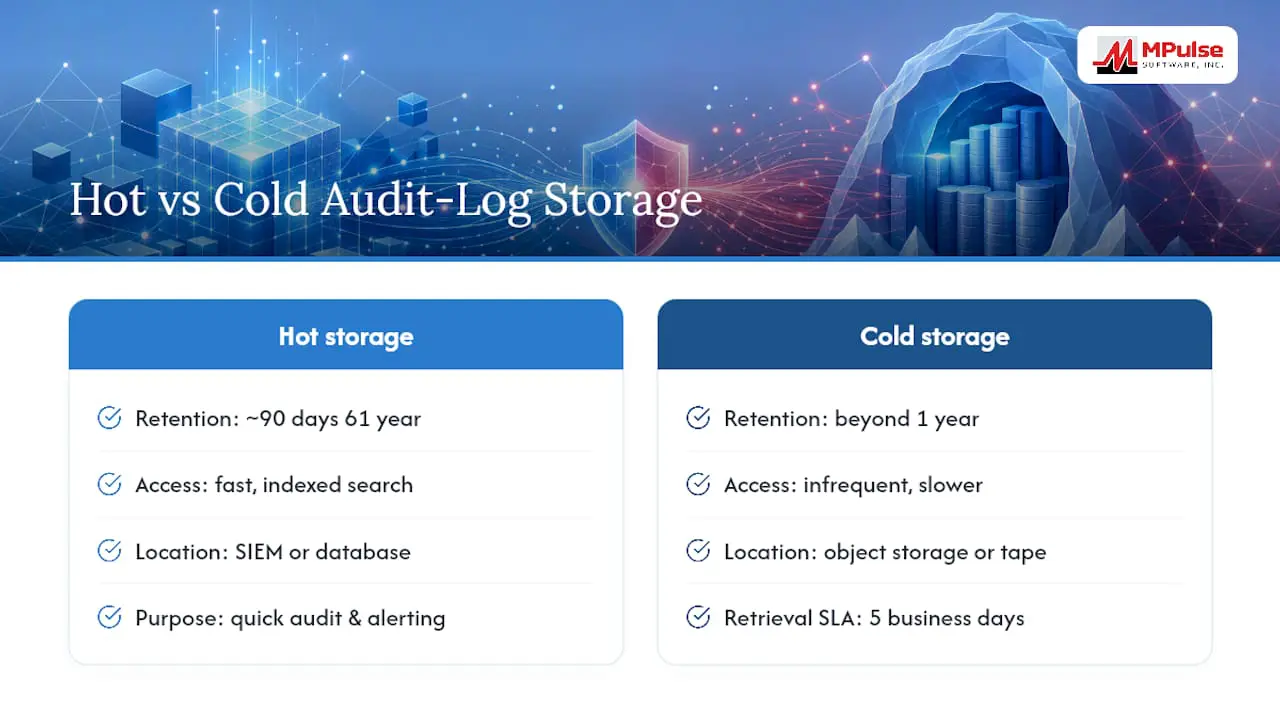
Storage strategy should split into two tiers. Hot storage holds recent logs that need fast search, typically 90 days to a year, indexed and query-ready inside a SIEM or database. Cold storage holds everything beyond that window, moved to cheaper object storage or tape, and accessed less often but still under a defined recovery time objective. A common mistake is archiving logs to cold storage without ever defining how long a retrieval request is allowed to take. If your policy says records must be reducible within five business days for an audit, your archive tooling has to actually support that.
Document the retention policy itself, in writing, with the specific regulation or contract clause driving each retention period. When a legal hold arrives, whether from litigation or a regulatory inquiry, the standard retention clock stops for the affected records. That means your purge jobs need a manual override, and someone needs clear authority to flag records as held before any scheduled deletion runs. Oracle’s documentation on administering the audit trail recommends scheduled archive-and-purge jobs using DBMS_AUDIT_MGMT, with explicit archive timestamps so purge operations never run ahead of what has actually been archived. That timestamp discipline is exactly what prevents a legal hold from arriving too late.
Integrity Controls That Make Logs Tamper-Evident
A log that can be quietly edited after the fact is not an audit trail. It is a liability. Integrity controls exist to make unauthorized changes detectable, even if they cannot always be prevented outright.
- Hash chains: each log entry includes a cryptographic hash of the previous entry, so altering one record breaks the chain and the tampering becomes visible on verification.
- Database checksums: PostgreSQL supports enabling data checksums to catch storage-level corruption, though PostgreSQL’s own documentation notes the process adds measurable I/O overhead and affects replication behavior while enabling checksums on a live cluster, so it is worth scheduling during a maintenance window rather than assuming it is free.
- Immutable storage: S3 Object Lock and Azure immutable blob storage enforce write-once, read-many behavior, which stops even a compromised administrator account from silently deleting evidence.
- Clock synchronization: NTP-synced servers storing every timestamp in UTC prevent the timezone confusion that turns a straightforward timeline into a multi-day reconciliation project.
Pro Tip: Run a hash-chain verification job on a schedule, not just after an incident. Catching a broken chain during a routine Tuesday check is a maintenance task. Catching it during a regulator’s audit is a career problem.
Cloud object storage adds a practical layer here. Amazon S3’s integrity-checking features let teams validate checksums across large archives without pulling every file back for a full restore, which matters once your cold storage runs into terabytes. That said, a checksum pass confirms bytes weren’t corrupted in storage. It does not confirm the archive can actually be rehydrated and searched under time pressure, which is a separate test entirely.
Building a Review Rhythm That Actually Gets Followed
Controls that exist only on paper fail the moment they are tested. The maintenance work that actually protects an organization happens on a recurring schedule, split across a few distinct rhythms.
- Real-time monitoring for high-risk events: privileged account logins, bulk data exports, and permission changes should trigger alerts the moment they happen, ideally correlated through a SIEM rather than reviewed manually.
- Daily review of critical-system logs, focused specifically on flagged anomalies rather than a full manual scan of every entry.
- Weekly or monthly review for lower-risk systems, where the cost of daily eyes-on review outweighs the actual threat level.
- Quarterly restore drills that pull a sample of archived logs out of cold storage and confirm they are both intact and searchable, not just present.
- Role-based access control on the logs themselves, since an audit trail that anyone can read or export defeats its own purpose, and every export action should generate its own log entry.
Practitioner guidance consistently treats the restore drill as the control that separates a real program from a paper one. A retention policy that has never been tested against an actual recovery is a hypothesis, not a safeguard. Treat a failed drill the same way you would treat a failed backup, as a high-priority incident that gets remediated before the next audit cycle, not filed away for later.
Choosing Tools Without Locking Into One Vendor’s Assumptions
The right toolset depends less on brand and more on whether each category does its job without creating gaps between systems. Four categories matter for most organizations:
- Native database audit features, like Oracle’s unified audit trail or PostgreSQL’s checksum and logging options, capture the lowest-level, hardest-to-fake record of what happened inside the data layer.
- Application middleware hooks that write structured events whenever a business action occurs, such as a work order approval or an inventory adjustment.
- Centralized SIEM platforms that ingest everything above and correlate it into a single searchable timeline.
- Cold-archive exporters that move aged logs to object storage on schedule, tagging them with retention metadata automatically.
Whatever combination you choose, insist on a few integration behaviors up front. Writes should happen asynchronously so logging never becomes a bottleneck for the underlying transaction. Field names should follow a canonical schema across systems, not five different names for “user ID.” Timestamps should normalize to UTC at the point of capture, not later during analysis. And exports to cold storage should carry a hash or signature so integrity can be verified without a full restore. Scalability matters here too: indexing everything for fast search gets expensive fast, so most programs index hot data aggressively and accept slower retrieval for cold archives.
Your Audit Trail Maintenance Runbook
A maintenance program only works if the tasks are specific enough to hand to whoever is on shift. This breaks into four cadences plus an incident procedure.
- Daily: triage overnight alerts, check storage-health metrics on log volumes, and confirm ingest latency hasn’t drifted (a sudden delay often signals a pipeline failure, not a quiet day).
- Quarterly: run a full restore drill pulling sample records from cold storage, verify the hash chain across a rolling window of entries, and audit who currently has access to log systems.
- Annual: review the retention policy against any regulatory changes, and run a full integrity validation across the entire archive rather than a sample.
- Incident response: immediately snapshot current logs before any further activity, preserve existing hashes as-is without regenerating them, and engage legal or compliance before making any storage changes.
| Cadence | Core task | What it catches |
|---|---|---|
| Daily | Alert triage, ingest-latency check | Pipeline failures, active threats |
| Quarterly | Restore drill, hash-chain verification | Corrupted or unrecoverable archives |
| Annual | Full archive integrity validation | Policy drift, silent long-term corruption |
| Incident | Snapshot and hash preservation | Chain-of-custody breaks during response |
How MPulse Software Keeps Maintenance Records Audit-Ready
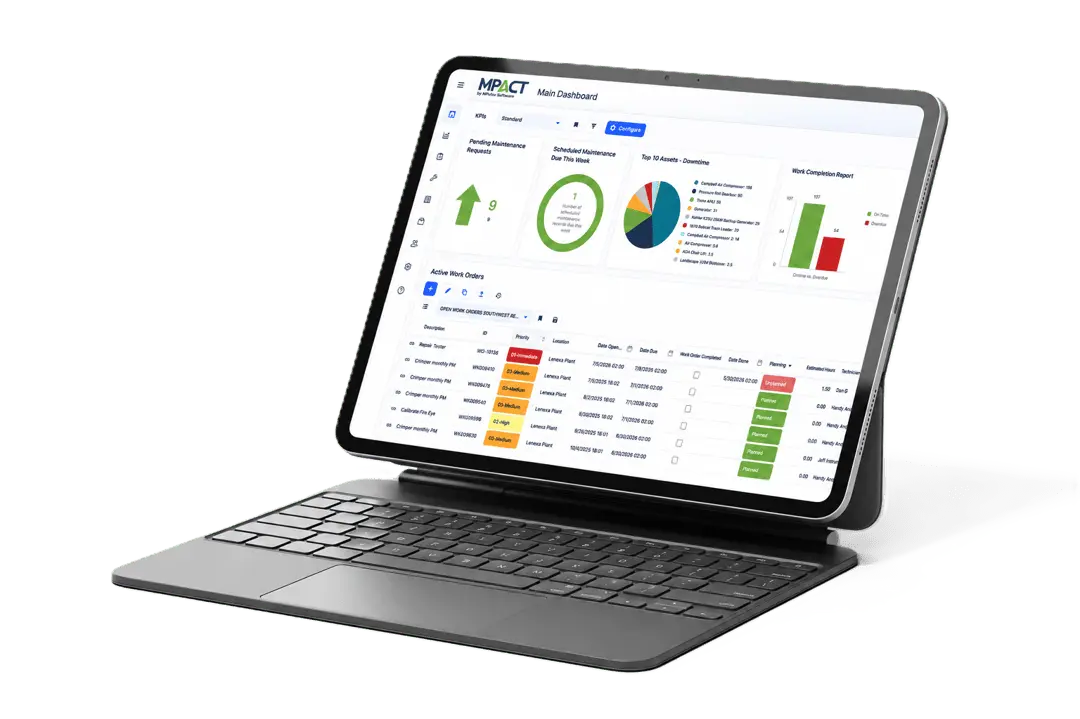
Maintenance operations generate their own audit trail whether anyone plans for it or not, every work order, parts requisition, and technician sign-off is a timestamped event that regulators and internal auditors will eventually want to see. MPulse Software builds that record-keeping into the daily workflow rather than treating it as a separate compliance project.
- Electronic work orders and maintenance logs capture who performed a task, when, and what changed, creating the “who, what, when” backbone an audit trail needs.
- The calendar scheduling interface ties preventive maintenance history to specific dates and technicians, so gaps in a maintenance record are visible immediately rather than discovered during an audit.
- Integration capabilities with ERP and sensor systems centralize records that would otherwise sit in disconnected spreadsheets across departments.
Those gains come as much from the reduced friction of automated record-keeping as from the maintenance scheduling itself.
Where to Put Your Effort First
Perfect documentation policies that have never been tested are worth less than most compliance teams assume. Recoverability and tamper-evidence deserve more attention than sheer retention volume. If your team is small, focus first on the systems that actually carry regulatory or security weight, and run quarterly restore drills on those before worrying about archiving everything else. A control that has been validated under pressure beats a control that looks flawless on paper but has never been tested.
— Mark
Get Your Maintenance Records Audit-Ready
MPulse Software gives compliance officers and maintenance teams a single system where every work order, inspection, and technician action becomes a timestamped, audit-ready record automatically, without a separate logging project bolted on afterward.
The calendar scheduling interface and ERP integrations mean your maintenance history stays centralized instead of scattered across spreadsheets and paper checklists that fall apart under audit scrutiny. If you’re weighing what a system like this costs against the hours spent reconstructing records by hand, MPulse’s pricing plans start at $29 per month per user for the Professional tier. Teams that need help getting a compliance-heavy environment set up correctly can also work with MPulse’s implementation services to build retention and record-keeping workflows into the rollout from day one. Check the pricing page or request a walkthrough to see how it fits your current audit requirements.
Sources
- NIST glossary — audit trail
- HHS — HIPAA Security Rule
- Administering the audit trail — Oracle Database documentation
- PostgreSQL: Data checksums
- Amazon S3 — checking object integrity
FAQ
Is It Mandatory for Companies to Maintain Audit Trails?
It depends on the industry and the data involved rather than being a universal legal requirement. Organizations handling health information fall under the HIPAA Security Rule’s audit-control requirements, while financial, payment, and government-contracted entities face similar mandates under their own frameworks, and many contracts impose retention terms even where no statute does.
What Does an Audit Trail Check For?
An audit trail checks who did what, when, where, and what the system’s state was before and after the action, following the reconstruction standard the NIST glossary describes. In practice, that means verifying user identity, timestamp accuracy, action type, and whether the before-and-after values match what actually happened.
What Are Common Audit Trail Mistakes?
The most frequent mistake is treating retention as the whole job and never testing whether archived logs can actually be restored and searched. Other common failures include storing timestamps without a consistent timezone, skipping hash verification on archives, and giving broad access to logs without recording who exported them.
What Is an Example of an Audit Trail?
A maintenance work order that logs the technician’s name, the timestamp of each status change, the parts requisitioned, and the before-and-after condition notes is a straightforward example. In an MPulse Software environment, that same record links to the calendar schedule and any related ERP transaction, producing one traceable chain instead of three disconnected records.