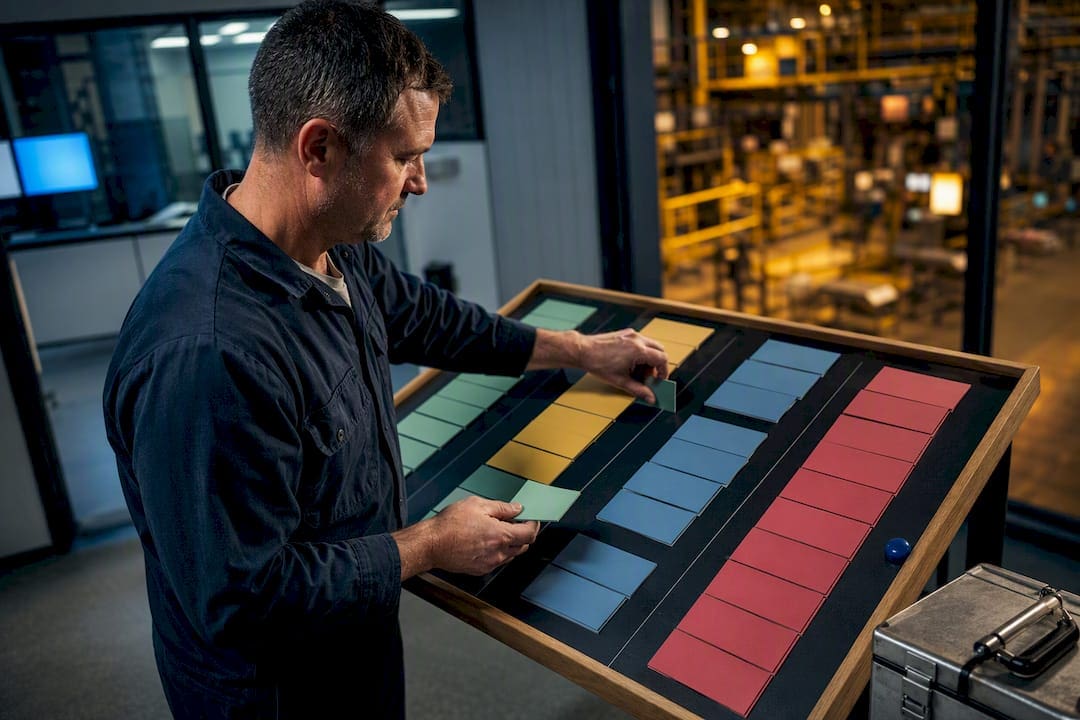
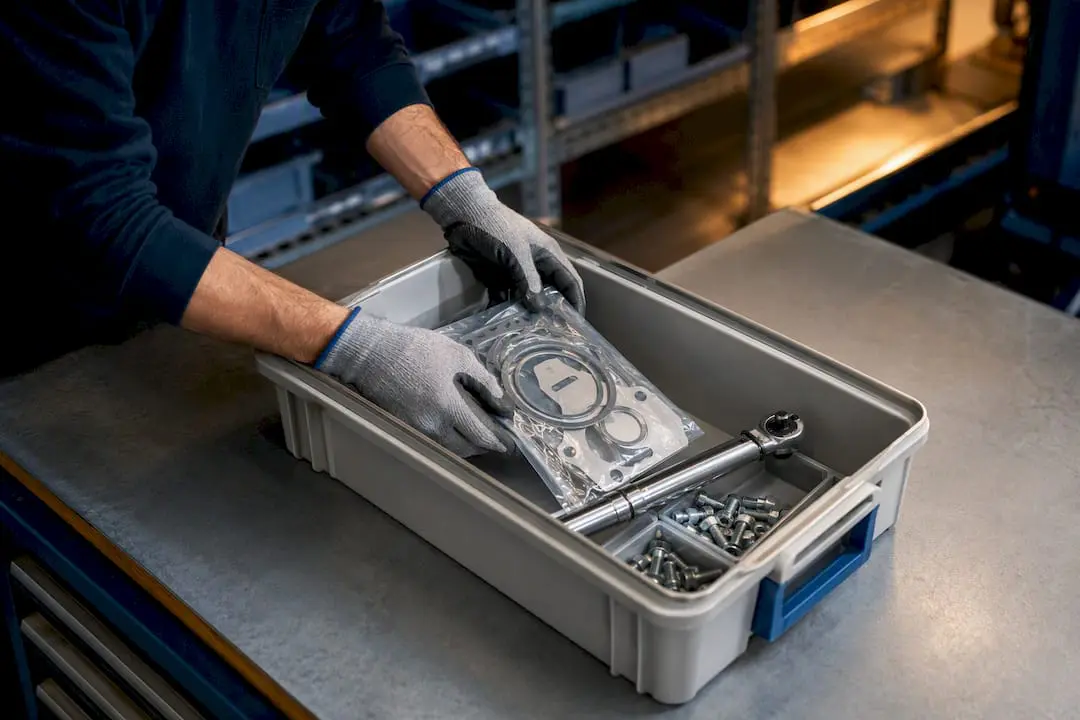
Parts kitting maintenance means pre-assembling every part, tool, consumable, and document a technician needs for a specific job before that job ever hits the schedule. The immediate payoff is more wrench time: technicians stop walking to the storeroom mid-repair and start working the whole shift. Get the process right, and downtime, schedule slippage, and shortage-driven callbacks all drop together.
TL;DR:
- Kitting is most effective for parts-dependent, planned, and critical jobs with long lead times, ensuring the kit is ready before the work is scheduled.
- A reliable kitting process requires clear roles, accurate bills of materials, a system for reserving parts, and strict enforcement that work does not proceed without a confirmed, complete kit.
- Linking kitting to a CMMS with inventory reservation and kit-ready signals prevents double-booking parts and improves inventory accuracy over time.
- Industry benchmarks for world-class performance are a 99.5% kit accuracy rate and a 95% on-time delivery rate, which most plants pursue after initial trials.
- Successful programs start small, enforce a scheduling gate for kit completion, and expand steadily, avoiding reliance on manual tracking that can lead to delays and errors.
Table of Contents
- What’s the Difference Between Kitting, Staging, and Point-of-Use?
- What Does Kitting Actually Improve on the Floor?
- Which Work Orders Should Actually Get Kitted?
- How Do You Build a Kitting Process Step by Step?
- What Belongs in a Complete Kit?
- How Should Kitting Connect to Your CMMS?
- What KPIs Prove Kitting Is Working?
- Why Do Kitting Programs Stall, and How Do You Sustain One?
- How Should You Handle and Store Kitted Parts?
- How Does Kitting Change Your Inventory Management?
- What Do Successful Kitting Rollouts Actually Look Like?
- What I’ve Learned Watching Kitting Programs Succeed and Fail
- How Does MPulse CMMS Make Kitting Routine Instead of Heroic?
- Sources
- FAQ
What’s the Difference Between Kitting, Staging, and Point-of-Use?
Parts kitting is the act of pre-assembling parts, tools, and consumables into a single package tied to one work order, so a technician arrives with everything the job requires and nothing missing. Kitting is fundamentally a planning function; it happens before the job is scheduled, not during it.
Staging is a separate decision: where the kit physically sits and when it moves. A kit staged at a job site the night before a shutdown behaves differently than one staged at a central cage awaiting pickup.
Point-of-use storage and consignment stock solve a different problem entirely. Rather than pulling parts for one job, they keep high-turnover items (fasteners, filters, common seals) sitting near the equipment or paid for only after use.
- Kitting: parts bundled for one specific work order
- Staging: physical placement and timing of the kit before the job starts
- Point-of-use: open bins near equipment for high-frequency, low-cost consumables
- Consignment: vendor-owned stock at your site, invoiced on consumption
Point-of-use works best for items too cheap and too common to justify kitting labor. Kitting earns its keep on planned, parts-dependent jobs where a shortage means a stalled crew.
What Does Kitting Actually Improve on the Floor?
The core mechanism is simple: kitting moves material verification from the job site to the planning desk. A shortage discovered on Tuesday during planning costs nothing. The same shortage discovered Thursday morning, with a technician standing at a disassembled pump, costs the whole job.
That shift produces three measurable effects:
- Wrench time rises because technicians spend less time walking to the storeroom, searching for substitute parts, or waiting on a runner.
- Schedule compliance improves because jobs that reach the calendar have already cleared a materials check, so fewer get pulled at the last minute.
- Repair quality holds steady because the right torque specs, gaskets, and consumables arrive with the job instead of getting swapped for whatever is on the shelf.
Kit accuracy of 99.5% or higher and an on-time kit delivery rate of 95% or better are the benchmarks industry practitioners treat as world-class targets. Most plants that adopt kitting for the first time land well below that, which is normal. The point of tracking the number is to close the gap, not to hit it on day one.
Storeroom staff benefit too. Batch-picking for known kits is faster and less error-prone than fielding piecemeal requests all day, which frees counter time for cycle counting and receiving.
Which Work Orders Should Actually Get Kitted?
Not every job needs a kit. Kitting labor is real labor, and spending it on a five-minute bolt-tightening task wastes the technique. Use these criteria to decide:
- Parts dependence: if the job cannot proceed without specific stocked or ordered parts, it’s a kitting candidate. A visual inspection is not.
- Planned versus reactive: planned and scheduled preventive or corrective jobs kit well because there’s lead time to build the kit. Pure emergency reactive work usually can’t wait for kit assembly, though recurring reactive failures (a pump seal that fails every quarter) can be pre-kitted in anticipation.
- Criticality: jobs on bottleneck or safety-critical assets deserve kitting priority because a stall there costs more than a stall on a redundant line.
- Long-lead items: any job pulling a part with a multi-week lead time should be flagged and kitted the moment the part arrives, not left sitting in receiving.
Bills of materials, recurring job histories, and known failure modes all help build the priority list; a job that recurs quarterly with a stable parts list is the easiest kitting win in the plant. The operating rule that ties this together: no parts-dependent job enters the schedule until the kit is confirmed complete. That single rule, enforced without exception, is what separates plants where kitting sticks from plants where it quietly fades after a few months.
How Do You Build a Kitting Process Step by Step?
Kitting fails most often not because the concept is wrong, but because nobody wrote down who does what. Here’s a sequence that works across most maintenance operations.
-
Build the process and assign RACI. Decide who plans kits, who picks them, who verifies them, and who signs off. A job kitting process typically needs a documented job plan, a reservation path from planner to storeroom, and a secure staging area. Write down each role before you build a single kit.
-
Create job plans and kit lists from your BOMs. Every recurring job should have a standing parts list tied to its work order template, not a list rebuilt from memory each time. This is where accurate bills of materials pay off repeatedly.
-
Send a reservation or pick list to the storeroom. The planner’s job ends when the list reaches the storeroom; the storeroom’s job is to pick, flag shortages immediately, and escalate anything with a lead time that threatens the schedule.
-
Assemble, verify, seal, stage, and signal “kit ready.” The kit gets physically built, checked against the list, sealed or bagged to prevent pilferage, moved to its staging location, and marked ready in whatever system tracks work order status.
Pro Tip: Assign one person, not a rotating shift, to own kit verification for your first ninety days. Consistency in who checks the kit matters more than which checklist format you use.
The step that most plants skip is the signal back to scheduling. Without it, a scheduler has no way to know a kit sat half-built for three days. That gap is where schedule adherence quietly erodes even after you’ve done the hard work of building the process.
What Belongs in a Complete Kit?
A complete job kit bundles parts, consumables, tools, permits, and instructions, not just the replacement component. Miss any category and the technician still ends up walking away from the job mid-repair.
- Parts and consumables: the replacement components plus gaskets, fasteners, lubricants, and anything consumed during the job
- Tools: any specialty tool not already on the technician’s cart, including calibrated instruments
- Permits and documentation: lockout/tagout permits, hot work permits, and any compliance paperwork the job requires
- Instructions and specs: torque values, wiring diagrams, or step sequences specific to that asset
- Labels and traceability data: lot or serial numbers recorded at kit build time for parts where expiry or traceability matters
Verification is the gate that catches a half-kit before it reaches the floor. That can be a barcode scan against the pick list, a manual count against a printed sheet, or both, but it needs a name attached to a sign-off, not an assumption that “someone checked it.”
A kit that looks complete and a kit that is verified complete are two different things. The first is a guess dressed up as a finished product; the second is the only version that belongs on the schedule.
Staging rules matter as much as the checklist. A kit sitting in a common aisle gets picked over for other jobs; a kit staged in a labeled, reserved location with the work order number visible survives until the scheduled date.
How Should Kitting Connect to Your CMMS?
Manual kitting works at small scale and breaks down fast at larger scale, mostly because BOMs drift out of sync with actual inventory. A CMMS closes that gap by linking the parts list directly to the work order template, so every technician pulling that job type sees the same current list instead of a printed sheet from two years ago.
Three connections matter most:
- Reservation flows that hold parts against a specific work order the moment it’s planned, so the same bolt doesn’t get promised to two jobs at once
- Kit-ready signals that flip a work order’s status the instant the storeroom confirms the kit, so scheduling isn’t guessing
- Barcode scanning at pick and verification, which cuts kitting errors compared to manual counting, particularly in plants running high part-mix production
A CMMS supports this chain through calendar scheduling interfaces, inventory reservation features, and work order templates that carry parts lists forward automatically instead of requiring a planner to rebuild them each cycle. When BOMs change, that link between the parts list and the work order template avoids the manual reconciliation that causes shortages in the first place. Component records inside the system also give you a structured place to track component specifications that feed kit accuracy over time, and reliable work order templates are what make kit lists repeatable job after job.
What KPIs Prove Kitting Is Working?
Four numbers tell you almost everything you need to know about a kitting program’s health:
| KPI | What it measures | Target range |
|---|---|---|
| Kit accuracy rate | Percentage of kits delivered with all correct items | 99.5% or higher |
| Kit on-time rate | Percentage of kits staged before the scheduled start | 95% or higher |
| Kit prep lead time | Time from work order release to kit-ready signal | Track trend, not a fixed target |
| Shortage rate | Percentage of kits missing at least one item at verification | Trending toward zero |
Those 99.5% accuracy and 95% on-time figures are the benchmarks practitioners cite as world-class performance. Wrench-time improvement itself gets measured by comparing technician time logged against the work order to total shift time, before and after kitting rolls out for that job class.
A worked example makes the payoff concrete. Take a recurring pump rebuild that historically takes a two-person crew six hours, with roughly ninety minutes of that spent walking to the storeroom for a missing seal kit or a torque wrench left in another building. Converting that job to a standing kit eliminates most of that ninety minutes outright. The job doesn’t get faster because the technicians work harder; it gets faster because they stop leaving.
Why Do Kitting Programs Stall, and How Do You Sustain One?
Most kitting failures trace back to one of three root causes: inventory records that don’t match the shelf, job plans missing parts because nobody updated the BOM, or staging areas too small to hold more than a day’s worth of kits.
- Inaccurate inventory poisons every kit built from it, no matter how good the process is on paper.
- Poor job plans produce kits that are technically complete but wrong for the job as actually performed.
- Insufficient staging forces storeroom staff to break down kits for space, which defeats the purpose entirely.
The fix that works consistently is a pilot-first rollout: pick one product line, one equipment family, or one shift, run kitting there for sixty to ninety days, and measure kit accuracy and prep time before expanding. Focused cycle counting on your A and B inventory items, not a full annual count, keeps the records feeding your kits honest in the meantime.
Pro Tip: Decide your partial-kit rule before your first shortage happens, not during it. Either the job waits for the missing item, or it proceeds with a documented exception, but leaving that decision to whoever’s on shift that day guarantees inconsistency.
Centralized kitting in one storeroom simplifies control but adds travel time for large sites; satellite kitting near high-volume equipment cuts travel but multiplies the number of locations you have to keep accurate. Most multi-building plants land on a hybrid: centralize slow-moving and high-value items, satellite the fast movers.
How Should You Handle and Store Kitted Parts?
A verified kit that gets damaged, contaminated, or picked apart before the job starts has failed just as completely as a kit that was never built correctly. Handling and storage rules deserve the same attention as the assembly process itself.
Seal each kit in a bag, bin, or cart with the work order number visible on the outside. An unlabeled kit sitting in a common area gets raided for parts by the next technician with an urgent need, and you’re back to square one. Assign a dedicated staging shelf or cart position per active kit rather than a shared pile; a well-organized storeroom layout with reserved kit space prevents the slow drift where kits get shuffled aside to make room for daily picks.
Environment matters more than most planners assume. Seals, gaskets, and electronic components degrade under heat, humidity, or direct sunlight even while sitting in a kit waiting for a job date. If a kit sits more than a few days before the scheduled start, store it under the same environmental controls you’d apply to the parts on the shelf, not on an open cart near a loading dock door.
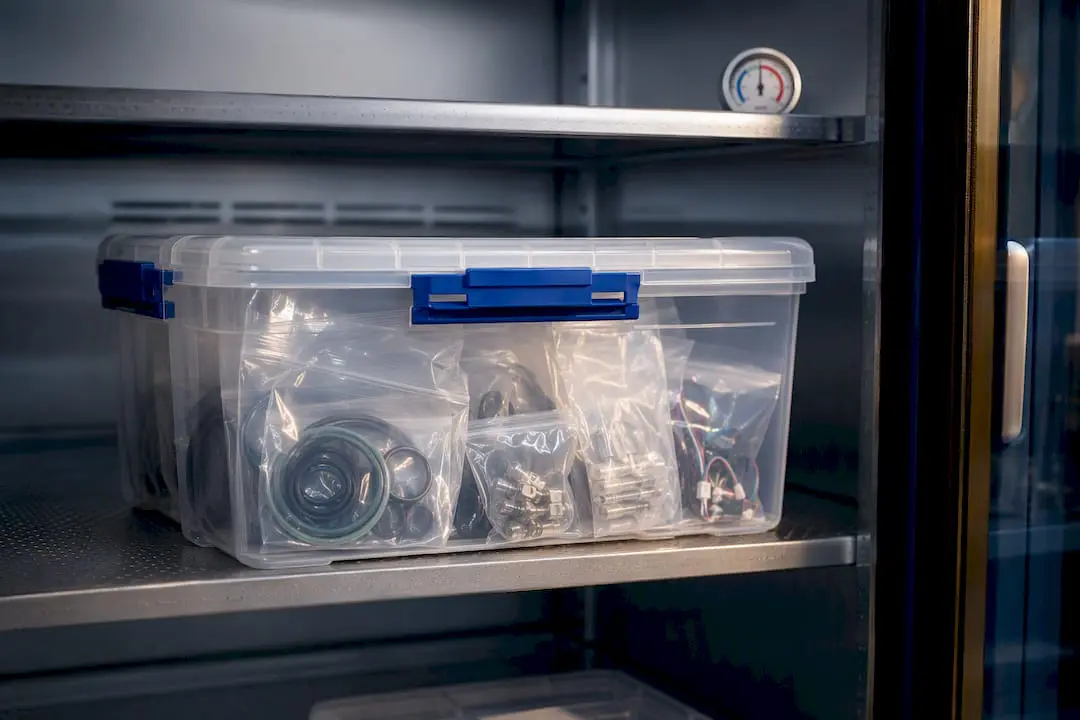
Time limits matter too. A kit built two weeks ahead of a shutdown is fine; a kit built two months ahead risks parts drift, superseded revisions, or expired shelf-life items sitting unchecked. Set a maximum staging window per job class and re-verify any kit that sits past it. Chain of custody counts as well: track who pulled a kit and when, especially for kits with lockout permits or calibrated tools that could otherwise walk off to another job.
How Does Kitting Change Your Inventory Management?
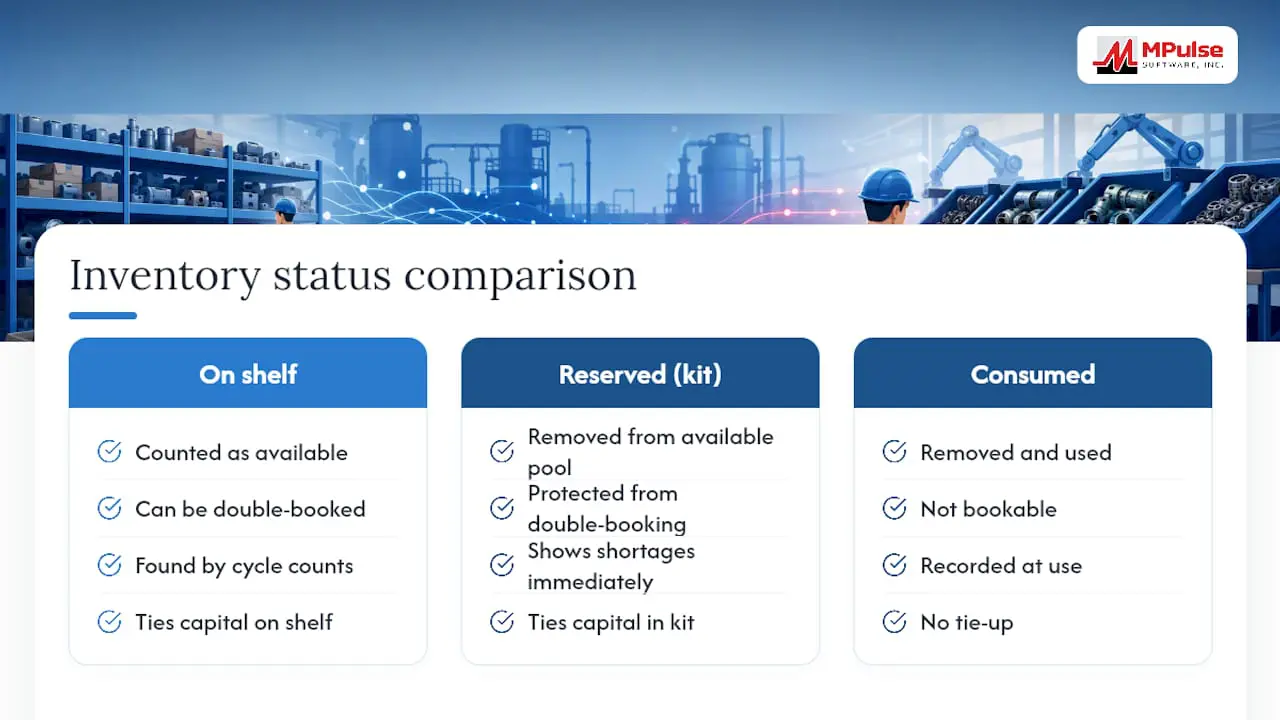
Kitting doesn’t just organize parts for a job. It changes how you manage inventory at the system level, because reserved-but-not-yet-consumed material behaves differently than either “on the shelf” or “used” stock.
Once a part is committed to a kit, it needs to leave the available-to-promise pool immediately, or your storeroom double-books it against a second work order. That reservation logic is exactly what separates a mature kitting program from a spreadsheet-based one; without it, two planners can build kits against the same last unit of a critical spare without either knowing until someone shows up empty-handed. Sound inventory management practices built around reservation, not just on-hand count, are the foundation kitting depends on.
Kitting also surfaces inventory accuracy problems faster than routine cycle counts do. A cycle count might not catch a phantom stock record for months; a kit that comes up short at verification catches it the same day, because someone was actively trying to pull that part for a real job. Plants that adopt kitting seriously often find their inventory data improves as a side effect, simply because shortages get reported and corrected in near real time instead of surfacing during an annual count.
The tradeoff is carrying cost. Reserved material sitting in a kit for a future job ties up capital just as surely as material sitting on a shelf. Planners need to weigh kit lead time against how long that reservation sits idle, particularly for expensive components used across multiple recurring jobs.
What Do Successful Kitting Rollouts Actually Look Like?
The plants that make kitting stick almost never start company-wide. They start with one recurring, parts-dependent job family, prove the accuracy and on-time numbers move in the right direction, and expand from there.
A pump rebuild program is a common starting point because the job recurs on a predictable interval, the parts list is stable, and the failure cost of a stalled crew is easy to quantify. Once a plant tightens the kit for that one job class and the crew stops walking to the storeroom mid-repair, the same job plan and reservation structure gets copied to the next recurring job family, usually a conveyor or motor swap program.
The common thread across programs that hold up past the first year isn’t the software or the checklist template. It’s the discipline of tying kit completion to the scheduling gate, so a parts-dependent job simply cannot appear on next week’s calendar without a confirmed kit behind it. Programs that skip that enforcement step tend to see kitting quietly become optional again within six months, as schedulers under pressure start slotting jobs in anyway “because the parts are probably fine.”
What I’ve Learned Watching Kitting Programs Succeed and Fail
The plants that get kitting right treat it as a scheduling gate, not a courtesy. The ones that struggle almost always kept kitting as an optional nice-to-have that schedulers could override under pressure, and pressure always wins if you let it. What surprises most planners is that kitting accuracy improves inventory accuracy as a side effect, because a shortage caught at kit verification gets fixed the same day instead of waiting for the next cycle count. Culturally, the hardest part isn’t the process. It’s convincing a scheduler that “the kit isn’t ready” is a good enough reason to move a job, every single time, without exception.
— Mark
How Does MPulse CMMS Make Kitting Routine Instead of Heroic?
Manual kitting works fine until you’re running fifty recurring jobs across three shifts. That’s where a CMMS earns its cost: A CMMS solution connects the work order, the parts list, the calendar, and the kit-ready signal in one place, so a planner doesn’t have to chase a status update by phone before releasing a job to the schedule.

Such CMMS software ties inventory reservations directly to work order templates, so parts committed to a kit come out of the available-to-promise count the moment they’re reserved, not the moment they’re consumed. The calendar scheduling interface shows kit status alongside job dates, giving schedulers the visibility they need to enforce the “no kit, no schedule” rule without a separate spreadsheet or a phone call to the storeroom.
If you’re ready to see how that fits your storeroom and your scheduling process, view MPulse pricing plans or talk to the implementation services team about mapping your current job plans into kit-ready work order templates.
Sources
For deeper reference on the concepts covered here, see Kitting: Definition for terminology, What is Parts Kitting and Staging? for the planning rationale, Maintenance Job Kitting Best Practices for verification checklists, and The Secret Weapon: Job Kitting for sustainment tactics. HVAC and facilities teams may also find Caledonian Mechanical’s service blog useful for field-level kitting practices.
- What is Parts Kitting and Staging?
- Maintenance Job Kitting Best Practices That End the Parts Scramble
- Kitting in Manufacturing: What It Is, How It Works, and Why It Matters
FAQ
What Is Parts Kitting?
Parts kitting is the practice of pre-assembling all the parts, tools, consumables, and documentation a technician needs for one specific work order before that job starts, so nothing is missing once the work begins.
What Are the 7 Types of Maintenance?
Common frameworks list reactive, preventive, predictive, corrective, condition-based, planned, and prescriptive maintenance, though definitions vary somewhat by industry and source.
What Skills Are Needed for Kitting?
Effective kitting requires reading and interpreting bills of materials, storeroom inventory management, attention to detail for verification steps, and basic familiarity with the CMMS or work order system tracking kit status.
What Does “Kitting” Mean?
In a maintenance context, kitting means bundling everything required for a job (parts, consumables, tools, permits, and instructions) into one verified package tied to a single work order.
Does MPulse CMMS Support Kitting Workflows?
MPulse CMMS supports kitting through work order templates carrying standing parts lists, inventory reservation flows, and calendar scheduling that reflects kit-ready status, letting planners enforce a confirmed kit before a job reaches the schedule.