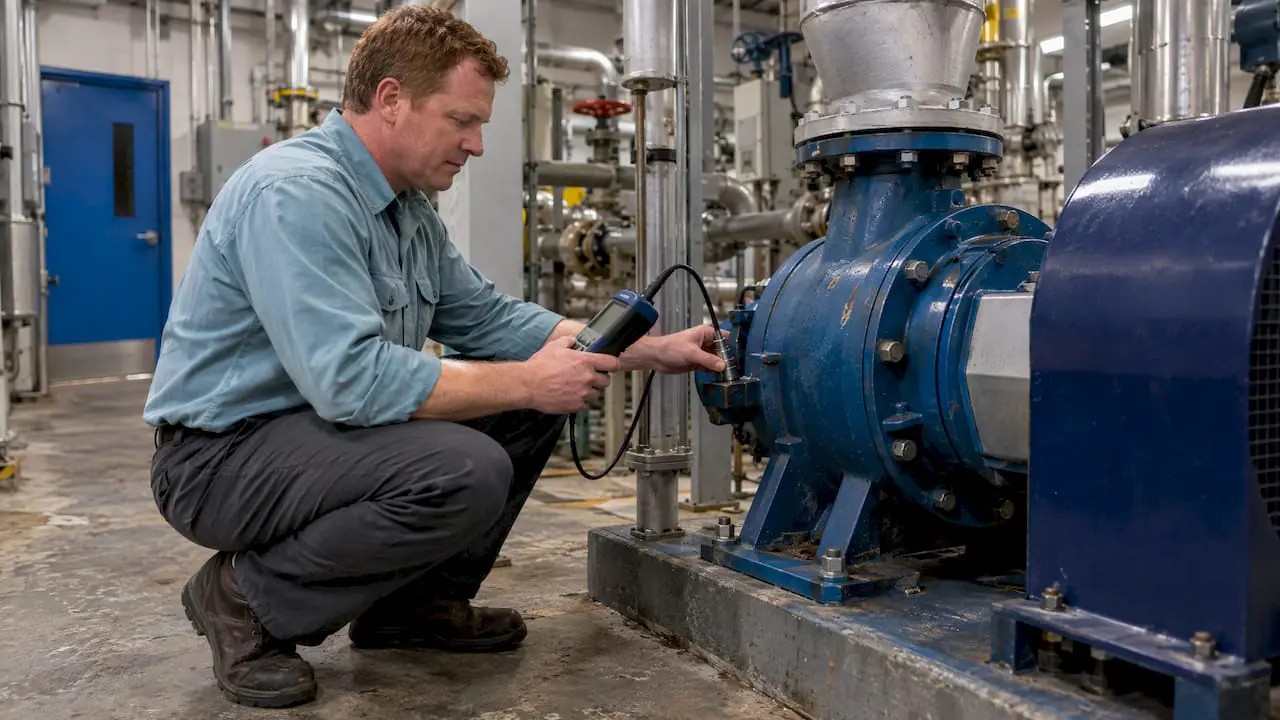
Reliability centered maintenance (RCM) is a structured process for deciding what maintenance each asset actually needs, based on what the asset does, how it can fail, and what that failure costs you. Instead of applying the same preventive schedule to everything, RCM matches the maintenance task to the consequence of failure. This guide explains the method, walks through the seven questions and the process steps, shows examples from U.S. facilities, and covers how to run the resulting tasks in day-to-day maintenance software.
TL;DR
- RCM is a logical, structured process that determines the best failure-management strategy for each asset, according to its function and operating context.
- It manages the consequences of failure rather than trying to prevent every failure, so some low-risk assets are deliberately run to failure.
- An RCM analysis answers seven questions about functions, failures, causes, effects, consequences, proactive tasks and default actions.
- Start with a risk assessment and a pilot on one system, then expand. Track results with downtime, labor hours and cost KPIs.
- The output of RCM is a set of tasks and intervals. A CMMS is where those tasks get scheduled, assigned, completed and documented.
Table of Contents
- What reliability centered maintenance means
- The seven questions of an RCM analysis
- RCM process steps
- How RCM chooses the right maintenance task
- How RCM differs from preventive, predictive and corrective maintenance
- RCM examples
- How to implement RCM in your facility
- Where a CMMS fits into an RCM program
- Our perspective on RCM
- Putting your RCM tasks to work in MPulse
- Frequently asked questions
- Sources
What reliability centered maintenance means
Pacific Northwest National Laboratory (PNNL) describes RCM as a logical, structured process for determining the optimal failure-management strategies for a system, based on its reliability characteristics and its operating context. It defines what must be done to reach the desired level of safety, environmental soundness and operational readiness at the best cost, and it continues throughout the system life cycle.
The American Institute of Chemical Engineers (AIChE) glossary frames it in similar terms: a systematic approach to evaluating how equipment failures affect system performance, then choosing specific strategies to manage them. Those strategies may include preventive maintenance, predictive maintenance, inspections, testing, and one-time changes such as design improvements or operational changes.
Two ideas make RCM different from a typical maintenance program:
- Design intent and real operation often differ. PNNL notes that a facility never has unlimited money or people, so both must be prioritized and optimized.
- Not every failure deserves the same response. A failure that endangers people or stops production is treated very differently from one that causes a minor inconvenience.
The four precepts of RCM
The Department of Defense manual on RCM (DoDM 4151.22) lists four precepts that define the approach:
- The objective of maintenance is to preserve an item’s function.
- RCM is a life-cycle management tool, applied from design through disposal.
- RCM manages the consequences of failure, not every failure.
- RCM identifies the most applicable and effective maintenance task or other logical action.
The same manual points out that a program built without RCM often grows through OEM recommendations, tasks borrowed from similar equipment, or habit. The result can be a program overloaded with ineffective work, and applying RCM will often eliminate unnecessary tasks.
The seven questions of an RCM analysis
The SAE JA1011 standard defines what qualifies as an RCM process: one that answers seven questions about each asset. The American Bureau of Shipping (ABS) guidance describes the same seven questions, and they work well as a worksheet for any facility team:
- What are the functions and desired performance standards of the asset in its present operating context?
- In what ways can it fail to fulfill those functions?
- What causes each functional failure?
- What happens when each failure occurs?
- In what way does each failure matter?
- What should be done to predict or prevent each failure?
- What should be done if a suitable proactive task cannot be found?
Questions 1 to 3 define the asset and its failure modes. Questions 4 and 5 establish consequences. Questions 6 and 7 produce the maintenance decision. Teams that skip straight to question 6 usually end up with the same calendar-based tasks they already had.
RCM process steps
PNNL outlines seven analysis steps: identify asset functions, discover functional failures, classify failure causes, identify failure effects, quantify those effects, determine the optimal maintenance approach, and identify alternatives. Its program guidance also recommends determining scope and prioritizing systems by risk or criticality before the analysis begins.
In practice, most facilities follow a sequence like this:
- Set the scope and secure sponsorship. Choose a system or asset class and get leadership support.
- Rank assets by criticality. Use safety, operational, environmental and cost impact to decide which assets deserve a full analysis.
- Define functions and performance standards. Write down what the asset must do, in measurable terms.
- List functional failures and failure modes. Include the causes behind each one.
- Describe the effects and consequences. Separate safety, environmental, operational and economic consequences.
- Select the task or action. Use decision logic to pick the applicable and effective task.
- Document, schedule and review. Load the tasks into your maintenance system and revise them as failure data accumulates.
Selecting which assets to analyze
Full RCM analysis takes team time, so most programs do not apply it to every asset. Common screening approaches use a set of yes/no questions about detectability, safety, operational and economic impact, or a criticality score built from rating scales for safety, maintenance, operations and environmental effect. High scorers get the full analysis. Low scorers may be managed with a simpler approach or run to failure.
How RCM chooses the right maintenance task
A NASA technical report states that a true RCM process must rest on a detailed failure modes and effects analysis (FMEA) and must include decision logic that determines which maintenance tasks are both applicable and effective for the asset.
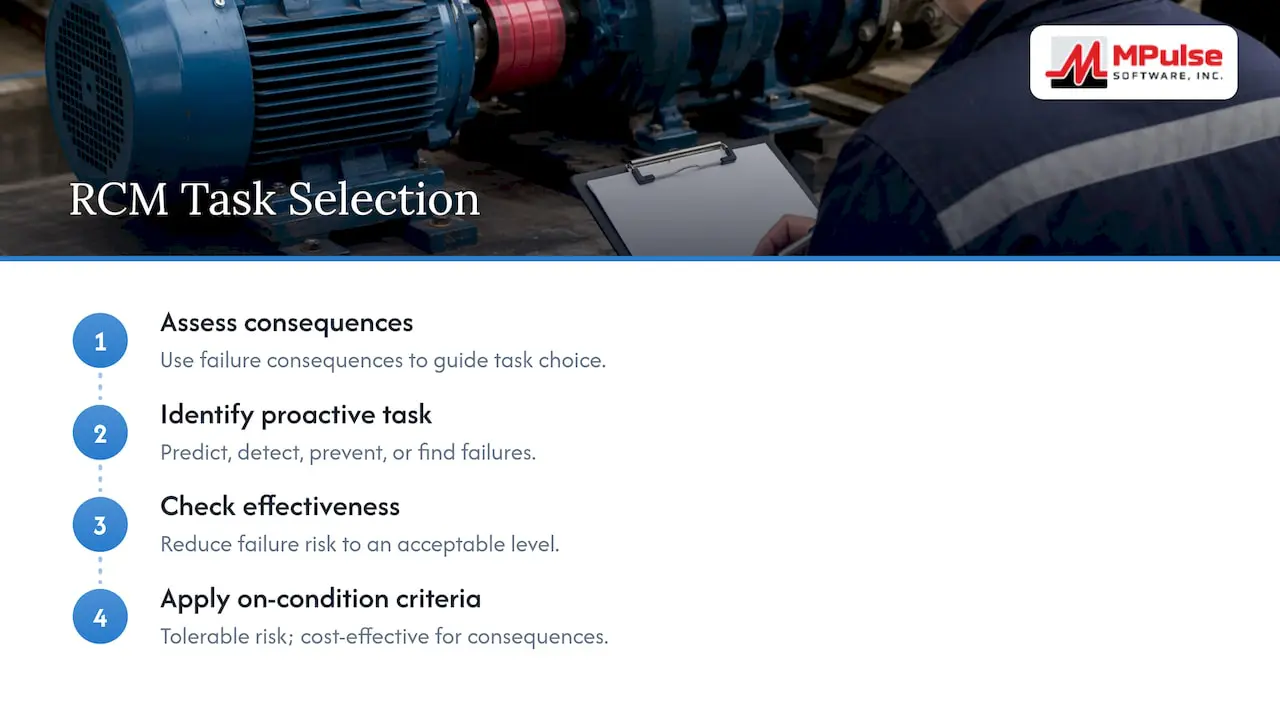
DoDM 4151.22 says that once consequences are assessed, the next step is to identify proactive tasks that predict, detect, prevent or find failures. A task is effective when it reduces the risk of failure to an acceptable level. For on-condition tasks, which look for signs of impending failure, the manual sets two criteria: the task must reduce risk to a tolerable level, and it must be cost effective for the operational or economic consequences.
Condition monitoring comes first when it is possible
The ABS guidance says condition-monitoring tasks should be considered first, but only when a detectable potential failure condition will exist before the failure happens. If no such warning sign can be identified, other options apply. Sandia National Laboratories adds that task frequencies should be derived from the potential failure interval, and that failure consequences, not habit, should drive the task.
The options an RCM team chooses from
| Strategy | When it fits | Example trigger |
|---|---|---|
| Condition-based (on-condition) task | A detectable warning sign appears before failure | Rising vibration or temperature on a motor |
| Time- or cycle-based task | Failure is age-related and the interval is predictable | Replace a belt after a set number of operating hours |
| Failure-finding task | A protective or standby device can fail without anyone noticing | Periodic test of a backup pump or alarm |
| Design change | No task reduces risk enough | Redesign, add redundancy, change the operating procedure |
| Run to failure | Risk is acceptable without any proactive task | A non-critical, low-cost component |
NASA’s maintenance policy (NPR 8831.2D) recognizes two kinds of tasks, interval-based and condition-based, plus run to failure. In RCM, run to failure is a conscious decision that is acceptable for some equipment.
How RCM differs from preventive, predictive and corrective maintenance
RCM is not a fourth type of maintenance competing with the other three. PNNL describes it as a strategic combination of reactive, preventive and predictive maintenance, coupled with root-cause analysis. It relies heavily on predictive methods while accepting that low-risk, non-critical or inexpensive equipment may be managed reactively.
The distinction is where the decision comes from:
- Preventive maintenance usually starts from a calendar or meter reading.
- Predictive maintenance starts from a measured condition.
- Corrective maintenance starts from a failure.
- RCM starts from function and consequence, then assigns whichever of the three fits each failure mode.
Sandoval County, New Mexico, makes the practical point in its asset management plan: traditional preventive maintenance can be costly and ineffective when it is the only type practiced, while predictive testing and inspection replaces arbitrarily timed tasks with work scheduled when equipment condition warrants it.
RCM examples
A simple asset-level example
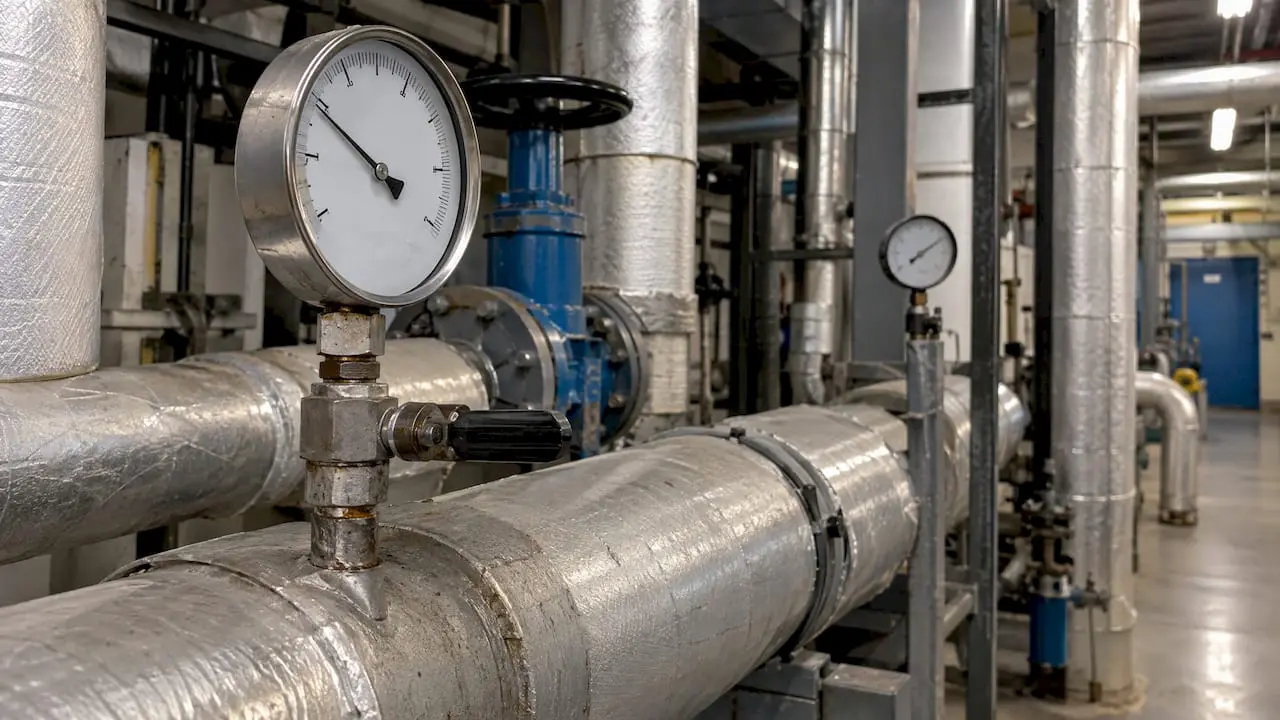
The ABS guidance gives a clear illustration of a run-to-failure decision. A local pressure gauge on a cooling water line that also has a remote-reading gauge can be allowed to fail, because the risk is acceptable without any proactive task. Run to failure is only appropriate when that test is met.
Compare that with a critical pump. Its function is to deliver a set flow. One failure mode is bearing wear, which produces rising vibration and heat well before seizure. Seizure stops production, so the consequence is operational and economic. A vibration or temperature check is a condition-based task with a useful warning window, so that task is chosen. A standby pump with an untested start circuit has a hidden failure, so a periodic failure-finding test fits.
A project-level example: heating water system
Sandia National Laboratories reported on a heating water system where RCM was performed three months before construction. The analysis determined an operating and control strategy, produced a maintenance policy that saved more than 100 labor hours per year compared with OEM recommendations, identified design changes that affected safety, and eliminated single points of failure.
A utility-scale example: nuclear generation
The River Bend boiling water reactor station in the United States used an RCM program as the cornerstone of a broader effort to hold operation and maintenance costs in line while maintaining safety and reliability. It combined several programs into one system. The report dates from 1989, which shows how long the method has been applied in U.S. industry.
How to implement RCM in your facility
The American Society for Health Care Engineering (ASHE) recommends securing executive buy-in, building a team and assessing asset risks, then piloting RCM on a selected system or asset and reporting initial findings to leadership. Only then does the formal seven-step process begin. ASHE also provides KPI resources for tracking progress and benchmarking improvements.
A practical rollout looks like this:
- Pick a pilot. Choose a system where downtime is costly and failure data exists.
- Build a cross-functional team. Include maintenance, operations and, where relevant, safety or compliance staff.
- Clean up your asset records. An analysis depends on accurate asset lists, hierarchies and failure history.
- Run the seven questions. Document each answer so the reasoning can be audited later.
- Convert decisions into scheduled work. Every recommended task needs an owner, an interval and a procedure.
- Measure and revise. Compare unplanned downtime, labor hours and maintenance cost to your pre-pilot baseline.
Using operators to extend maintenance coverage
Once the program defines simple monitoring tasks, some of them can move to operations staff with basic training. That frees skilled technicians for complex repairs, a point made in a wastewater utility case study published in 2017.
Where a CMMS fits into an RCM program
RCM decides what to do. A computerized maintenance management system (CMMS) makes sure it gets done, on time, and leaves a record. The analysis produces tasks of three kinds, and each maps to a CMMS capability:
- Time-based tasks become recurring preventive maintenance schedules with assigned work orders.
- Condition-based tasks become triggers tied to meter readings, inspection results or sensor data. See how condition-based maintenance software handles those triggers, and how real-time monitoring through IIoT feeds them.
- Failure-finding and compliance tasks become inspection checklists with completion records, which matter in regulated settings. The same applies to keeping a full asset history that future analyses can draw on.
That history closes the loop. Each completed work order records what failed, what was found and what it cost, and the next RCM review uses that data to adjust intervals or retire tasks that add no value. For a deeper look at the maintenance side, our article on how to use RCM to build efficiencies covers the topic from the CMMS angle.
Our perspective on RCM
We see the same pattern across facilities, plants, hospitals and campuses: the analysis is rarely where RCM programs stall. The stall happens afterward, when a good set of tasks lives in a spreadsheet or a binder and never becomes scheduled, assigned, tracked work.
That is why we build MPulse CMMS around preventive maintenance automation, condition-based maintenance and a calendar interface that shows planners what is due and when. When an RCM review changes an interval or swaps a calendar task for a condition trigger, the change should take minutes to make, not a project.
We also believe RCM is for the whole maintenance team, not only reliability engineers. Our platform includes unlimited free requesters, so operators and staff can report problems that feed the failure history your next analysis depends on. For teams in compliance-heavy industries, the same records support audit readiness.
Start with one critical system, document your decisions, and let real work order data tell you whether each task earns its place.
Mark
Putting your RCM tasks to work in MPulse
If your analysis is done or underway, the next step is getting the tasks into a system your team will use every day. MPulse CMMS offers preventive maintenance automation, work order management, asset tracking, condition-based maintenance and graphical reporting, with mobile access and barcode scanning for technicians in the field.
Plans are published on our pricing page: Professional is $29 per month per user and Advanced is $79 per month per user. If you want help moving an RCM program into the software, our implementation, training and consulting services are designed to support that transition.
Frequently asked questions
What are the three main types of maintenance?
The three most commonly cited types are corrective (reactive), preventive and predictive maintenance. Corrective work responds to a failure, preventive work follows a schedule, and predictive work is triggered by measured condition. RCM combines all three, choosing the right one for each failure mode based on consequence and risk.
What are the seven questions of RCM?
They cover an asset’s functions, how it can fail, what causes each failure, what happens when it fails, why the failure matters, what can predict or prevent it, and what to do if no suitable proactive task exists. The full list appears in the section above, as set out in ABS guidance built on SAE JA1011.
Does RCM mean every asset gets a full analysis?
No. Programs usually rank assets by risk or criticality and analyze the highest-ranked systems first. Low-risk, non-critical or inexpensive equipment may be managed reactively, and run to failure is a deliberate RCM choice when the risk is acceptable.
How do I start RCM in a hospital or healthcare facility?
ASHE advises securing executive buy-in, forming a team and assessing the risk of your assets, then piloting the seven-step process on one system. Report initial findings to leadership before expanding, and use KPIs to track progress over time.
Can RCM reduce maintenance costs?
Published cases suggest it can. A project at Sandia identified a maintenance policy saving over 100 labor hours per year compared with OEM recommendations, and the DoD manual notes that RCM often removes unnecessary tasks. Results depend on your assets, your starting program and how consistently tasks are carried out.
Sources
- PNNL: An Advanced Maintenance Approach, Reliability Centered Maintenance
- AIChE CCPS Process Safety Glossary: Reliability-Centered Maintenance
- DoDM 4151.22, Reliability Centered Maintenance
- ABS Guidance Notes on Reliability-Centered Maintenance
- NASA Technical Report NTRS 20130012596
- Sandia National Laboratories: Reliability-Centered Maintenance, Sandia’s Experience
- NASA NPR 8831.2D, Chapter 7
- River Bend station RCM program report (OSTI)
- ASHE: Reliability Centered Maintenance Journey for Health Care
- RCM case study: 26% reduction in annual O&M costs