EPA refrigerant tracking means keeping an equipment-by-equipment record of every refrigerant charge, addition, removal, leak-rate calculation and repair, and being able to produce it on request. Two sets of federal rules drive it: Section 608 of the Clean Air Act for ozone-depleting refrigerants, and the newer HFC leak-repair rule that began applying to 15-pound-plus appliances on January 1, 2026. The records only hold up when they sit in the same system that schedules, assigns and closes out the work. A computerized maintenance management system (CMMS) is built for that, and it is why we recommend running refrigerant records through your CMMS rather than in separate spreadsheets and binders.
TL;DR
- Owners and operators of appliances with 50 or more pounds of ozone-depleting refrigerant must keep service records and leak-inspection and verification-test records.
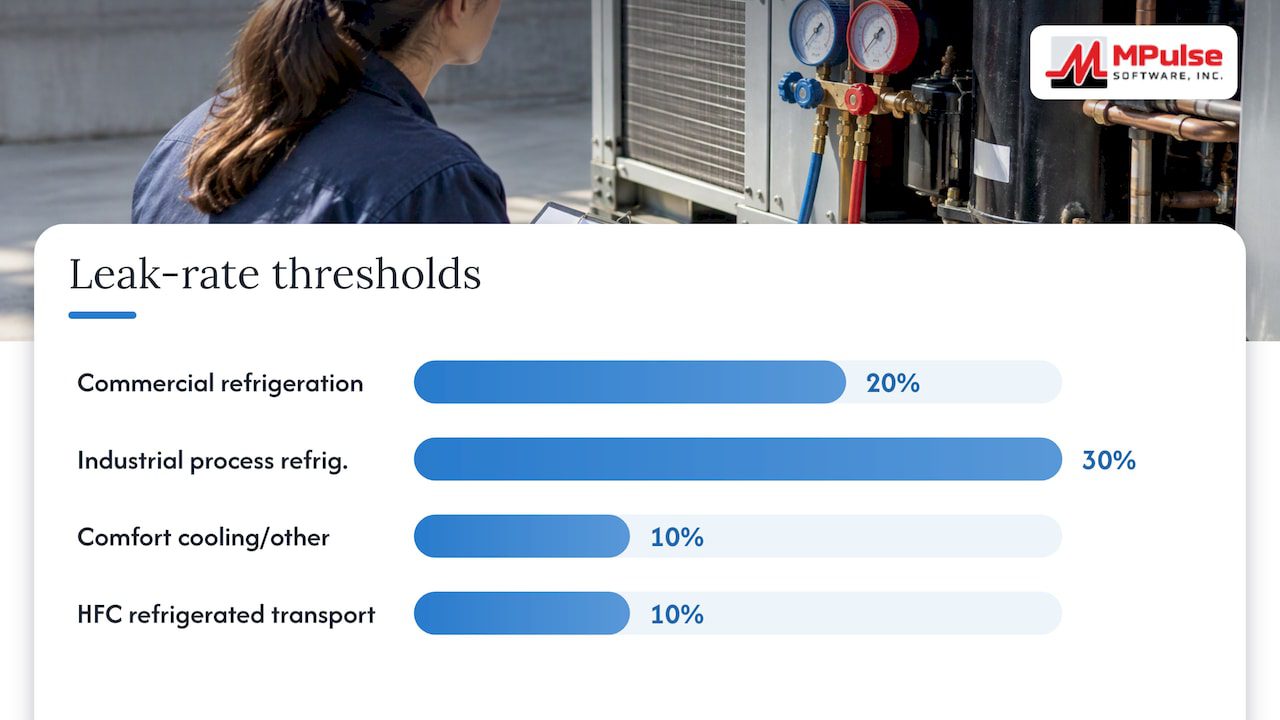
- Since January 1, 2026, a parallel rule at 40 CFR 84.106 covers appliances with 15 or more pounds of HFC refrigerant, with leak-rate thresholds of 20%, 30% or 10% depending on the appliance type.
- When a threshold is exceeded, repairs are due within 30 days (120 days for industrial process shutdowns), followed by verification tests.
- Records must be kept at least three years; full-charge records stay until three years after the appliance is retired.
- The strongest audit position is one record per asset, linked to the work orders that created it.
Table of Contents
- What EPA refrigerant tracking covers
- Two rules, two thresholds
- What records you must keep
- Where manual tracking breaks down
- A tracking workflow that stays audit-ready
- How a CMMS carries the workload
- Our perspective
- Getting started with MPulse
- FAQ
- Sources
What EPA refrigerant tracking covers
EPA’s Section 608 program governs refrigerant management in stationary refrigeration and air-conditioning equipment. Its stated aims are to reduce the use and emission of ozone-depleting substances, maximize recapture and recycling, and ensure safe disposal, according to EPA’s managing-refrigerant page. Vehicle air conditioning is handled separately under Section 609.
Two terms matter for scoping your inventory:
- Appliance. EPA defines it as a household or commercial device that uses a Class I, Class II or substitute refrigerant, and each independent circuit counts as its own appliance. A rooftop unit with two circuits is two appliances for charge and leak-rate purposes.
- Full charge. The amount of refrigerant the appliance is designed to hold. Every leak-rate calculation starts from it, so a wrong or missing full-charge figure makes every later number unreliable.
For most facilities, that means walk-in coolers, supermarket racks, chillers, large rooftop units, process cooling and cold storage. These are the assets that already sit on a preventive maintenance schedule, which is why tracking belongs next to that schedule.
Two rules, two thresholds
Section 608: 50 pounds or more of ozone-depleting refrigerant
Under 40 CFR 82.157, owners or operators of appliances with a full charge of 50 or more pounds of Class I or Class II refrigerant (including blends containing them) must calculate the leak rate every time refrigerant is added. The rule applies to appliances with solely substitute refrigerants only through the newer provisions below.
HFC rule: 15 pounds or more
The EPA’s HFC management rule added Subpart C to 40 CFR Part 84. Under 40 CFR 84.106, owners and operators had to determine the full charge of every refrigerant-containing appliance of 15 or more pounds by January 1, 2026, or at installation for equipment installed later. Appliances containing solely an ozone-depleting substance stay under 82.157, and appliances in the residential and light commercial air conditioning and heat pump subsector are exempt from 84.106.
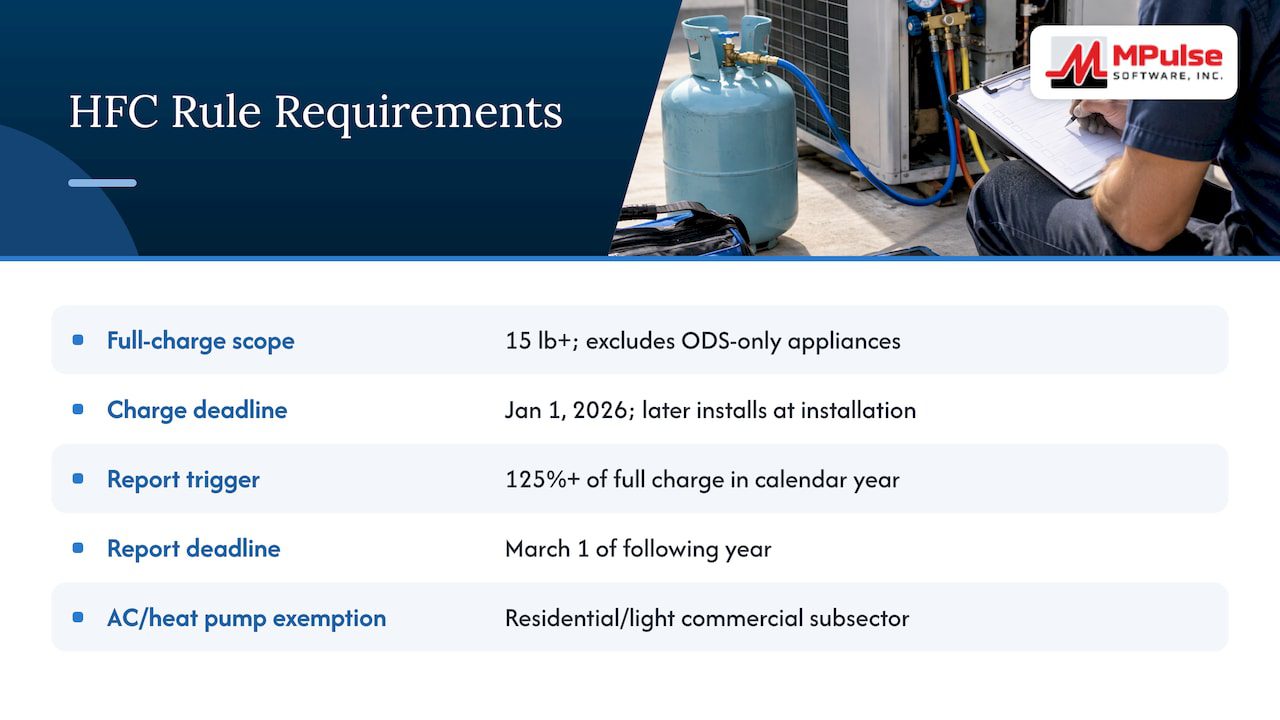
EPA also publishes a leak repair fact sheet for the HFC rule. It notes that owners of 15-pound-plus appliances that leak 125 percent or more of the full charge in a calendar year must submit a report to EPA by March 1 of the following year. Read the fact sheet for the full reporting content before your first reporting season.
Leak-rate thresholds at a glance
| Appliance type | Leak-rate threshold |
|---|---|
| Commercial refrigeration | 20% |
| Industrial process refrigeration | 30% |
| Comfort cooling and other appliances | 10% |
These percentages appear in both 82.157 and 84.106; the HFC rule lists refrigerated transport in the 10% group as well. When the leak rate exceeds the threshold, a certified technician must repair the appliance within 30 days, or 120 days if an industrial process shutdown is required. If repairs do not bring the rate under the threshold, the owner must create and carry out a retrofit or retirement plan, unless the owner elects to retrofit or retire the appliance in the first place (see 82.157©).
So, to answer a question readers often ask: yes, EPA requires leak repair once an appliance crosses its threshold.
What records you must keep
The EPA recordkeeping page separates duties for technicians and for owners and operators. For a 50-pound-plus appliance, owners must keep servicing records showing the date and type of service and the quantity of refrigerant added, plus records of leak inspections and verification tests.
The detailed service record under 82.157(l)(2) includes:
- Appliance identity and location
- Date of service
- Parts serviced
- Type of service
- Name of the person performing it
- Amount and type of refrigerant added or removed
- The full charge
- The leak rate and the method used to determine it (with exceptions such as disposal, post-retrofit, new installation and seasonal-variance additions)
Retention is at least three years in paper or electronic form. Full-charge records are kept until three years after the appliance is retired, per the same section. The HFC rule adds the installation date to what you keep and carries its own three-year minimum.
Verification tests
A repair is not finished when the wrench is put down. Repairs must be documented by an initial verification test and a follow-up verification test. The initial test is due within the 30-day (or 120-day) repair window, and the follow-up within 10 days of the successful initial test or of the appliance returning to normal operating conditions, according to 40 CFR 82.157(e). Each test is its own dated record, and each has its own deadline.
Where manual tracking breaks down
The rules are not complicated. The failures are practical:
- Fragmented records. The technician’s invoice holds the pounds added, the spreadsheet holds the full charge, and the leak-rate math lives in someone’s head.
- Missed clocks. A 30-day repair window and a 10-day follow-up window run side by side across dozens of units. Without scheduled reminders, one slips.
- Orphaned assets. Equipment installed or replaced without a full-charge entry cannot be calculated against.
- Retention gaps. Three years after retirement is a long time for a binder to survive a staff change or a move.
An audit request then becomes a scramble to reconstruct history. The fix is structural: one record per asset, and every refrigerant event created as a work order against that asset.
A tracking workflow that stays audit-ready
- Build the asset list. Add every appliance at or above the thresholds, one entry per independent circuit, with location, refrigerant type and full charge.
- Record the full charge once, at the asset level. Treat it as controlled data, not a field anyone edits casually.
- Log every addition and removal on a work order. Capture the technician, the date, the part serviced, and the pounds and type of refrigerant.
- Calculate the leak rate at each addition. Store the result and the method beside the work order, and flag any result above the appliance’s threshold.
- Trigger the repair clock. When a threshold is exceeded, create the repair work order with a due date inside 30 days (120 for industrial shutdowns), then the initial and follow-up verification tests as linked tasks.
- Schedule inspections as preventive maintenance. Recurring leak checks belong on the calendar with the rest of the equipment’s routine.
- Retain by rule. Keep three years of records, and full-charge history until three years after retirement.
- Review before reporting season. Pull the year’s leak history for 15-pound-plus appliances ahead of the March 1 report deadline.
For the commercial HVAC assets in that list, our practical guide to commercial HVAC maintenance covers how routine inspections and records fit together.
How a CMMS carries the workload
MPulse CMMS combines preventive maintenance automation, work order management, asset tracking, calendar scheduling and customizable workflows with support for compliance and regulatory recordkeeping. Mapped to the workflow above:
- Asset tracking gives each circuit its own record with location and history.
- Work order management captures who serviced what, when, and what was done.
- Preventive maintenance scheduling puts recurring leak inspections and follow-up tests on the calendar so deadlines are assigned instead of remembered.
- Mobile and barcode scanning let technicians open the right asset and log the service at the unit.
- Inventory management tracks parts and supplies used in repairs.
- Customizable workflows let you add the fields your recordkeeping needs.
- Graphical reporting helps you pull history when someone asks for it.
Facilities that already use sensors can also look at real-time monitoring and IIoT, which MPulse supports through sensor integration and condition-based maintenance.
The same structure serves different sites. Hospitals and food facilities with compliance-heavy equipment need records they can produce quickly. School districts with many buildings need one standard across all of them, and our education maintenance software overview shows how. Contractors servicing client equipment need each job tied to a specific asset and technician.
Our perspective
Refrigerant compliance is a recordkeeping problem long before it is a refrigerant problem. The leak that goes unrepaired past 30 days is rarely a mystery to the technician. It is a due date nobody owned.
We built MPulse around the idea that maintenance work should be scheduled, assigned and documented in one place. Preventive maintenance automation, work orders tied to assets, and an intuitive calendar mean the repair window and the verification tests show up as tasks with names and dates attached, not as a note in a folder.
With over 3,500 customers globally and customers reporting up to 40% efficiency improvements, we have seen what happens when records are a by-product of the work rather than a separate chore. Audit readiness follows from that. Our approach is to make the compliant way of working the easy way of working.
Mark
Getting started with MPulse
MPulse is sold as annual subscriptions, with published pricing of $29 per month per user for Professional and $79 per month per user for Advanced. Technician License and Enterprise Add-Ons are quoted separately. See the pricing page for what each edition includes.
Teams moving off spreadsheets can draw on CMMS implementation, training and consulting services. The Maintenance & Support Program is available as an add-on, and DataLink and other add-ons connect MPulse with ERP and other systems.
FAQ
Does the EPA require the repair of refrigerant leaks?
Yes. When an appliance exceeds its leak-rate threshold, the owner or operator must have it repaired within 30 days, or 120 days if an industrial process shutdown is required. If repairs do not bring the rate under the threshold, a retrofit or retirement plan is required, per 40 CFR 82.157. Initial and follow-up verification tests document the repair.
How long must refrigerant records be kept?
At least three years, on paper or electronically. Full-charge records must be kept until three years after the appliance is retired. The HFC rule at 40 CFR 84.106 also sets a three-year minimum and adds the installation date to the record.
Which appliances does the HFC leak-repair rule cover?
It covers appliances with a full charge of 15 or more pounds of an HFC or certain substitutes. Appliances containing only an ozone-depleting substance remain under 82.157, and the residential and light commercial air conditioning and heat pump subsector is exempt, according to 40 CFR Part 84 Subpart C.
Do small appliances need leak-rate tracking?
Small appliances are factory-made, charged, hermetically sealed products with five pounds or less of refrigerant, as EPA defines them. They fall below the 15-pound and 50-pound thresholds that trigger leak-rate calculations and inspections, though your asset list should still note them.
Sources
- Managing Refrigerant in Stationary Refrigeration and Air-Conditioning Equipment, US EPA
- Definitions of Section 608 Terms, US EPA
- Recordkeeping and Reporting Requirements for Stationary Refrigeration, US EPA
- 40 CFR 82.157, Appliance maintenance and leak repair, eCFR
- 40 CFR 82.157 (Mar. 11, 2020), eCFR
- 40 CFR Part 84 Subpart C, Management of Regulated Substances, eCFR
- Leak Repair Requirements for Appliances Containing HFCs and Certain Substitutes, US EPA fact sheet