To reach basic student safety facility compliance, establish a named safety committee, gather your three core documents (current fire inspection certificate, AHERA asbestos management plan, and signed emergency operations plan), schedule your first building walkthrough within 30 days, and assign corrective-action owners before your next board meeting. Schoolsafety and the FEMA Guide for Developing High-Quality School Emergency Operations Plans provide the federal framework; MPulse Software can centralize the inspection records and preventive maintenance schedules that prove compliance to auditors.
Start here — three documents to locate today:
- Current fire inspection certificate (signed, dated, on file)
- AHERA asbestos management plan with the most recent 3-year inspection date
- Emergency operations plan (ERP), signed by the superintendent or designee
30-day priorities:
- Fix any life-safety defects identified in the last inspection (blocked egress, inoperative emergency lighting, missing extinguisher tags)
- Assign a facilities lead and law enforcement liaison to the safety committee
- Confirm boiler, elevator, and playground inspection currency
90-day priorities:
- Complete medium-risk repairs and document corrective actions with photos and work-order numbers
- Run at least one evaluated drill with local fire or police observers
- Begin loading inspection schedules into a CMMS or digital inspection system
365-day priorities:
- Complete capital or retrofit items (access-control upgrades, glazing hardening, controlled vestibule)
- File all required state submissions and update the ERP
- Establish a recurring annual compliance calendar with named owners for each task
Key Takeaways
Effective student safety facility compliance requires a named committee, current certificates, a tested emergency plan, and a CMMS that creates a closed-loop audit trail from inspection to corrective action.
| Point | Details |
|---|---|
| Establish a named committee | Assign a facilities lead, law enforcement liaison, public health rep, and special-needs rep in writing before the first audit. |
| Gather three core documents | Fire inspection certificate, AHERA asbestos management plan, and signed ERP are the first items any auditor will request. |
| Use a 100%/80% scoring model | Non-negotiable items (egress, fire certificates, boilers) must be fully compliant; all deficiencies require a documented corrective action. |
| Schedule drills with external observers | At least one evaluated drill per year with signed fire or police feedback materially strengthens your audit record. |
| MPulse CMMS centralizes compliance records | MPulse automates PM schedules, attaches signed evidence to work orders, and exports audit packages, reducing assembly time from days to hours. |
Table of Contents
- What federal and state law actually requires for student safety facility compliance
- How to schedule inspections and keep audit-ready records
- How to make your emergency operations plan audit-ready
- What physical security measures actually move the compliance needle
- Environmental health compliance: AHERA, lead, IAQ, and water
- Who owns compliance: safety committees, roles, and the annual calendar
- Why digital tools reduce compliance risk in school facilities
- An audit-ready building checklist: top 20 items with scoring guidance
- A 30/90/365-day action plan to operationalize compliance
- What compliance programs actually look like in practice
- MPulse CMMS gives your compliance program a verifiable audit trail
- Sources
- FAQ
What federal and state law actually requires for student safety facility compliance
Facility managers often underestimate how many overlapping legal layers govern school building safety. Federal guidance sets the floor; state statutes and agency rules add specific deadlines, certificates, and scoring thresholds on top.
Federal references that shape your compliance program
The federal framework starts with SchoolSafety.gov, which consolidates guidance from the Departments of Education, Justice, Health and Human Services, and Homeland Security. Its all-hazards approach means your emergency planning must account for fire, severe weather, medical emergencies, and security threats, not just one scenario. The FEMA Guide for Developing High-Quality School Emergency Operations Plans (co-published with the Department of Education) provides the model template most state agencies reference when they evaluate local ERPs.
For environmental health, the EPA’s Asbestos Hazard Emergency Response Act (AHERA) requires every K-12 school to maintain a written asbestos management plan, conduct 6-month periodic surveillance, and complete a 3-year re-inspection by an accredited inspector. Failure to maintain the plan is a federal violation, not just a paperwork gap.
For postsecondary institutions with campus housing, the Clery Act adds daily crime logs, timely warning obligations, and annual campus security and fire safety reports with specific retention and public-disclosure requirements. K-12 administrators who oversee shared campuses or district-run residential programs should confirm whether Clery obligations apply to their context.
How states layer additional mandates
-
New Jersey (QSAC): The NJ QSAC Health and Safety Guidance Checklist requires an annual building checklist for every instructional building, distinguishes 100%-compliance items (non-negotiable) from 80%-threshold items, and requires senior administrator signatures on monitoring submissions. Required certificates include fire inspection, boiler, and Black Seal operator credentials.
-
Connecticut (DEMHS): The All-Hazards School Security and Safety Plan Standards (updated July 2025) require each district to establish a school security and safety committee, submit plans annually by November 1, and complete a security and vulnerability assessment every two years.
-
Virginia: Under Code of Virginia § 22.1-279.8, the Virginia School Safety Inspection Checklist mandates zone-based safety audits using CPTED principles, multi-disciplinary inspection teams that include local law enforcement, and certification protocols for submission to the state.
-
New York: The NYSED Safe Schools by Design guidance (April 2025) requires districts to incorporate safety and design considerations into five-year capital plans, with specific attention to fire safety, glazing hardening, and fire department connection access.
Certificates and records to track
Every school facility compliance file should contain, at minimum: fire inspection certificates, boiler inspection certificates, Black Seal operator credentials (where required), elevator inspection certificates, AHERA asbestos management plan with re-inspection dates, health department kitchen certificates, and playground inspection reports. States with Life Hazard Use registration requirements (such as New Jersey) add a certificate of registration to that list.
Pro Tip: When you collect signed certificates, create a chain-of-custody log that records who received each document, the date, and where the original is stored. Auditors frequently ask for the chain of custody, not just the certificate itself.
How to schedule inspections and keep audit-ready records
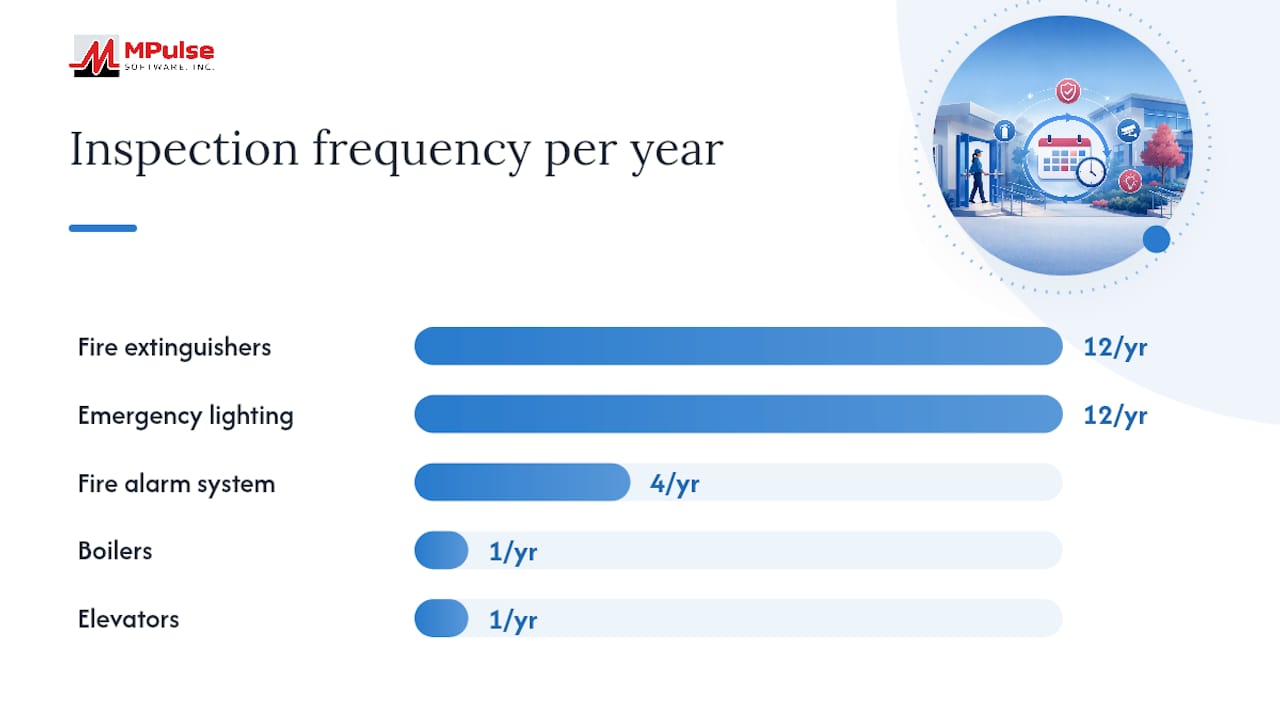
Inspection frequency is not optional or discretionary. Most state codes and insurance carriers specify minimum intervals, and auditors check dates against those intervals. Missing a quarterly fire extinguisher tag is a finding; missing an annual boiler inspection is a potential shutdown order.
Inspection frequency by asset type
| Asset Type | Minimum Interval | Minimum Record Elements |
|---|---|---|
| Fire extinguishers | Monthly visual / Annual service | Inspector name, date, result, tag attached |
| Emergency lighting / exit signs | Monthly test / Annual full test | Tester name, date, duration, corrective action |
| Fire alarm system | Quarterly / Annual full inspection | Contractor name, date, test results, deficiencies |
| Boilers | Annual (state-licensed inspector) | Inspector license number, date, certificate number |
| Elevators | Annual (state-licensed inspector) | Certificate number, date, posted in cab |
| HVAC systems | Quarterly filter / Annual full service | Technician name, date, filter specs, readings |
| Electrical panels | Annual visual / 5-year thermographic | Inspector name, date, findings, corrective work order |
| Roofs | Semi-annual (spring and fall) | Inspector name, date, photos, drainage condition |
| Playgrounds | Monthly visual / Annual professional | Inspector name, date, compliance notes |
| Plumbing / backflow preventers | Annual | Certified tester name, date, test results |
The NJ QSAC checklist illustrates how scoring works in practice: items in the 100% category (egress, fire certificates, boiler certificates) must be fully compliant with no exceptions, while 80% items allow a small margin. Recording “N/A” on a checklist item requires a written explanation of why the item does not apply, not a blank cell. Corrective actions must include the responsible party, target completion date, and verification signature.
Audit-readiness depends on four practices:
- Signed checklists: Every inspection form carries the inspector’s printed name, signature, and date. Electronic signatures with timestamps are equally valid and easier to retrieve.
- Photographic evidence: Attach photos to work orders for any deficiency. A photo of a blocked exit door with a date stamp is far more defensible than a text note.
- Work-order linkage: Every corrective action should generate a numbered work order that ties back to the inspection finding. This creates a closed-loop audit trail.
- Retention schedules: Most states require inspection records to be retained for a minimum of 3–7 years. Confirm your state’s requirement and set a documented retention policy.
The Virginia School Safety Inspection Checklist also requires multi-disciplinary inspection teams, meaning a single facilities manager walking the building alone does not satisfy the statutory requirement in Virginia. Build your team composition into the inspection protocol from the start.
Pro Tip: Pre-fill inspection templates with asset IDs, locations, and last-inspection dates before the walkthrough. Inspectors who spend less time filling in header fields spend more time actually examining the asset.
How to make your emergency operations plan audit-ready
An ERP that sits in a binder on a shelf is not a compliance document. Auditors look for evidence that the plan is current, tested, and understood by the people who would execute it.
Your ERP should follow the plain-language, all-hazards template framework recommended by FEMA and the Department of Education. Where your state requires it, the school ERP must be annexed to the local emergency operations plan (LEOP) so that district and municipal responders share a common operational picture. SchoolSafety.gov provides model templates and a self-assessment tool to evaluate plan quality against federal standards.
Building a drill program that satisfies auditors
-
Establish required drill types and frequencies. Most states mandate a minimum number of fire drills (commonly 4–12 per year depending on grade level and season), plus at least one lockdown or secure-in-place drill and one reunification drill annually. Confirm your state’s specific count before setting the calendar.
-
Document every drill with consistent fields. Each drill record should capture: date and time, scenario type, duration, number of participants, names of observers (including any external responders), identified deficiencies, and corrective actions with target dates.
-
Run at least one evaluated drill with external observers. Invite local fire or police to observe, walk the building, and sign a feedback form. Their written observations carry significant weight with state auditors and provide independent verification that the drill was conducted.
-
Address special populations explicitly. Students with disabilities require individualized emergency evacuation plans (IEEPs) or Annex M-style accommodations that specify how each student will be moved, who is responsible, and what equipment is needed. English learner communities need translated communications and bilingual staff assigned to reunification zones.
-
Reunification drills deserve their own protocol. A reunification drill should test the parent notification system, the student release process, and the documentation of who was released to whom. This is the drill most districts skip, and it is the one that generates the most findings during state reviews.
Pro Tip: After each evaluated drill, send a written summary to your superintendent and board within 48 hours. Documenting what worked and what needs correction demonstrates program maturity and builds institutional support for the resources needed to fix deficiencies.
What physical security measures actually move the compliance needle
Physical security compliance is not about installing the most technology. It is about controlling entry, maintaining sightlines, and hardening the specific vulnerabilities that allow unauthorized access or delay emergency response.
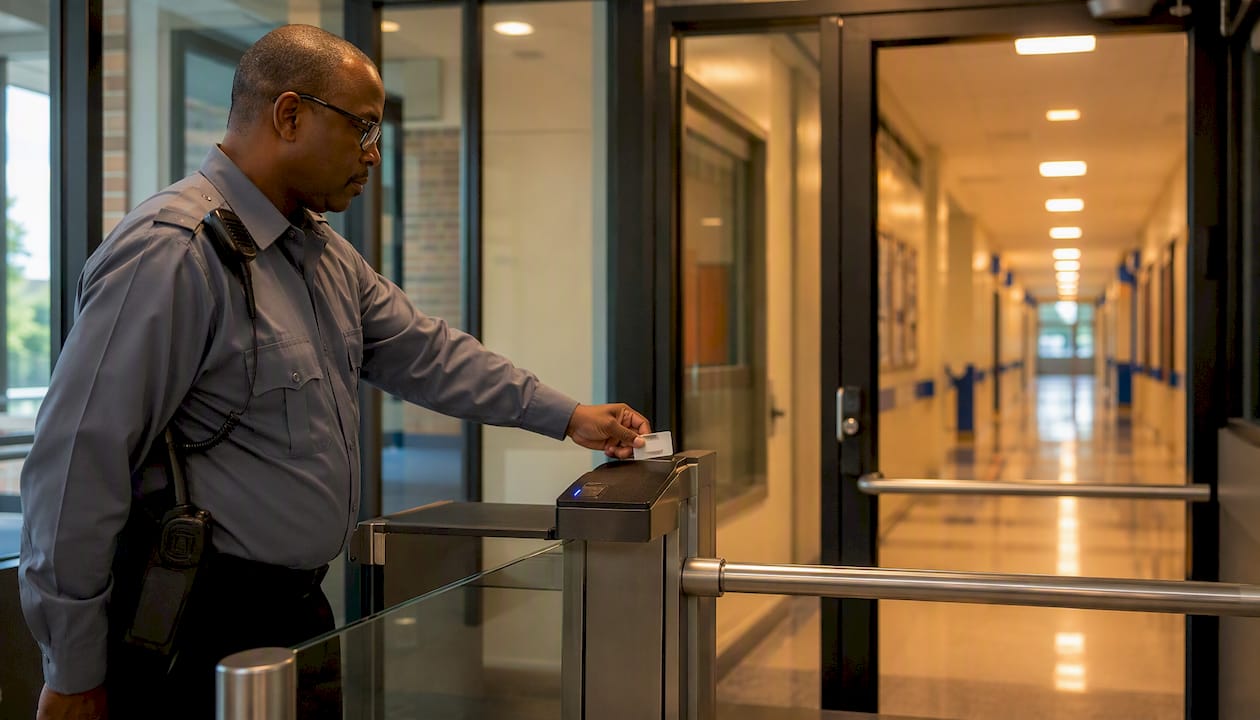
The NCEF school safety checklist organizes physical security assessment around CPTED (Crime Prevention Through Environmental Design) principles: natural surveillance, access control, and territorial reinforcement. These principles translate directly into auditable checklist items.
CPTED and access-control checklist items
- All exterior doors locked during the school day except the designated main entry point
- Controlled vestibule at the main entry with intercom, camera, and staff-controlled release
- Clear sightlines from the main office to the vestibule and main entry path (no obstructions)
- Visitor management system that captures ID and generates a badge before entry to the building interior
- Perimeter fencing or landscaping that channels visitors toward the controlled entry point
- Exterior lighting covering all entry points, parking areas, and loading zones
- Surveillance cameras covering entry points, hallways, and common areas with recorded footage retained per policy
- Interior door hardware that allows classroom lockdown from inside without a key (per ASTM F3561 or equivalent state guidance)
- Vision panels on classroom doors (or film applied to existing solid doors) to allow visual confirmation before opening
- Knox box or key-control system accessible to fire and police at the main entry
The National K-12 School Security Minimum Standards distinguish between a panic button (a silent duress signal to law enforcement) and a lockdown button (a building-wide alert that initiates lockdown procedures). These are not interchangeable. Alyssa’s Law, enacted in New Jersey and Florida and under consideration in other states, specifically requires silent panic alert systems that connect directly to 9-1-1 or law enforcement dispatch. Confirm whether your state has enacted a version of Alyssa’s Law and what the technical specifications require.
Mass notification should be multi-modal: PA announcement, visual strobes or colored lights, and a digital notification to staff devices. Relying on a single channel creates a single point of failure during an actual emergency.
Pro Tip: Window film is one of the highest-value, lowest-cost physical security upgrades available. Applied to ground-floor glazing, 3M Safety Series or equivalent security film delays forced entry by several minutes without requiring structural changes or permits in most jurisdictions. The NYSED Safe Schools by Design guidance specifically recommends glazing hardening as a capital planning priority.
Environmental health compliance: AHERA, lead, IAQ, and water
Environmental compliance is where many school facilities teams fall behind, not because they ignore it, but because the regulatory requirements span multiple agencies and the documentation is scattered across different offices.
The core regulatory checkpoints
-
AHERA (asbestos): Confirm that your written asbestos management plan is current, that the most recent 3-year re-inspection was conducted by an accredited inspector, and that 6-month periodic surveillance records are on file. The plan must be available to parents and staff upon request within 5 days.
-
EPA IAQ Tools for Schools: The EPA’s Indoor Air Quality Tools for Schools program provides a framework and action kit for managing IAQ in K-12 buildings. An IAQ coordinator should be designated, and the building should have a documented IAQ management plan that addresses ventilation rates, moisture control, and chemical storage.
-
Lead in water: Following EPA’s Lead and Copper Rule revisions, schools are expected to test drinking water outlets and remediate fixtures that exceed action levels. Many states have enacted their own lead-in-water testing requirements for schools with specific timelines and reporting obligations. Collect and retain all test results and contractor remediation records.
-
Health department certificates: Kitchen facilities require current health department inspection certificates. These are typically annual and must be posted. Confirm that the certificate on the wall matches the current inspection year.
-
Sanitation and pest management: Integrated pest management (IPM) plans are required in many states for schools receiving federal funding. Document pesticide applications, contractor licenses, and parent notification records.
Tie every monitoring result to a corrective work order. When a water test shows an elevated lead reading, the work order that documents fixture replacement or flushing protocol becomes the evidence that the district responded appropriately. Without that linkage, the test result alone looks like an unresolved finding.
Pro Tip: Build a single indexed compliance binder, both digital and physical, with labeled tabs for each regulatory area (AHERA, IAQ, Lead/Water, Kitchen, Pest Management). Include a cover sheet that lists the last inspection date and next due date for each item. Auditors who can find what they need in under two minutes are auditors who leave faster.

Who owns compliance: safety committees, roles, and the annual calendar
Compliance without named owners is a plan that exists only on paper. Every task, certificate, and submission deadline needs a person attached to it.
Committee composition and responsibilities
Establish a school safety committee with, at minimum, these roles:
- Administrator (principal or assistant superintendent): Signs the ERP, certifies state submissions, and chairs the committee
- Facilities lead (director of facilities or head custodian): Owns the inspection schedule, corrective-action log, and certificate file
- Law enforcement liaison (school resource officer or local police contact): Reviews physical security measures, participates in drills, and signs drill observation forms
- Public health representative (school nurse or district health officer): Owns AHERA, IAQ, lead/water, and kitchen certificate records
- Special-needs representative (special education director or 504 coordinator): Ensures IEEPs and drill accommodations are current for all students with disabilities
Connecticut’s All-Hazards School Security and Safety Plan Standards require this committee structure and mandate annual plan submission by November 1. Virginia’s checklist requires the inspection team to include local law enforcement. Build both requirements into your committee charter from the start, even if your state does not yet mandate them, because they represent the direction most state frameworks are moving.
Annual compliance calendar (recurring tasks)
- July/August: Update ERP, confirm committee membership, schedule all annual inspections for the coming school year
- September: Conduct first fire drill of the year, confirm all certificates are current before school opens
- October: Complete security and vulnerability assessment (biennial in Connecticut; confirm your state’s cadence), submit any fall state reports
- November 1: Annual plan submission deadline (Connecticut; confirm your state’s equivalent)
- December/January: Mid-year inspection review, confirm HVAC filter replacements completed
- February/March: Run lockdown or secure-in-place drill with law enforcement observer
- April/May: Complete spring roof inspection, schedule summer capital work, begin AHERA periodic surveillance
- June: Annual compliance review meeting, document the year’s findings and corrective actions for the board
Why digital tools reduce compliance risk in school facilities
Manual inspection logs stored in binders create three predictable problems: records get lost, corrective actions go unverified, and assembling an audit package takes days instead of hours. A CMMS (computerized maintenance management system) solves all three by centralizing records, automating schedules, and attaching proof to every work order.
SchoolSafety.gov specifically recommends that administrators use automated, mobile-capable software to manage documentation and evolving safety requirements. That recommendation reflects what practitioners already know: the districts that pass audits cleanly are the ones whose records are complete, retrievable, and linked to corrective actions.
Features that matter for school compliance workflows
- Mobile inspection forms: Inspectors complete checklists on a tablet or phone, attach photos, and submit in real time. No paper to transcribe, no missing signatures.
- Scheduled preventive maintenance: The system generates work orders automatically based on the inspection calendar, so a quarterly fire extinguisher check cannot be accidentally skipped.
- Document attachments: Certificates, contractor reports, and signed drill forms attach directly to the relevant asset or work order record.
- Signed audit trails: Every record shows who created it, who modified it, and when, creating the chain-of-custody documentation auditors require.
- Role-based access: Facilities staff see their assigned work orders; administrators see the compliance dashboard; auditors get a read-only export package.
- Reporting for regulators: Pre-built or custom reports export inspection histories, open corrective actions, and certificate expiration dates in formats auditors recognize.
- Multi-site rollup: Districts with multiple buildings need a single view of compliance status across all campuses, not a separate binder for each school.
Questions to ask any CMMS vendor before purchasing
- How long does the system retain inspection records, and can records be exported in a format acceptable to state auditors?
- Does the mobile app work offline, and does it sync automatically when connectivity is restored?
- Can the system send automated alerts when a certificate or PM due date is approaching?
- Does the platform support integration with existing ERP, HR, or building automation systems?
- How does the system handle multi-site management for a district with multiple buildings?
MPulse Software supports campus asset management workflows and CMMS-driven compliance recordkeeping, making it a practical fit for districts that need to centralize inspection logs and automate preventive maintenance across multiple buildings.
An audit-ready building checklist: top 20 items with scoring guidance
The checklist below draws from the NJ QSAC Health and Safety Guidance Checklist, the NCEF school safety checklist, and the Virginia School Safety Inspection Checklist. Items are ordered by immediate safety impact.
| # | Checklist Item | Scoring Category | Record Required |
|---|---|---|---|
| 1 | All egress paths clear and unobstructed | 100% (non-negotiable) | Inspector name, date, photo |
| 2 | Fire inspection certificate current and posted | 100% | Certificate on file, date verified |
| 3 | All exterior doors locked except controlled entry | 100% | Walkthrough log, date |
| 4 | Emergency lighting functional (monthly test) | 100% | Test log, duration, corrective action |
| 5 | Fire extinguishers tagged and accessible | 100% | Monthly visual log, annual service tag |
| 6 | Boiler inspection certificate current | 100% | Certificate on file, inspector license |
| 7 | AED present, charged, and staff trained | 100% | Device check log, training records |
| 8 | AHERA asbestos management plan on file | 100% | Plan location, last inspection date |
| 9 | Signed ERP current (within 12 months) | 100% | Signed copy, superintendent signature |
| — | Elevator inspection certificate current | 100% | Certificate posted in cab |
| — | Controlled vestibule operational | 80% | Walkthrough log, camera check |
| 12 | Visitor management system active | 80% | System log, staff training record |
| — | Playground inspection current | 80% | Inspection report, corrective actions |
| — | HVAC filters replaced per schedule | 80% | PM work order, filter specs |
| — | IAQ coordinator designated and documented | 80% | Designation letter on file |
| — | Lead/water test results on file | 80% | Test results, remediation work orders |
| 17 | Kitchen health department certificate posted | 80% | Certificate date verified |
| — | Roof inspection completed (spring and fall) | 80% | Inspection report, photos |
| — | Drill records current (all required types) | 80% | Drill logs with observer signatures |
| 20 | Safety committee meeting minutes on file | 80% | Signed minutes, attendance list |
Scoring logic: Items in the 100% category must be fully compliant with no exceptions. Items in the 80% category allow a small margin, but any deficiency still requires a documented corrective action with a target completion date. Mark any item “N/A” only with a written explanation of why it does not apply to your building type or grade level.
To use this checklist in a CMMS or mobile inspection app, export it as a template with asset IDs pre-populated. Each row becomes a work order trigger when a deficiency is found, creating the closed-loop audit trail that satisfies state reviewers.
A 30/90/365-day action plan to operationalize compliance
30-day priorities
- Gather the three core documents: Fire inspection certificate, AHERA asbestos management plan, and signed ERP. If any is missing or expired, that is your first corrective action.
- Conduct a building walkthrough using the top 20 checklist above. Assign a score to each item and document every deficiency with a photo and a responsible owner.
- Fix all 100%-category deficiencies immediately. Blocked egress, missing fire certificates, and inoperative emergency lighting are not deferred items. Address them before the next school day if possible.
- Assign committee roles. Name the facilities lead, law enforcement liaison, public health representative, and special-needs representative in writing.
- Schedule all annual inspections for the year. Boiler, elevator, fire alarm, and playground inspections should be on the calendar with contractor names and confirmation numbers.
90-day priorities
- Complete all medium-risk (80%-category) repairs and close each corrective action with a verification signature and photo.
- Run an evaluated drill with at least one external observer (fire or police). Capture their signed feedback and distribute a written summary to the superintendent within 48 hours.
- Formalize the safety committee calendar with meeting dates, submission deadlines, and assigned owners for each recurring task.
- Begin loading inspection schedules into a CMMS. Start with the highest-frequency assets (fire extinguishers, emergency lighting) so the system begins generating automated work orders before the next inspection cycle.
- Confirm AHERA 6-month surveillance is scheduled and that the accredited inspector for the next 3-year re-inspection is identified.
365-day priorities
- Complete capital or retrofit items: Controlled vestibule installation, glazing hardening (window film or laminated glass), and access-control hardware upgrades. The NYSED Safe Schools by Design guidance requires these items to appear in five-year capital plans.
- File all required state submissions (annual plan updates, QSAC checklists, or equivalent) with signed administrator attestations.
- Complete a full-year compliance review with the safety committee. Document what was accomplished, what remains open, and what budget requests are needed for the next fiscal year.
- Establish a multi-year maintenance plan that maps inspection cycles to the state-required cadence and includes a retention schedule aligned with your state’s minimum record-keeping requirements.
Verification at each stage: “Done” means a signed record exists, a corrective action is closed with verification, and the next due date is scheduled in the system. A task without a next scheduled date is not complete.
What compliance programs actually look like in practice
The gap between a compliance program that looks good on paper and one that holds up under a state audit is almost always a documentation gap, not a safety gap. Most facility managers who have gone through a state review will tell you the same thing: the building was safer than the records suggested, and the findings were about missing signatures and expired certificates, not actual hazards.
The most effective compliance programs share a few characteristics that are easy to overlook. First, they treat the annual compliance calendar as a non-negotiable operational document, not a suggestion. When a boiler inspection is due in October, it is on the calendar in August, with a contractor name and a backup contact. Second, they invest in stakeholder communication early. Boards and superintendents who understand why a controlled vestibule costs $40,000 are far more likely to approve the budget than those who receive a one-paragraph memo the week before the state audit.
The trade-off between budget and urgency is real. Not every district can address every capital item in a single fiscal year. The practical answer is to document the prioritization decision explicitly: which items were deferred, why, what interim mitigations are in place, and what the timeline is for full remediation. An auditor who sees a documented, board-approved deferral with interim controls is in a very different position than one who sees a blank corrective-action field.
One outcome worth pursuing deliberately: reduce the number of repeat findings from one audit cycle to the next. A district that had 12 findings in year one and 3 in year two has demonstrated a functioning compliance program, even if it is not yet perfect. That trajectory matters to state reviewers and to the communities those schools serve.
MPulse CMMS gives your compliance program a verifiable audit trail
Assembling a state audit package from paper binders and shared drives can take days. MPulse CMMS reduces that to hours by centralizing inspection logs, automating preventive maintenance schedules, and attaching signed evidence directly to every work order. When an auditor asks for the last three years of fire extinguisher inspection records across six buildings, the answer is a filtered report, not a filing-cabinet search.
MPulse Software maps directly to the compliance workflows described in this guide: mobile inspection forms with photo attachments, scheduled PMs that trigger automatically based on your inspection calendar, role-based access for facilities staff and administrators, and exportable audit packages formatted for state reviewers. The platform supports preventive maintenance automation and CMMS-driven safety outcomes that keep inspection cycles on track and corrective actions closed.
Districts using MPulse report faster audit assembly and fewer missed inspection cycles because the system generates the work order before the due date arrives, not after. For a facility manager responsible for multiple buildings, that automation is the difference between a compliance program that runs itself and one that depends on someone remembering to check a spreadsheet.
Request a demo at MPulse Software to see how the platform handles school facility compliance workflows, or download a template inspection schedule to start building your audit-ready records today.
Sources
The sources below are the primary federal and state references used throughout this guide. Each provides templates, checklists, legal language, or technical guidance that facility managers can download and use directly.
- Schoolsafety
- Health and Safety Guidance Checklist Instructions (NJ QSAC)
- National K-12 School Security Minimum Standards (NSSPA / LA Safe Schools)
- All Hazards School Security and Safety Plan Standards (Connecticut DEMHS)
- NCEF school safety checklist (NCEF / National Clearinghouse for Educational Facilities)
- Safe Schools by Design Act – A Guide by NYSED
- Virginia School Safety Inspection Checklist (DCJS/VCSCS)
- EPA: Indoor Air Quality Tools for Schools
- Handbook for Campus Crime Reporting (FSA partners / Clery Act guidance)
To package these sources for a state auditor, download each as a PDF, label the file with the source name and date accessed, and store them in a labeled folder within your compliance binder (digital and physical). Include a one-page index that maps each source to the regulatory area it covers.
This article is general information, not a substitute for advice from a qualified lawyer. Consult a qualified legal professional about your own circumstances before acting on anything here.
FAQ
What are the core safety compliance standards for K-12 schools?
Federal standards come from FEMA’s all-hazards ERP framework and EPA’s AHERA and IAQ guidance; state standards layer additional requirements for specific certificates, inspection frequencies, and plan submission deadlines that vary by jurisdiction.
Are schools legally responsible for student safety?
Yes. Schools have a legal duty of care for students under state tort law, and specific federal statutes (AHERA, Clery Act for postsecondary institutions) impose additional compliance obligations with defined penalties for non-compliance.
What are the most important safety rules facility managers should enforce?
The highest-priority items are clear egress paths, current fire inspection certificates, functional emergency lighting, locked exterior doors except at the controlled entry point, and a signed, current emergency operations plan. These are the items most state checklists classify as non-negotiable.
What is the Clery Act and does it apply to K-12 schools?
The Clery Act applies to postsecondary institutions that participate in federal financial aid programs and have campus housing; it requires daily crime logs, timely warnings, and annual campus security and fire safety reports. K-12 schools are generally not subject to Clery, but district administrators overseeing residential programs should confirm applicability with legal counsel.
How does a CMMS help with school facility compliance?
A CMMS automates inspection schedules, generates work orders before due dates arrive, attaches signed evidence and photos to records, and produces exportable audit packages, reducing the time to assemble a state audit submission from days to hours.