Cutting mean time to repair comes down to four levers: a modern CMMS, condition monitoring, spare-parts readiness, and technician enablement. Applied together, these levers typically produce MTTR reductions in the 15–40% range, with some AI-assisted troubleshooting programs reporting repair-time cuts of up to 50% when documentation, work orders, and parts data are unified into one searchable source.
The core insight: MTTR reduction is not one project. It is four coordinated changes to how your team diagnoses, sources, repairs, and verifies work.
The fastest wins usually come from these areas:
- Centralizing work orders and asset history in a CMMS
- Catching faults earlier with condition monitoring or IIoT sensors
- Keeping critical spare parts staged and tracked
- Giving technicians mobile access to procedures and troubleshooting data
MPulse CMMS addresses all four levers directly, and organizations using it report efficiency gains of up to 40%. The rest of this guide breaks down exactly how to get there, starting this month.
Key Takeaways
MTTR reduction depends on combining CMMS-driven workflows, condition monitoring, spare-parts readiness, and technician enablement into one coordinated program rather than isolated fixes.
| Point | Details |
|---|---|
| Set a baseline first | Calculate current MTTR from 90 days of repair records before changing any process. |
| Fix parts availability early | Staged critical-spare kits remove sourcing delays, one of the biggest avoidable causes of extended repair time. |
| Follow a phased timeline | A 30/90/180-day roadmap delivers compounding MTTR gains rather than a single disruptive rollout. |
| Track MTBF alongside MTTR | Rising MTBF with falling MTTR confirms real reliability gains, not just faster patchwork. |
| MPulse CMMS supports the full roadmap | The platform combines PM automation, mobile work orders, and parts tracking, with customers reporting up to 40% efficiency gains. |
Table of Contents
- Quick Wins for MTTR Reduction This Month
- What Actually Shortens Repair Time?
- Building Your 30, 90, and 180-Day MTTR Roadmap
- How Do You Measure and Sustain MTTR Gains?
- How MPulse CMMS Maps to This Roadmap
- Why Sustaining MTTR Gains Is Harder Than Achieving Them
- Put the Roadmap Into Practice With MPulse CMMS
- Sources
- FAQ
Quick Wins for MTTR Reduction This Month
You don’t need a six-month software rollout to start seeing results. Most facilities can shave measurable time off repairs within 30 days by tightening a few operational gaps.
- Set your MTTR baseline. Pull the last 90 days of repair records and calculate average time from failure report to verified fix. Track it on one dashboard metric, even a simple spreadsheet chart, so every improvement has a number to beat.
- Run a top-five asset audit. Identify the five assets responsible for the most downtime hours and interview the technicians who work on them. Ask specifically what slows them down: missing parts, unclear procedures, or waiting on approvals.
- Turn on mobile work orders. If your CMMS supports mobile access, activate it now. Technicians who can pull up procedures and log status from the floor skip the walk back to the shop office.
- Build critical-spare kits. For your bottleneck assets, stage the three or four parts that fail most often in a labeled bin near the equipment, not the general stockroom.
- Name one owner. MTTR reduction stalls without a single person accountable for tracking the metric and pushing the fixes forward.
Pro Tip: Pick the one asset with the worst MTTR last quarter and fix only that one first. A visible early win builds the case for expanding the program.
What Actually Shortens Repair Time?
MTTR breaks into four distinct phases: diagnosis, parts sourcing, the repair itself, and verification. Each lever below attacks a different phase, and understanding which phase you’re bottlenecked on determines where to invest first.
CMMS: cutting diagnosis and handoff time
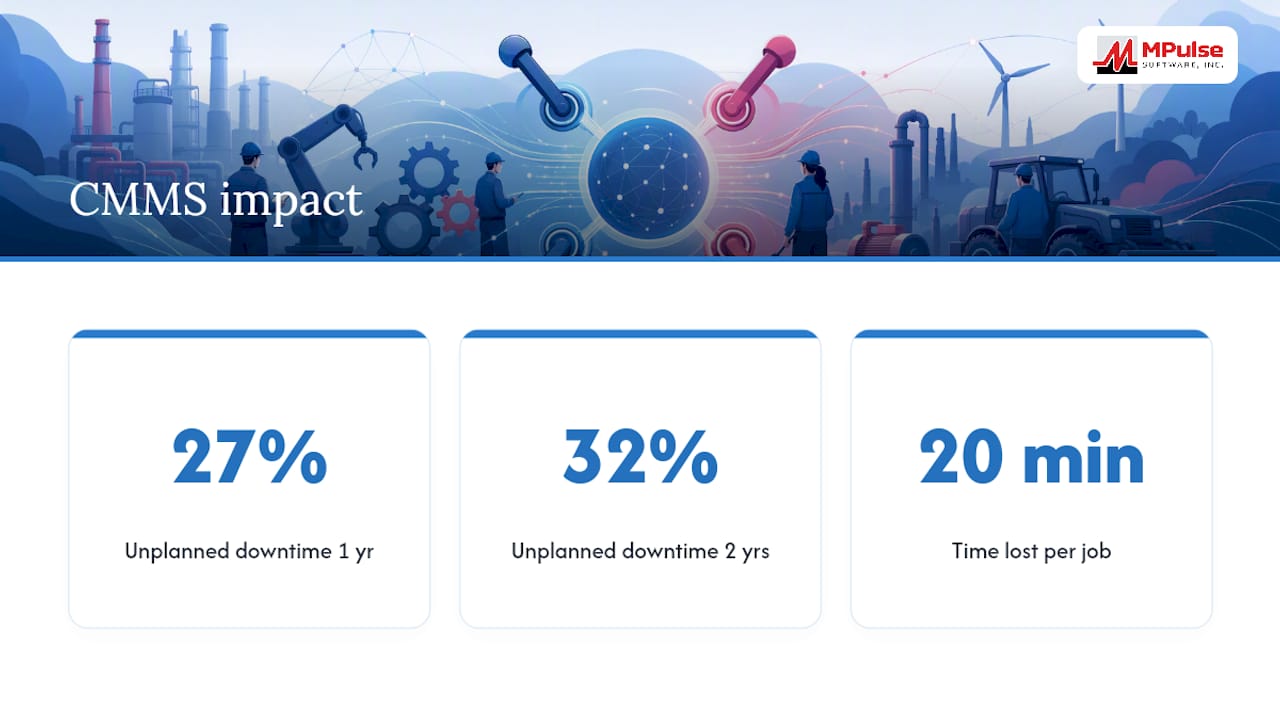
A modern CMMS gives technicians instant access to an asset’s full work history, so they aren’t re-diagnosing a problem someone already solved last quarter. Standardized procedures attached to each work order remove guesswork, and mobile access means a technician logs findings in real time instead of losing details on a walk back to the office. Companies adopting a modern CMMS or EAM system reduced unplanned downtime by 27% in the first year and 32% within two years, largely because centralized data and automated scheduling eliminate the manual lookups that used to eat up the first twenty minutes of every job.
Condition monitoring: catching faults before they escalate
Sensors on vibration, temperature, or pressure flag anomalies before a full failure, which shrinks the diagnosis window dramatically. Instead of a technician arriving cold to troubleshoot, they show up already knowing which component triggered the alert. A phased pilot on a single line or equipment class limits your capital exposure while proving the concept before a plant-wide rollout.

Parts readiness: eliminating sourcing delays
Waiting on a part is one of the most avoidable causes of extended MTTR. A critical-parts list with defined min/max thresholds, backed by vendor service-level agreements or on-site consignment stock, removes the emergency-shipping scramble entirely. Maintenance teams consistently name parts management as the number-one lever for cutting unplanned downtime, ahead of most technology investments.
Technician enablement: speeding troubleshooting itself
Searchable manuals, step-by-step checklists, and captured tribal knowledge cut the time technicians spend hunting for answers. One industrial manufacturer integrated over 1,000 documents with live work-order and spare-parts data into a single troubleshooting tool, reducing repair time by up to 50% with roughly 90% answer accuracy across the ingested material. That is an extreme case, but it illustrates the ceiling when documentation stops being scattered across binders and PDFs.
Standardized workflows: enforcing accountability at each phase
Set explicit service-level targets for time-to-diagnose, time-to-repair-start, and time-to-repair-complete. Pair those targets with clear escalation rules, so a stuck technician automatically triggers supervisor involvement rather than sitting idle waiting for guidance.
Building Your 30, 90, and 180-Day MTTR Roadmap
MTTR reduction improves faster when it follows staged milestones rather than a single big-bang rollout. A structured program moving from asset audit through condition monitoring and training typically compounds gains over two quarters rather than one.
- Days 1 to 30: Establish your MTTR baseline, audit critical assets, stage urgent spare parts, and roll out mobile work order access. Expect modest, immediate gains as sourcing delays and documentation gaps close.
- Days 31 to 90: Lock your preventive maintenance schedule, standardize CMMS work-order templates, pilot condition-monitoring sensors on one line, and begin technician training on new procedures. Vendor playbooks commonly show CMMS work orders live by week six and PM calendars locked by week ten, with baseline KPIs confirmed around week twelve.
- Days 91 to 180: Scale condition monitoring across additional asset classes, introduce predictive alerting, and establish a recurring continuous-improvement cadence. This phase typically delivers the largest cumulative MTTR gains as data volume and technician familiarity both increase.
| Phase | Primary Owner | Key Milestone |
|---|---|---|
| Days 1–30 | Maintenance supervisor | Baseline MTTR set, critical parts staged |
| Days 31–90 | Maintenance + IT | CMMS standardized, sensor pilot live |
| Days 91–180 | Operations director | Predictive alerts scaled, monthly CI reviews |
Procurement should sit in on the 90-day checkpoint to confirm vendor SLAs for spare parts, and IT needs a seat at the table wherever sensor data feeds into your CMMS. A monthly cross-functional review keeps the roadmap from drifting once the initial urgency fades.
How Do You Measure and Sustain MTTR Gains?
MTTR is calculated as total repair time divided by the number of repairs in a given period, and the accuracy of that number depends entirely on how consistently you timestamp each repair phase. Log the moment a failure is reported, the moment a technician begins diagnosis, the moment repair work starts, and the moment the asset is verified back in service. Skip a timestamp and your MTTR data quietly becomes fiction.
Track MTTR alongside these complementary KPIs:
- MTBF (mean time between failures): rising MTBF alongside falling MTTR signals genuine reliability improvement, not just faster patchwork.
- PM compliance rate: low compliance almost always precedes MTTR creep.
- Backlog age: an aging work-order backlog often masks a resourcing problem, not a process one.
- Parts lead time: rising lead times are an early warning that vendor agreements need renegotiation.
- OEE impact: connects MTTR improvements to actual production output, which is the number operations directors care about most.
Build dashboards that trend MTTR by asset, failure mode, and shift, with alerts triggered on any regression. A single average hides more than it reveals. Tracking downtime consistently across assets surfaces which failure modes are actually driving your average up.
How MPulse CMMS Maps to This Roadmap
MPulse CMMS gives maintenance teams a direct implementation path for every lever in this article, rather than a separate tool for each one.
- Preventive maintenance automation with a calendar interface that locks PM schedules without manual tracking
- Mobile work orders that let technicians log status and access procedures from the floor
- Spare-parts tracking with reorder points to shorten sourcing delays
- IIoT integrations for condition-based maintenance and earlier fault detection
- Analytics and reporting to trend MTTR by asset and verify improvement over time
MPulse supports over 3,500 customers globally, with documented efficiency improvements of up to 40% among organizations that have deployed the platform against a phased rollout similar to the 30/90/180 roadmap above.
Pro Tip: Start your MPulse deployment with the asset class causing the most downtime, not the easiest one to configure. Early proof on your worst performer builds internal buy-in fastest.
Why Sustaining MTTR Gains Is Harder Than Achieving Them
Most teams can hit an early MTTR win. Few sustain it past the second quarter, because the initial audit energy fades and technicians drift back to old habits once nobody is watching the dashboard.
Set targets your team can actually hit in 90 days, not 12 months, and say so out loud when you hit them. Keep technicians in the improvement loop directly. The people fixing equipment daily spot friction points that a supervisor reviewing a dashboard never will. Tie MTTR review into your existing monthly operations meeting instead of creating a separate one nobody attends after month three.
— Mark
Put the Roadmap Into Practice With MPulse CMMS
Building this roadmap in a spreadsheet works for a pilot. Scaling it across a plant with dozens of asset classes needs a system built for exactly this job. MPulse CMMS gives you the calendar-based preventive maintenance automation, mobile work orders, and spare-parts tracking this article covers, in one platform rather than three disconnected tools.

If unplanned downtime is eating into your production numbers, start by reviewing what MPulse CMMS offers for your asset mix, then request a walkthrough of how preventive maintenance scheduling and IIoT-based real-time monitoring apply to your specific bottleneck assets. Request a demo this week and bring your top-five MTTR offenders list. That single conversation typically clarifies which lever to tackle first.
Sources
- Leading Tire Manufacturer Reduces Equipment Troubleshooting Time with C3 Generative AI
- The State of Industrial Maintenance 2026
- MTTR Reduction: 7 Proven Strategies to Cut Mean Time to Repair in Half | Dovient Blog
FAQ
What Is a Good MTTR Reduction Target?
A conservative target is a 15% to 40% reduction over six months when combining CMMS deployment, parts readiness, and technician training, though results vary by starting baseline and asset complexity.
How Is MTTR Different From MTBF?
MTTR measures how long it takes to fix a failed asset, while MTBF measures how long an asset runs between failures. Reducing MTTR shortens repair time, but improving MTBF requires addressing why assets fail in the first place, and tracking both together confirms genuine reliability gains.
What Is the Fastest Way to Lower MTTR?
Fixing spare-parts availability and giving technicians mobile access to manuals typically produces the fastest gains, since these two factors are usually cheaper and faster to fix than sensor rollouts.
Does a CMMS Actually Reduce MTTR?
Yes. Organizations adopting a modern CMMS reported unplanned downtime reductions of 27% in year one and 32% within two years, driven largely by centralized work history and mobile execution. MPulse CMMS applies this same model through preventive maintenance automation and mobile work orders.
How Do I Calculate My Facility’s MTTR?
Divide total repair time by the number of repairs completed in a given period, using consistent timestamps for failure report, diagnosis start, repair start, and verified completion.