Medical equipment failures don’t announce themselves in advance. When a ventilator malfunctions mid-shift or an infusion pump throws an error during a critical procedure, the consequences extend far beyond the repair bill. Understanding the types of medical equipment maintenance your facility relies on is the foundation of any serious safety and compliance program. Each maintenance type carries different costs, risk profiles, and resource demands. Choosing the right mix determines whether your equipment supports patient care or interrupts it.
Table of Contents
- Key takeaways
- 1. Preventive maintenance: scheduled tasks to prevent failure
- 2. Corrective maintenance: reactive repairs after failures occur
- 3. Predictive maintenance: using data and AI to forecast failures
- 4. Routine maintenance and scheduled checks: daily operational upkeep
- 5. Condition-based maintenance: acting on equipment signals
- 6. Comparison of maintenance types: choosing the right approach
- My take on what most facilities get wrong
- How maintenance software supports your entire program
- FAQ
Key takeaways
| Point | Details |
|---|---|
| Preventive maintenance reduces downtime | Scheduled tasks like calibration and inspection prevent failures before they occur. |
| Corrective maintenance carries real risk | Reactive repairs after breakdowns can disrupt patient care and increase long-term costs. |
| Predictive maintenance targets real need | IoT sensors and AI flag deterioration early, so maintenance happens only when warranted. |
| Routine checks protect compliance | Daily upkeep tasks feed directly into regulatory readiness and extend equipment life. |
| Strategy should match equipment criticality | High-risk devices demand proactive approaches; lower-risk assets may tolerate reactive repairs. |
1. Preventive maintenance: scheduled tasks to prevent failure
Preventive maintenance (PM) is the most widely adopted approach in healthcare facilities. At its core, it means performing planned tasks on a fixed schedule, whether time-based (monthly, quarterly, annually) or usage-based (after a set number of cycles or operating hours), before any failure occurs. See also: Why Healthcare Facilities are Switching to CMMS Systems.
Typical preventive maintenance tasks for medical devices include:
- Electrical safety inspections and performance verification
- Cleaning and decontamination of internal and external components
- Lubrication of mechanical parts
- Calibration checks to confirm measurement accuracy
- Replacement of filters, batteries, and wear components on schedule
The benefits are real. Predictable scheduling allows for budget planning, and proactive biomedical service planning extends equipment life while keeping your facility audit-ready. PM also reduces the likelihood of sudden failures during patient care.
That said, PM has a well-documented limitation that many facilities overlook. OEM schedules are often conservative, and applying them without adjustment to actual usage data can lead to over-maintenance. Excessive or unnecessary interventions introduce what biomedical engineers call iatrogenic failures, where the maintenance activity itself causes the problem. A technician who replaces a perfectly functional component on a rigid schedule may inadvertently introduce a connection error or seal failure.
Pro Tip: Review your PM frequencies annually against actual failure data. If a device consistently passes inspection with no findings, consider extending the interval. If it repeatedly fails, shorten it. Let data drive the schedule, not just the OEM manual.
2. Corrective maintenance: reactive repairs after failures occur
Corrective maintenance is what most people picture when they hear “equipment repair.” It happens after a device breaks down, malfunctions, or fails a performance check. The goal is to restore the equipment to full operational status as quickly as possible.
Common triggers for corrective maintenance include:
- Device alarms indicating hardware or software faults
- Physical damage from drops, spills, or mishandling
- Calibration drift discovered during a routine check
- Unexpected shutdowns or erratic readings during clinical use
The challenge with corrective maintenance is timing. Unplanned downtime in a clinical environment is not just an inconvenience. It can delay procedures, strain staff, and in critical care settings, directly affect patient outcomes. Many facilities struggle with maintenance program failures tied to poor asset criticality analysis, which means corrective maintenance ends up consuming resources that should have gone toward prevention.
Corrective maintenance does have a legitimate role in any balanced program. Not every piece of equipment justifies the cost of aggressive preventive schedules. For lower-criticality assets, accepting a corrective approach and keeping spare units on hand is a rational, cost-effective decision. The risk lies in applying that logic to high-stakes devices like infusion pumps, defibrillators, or imaging systems.
One practical advantage: specialized repair services can respond within 24 hours, offer loaner equipment, and deliver compliance-calibrated service at roughly 50% of replacement cost. That changes the calculus for corrective maintenance on expensive capital equipment.
3. Predictive maintenance: using data and AI to forecast failures
Predictive maintenance (PdM) represents the most technologically advanced approach to medical device upkeep. Rather than following a fixed calendar or waiting for a breakdown, PdM uses real-time data from IoT sensors, machine learning algorithms, and analytics platforms to detect early signs of equipment wear or performance degradation.
The technology stack typically includes:
- IoT sensors embedded in or attached to devices to monitor temperature, vibration, current draw, and other parameters
- Data aggregation platforms that collect and normalize readings across equipment fleets
- Machine learning models trained to recognize patterns that precede failures
- Alert systems that notify biomedical teams when a device crosses a defined threshold
PdM improves on preventive maintenance by targeting interventions only when equipment condition data indicates they are needed, rather than on a fixed schedule. That precision reduces unnecessary maintenance labor and minimizes the risk of iatrogenic failures.
The cost savings can be significant. Facilities that adopt condition-based monitoring approaches report 25 to 30% maintenance cost savings compared to purely schedule-driven programs. For high-utilization devices like MRI machines, CT scanners, and ventilators, those savings add up quickly.
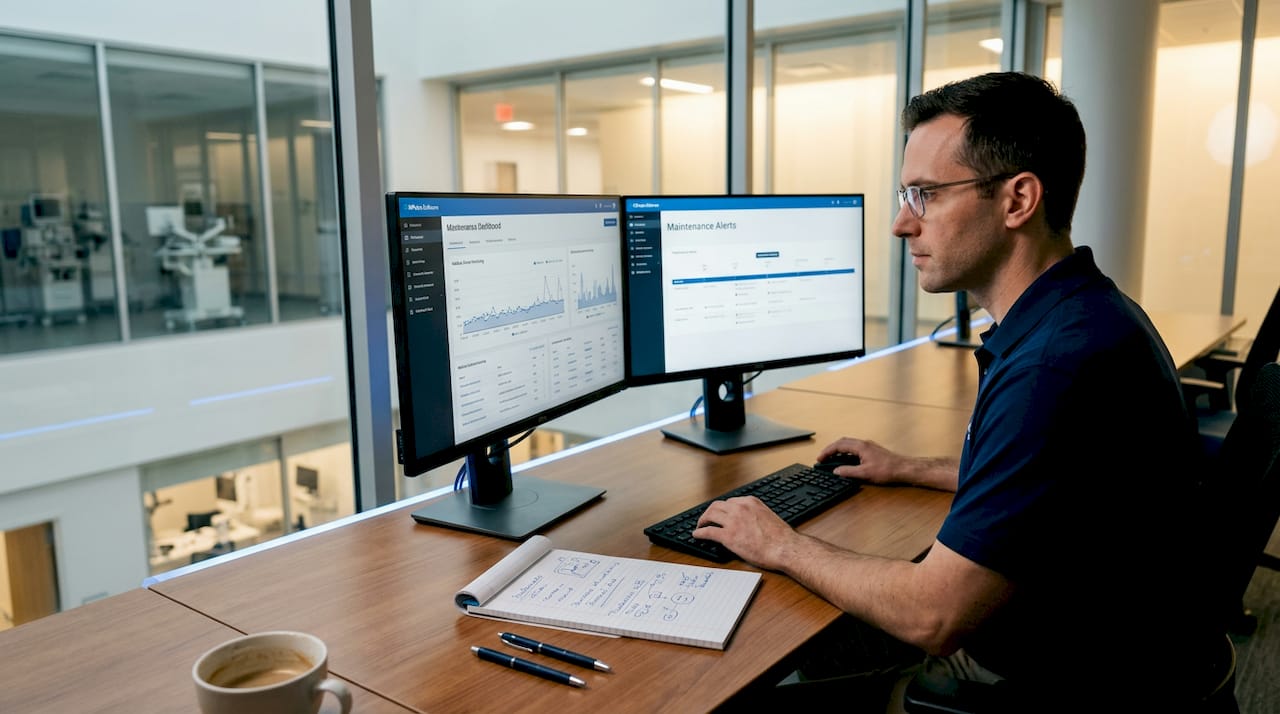
PdM also opens the door to remote diagnostics. Tele-maintenance enables remote expert guidance in resource-limited environments, allowing specialists to assess device condition and direct on-site technicians without traveling to the facility. For multi-site healthcare systems or rural hospitals, that capability is genuinely transformative.
The barrier to entry is real, though. PdM requires upfront investment in sensor infrastructure, data platforms, and staff with the analytical skills to interpret outputs. Smaller facilities may find that a well-executed preventive program delivers most of the benefit at a fraction of the cost.
4. Routine maintenance and scheduled checks: daily operational upkeep
Routine maintenance sits at the foundation of every effective medical equipment servicing program. These are the daily, weekly, and shift-level tasks performed by clinical and biomedical staff to keep devices clean, calibrated, and ready for use.
Common routine equipment checks include:
- Visual inspections for physical damage, frayed cables, or loose connectors
- Cleaning and sanitizing external surfaces per manufacturer and infection control guidelines
- Verification of battery charge levels and power supply integrity
- Functional tests at the start of each shift for critical devices
- Documentation of any observed anomalies for biomedical follow-up
Routine cleaning and sanitizing of medical equipment is directly tied to device longevity and safety compliance. A ventilator circuit that isn’t cleaned properly doesn’t just risk infection. It can also clog sensors and degrade performance over time.
Routine checks also serve as an early warning system. When a nurse notices that an infusion pump is running louder than usual, or that a monitor’s touchscreen response has slowed, that observation feeds directly into the preventive and corrective maintenance pipeline. The clinical team becomes part of the maintenance program, not separate from it.
Pro Tip: Create standardized shift-start checklists for high-criticality devices and make them part of clinical onboarding. When staff know exactly what to check and how to document it, you get consistent data that improves both safety and your audit trail.
Staff training is non-negotiable here. Routine checks are only as good as the people performing them. Biomedical teams should provide periodic refreshers to clinical staff on what to look for, how to document findings, and when to escalate to a formal work order.
5. Condition-based maintenance: acting on equipment signals
Condition-based maintenance (CBM) sits between preventive and predictive approaches. Rather than acting on a calendar or waiting for a full failure, CBM triggers maintenance when a device shows measurable signs of degradation, whether through sensor data, performance testing, or visual inspection findings.
The distinction from full predictive maintenance is largely one of technology sophistication. CBM can be implemented with relatively simple monitoring tools, such as periodic vibration readings or regular oil analysis on imaging equipment cooling systems, without requiring a full IoT sensor network. That makes it accessible to mid-size facilities that want to move beyond pure schedule-driven maintenance without committing to a complex PdM infrastructure.
For medical equipment specifically, CBM works well for devices with measurable performance indicators. Imaging systems, for example, can be monitored for image quality degradation. Sterilization equipment can be tracked through biological indicator test results. When those indicators drift outside acceptable ranges, maintenance is triggered. Not before, and not after a breakdown.
6. Comparison of maintenance types: choosing the right approach
No single maintenance type fits every device or every facility. The right strategy depends on equipment criticality, available resources, and regulatory requirements. The table below provides a direct comparison to support your decision-making.
| Maintenance type | Trigger | Cost profile | Complexity | Best for |
|---|---|---|---|---|
| Preventive | Fixed schedule | Moderate, predictable | Low to moderate | Most clinical devices with OEM schedules |
| Corrective | Equipment failure | Variable, often high | Low | Low-criticality, easily replaced devices |
| Predictive | Real-time data signals | High upfront, lower ongoing | High | High-utilization, high-criticality devices |
| Condition-based | Performance threshold | Moderate | Moderate | Devices with measurable output indicators |
| Routine checks | Daily/shift schedule | Low | Low | All devices, every day |
The most effective programs layer these approaches. High-criticality devices like life-support equipment benefit from preventive maintenance combined with predictive monitoring. Mid-tier devices may run on a solid preventive schedule with routine checks. Lower-criticality assets can tolerate a corrective approach with loaner coverage as a backup.
Equipment maintenance best practices also require that you document every intervention, regardless of type. That documentation is what makes your program defensible during a Joint Commission survey or an FDA audit.
My take on what most facilities get wrong
I’ve spent years working with healthcare facilities on maintenance program design, and the pattern I see most often is this: teams treat preventive maintenance as a compliance checkbox rather than a clinical risk management tool. They follow the OEM schedule to the letter, document the work, and consider the job done. What they miss is that the schedule is a starting point, not a prescription.
The facilities that actually reduce downtime and avoid adverse events are the ones that use their maintenance data to ask better questions. Why did this device fail three months after a PM visit? Are we replacing components that still had useful life? Are our routine check findings being acted on or just filed away?
Predictive maintenance gets a lot of attention, and rightly so. But I’ve seen smaller facilities invest in sensor platforms before they’ve fixed their basic PM documentation, and that’s backwards. Get your preventive and routine programs solid first. Build the data discipline. Then layer in predictive tools where the ROI justifies it.
The other thing I’d push back on: poor asset criticality analysis is the root cause of most maintenance program failures, not budget or staffing. When you don’t know which devices are truly mission-critical, you end up over-maintaining low-risk assets and under-protecting the ones that matter most. That analysis is worth doing carefully, and revisiting every time your equipment profile changes.
— Mark
How maintenance software supports your entire program
Managing multiple maintenance types across a complex equipment inventory without software is a losing proposition. Spreadsheets don’t send alerts when a PM is overdue. Paper logs don’t generate the compliance reports your accreditation body expects.
Mpulsesoftware’s CMMS platform gives healthcare facilities a single system to schedule preventive maintenance, log corrective repairs, track routine check results, and monitor equipment condition data in one place. The platform’s calendar interface makes it straightforward to manage scheduled maintenance plans across hundreds of devices, and its reporting tools produce the audit-ready documentation that compliance requires. For facilities managing distributed equipment across multiple sites, application hosting options provide remote access without the burden of on-premise infrastructure. Mpulsesoftware’s implementation services also support facilities through deployment and staff training, so your team is using the system effectively from day one. Over 3,500 customers globally have reported efficiency improvements of up to 40% after adopting the platform.
FAQ
What are the main types of medical equipment maintenance?
The main types are preventive, corrective, predictive, condition-based, and routine maintenance. Each serves a different purpose and applies to different equipment criticality levels.
Why is preventive maintenance important for medical devices?
Preventive maintenance reduces unplanned failures, supports regulatory compliance, and extends device lifespan by addressing wear and calibration drift before they cause breakdowns.
How does predictive maintenance differ from preventive maintenance?
Preventive maintenance follows a fixed schedule regardless of device condition, while predictive maintenance uses real-time sensor data and analytics to trigger interventions only when equipment signals actual deterioration.
What role do routine equipment checks play in a maintenance program?
Routine checks performed daily or per shift catch early warning signs, support infection control, and feed findings into formal maintenance workflows, making them a critical first line of defense.
When should a facility rely on corrective maintenance?
Corrective maintenance is appropriate for low-criticality devices where the cost of preventive programs outweighs the risk of failure, provided spare or loaner equipment is available to maintain operations during repairs.