

A maintenance contractor onboarding process is the structured sequence of steps that prepares an outside contractor to operate inside your facility’s maintenance program and CMMS — with the right access, defined scope, verified training, and complete compliance records — so they can accept work orders, capture evidence to asset records, and meet your safety and performance requirements from day one.
A complete onboarding process covers five core elements:
- Scope definition: what tasks the contractor is permitted to perform and at what risk level
- CMMS access: user accounts, role-based permissions, and mobile evidence capture
- Paperwork and qualifications: insurance, licenses, certifications, and expiration tracking
- Training and competency verification: site orientation, SOPs, and supervised pilot jobs
- Performance metrics: KPIs tied to SLAs and safety outcomes, tracked in the CMMS
Key Takeaways
A complete maintenance contractor onboarding process requires defined scope, verified credentials, CMMS-configured access, a supervised pilot job, and ongoing KPI monitoring tied to contractual SLAs.
| Point | Details |
|---|---|
| Define scope before access | Build a risk-based scope matrix and record permitted tasks in the CMMS vendor record before granting any site access. |
| Provision CMMS accounts first | Create vendor records, user accounts, asset links, and evidence templates before the contractor’s first work order. |
| Run a pilot job within 7 days | A supervised pilot job confirms CMMS navigation, evidence capture, and competency in one documented step. |
| Track 5 core KPIs | Monitor on-time arrival, first-time-fix rate, reopened work orders, documentation completeness, and safety incidents monthly. |
| MPulse CMMS centralizes the process | MPulse Software supports vendor records, permission templates, mobile evidence capture, expiration reminders, and KPI dashboards in one system. |
Table of Contents
- Why does a formal contractor onboarding process matter?
- What does a step-by-step contractor onboarding checklist look like?
- How do you define contractor scope using a risk-based approach?
- How do you configure your CMMS for contractor access?
- What paperwork and qualifications do you need to collect?
- How do you verify contractor competency and training?
- What work-order workflow should contractors follow?
- How do you track contractor performance with KPIs?
- How long does contractor onboarding typically take?
- How do you offboard a contractor and preserve the audit trail?
- What templates should you store in your CMMS?
- The part most facility teams get wrong
- MPulse CMMS gives you the contractor onboarding infrastructure you need
- Sources
- FAQ
Why does a formal contractor onboarding process matter?
A formal, CMMS-centered onboarding process reduces rework, protects assets, and creates an audit trail that holds up under regulatory scrutiny. Without it, contractors operate with unclear boundaries, and your team loses visibility the moment a technician leaves the site.
The ISO outsourcing guidance aligned with ISO 55001 is direct on this point: organizations must document the scope and boundaries of outsourced asset-management activities, define responsibilities, and monitor performance through agreed KPIs and records. That is not a compliance formality. It is the operational foundation that prevents a contractor from servicing the wrong asset, skipping a required inspection, or leaving no evidence that work was done at all.
Practical impact: Facilities that link contractor work orders to asset records and set automated expiration reminders on certifications can identify compliance gaps before an audit, not during one.
High-risk outsourced activities — those that can harm your facility’s reputation or safety record — should either be retained internally or managed under tight oversight. Outsourcing them without a formal onboarding structure is where incidents and liability originate.
What does a step-by-step contractor onboarding checklist look like?
- Qualification gate: Confirm trade competencies, verify insurance certificates, check references, and confirm the contractor’s license is current for your state.
- Contract and SLA setup: Define permitted scope, KPIs, evidence requirements (photos, readings, signatures), and inspection hold points before any site access is granted.
- Paperwork collection: Gather proof of general liability insurance, workers’ compensation, trade licenses, relevant certifications (OSHA 10/30, EPA 608, NFPA, etc.), and any required safety training records.
- CMMS account provisioning: Create the contractor vendor record, set up the user account with role-based permissions, and link the account to the relevant assets and work-order templates.
- Site induction scheduling: Book the safety orientation session covering site hazards, emergency procedures, lockout/tagout, confined space requirements, and PPE standards.
- Technical setup: Attach SOPs, job hazard analyses (JHAs), and P&IDs to the relevant asset records. Configure mobile evidence capture templates (photo fields, signature fields, condition-reporting forms).
- Pilot job: Assign one supervised work order within the first seven days. Confirm the contractor can navigate the CMMS on a mobile device, attach evidence, and close the work order correctly.
- Acceptance and handoff: Review pilot job performance, adjust permissions if needed, and move the contractor to recurring scheduling.
Pro Tip: Build a single onboarding checklist work order in your CMMS and assign it to your CMMS administrator every time a new contractor is added. That way, no step is skipped and the completion record is automatically archived.
For field-service-specific onboarding examples, the HVAC onboarding 90-day plan from LocateHire offers a practical competency-check timeline you can adapt for your own trades.
How do you define contractor scope using a risk-based approach?
Adopt risk-based scoping so the permissions you grant in the CMMS and the controls you write into the contract match the actual risk level of each task. The ISO guidance recommends applying ISO 31000 risk principles to determine the competencies, controls, and monitoring required for each outsourced activity.

| Risk Tier | Example Tasks | Required Certifications | Supervision | Evidence Required |
|---|---|---|---|---|
| Low | Janitorial, landscaping, general cleaning | Basic site induction | Periodic spot check | Completion sign-off |
| Medium | HVAC filter changes, minor plumbing, painting | Trade license, OSHA 10 | Initial supervised job | Photos, time-on-task |
| High | Electrical panel work, confined space entry, refrigerant handling | OSHA 30, EPA 608, trade license + permit | Direct supervision or permit-to-work | Permit, photos, readings, signatures |
Record the permitted task list and the required evidence for each tier in both the contract and the contractor’s CMMS vendor record. Any task not listed in the approved scope should generate a work-order rejection or escalation, not a verbal override.
Pro Tip: Add a “scope exceeded” flag to your work-order closure workflow. If a contractor selects a task category outside their approved tier, the system routes the work order to a supervisor for review before it can close.
How do you configure your CMMS for contractor access?
Configure contractor user accounts, role-based permissions, and mobile evidence capture before the first work assignment. The goal is a permission structure that gives contractors exactly what they need and nothing more.
Key CMMS objects to create for each contractor:
- Vendor record: company name, contact details, insurance expiration dates, license numbers, and attached compliance documents
- User account: linked to the vendor record, with a role that restricts asset editing and work-order creation to approved categories
- Asset associations: link the contractor’s account to the specific assets or asset groups they are authorized to service
- Work-order templates: pre-built templates with required evidence fields (photos, readings, signatures) for each task type in their approved scope
- Document attachments: SOPs, JHAs, and P&IDs attached to both the vendor record and the relevant asset records
Getting started with a new CMMS covers the initial configuration steps in detail, including how to structure vendor records and user roles.
Mobile access is non-negotiable for field contractors. Mobile field apps keep field workers connected to work-order updates and document access in real time, which is why your CMMS mobile configuration should be tested during the pilot job, not after.
What paperwork and qualifications do you need to collect?
Collect proof of insurance, trade licenses, relevant certifications, safety training records, and written SOPs where applicable. Attach every document to the contractor’s vendor record in the CMMS and set automated expiration reminders so your team is notified before a certificate lapses.
Mandatory items:
- Certificate of general liability insurance (with your organization listed as additional insured)
- Workers’ compensation certificate
- State trade license(s) applicable to the scope
- OSHA training card (10-hour or 30-hour, as required by scope)
- Scope-specific certifications (EPA 608, NFPA 70E, confined space, etc.)
- Signed site safety acknowledgment
Recommended where applicable:
- Drug-testing policy documentation (if required by your organization’s contractor policy)
- Background check confirmation (if required for your facility type or security classification)
- Manufacturer training certificates for specialized equipment
For CMMS compliance recordkeeping practices, including how to structure document retention for audit readiness, MPulse Software’s compliance guide covers the key fields and retention timelines.
How do you verify contractor competency and training?
Verify competency through a combination of documentation review, observed demonstration, and a supervised pilot job. No single method is sufficient on its own.
- Documentation review: Confirm certifications are current and match the approved scope.
- Site orientation: Cover site hazards, emergency procedures, confined space requirements, lockout/tagout protocols, PPE requirements, and incident reporting procedures.
- SOP walkthrough: Walk the contractor through the relevant SOPs for their first assigned asset or task type.
- Observed demonstration: For medium- and high-risk tasks, have a supervisor observe the contractor performing the task before unsupervised work begins.
- Sign-off in CMMS: Record the orientation completion, assessments passed, and supervisor sign-off as attachments on the contractor’s vendor record.
- Refresher cadence: Set automated reminders for annual or task-triggered refresher training, particularly for confined space, LOTO, and electrical safety.
Pro Tip: Attach a short competency checklist to the pilot work order itself. When the supervisor closes the pilot job, the checklist becomes a permanent, timestamped record of verified competency.
For trade-specific onboarding steps, the plumbing technician onboarding playbook from LocateHire offers evidence-capture practices you can adapt directly to your CMMS templates.
What work-order workflow should contractors follow?
Standardize the contractor work-order lifecycle: request → approve → dispatch → accept → perform → verify → close. Every state transition should have a defined owner and a time expectation.
Key protocol decisions to document:
- Acceptance SLA: how long the contractor has to acknowledge a dispatched work order (typically 2–4 hours for standard priority, 30 minutes for emergency)
- Required attachments before close: at minimum, one photo of completed work, any meter readings, and a technician signature
- Verification step: who on your team reviews completed work before the work order closes (supervisor, quality inspector, or automated checklist pass)
- Escalation matrix: if a contractor cannot complete a job within the agreed window, who is notified and what is the fallback
- Communication channel: define whether dispatch happens through the CMMS notification, email, or phone, and document it in the SLA
How do you track contractor performance with KPIs?
Pick a small set of measurable KPIs tied directly to your contractual SLAs and safety outcomes. More than six KPIs typically dilutes focus; fewer than three leaves gaps in accountability.
Build these KPIs as saved reports in your CMMS and schedule them to run monthly. The ISO guidance recommends agreeing on SMART performance criteria, measurement frequency, and documented consequences for unmet levels — write those consequences into the SLA before the contractor starts.
Pro Tip: Share the KPI dashboard with the contractor at the 30-day review. Contractors who can see their own metrics tend to self-correct faster than those who receive only periodic verbal feedback.
How long does contractor onboarding typically take?
Most contractors are CMMS-ready within a few weeks when paperwork and system accounts are prepared in advance. High-risk scopes requiring permits, confined-space certifications, or specialized equipment training can extend that timeline.
The onboarding milestones typically include qualification gate and contract execution, paperwork collection and CMMS account setup, site orientation and SOP review, pilot job and competency sign-off, and performance review and full access confirmation, with each phase spanning a few days to a couple of weeks.
Resource requirements to budget include several hours of CMMS administrator time per contractor for account setup and template configuration, safety officer time for orientation, and supervisor time for pilot job oversight. Some facilities also charge a vendor onboarding fee to offset administrative costs, though this varies by organization.
How do you offboard a contractor and preserve the audit trail?
Maintain a consistent offboarding checklist that revokes CMMS access, archives documents, and records the exit condition of any assets the contractor managed.
Required steps and archive items:
- Revoke the contractor’s CMMS user account immediately upon contract end
- Mark the vendor record as inactive (do not delete it — historical work orders and attachments must remain accessible)
- Archive the final performance review, copies of all certifications collected, and the last work-order evidence package
- Document the handback condition of any assets the contractor was responsible for, per the ISO guidance recommendation for exit and handback arrangements
- Retain all records for a minimum of three years, or longer if your regulatory environment requires it (OSHA, EPA, or facility-specific requirements may apply)
What templates should you store in your CMMS?
Prepare a set of CMMS-stored templates so onboarding is repeatable and auditable regardless of who manages the process.
| Template | Purpose | Where to Store in CMMS |
|---|---|---|
| Contractor onboarding checklist | Tracks completion of every pre-access step | Work-order template assigned to CMMS admin |
| Permission matrix | Documents approved roles and access levels | Attached to vendor record |
| Scope/risk matrix | Maps approved tasks to risk tier and required evidence | Attached to vendor record and contract |
| Training sign-off form | Records orientation completion and competency verification | Attached to vendor record and pilot work order |
Version-control each template by including the revision date in the file name and attaching the current version to the vendor record. Auditors should be able to pull the template version that was active at the time of any given work order. Adapt every template to your facility’s specific risk profile and any applicable regulatory requirements before use.
The part most facility teams get wrong
The most common failure in contractor onboarding is treating it as a one-time administrative task rather than an ongoing operational discipline. Teams invest effort in the initial paperwork collection, then let certifications lapse, skip the 30-day KPI review, and never run the pilot job because “the contractor has done this before.”
That logic is where compliance gaps originate. A contractor who passed orientation 18 months ago at a different facility has not been verified against your site’s current hazards, your CMMS’s current templates, or your updated SOPs. The pilot job is not a formality. It is the only moment where you can confirm that the contractor’s competency, your CMMS configuration, and your evidence requirements all work together before a real asset is at risk.
The quick win most teams overlook: assign the onboarding checklist as a CMMS work order on day one, not a spreadsheet. When it lives in the system, it gets a completion date, an owner, and a permanent record. When it lives in a shared drive, it gets skipped.
MPulse CMMS gives you the contractor onboarding infrastructure you need
Contractor onboarding requires vendor records, permission templates, document attachments, mobile evidence capture, expiration reminders, and KPI reporting — all in one place. MPulse Software delivers exactly that, purpose-built for facility maintenance teams.
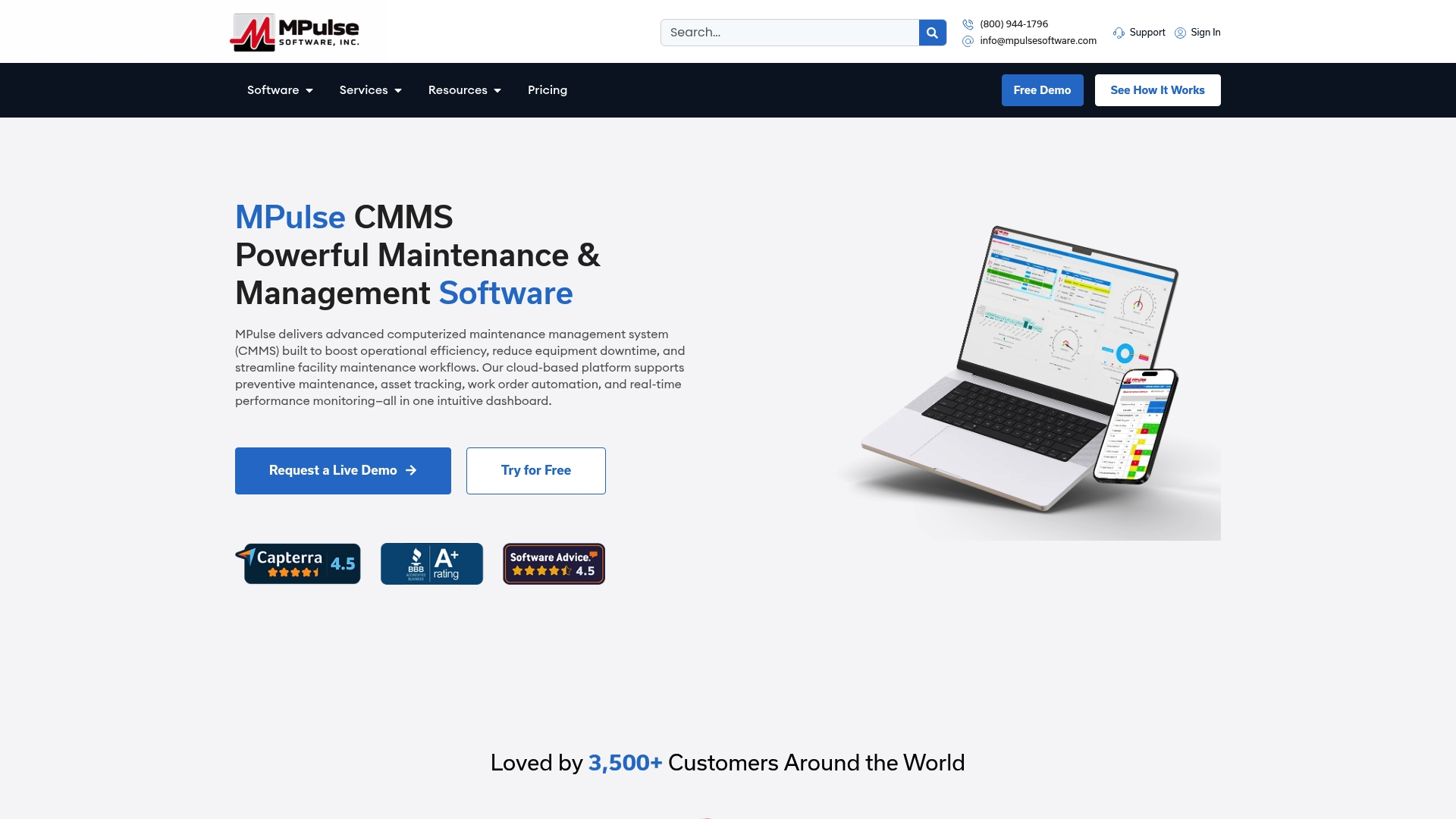
MPulse CMMS supports every stage of the onboarding process described above:
- Vendor records with attached insurance certificates, licenses, and certifications
- Role-based user accounts with configurable permission levels for contractor access
- Customizable work-order templates with required evidence fields (photos, signatures, readings)
- Automated expiration reminders for certifications and insurance renewals
- Mobile evidence capture so contractors can close work orders and attach photos from the field
- KPI reporting dashboards tied to SLA thresholds and contractor performance data
Over 3,500 customers trust MPulse Software to manage their maintenance operations. See how the platform handles contractor onboarding from vendor setup through performance reporting — explore MPulse CMMS or start a free trial today.
Sources
- Guide for Outsourcing Asset Management
- Sage Construction Management Mobile App for Apple iPhones and iPads
FAQ
What is a maintenance contractor onboarding process?
A maintenance contractor onboarding process is the structured sequence of steps that prepares an outside contractor to receive and complete CMMS-driven work orders while meeting your facility’s safety, compliance, and performance requirements. It covers scope definition, CMMS account setup, paperwork collection, site orientation, and KPI tracking.
How long does it take to onboard a maintenance contractor?
Most contractors are CMMS-ready within a few weeks when paperwork and system accounts are prepared in advance. High-risk scopes requiring permits or specialized certifications can extend that timeline.
What documents should you collect during contractor onboarding?
Collect a certificate of general liability insurance, workers’ compensation certificate, applicable state trade licenses, OSHA training records, and any scope-specific certifications such as EPA 608 or NFPA 70E. Attach all documents to the contractor’s vendor record in the CMMS and set automated expiration reminders.
What KPIs should you track for maintenance contractors?
Track on-time arrival rate, first-time-fix rate, reopened work orders, documentation completeness, and safety incidents. Build these as saved CMMS reports and review them monthly against the thresholds defined in the contractor’s SLA.
How does MPulse Software support contractor onboarding?
MPulse Software provides vendor records, role-based user accounts, customizable work-order templates with evidence fields, automated expiration reminders, mobile evidence capture, and KPI reporting dashboards — covering every stage of the contractor onboarding and management process.