

A CMMS cannot hold ISO 55001 certification itself, but when configured and used correctly it is the single best system for producing the documented evidence and operational controls auditors require. It anchors your asset register, work order history, maintenance plans, and performance data into one traceable record. Auditors certify your management system, not your software. But without a CMMS like MPulse CMMS behind it, most teams cannot produce that evidence at scale. For how this compares with enterprise asset management, see the overlap between enterprise asset management and a CMMS.
TL;DR:
- Effective use of a CMMS like MPulse CMMS provides the documentation and operational controls necessary for ISO 55001 audits.
- Auditors focus on records such as asset hierarchy, risk assessments, management of change logs, and KPI review evidence, which a CMMS can generate.
- Ensuring data completeness, standardized entry, role permissions, and retention policies in your CMMS is critical to passing surveillance audits.
- A thorough gap analysis and aligning your CMMS data structure with ISO 55001 requirements streamline the certification process.
- Most audit findings stem from configuration or procedural gaps, not from the CMMS itself, emphasizing the importance of disciplined data governance.
Table of Contents
- What Is ISO 55001, and How Does It Fit Into the ISO 55000 Family?
- What Do ISO 55001 Auditors Actually Look For?
- How Does a CMMS Map to ISO 55001 Clauses?
- What Should Be on Your Audit-Ready CMMS Checklist?
- How Do You Implement a CMMS for ISO 55001 Certification?
- What Audit Findings Come Up Most Often, and How Do You Fix Them?
- How Have Organizations Used CMMS to Achieve ISO 55001 Alignment?
- Where Do Maintenance Teams Underestimate What ISO 55001 Actually Requires?
- Get Audit-Ready CMMS Records Without Rebuilding Your Process
- Sources
- FAQ
What Is ISO 55001, and How Does It Fit Into the ISO 55000 Family?
ISO 55001 is the requirements standard within the ISO 55000 family. It sets out mandatory conditions for establishing, implementing, maintaining, and improving an asset management system. Organizations adopt it voluntarily to demonstrate systematic control over asset life cycles, the risks tied to those assets, and the performance goals they’re meant to deliver.
The family splits responsibilities cleanly. ISO 55000 gives the overview, principles, and terminology. ISO 55001 contains the auditable requirements: the “shall” statements a certification body checks against. ISO 55002 offers guidance on how to interpret and apply those requirements in practice, without adding new obligations.
That distinction matters for anyone assuming a CMMS vendor can be “ISO 55001 certified.” Certification applies to the organization’s asset management system, the combination of policy, processes, people, and records governing how assets are managed. Software is a tool inside that system, not the system itself.
The 2024 update to ISO 55001 reinforces the Strategic Asset Management Plan, documented objectives, and continual improvement as central pillars. It follows the Annex SL high-level structure shared by ISO 9001, ISO 14001, and ISO 45001, which is why organizations running integrated management systems often find ISO 55001 slots in without duplicating existing documentation frameworks.
What Do ISO 55001 Auditors Actually Look For?
Clause language can feel abstract until you translate it into the records an auditor will actually ask to see. Here’s what that translation looks like in practice.
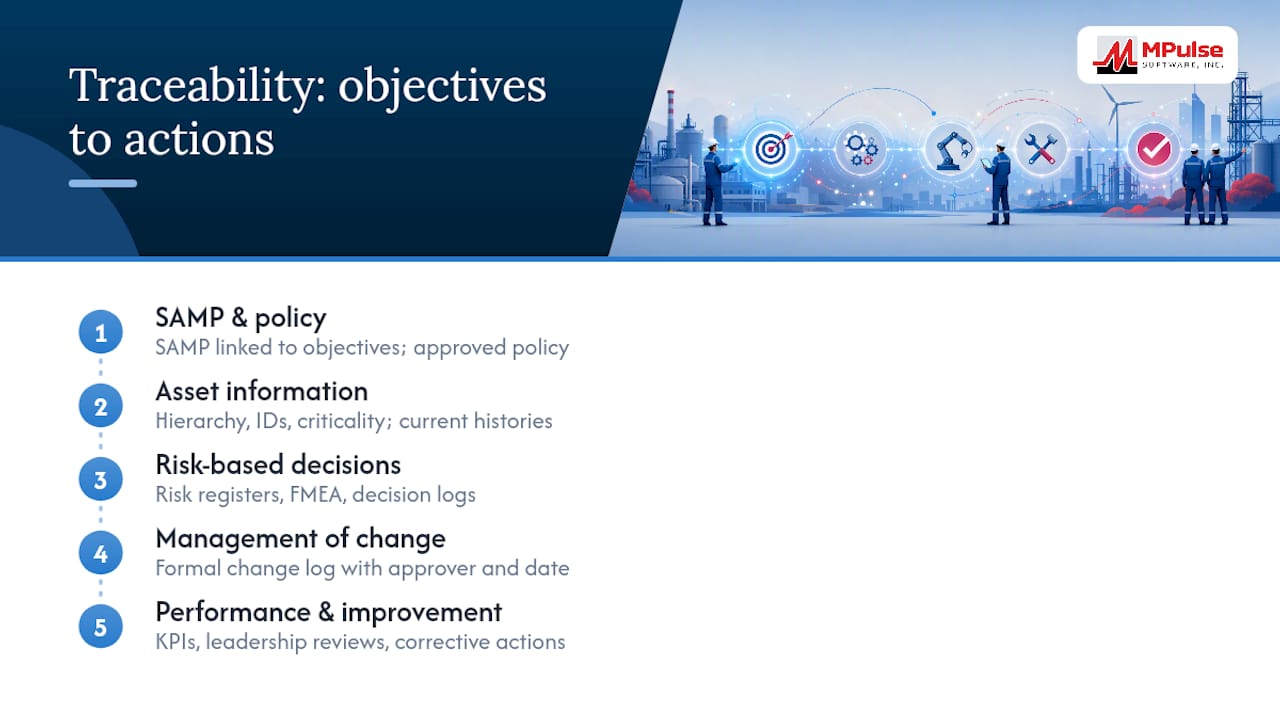
SAMP and policy. Auditors expect a Strategic Asset Management Plan that traces directly back to organizational objectives, and a policy document that’s been reviewed, approved, and communicated. They’ll ask how a maintenance decision made last month connects to a stated objective in the SAMP. If you can’t draw that line, it’s a finding.
Asset information requirements. This means a defined asset hierarchy, consistent identification (serial numbers, location codes, criticality ratings), and information that’s current enough to support decisions. Auditors frequently sample individual assets and ask you to pull up their full history on the spot.
Risk-based decision making. Evidence here includes risk registers, failure mode analyses, and documented decision logs showing why a repair, replacement, or deferral was chosen. The standard doesn’t require a specific risk methodology, but it does require that decisions are traceable and consistent with your stated risk criteria.
Management of change. Any modification to assets, processes, or the management system itself needs a controlled record: who approved it, when, and what risk assessment preceded it. Auditors look for a formal change log, not an email thread.
Performance evaluation and continual improvement. Expect questions about your KPIs, how often leadership reviews them, and what corrective actions followed a missed target. A management review that happened once and was never repeated is a common gap.
How Does a CMMS Map to ISO 55001 Clauses?
Once you know what auditors ask for, the next question is which CMMS functions actually generate that evidence. The mapping is more direct than most teams expect.
- SAMP evidence comes from your asset register, lifecycle cost records, and any documented objectives tied to specific assets or asset classes inside the CMMS.
- Risk-based decision evidence comes from failure mode tracking, condition monitoring data, and work order history that shows the reasoning behind repair-versus-replace calls.
- Management of change evidence comes from configuration and version history: who edited a maintenance plan, when, and under what approval.
- Performance evaluation evidence comes from KPI dashboards and exportable reports that show trends over time, not just a single snapshot.
- Documented information controls come from user role permissions, audit logs, and retention settings that prove records haven’t been altered without a trail.
According to the National Academies’ guidebook on CMMS integration, data quality, system integration, and governance discipline are the biggest determinants of whether an organization passes audit review without findings. A CMMS with clean role based permissions and automatic timestamping does most of the traceability work before an auditor ever asks a question.
Pro Tip: Set your CMMS retention policy to match your certification body’s surveillance cycle, typically one year, so historical records never age out mid-audit.
Auditors also commonly request evidence that financial and operational decisions align. ISO/TS 55010 addresses exactly this gap, and CMMS-generated lifecycle cost exports are often the easiest way to show that alignment without building a separate reporting process.
What Should Be on Your Audit-Ready CMMS Checklist?
Preparing for a surveillance audit or initial certification comes down to making sure specific records exist, are complete, and are retrievable in minutes rather than days.
- Asset register and hierarchy. Every asset needs a unique ID, parent/child location, installation date, and criticality rating populated, not just a name and a number.
- Work order evidence. Timestamps for creation, assignment, and completion; approval signatures; completion notes; parts consumed; and any photo or document attachments.
- Decision records. Risk assessments tied to specific assets, management of change forms, and a corrective action log showing root cause and closure.
- Measurement evidence. KPI baselines, exportable trend reports, and copies of management review minutes, not just the raw data behind them.
- Technical configuration. Defined user roles, an active audit log tracking edits, automated backups, and a written data retention policy.
Mobile capture matters more here than most teams realize, and technologies like CMM inspection can enhance the accuracy of field data and support traceability. Field technicians using CMMS mobile apps to log timestamps and attach photos on the spot close the gap between when work happens and when it’s recorded, which is exactly the kind of traceability auditors probe for during on-site assessment.
How Do You Implement a CMMS for ISO 55001 Certification?
Certification follows a two-stage third-party audit process, a documentation review followed by an on-site assessment, with surveillance audits continuing afterward. Getting there requires sequencing your CMMS work correctly.
- Run a clause-mapped gap analysis. Go through ISO 55001 clause by clause and identify which records your current CMMS setup already produces and which it doesn’t.
- Feed findings into your SAMP. Use the gaps to set concrete asset-management objectives rather than treating the SAMP as a document written in isolation from your maintenance data.
- Migrate and verify data. Import legacy asset records, but sample and verify a statistical portion of them before going live. Projects that skip this step see more audit findings tied to inaccurate baseline data than projects that verify first.
- Prioritize integrations that matter. Condition monitoring sensors and ERP connections feed the risk-based decision evidence auditors want most; treat these as priority integrations, not add-ons.
- Train, audit internally, and repeat. Run internal audits on a fixed cadence, train staff on documentation habits, and treat each surveillance cycle as a chance to tighten the process further.
What Audit Findings Come Up Most Often, and How Do You Fix Them?
Certification bodies tend to flag the same handful of issues year after year, and nearly all of them trace back to how the CMMS was configured or used, not the CMMS itself.
- Incomplete asset hierarchies. Assets get added without parent locations or criticality ratings, which breaks traceability. Fix it by making those fields mandatory at data entry, not optional.
- Work orders closed without notes. Technicians mark jobs complete with no completion detail, leaving no evidence of what was actually done. Require a completion note field before a work order can close.
- Missing management of change records. Maintenance plans get edited with no approval trail. Turn on version history and require sign off for any plan change.
- Stale KPI reviews. Dashboards exist but nobody reviews them on a schedule. Set a recurring management review meeting tied directly to CMMS report exports.
- Inconsistent data entry across sites. Multi-site organizations often have different naming conventions per location. Standardize asset ID formats before certification, not during it.
A quarterly internal audit, checking a random sample of work orders and asset records against these five points, catches most of these before a certification body ever does.
How Have Organizations Used CMMS to Achieve ISO 55001 Alignment?
Airports offer some of the clearest public examples of CMMS-driven ISO 55001 alignment, largely because aviation infrastructure carries safety and regulatory pressure that forces documentation discipline. The National Academies’ guidebook walks through how airport operators integrated CMMS platforms specifically to satisfy ISO 55001’s documented information requirements, treating data quality and system integration as the two levers that determined audit outcomes.
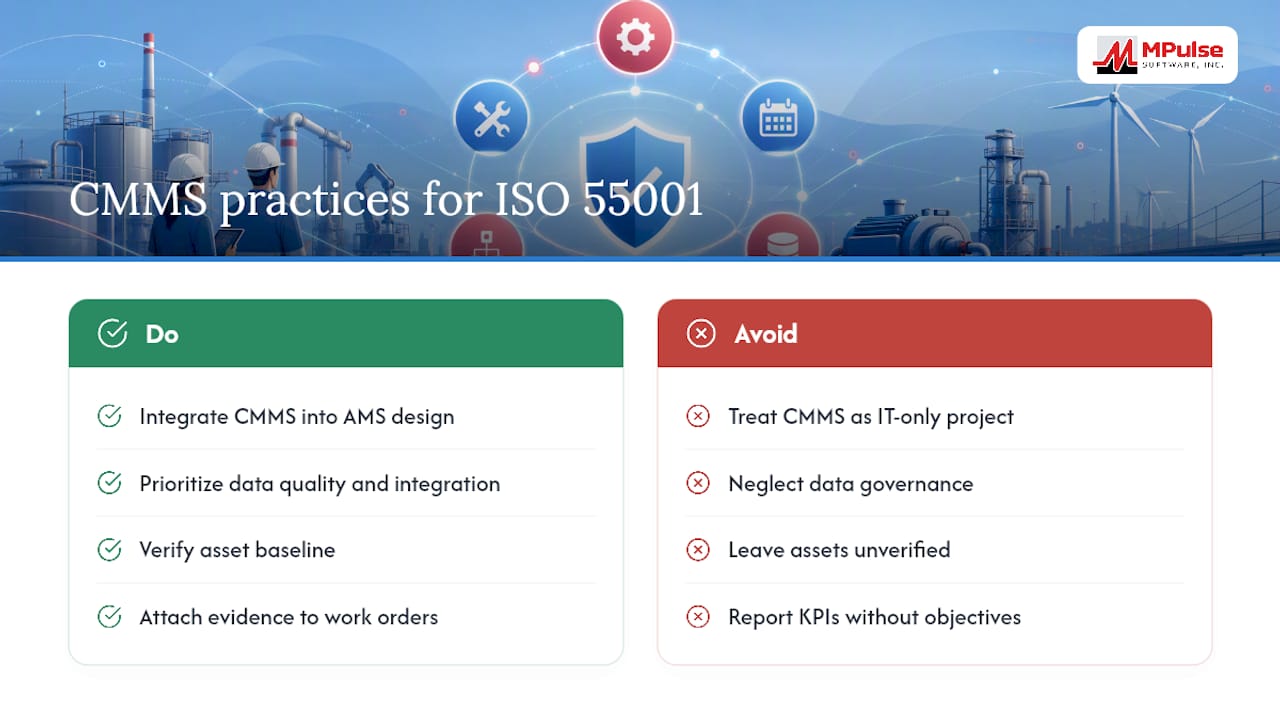
The pattern that shows up across these examples is consistent: organizations that treated CMMS configuration as part of their asset management system design, rather than a separate IT project, moved through certification with fewer findings. Runway lighting systems, baggage handling equipment, and terminal HVAC assets all required the same underlying discipline: a verified asset baseline, work orders with attached evidence, and KPI reporting tied back to stated objectives.
Manufacturing and utilities organizations pursuing ISO 55001 tend to follow a similar arc, even without the aviation-specific regulatory pressure. The common thread isn’t the industry. It’s that CMMS data quality and governance, not the certification process itself, determines how smoothly the audit goes. Facilities managing critical infrastructure, whether a data center or a distribution warehouse, benefit from the same asset hierarchy and evidence trail discipline described in MPulse’s compliance guidance.
Where Do Maintenance Teams Underestimate What ISO 55001 Actually Requires?
Most teams treat ISO 55001 as a paperwork exercise layered on top of maintenance work that’s already happening. That’s backwards. The standard is really asking whether your maintenance decisions can be traced back to a stated objective and a documented risk rationale, and most CMMS deployments weren’t built with that traceability in mind from day one.
Here’s the part that gets missed: the technical requirements of ISO 55001 are rarely the hard part. Auditors don’t expect exotic risk models or elaborate SAMPs. What trips teams up is inconsistency. An asset register that’s thorough for the equipment installed in 2023 and thin for equipment installed in 2015. A management of change process that exists on paper but isn’t actually followed for smaller edits. A KPI dashboard nobody reviews on a fixed schedule.
That inconsistency is a data governance problem before it’s a compliance problem. A CMMS solves it only when the organization commits to mandatory fields, defined user roles, and a retention policy from the start, not retrofitted six months before an audit. Teams that treat their CMMS setup as the asset management system’s backbone, rather than a records dump, tend to sail through surveillance audits. Teams that bolt on documentation requirements after the fact spend years chasing gaps they created themselves.
— Mark
Get Audit-Ready CMMS Records Without Rebuilding Your Process
Maintenance management software is built around the exact records ISO 55001 auditors ask for: a verifiable asset register, timestamped work order history, preventive maintenance schedules tied to objectives, and exportable KPI reports for management review. Unlike a generic system retrofitted for compliance, some maintenance software’s calendar interfaces and integration options are designed so audit trails build themselves as your team does its normal work, not as a separate documentation task bolted on afterward.
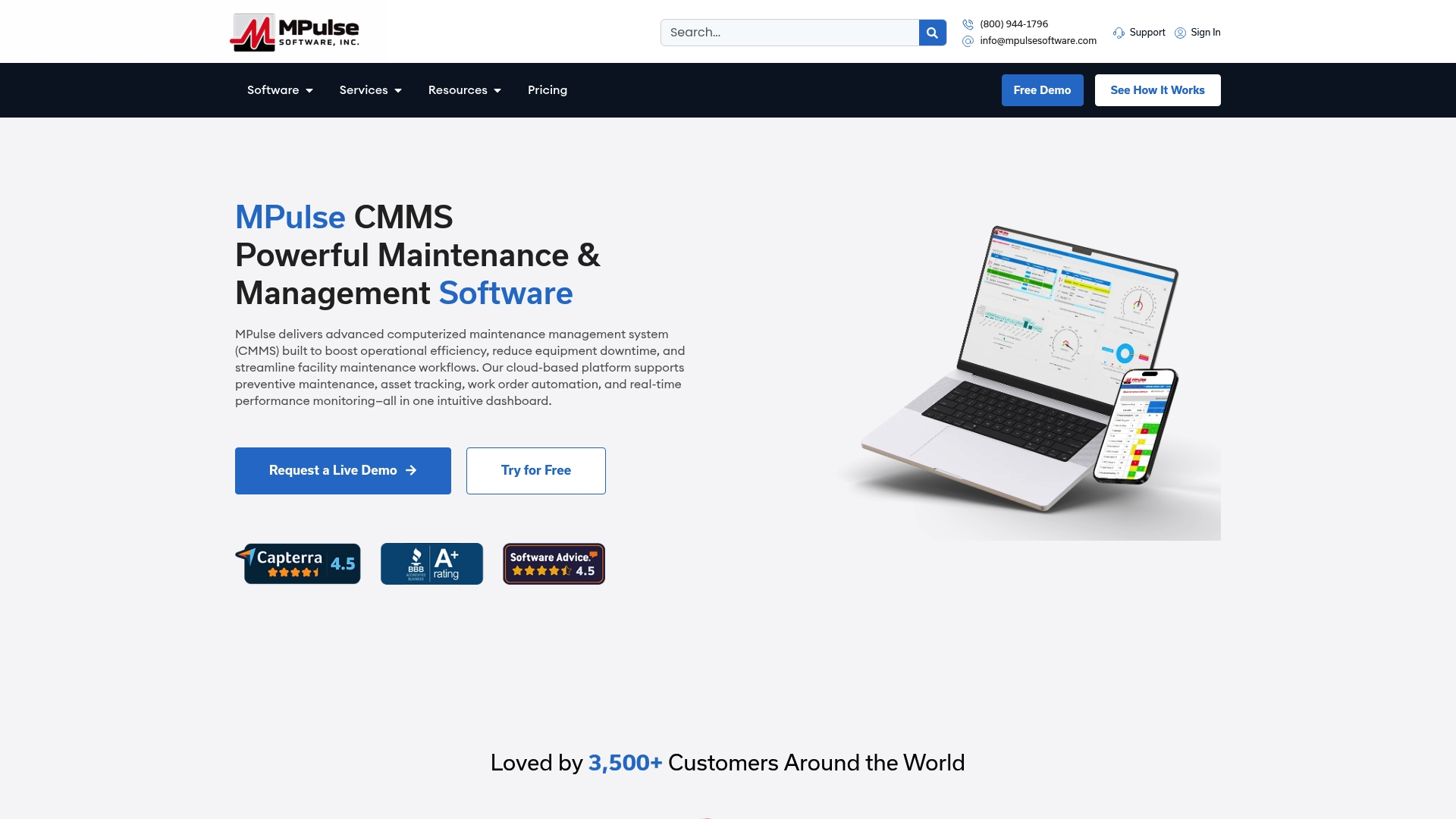
Many organizations use maintenance management software to run preventive maintenance and track asset performance, with some reporting notable efficiency gains. If you’re planning a gap analysis ahead of ISO 55001 certification, start by reviewing MPulse’s CMMS platform and mapping its asset register and reporting features against your current documentation gaps. A sample data migration assessment is the fastest way to see whether your existing records are audit ready before you commit to a full rollout.
Sources
For the normative text behind this article, see ISO 55001:2024, ISO 55001:2014, ISO/TS 55010:2024, ASTM’s asset management standards, and the National Academies’ CMMS integration guidebook.
- ISO 55001:2014 – Asset management — Management systems — Requirements
- Guidebook for Advanced Computerized Maintenance Management System Integration at Airports — Chapter 7: CMMS Implementation and Compliance with ISO 55001
FAQ
What Is the ISO 55001 Standard?
ISO 55001 is the certifiable requirements standard for an asset management system, specifying how organizations should control asset life cycles, risks, and performance objectives.
Is ISO 55001 Certification Mandatory?
No. ISO 55001 certification is voluntary; organizations pursue it to demonstrate systematic asset management control to regulators, customers, or investors.
What Is the Difference Between ISO 55000 and ISO 55001?
ISO 55000 provides the overview, principles, and terminology for asset management, while ISO 55001 contains the specific, auditable requirements a certification body assesses.
How Is ISO 55001 Different From ISO 9001?
ISO 9001 governs quality management systems broadly, while ISO 55001 focuses specifically on physical asset life cycles, risk, and performance, though both share the same Annex SL structure for easier integration.
Can a CMMS Like MPulse Be ISO 55001 Certified?
No software product can be ISO 55001 certified since certification applies to an organization’s management system, but a CMMS like MPulse CMMS generates the asset records, work order history, and KPI reports auditors require as evidence.