

Vibration monitoring maintenance is the fastest, most reliable way to catch developing mechanical faults on rotating equipment before they cause a breakdown. The best programs prioritize critical assets, combine time-domain, FFT, and envelope analysis rather than relying on one method, and route every alert into a CMMS so it becomes a scheduled repair instead of a forgotten data point.
TL;DR:
- Vibration monitoring should focus on critical assets like motors, gearboxes, and turbines to prevent unplanned failures effectively.
- Envelope and FFT analysis are the most reliable techniques, with envelope analysis being especially useful for early bearing defect detection.
- Sensors must be mounted close to bearings, consistently oriented, and recalibrated regularly to avoid false alarms caused by poor data quality.
- Prioritizing assets based on criticality and failure cost leads to more efficient deployment of continuous or route-based monitoring programs.
- Integrating vibration alerts into a CMMS automates work order creation, ensuring timely repairs and avoiding missed maintenance actions.
Table of Contents
- What Is Vibration Monitoring and Why Does It Matter for Predictive Maintenance?
- Which Vibration Analysis Technique Should You Use?
- What Sensors Should You Use and Where Should You Place Them?
- How Do You Design and Roll Out a Vibration Monitoring Program?
- How Do You Avoid False Alarms and Bad Data?
- Is Vibration Monitoring Worth the Investment?
- How Does a CMMS Turn Vibration Alerts Into Finished Repairs?
- A Reliability Engineer’s Take on What Actually Works
- Turn Vibration Alerts Into Scheduled Repairs With MPulse CMMS
- Sources
- FAQ
What Is Vibration Monitoring and Why Does It Matter for Predictive Maintenance?
Vibration monitoring measures the mechanical motion of a machine, usually with an accelerometer, to detect changes that signal wear, damage, or misalignment before they cause failure. It’s the backbone of condition-based maintenance because vibration signatures change well before a machine sounds or feels different to a human observer.
Vibration-based sensing is the dominant technique in predictive maintenance for rotating machinery, and it pairs well with data analytics and proper sensor selection to cut unplanned downtime, according to a comprehensive review of AI and robotics in predictive maintenance.
Some assets benefit far more than others. Prioritize vibration monitoring on:
- Motors, pumps, and fans with rolling-element bearings
- Gearboxes and couplings subject to torque and alignment stress
- Compressors and turbines running at consistent operating speeds
- Any asset where unplanned failure stops a production line
Vibration doesn’t work alone. Pair it with temperature sensors for early overheating and ultrasound for electrical arcing or air leaks, but treat vibration as the primary early-warning layer for mechanical faults specifically.
Which Vibration Analysis Technique Should You Use?
Different fault types show up in different parts of a vibration signal, and picking the wrong technique means missing the fault entirely. Here’s how to match technique to symptom:
- Time-domain analysis looks at the raw waveform over time. Use it to catch transients, impacts, and to verify data quality before running deeper analysis.
- Frequency-domain analysis (FFT) converts the waveform into a spectrum. It’s the workhorse for steady-state faults like imbalance, misalignment, and looseness, because those problems generate energy at predictable frequencies tied to running speed.
- Envelope or demodulation analysis filters out low-frequency noise to expose the faint, repetitive impacts that early bearing and gear defects produce. This technique typically flags bearing damage well before it appears clearly in a standard FFT spectrum, according to research on vibration sensors for condition monitoring.
- Cepstrum and modal analysis handle the harder cases: complex gear-mesh modulation, resonance, and structural issues. These require more expertise, so most teams escalate to a specialist analyst when a spectrum shows sidebands or harmonics that don’t map cleanly to a known fault.
Pro Tip: Trend charts, waveform checks, and spectrum analysis form the minimum toolkit most practitioner programs rely on. Add envelope analysis specifically for bearing-heavy equipment, since standard FFT alone often catches bearing wear too late to prevent secondary damage.
What Sensors Should You Use and Where Should You Place Them?
Sensor choice depends on the fault frequencies you need to see and your budget for wiring and infrastructure. Piezoelectric accelerometers remain the standard for wide dynamic range and high-frequency sensitivity, while MEMS sensors have grown popular for low-cost, battery-powered wireless deployments, though they can trade off some bandwidth. Match the sensor’s frequency range to your asset’s expected fault frequencies rather than buying on price alone, a point emphasized in vibration sensor research for condition monitoring.
Triaxial sensors capture motion in three planes at once and suit complex or hard-to-access machines. Uniaxial sensors cost less and work fine when you already know which direction (radial or axial) shows the clearest fault signature.
Placement rules that actually matter:
- Mount as close to the bearing housing as physically possible.
- Use the same mounting method (stud, adhesive pad, or magnet) every time you take a reading.
- Keep orientation consistent between readings so trends stay comparable.
- Recalibrate sensors periodically and inspect mounts after any maintenance work that disturbs them.
Wireless sensors cut installation cost and work well for route-based screening across many assets. Wired, continuous systems cost more upfront but deliver denser data for your most critical machines.
How Do You Design and Roll Out a Vibration Monitoring Program?
Start with a prioritization exercise, not a sensor purchase. Rank assets by three factors: criticality to production, cost of failure, and physical accessibility for data collection. This ranking determines which assets get continuous online monitoring and which get periodic route-based checks.
- Score every asset on downtime cost, safety risk, and repair lead time.
- Assign continuous monitoring to the highest-criticality assets where failure stops production or creates safety exposure.
- Assign route-based screening to lower-criticality equipment where a technician can walk a route weekly or monthly with a handheld collector.
- Establish baselines for each asset under normal operating conditions before setting alarm thresholds.
- Run a proof-of-concept pilot on a handful of critical assets first, a step vendors and practitioners consistently recommend before scaling, according to Fluke’s guidance on measuring vibration for predictive maintenance.
Once baselines exist, build the escalation path:
- Set two-tier alarms (warning and alert) tied to deviation from baseline, not arbitrary universal thresholds.
- Define who gets notified and how fast, based on asset criticality.
- Route every alarm automatically into a CMMS so it generates a work order instead of an email nobody tracks.
- Schedule the resulting repair during a planned maintenance window whenever severity allows.
Continuous systems give you higher-resolution baselines and faster detection, but they cost more to deploy. Route-based screening is cheaper and often sufficient for equipment that isn’t mission-critical, a trade-off worth mapping out before you commit budget, as outlined in ifm’s predictive maintenance implementation guide.
How Do You Avoid False Alarms and Bad Data?
Bad sensor mounting, electrical noise, and one-off transient events cause most false alarms, not actual mechanical degradation. Baselining against normal operating conditions, and normalizing readings for speed and load changes, is essential to keep alerts trustworthy rather than a source of alarm fatigue, according to research on vibration sensors for condition monitoring.
Common causes worth checking before you escalate any alert:
- Loose or inconsistent sensor mounting between readings
- Electrical interference near variable-frequency drives
- Transient startup or shutdown vibration mistaken for a developing fault
- Alarms set as fixed thresholds instead of deviation-from-baseline trends
Beyond raw waveforms, extract features like RMS amplitude, kurtosis, and specific spectral peaks tied to known fault frequencies. These numbers turn a noisy signal into a trackable trend line. Machine learning can sharpen prognostics further, but it depends entirely on quality labeled failure history. Without that history, stick to feature-based thresholds and trend rules. They’re more transparent and far easier to defend when a maintenance manager asks why a work order got generated, a caution raised directly in the Frontiers review of AI in predictive maintenance.
Is Vibration Monitoring Worth the Investment?
Programs that catch faults early replace emergency repairs with planned, cheaper ones. That shift alone often justifies the cost, since unplanned downtime on a critical line typically dwarfs the price of a sensor.
Documented outcomes across predictive maintenance programs show asset-utilization gains in the range of 10 to 35 percent when vibration data feeds into an active maintenance response process rather than sitting in a dashboard.
Budget for four cost categories:
- Sensor hardware and installation labor
- Wireless connectivity or data-plan fees for remote assets
- Analytics software or platform licensing
- Ongoing calibration and technician training
Build your ROI case from a pilot: measure downtime cost on your top five critical assets before rollout, run the pilot for a quarter, then compare avoided failures against the program’s total cost.
How Does a CMMS Turn Vibration Alerts Into Finished Repairs?
An alert is only useful if it turns into a scheduled repair, not a screenshot nobody acts on. A CMMS closes that gap by ingesting vibration alerts and automatically generating prioritized work orders, checking parts availability, and scheduling the job during a planned window. MPulse CMMS supports condition-based maintenance workflows with a calendar interface built specifically for this kind of triage.
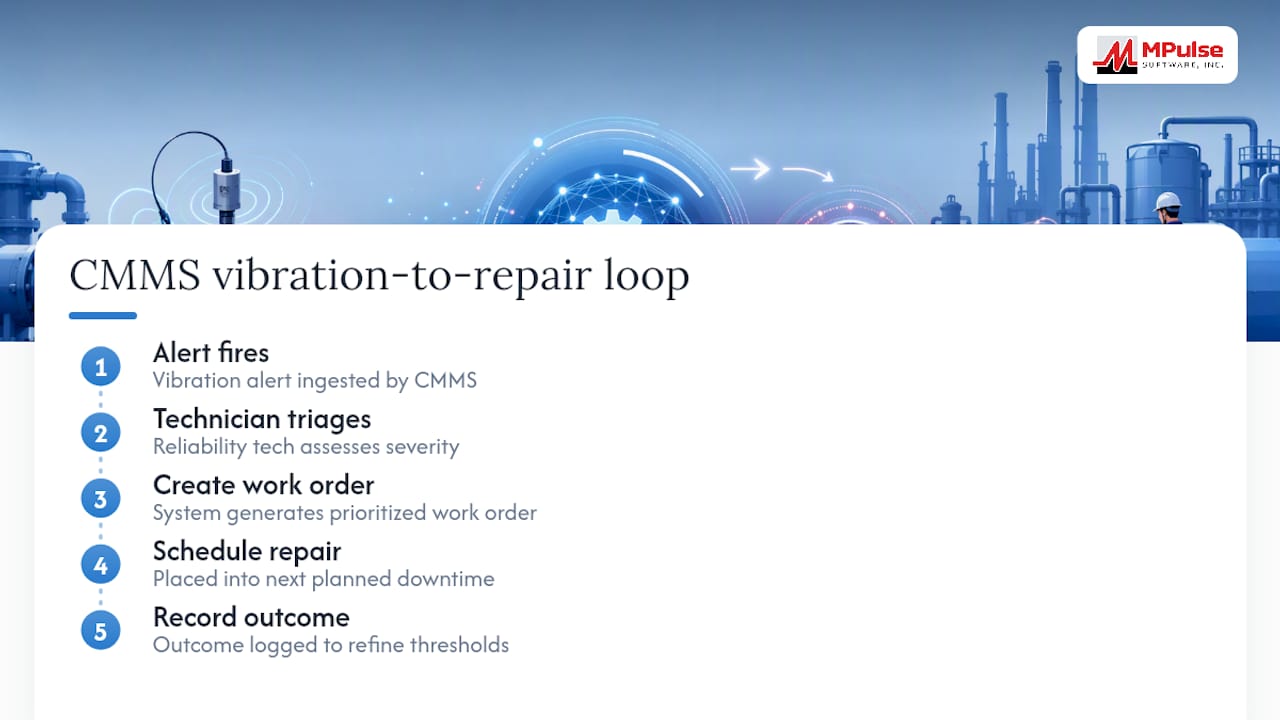
The workflow that works: alert fires, a reliability technician triages severity, the system creates a work order, scheduling lands the job in the next planned downtime, and the outcome gets recorded to refine future thresholds. That closed loop is what separates a functioning predictive maintenance program from a pile of spectrum charts, and it’s the piece most PdM initiatives underweight during early rollout.
A Reliability Engineer’s Take on What Actually Works
Most vibration programs fail from data overload, not bad sensors. Pilot two or three critical assets, standardize your mounting hardware from day one, and make sure every alert lands directly in your CMMS as a work order. Train technicians on interpretation before you scale, not after.
— Mark
Turn Vibration Alerts Into Scheduled Repairs With MPulse CMMS
MPulse CMMS is built specifically to close the gap between a vibration alert and a finished repair, automating the work order, parts check, and scheduling steps that most programs still do manually.
Facilities running condition-based programs use MPulse to ingest sensor alerts, track real-time equipment monitoring through IIoT integrations, and route flagged assets straight into a prioritized maintenance calendar. If your vibration data currently lives in a spreadsheet nobody checks, that’s the exact workflow gap MPulse closes. Start a free trial and connect your first sensor alert to a real work order this week.
Sources
For deeper technical grounding, see the PMC review of vibration sensors, Fluke’s measurement guide, and ifm’s implementation guide. Technical partners like Aspen Rentals also offer support interpreting vibration trends.
- An in-depth study of vibration sensors for condition monitoring – PMC
- Artificial intelligence and robotics in predictive maintenance: a comprehensive review – Frontiers
- Measuring vibration for predictive maintenance – Fluke
- Implementing a predictive maintenance strategy: Complete guide – ifm
FAQ
How Much Does Vibration Monitoring Cost?
Costs vary widely based on sensor type, wired versus wireless deployment, and analytics software, but most programs start with a low-cost pilot on a handful of critical assets before scaling to the full facility.
How Is Vibration Monitoring Used in Predictive Maintenance?
Vibration monitoring supplies the early-warning data predictive maintenance depends on, flagging bearing wear, imbalance, and misalignment before failure, then feeding that data into a CMMS to trigger scheduled work orders.
What Standards Apply to Vibration Monitoring?
ISO standards define vibration severity zones for rotating machinery, giving reliability teams a reference for setting alarm thresholds beyond simple baseline deviation.
What Are the Three Types of Predictive Maintenance?
The three main categories are vibration analysis, thermal imaging (infrared), and oil/lubricant analysis, each detecting different failure modes and often used together for full asset coverage.