

Yes: keep a small, risk-ranked set of critical and insurance spares, and link every one of them to its asset in your CMMS. A multi-criteria study of 13,488 industrial spare parts found a very small percentage actually warranted special critical-spare handling. Run an FMECA under IEC 60812 on your highest-consequence assets first, then tag the results directly in your maintenance management system before you touch reorder quantities.
TL;DR:
- Critical spares planning relies on FMECA analysis to prioritize parts that can halt operations, endanger safety, or cause regulatory breaches, rather than using simple usage data.
- Linking spares to asset hierarchy ensures traceability and enables automatic replenishment alerts during maintenance, reducing phantom stock issues and improving accuracy.
- Regular cycle counts, immediate logging of parts used, and annual OEM discontinuation reviews are essential to prevent inventory inaccuracies and obsolescence issues.
- Replenishment of insurance spares should be based on expected value calculations, considering failure probability and downtime costs, not just demand history.
- A CMMS like MPulse automates critical spares management by integrating asset data, inventory tracking, reorder triggers, and compliance documentation within a single system.
Table of Contents
- What Is Critical Spares Planning and Why Start With FMECA?
- How Do You Link Spares to the Assets They Protect?
- How Do You Keep Spares Inventory Records Accurate?
- What Is the Right Replenishment Strategy for Insurance Spares?
- How Do You Govern and Document a Critical Spares Program?
- What Does a Phased Critical Spares Rollout Look Like?
- How Does a CMMS Operationalize Critical Spares Planning?
- Why Expected-Value Thinking Beats Gut Feel on Spares
- Put Critical Spares Planning Into Practice With MPulse CMMS
- Sources
- FAQ
What Is Critical Spares Planning and Why Start With FMECA?
Critical spares planning is the process of identifying which parts, if unavailable, would stop production, endanger safety, or trigger regulatory exposure, then setting deliberate stocking and replenishment rules for that narrow list. It is not the same exercise as general spares inventory management, which handles the thousands of routine consumables that keep a plant running day to day. The distinction matters because applying critical-level attention to every SKU wastes budget, while applying routine ABC logic to a critical part can shut down a line for weeks.
Failure Mode, Effects, and Criticality Analysis, or FMECA, gives you the structured method for telling the two apart. The IEC 60812 standard lays out the worksheets and criticality matrices maintenance teams use to score failure modes by severity, occurrence, and detectability, then roll that score up into a defensible part ranking. Skipping this step is the most common mistake in critical spares analysis: teams guess at criticality based on gut feel or past emergencies, then build a spares list that reflects memory rather than risk.
Score each candidate part against these criteria:
- Consequence of failure — does it stop the line, create a safety hazard, or trigger a compliance breach?
- Lead time to replace — weeks or months from a single-source vendor versus days from stock?
- Sourcing risk — is this a single-source or obsolete component with no ready substitute?
- Repair versus replace time — can a technician fix it in hours, or does it require a rebuild?
- Safety and regulatory weight — does a regulator, insurer, or classification society require documented coverage?
Once you have scores, set a pragmatic threshold instead of trying to protect everything. Everything below that line stays in standard spares inventory management.
How Do You Link Spares to the Assets They Protect?
A critical spares list only works if it is traceable to a specific asset, not floating in a spreadsheet disconnected from the equipment it protects. That link runs through your bill of materials and asset hierarchy, and it needs to be built deliberately, not assumed.
- Map every critical part to its asset in the hierarchy. Use OEM part numbers, not internal shorthand, so a technician pulling a spare at 2 a.m. matches the exact component rather than a close approximation.
- Attach the part to preventive maintenance and work order templates. When a PM task consumes a spare, the work order should trigger an automatic check against reorder thresholds rather than relying on someone noticing an empty shelf.
- Record minimum data fields for each part, including OEM number, supplier, unit cost, quantity on hand, minimum stock level, and lead time. Lead-time data is the field most operations leave blank, and it is the one that determines whether your reorder trigger fires early enough to matter.
- Tie the BOM to the maintenance history, so consumption patterns on a given asset inform whether the criticality score needs revisiting.
Getting this mapping right before you expand a spares program is worth more than any amount of downstream tuning. A CMMS asset record built with accurate hierarchy data turns a static spares list into something a technician can actually query mid-repair, which is the whole point.
How Do You Keep Spares Inventory Records Accurate?
Inventory visibility fails quietly. A part shows “in stock” in the system, but the physical bin is empty because someone pulled it for an emergency repair last month and never logged it. That gap, often called phantom stock, is the single biggest threat to critical maintenance supplies programs, because it surfaces at the worst possible moment: during an actual failure.
Barcode or QR scanning tied to your CMMS inventory module closes most of that gap by making consumption logging part of the work order process rather than a separate paperwork step. A technician scans the part when it comes off the shelf, and the record updates in real time instead of during a monthly reconciliation.
Beyond scanning, a few process controls matter:
- Run cycle counts on critical spares monthly, not annually, given how much a single missing part can cost.
- Reconcile discrepancies within the same week they surface, before the root cause is forgotten.
- Require immediate logging at time of use, not end-of-shift batch entry.
- Flag shelf-life-sensitive items (seals, gaskets, lubricated bearings) for rotation before they degrade past usability.
Obsolescence deserves its own attention here. A part can sit in inventory for years and still become useless if the manufacturer discontinued it and no direct replacement exists. Review critical spares annually against OEM discontinuation notices, not just against usage data.
Pro Tip: Tag every critical spare with a shelf-life expiration date in your CMMS, even for items you assume are inert. Rubber seals and electronic components both degrade in storage, and a spare that fails on installation is worse than no spare at all.

What Is the Right Replenishment Strategy for Insurance Spares?
Insurance spares are the parts you stock specifically because the cost of not having them, measured in downtime, safety exposure, or regulatory penalty, dwarfs the carrying cost of keeping one on a shelf that may never turn. Standard inventory formulas like min-max or EOQ often recommend holding zero of these parts, because demand history shows near-zero movement. That is precisely why usage-based math fails critical maintenance supplies: it treats a part that fails once a decade the same way it treats a part that fails weekly, when the two need entirely different logic.
The right frame is expected value: compare the probability of failure times the cost of downtime against the annual carrying cost of the spare. When downtime costs run into the tens of thousands of dollars per hour, even a low-probability failure can justify holding an expensive, rarely-used part.
Reorder triggers for this tier should be based on lead time and criticality, not consumption velocity. A conditional reliability model combined with stochastic lead-time forecasting can tell you when to place an order for a long-lead, high-value spare rather than waiting for a failure signal that arrives too late.
Practical sourcing options include:
- Pooled spares across multiple sites or a hub-and-spoke model to spread the carrying cost of expensive, low-turnover parts.
- Vendor-managed inventory (VMI) agreements that shift stocking responsibility to the supplier while preserving your access.
- Emergency procurement contracts with pre-negotiated expedited lead times for the parts too expensive to stock outright.
How Do You Govern and Document a Critical Spares Program?
A critical spares list without documentation is a liability during an audit, an insurance claim, or a regulatory inspection. For compliance-bound operations, that documentation often functions as de facto regulatory evidence, and its absence can affect both inspection outcomes and insurance standing.
- Document the critical spares list itself, including criticality scores, minimum stock levels, and the review date of the last FMECA update.
- Set service-level agreements with key suppliers covering lead time, expedited shipping terms, and emergency order procedures written into the procurement contract, not just assumed.
- Decide single-source versus multi-source mitigation for each critical part, and document the inspection and acceptance criteria for any alternate supplier.
- Build an escalation flow so a stockout on a top-tier critical part triggers a defined response chain rather than an improvised scramble.
The OCIMF safety-critical equipment and spare parts guidance offers a useful compliance template even outside maritime operations: procedures, documentation, inventory controls, and procurement controls, all auditable on demand. Any operation with regulatory exposure should be able to produce equivalent evidence within a day of being asked.
What Does a Phased Critical Spares Rollout Look Like?
Trying to overhaul spares inventory management across an entire plant at once usually stalls. A phased rollout gets a defensible program running in weeks rather than quarters, and it gives you proof points to justify expanding the effort.
- Clean up existing data first. Reconcile physical counts against system records before running any criticality scoring, since a ranking built on bad inventory data will be wrong from day one.
- Pilot FMECA on your highest-consequence assets. Pick the equipment where failure is most expensive or most dangerous, not the easiest to analyze.
- Tag pilot parts in the CMMS. Attach OEM numbers, lead times, minimum stock levels, and supplier data to each part identified in the pilot.
- Enforce logging and replenishment discipline on the pilot group. This is where phantom stock gets caught before it becomes a habit.
- Scale to the next tier of assets once the pilot demonstrates measurable improvement.
Track these KPIs from the start:
- Critical fill rate: percentage of critical-part requests filled from stock without an emergency order.
- Time-to-restore: hours from failure detection to asset back in service.
- Stock accuracy: percentage match between system quantity and physical count on critical items.
- Percentage of critical parts with complete lead-time data, since this field predicts how well your reorder triggers will actually perform.
A few quick wins compound fast. Parts kitting, pre-staging the full set of components a technician needs for a specific repair, cuts wrench time on emergency work. Pooling arrangements with sister sites reduce the number of expensive, rarely-used parts any single location has to carry alone. Procurement clauses that lock in expedited lead times from key suppliers shrink your exposure on the parts you deliberately choose not to stock. None of these require a full software overhaul to start; they require the data discipline from phase one and a CMMS that can hold it.
How Does a CMMS Operationalize Critical Spares Planning?
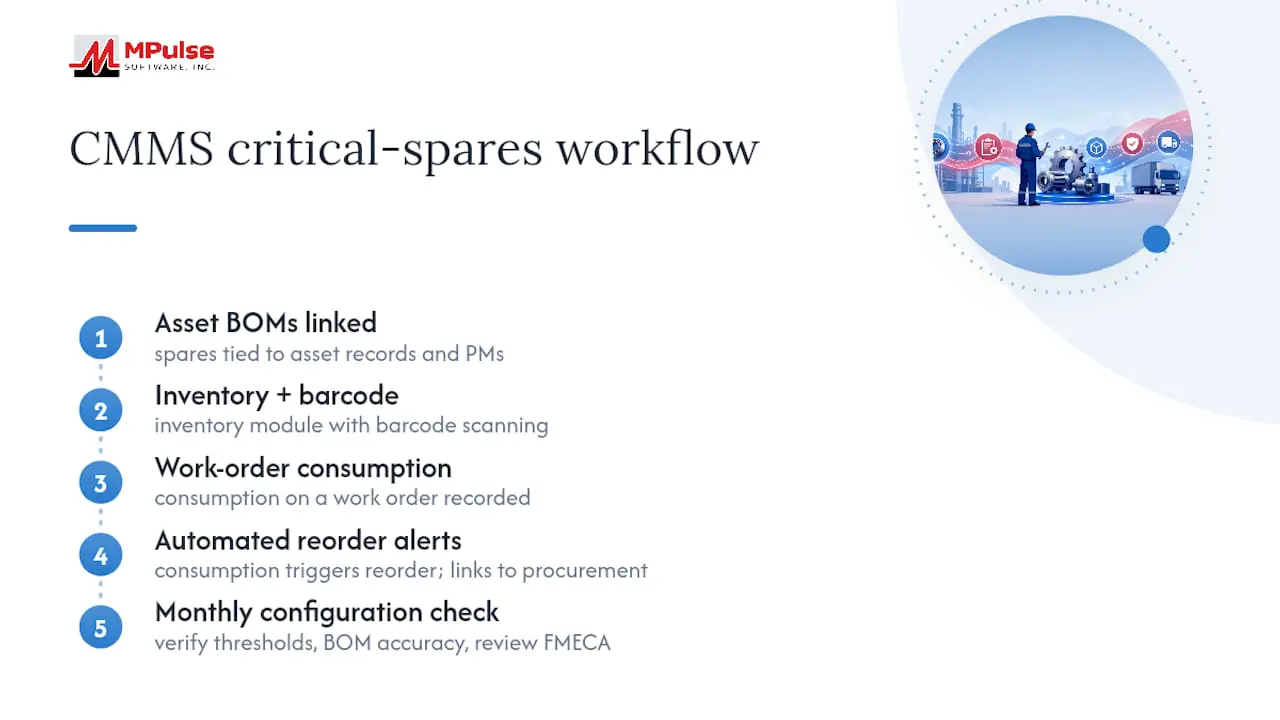
A spares program lives or dies on the system tracking it. Prioritize a CMMS that handles asset BOMs, an inventory module with barcode scanning, automated reorder alerts, and direct links from work orders to procurement. MPulse CMMS ties spares data to asset records and preventive maintenance schedules, so consumption on a work order can trigger a reorder alert automatically. A monthly configuration check, verifying alert thresholds, confirming BOM accuracy, and reviewing the critical list against recent FMECA updates, keeps the system honest.
Why Expected-Value Thinking Beats Gut Feel on Spares
Finance will push back on carrying expensive parts that rarely turn over, and that pushback is fair unless you can show the math. Frame every insurance spare as an expected-value calculation, probability of failure times downtime cost, against the cost of holding it, and the conversation changes from opinion to arithmetic.
Start with your highest-consequence assets, prove the fill-rate and time-to-restore improvement on that pilot, then ask for budget to scale. Broad rollouts without early proof rarely survive the next budget cycle.
— Mark
Put Critical Spares Planning Into Practice With MPulse CMMS
MPulse Software gives maintenance teams the calendar-driven scheduling, inventory tracking, and asset BOM structure this playbook depends on, without forcing you to stitch together separate tools for parts, work orders, and preventive maintenance.
Every step covered here, tagging OEM part numbers, setting lead-time fields, triggering reorder alerts from a work order, runs inside a single system rather than across disconnected spreadsheets. MPulse’s condition-based maintenance features connect equipment condition data directly to spare-part reorder logic, which is exactly the kind of trigger the replenishment section above calls for instead of relying on usage history alone. Organizations with compliance recordkeeping needs can also lean on the platform’s audit trail to produce the documentation regulators and insurers expect.
Pricing starts with the Professional plan at $29 per month per user, with an Advanced tier at $79 per month per user for teams that need deeper reporting and integration capability. If your rollout needs hands-on setup, CMMS Implementation Services can get your asset hierarchy and critical spares list built correctly the first time. Review the pricing page to find the plan that matches your site count and start tagging your first pilot assets this quarter.
Sources
- Classification of Spare Parts Criticality: A Multi-Criteria Decision-Making framework with an Application in an Oil and Gas Company (IEOM 2025)
- Safety-critical equipment and spare parts guidance (OCIMF)
- Critical spare parts ordering decisions using conditional reliability and stochastic lead time (Reliability Engineering & System Safety, 2013)
- Spare parts inventory management review (MDPI, 2021)
FAQ
What Are Critical Spares?
Critical spares are parts whose unavailability would stop production, create a safety hazard, or cause a regulatory breach, distinct from routine consumables managed through standard inventory rules. They’re identified through criticality scoring methods like FMECA, which weigh consequence, lead time, and sourcing risk rather than simple usage history.
What Is a Critical Spares List?
A critical spares list is a documented, ranked inventory of the parts an operation has determined require dedicated stock, minimum quantities, and defined replenishment rules. It typically includes OEM part numbers, lead times, suppliers, and the asset each part supports, tagged directly in a CMMS like MPulse so the data stays actionable rather than sitting in a static spreadsheet.
What Are the Most Critical Systems on a Ship?
Maritime critical systems typically include propulsion, steering gear, main engine components, fire and safety systems, and navigation equipment, the systems whose failure would compromise vessel safety or seaworthiness. The OCIMF safety-critical spares guidance outlines the documentation and inventory controls expected for spares tied to these systems.
What Is the Difference Between Critical Spares and Insurance Spares?
Critical spares are parts identified through criticality scoring as essential to keep on hand because of consequence and lead time. Insurance spares are a specific subset held almost exclusively for extreme, low-probability failures where the expected downtime cost far outweighs the carrying cost, even though standard usage-based formulas would recommend stocking zero.