
TL;DR:
- A maintenance dispatch system automates work order priorities, assignments, and tracking to improve efficiency. It handles routine scheduling and exceptions by human dispatchers while integrating asset history and preventive maintenance. This approach reduces downtime, speeds technician deployment, and enhances operational oversight.
A maintenance service dispatch system is defined as software that automates receiving, prioritizing, assigning, and tracking maintenance work orders to get the right technician to the right job at the right time. The industry standard term for this category is field service dispatch, and it sits at the core of any modern computerized maintenance management system (CMMS). Manual dispatch collapses under the weight of 20 or more technicians and 60 or more daily jobs, where hundreds of real-time decisions become impossible to manage by hand. Automation resolves those decisions in seconds. MPulse Software is one platform trusted by over 3,500 customers globally that brings this capability to facility managers across industries.
What is a maintenance service dispatch system and how does it work?
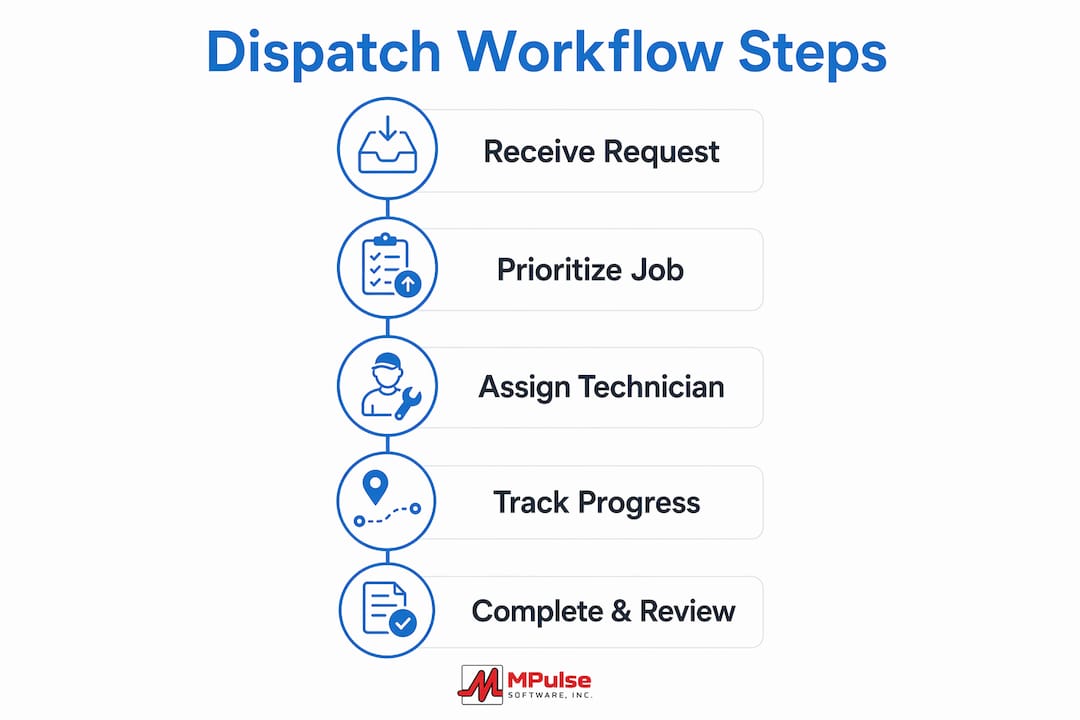
A dispatch management system processes a service request the moment it enters the system. The workflow moves through five clear stages: intake, evaluation, assignment, execution, and closure.
- Intake. A work order is created from a submitted request, a sensor alert, or a scheduled preventive maintenance trigger. The system logs the asset, location, priority level, and required skill set.
- Evaluation. The auto-dispatch engine evaluates every available technician against the job’s requirements. It checks certifications, current workload, geographic proximity, and time constraints simultaneously.
- Assignment. The system assigns the best-matched technician and sends a notification to both the technician and the requesting party. High-priority jobs can trigger immediate alerts via mobile.
- Execution. The technician receives job details, asset history, warranty status, and any active service contracts on a mobile device. Updates flow back to the dispatch console in real time.
- Closure. On job completion, the system records labor time, parts used, and outcome notes. Asset history updates automatically, feeding future scheduling decisions.
Human dispatchers do not disappear in this model. Dispatchers shift from making every individual assignment to managing exceptions: a technician calling in sick, a VIP client escalation, or a job that expands in scope mid-visit. That shift is a significant upgrade in how dispatcher time is spent.
Pro Tip: Set your dispatch system to flag any job that exceeds its estimated completion time by more than 20%. That single rule catches scope creep early and prevents one delayed job from cascading into a missed afternoon schedule.

A dispatch console consolidates live work orders, technician status, customer communication, and financial tracking into one operational view. Reducing tool switching cuts synchronization errors and speeds up every dispatch decision.
How maintenance dispatch differs from general field service software
Maintenance dispatch systems are asset-centric. That distinction separates them from delivery logistics platforms or generic scheduling tools.
A delivery dispatch system cares about route efficiency. It asks: what is the fastest path between stops? A maintenance dispatch system asks a fundamentally different set of questions. Which technician holds the certification for this equipment? When was this asset last serviced? Is it still under warranty? Does an annual maintenance contract (AMC) govern the response time?
Effective field service management requires deep asset records and scheduling rules tied directly to maintenance history. A generic dispatch tool carries none of that context.
| Feature category | Maintenance dispatch system | General delivery dispatch |
|---|---|---|
| Core scheduling logic | Skills, certifications, asset history | Route efficiency, stop sequence |
| Asset data integration | Maintenance history, warranties, AMCs | Not applicable |
| Preventive maintenance | Built-in scheduling triggers | Not supported |
| Compliance tracking | Regulatory and audit records | Not applicable |
| Technician matching | Skill and certification based | Availability and proximity only |
Facility managers running multi-site operations face an additional layer of complexity. Each location may have different equipment, different compliance requirements, and different technician skill pools. A maintenance-specific dispatch system handles that variation natively. A general delivery platform requires workarounds that break down at scale.
Preventive maintenance scheduling is the clearest example of where general dispatch tools fall short. Preventive jobs must fire on calendar triggers or meter readings, not just on demand. That logic is built into maintenance dispatch software from the ground up.
What are the key benefits of a service dispatch system?
The benefits of service dispatch automation are measurable and directly tied to the operational problems facility managers face most often.
- Faster technician assignment. Automated matching eliminates the manual search for the right person. The system evaluates the full technician roster in seconds, not minutes.
- Reduced travel time. Scheduling engines balance skills, location, and time windows simultaneously. Technicians spend more time working and less time driving.
- Fewer missed preventive maintenance windows. Automated scheduling and technician notifications prevent service windows from being skipped, which directly extends asset lifespan and reduces emergency repairs.
- Real-time visibility. Dispatchers and facility managers see every open job, every technician status, and every pending escalation on one screen. Decisions are based on current data, not yesterday’s spreadsheet.
- Improved customer communication. Automated notifications keep requesters informed at each stage: confirmation, technician en route, job complete. That transparency reduces inbound status calls.
- Compliance and audit readiness. Every job creates a timestamped record. Regulatory audits become a data export, not a manual search through paper logs.
MPulse Software customers report efficiency improvements of up to 40% after implementing CMMS-based dispatch workflows. That figure reflects faster job completion, better technician utilization, and a measurable drop in unplanned downtime.
Pro Tip: Track first-time fix rate as your primary dispatch quality metric. A high first-time fix rate confirms that your skill-matching logic is working. A declining rate signals that your technician profiles or job classification rules need updating.
Mobile maintenance management amplifies every one of these benefits. Technicians who receive job details, asset history, and parts information on a mobile device before they arrive resolve jobs faster and with fewer return visits.
How to choose and implement a maintenance dispatch system
Selecting the right system starts with an honest assessment of your operation’s current state.
- Audit your job volume and technician count. If your team handles more than 60 jobs per day or manages more than 20 technicians, manual dispatch is already a bottleneck. That threshold is where automation delivers immediate returns.
- Define your required features. The minimum viable feature set for most facility managers includes auto-dispatch algorithms, mobile technician access, asset record integration, and preventive maintenance scheduling. Multi-location operators also need role-based access controls and consolidated reporting.
- Evaluate integration requirements. A dispatch console embedded in your existing CMMS or ERP performs better than a bolted-on tool. Integrated dispatch consoles automate billing, customer communication, and inventory updates without manual intervention. Standalone tools require duplicate data entry and create synchronization gaps.
- Test before full deployment. Cloud-native systems allow sandbox testing of dispatch rules on a subset of data before going live. That testing step prevents configuration errors from disrupting active operations.
- Plan for change management. Dispatcher retraining is the most underestimated part of any implementation. Dispatchers need to understand their new role: exception management and schedule reconstruction, not individual job assignments. That shift requires structured training, not just a software walkthrough.
| Implementation phase | Key action | Common pitfall |
|---|---|---|
| Assessment | Map current job volume and technician skills | Underestimating daily job complexity |
| Configuration | Set dispatch rules and skill profiles | Skipping sandbox testing |
| Integration | Connect CMMS, ERP, and asset records | Treating dispatch as a standalone tool |
| Training | Retrain dispatchers on exception management | Assuming dispatchers adapt without guidance |
| Go-live | Monitor first-time fix rate and response times | Failing to track baseline metrics for comparison |
Contractor scheduling strategies follow the same framework. If your operation uses external contractors alongside internal technicians, your dispatch system must handle both workforce types within the same scheduling logic.
Key takeaways
A maintenance service dispatch system delivers the most value when automation handles volume and human dispatchers manage exceptions, supported by deep asset data integration.
| Point | Details |
|---|---|
| Core definition | A dispatch system automates work order assignment by matching jobs to technicians based on skills, location, and availability. |
| Human role remains critical | Dispatchers shift to exception management, handling absences, escalations, and scope changes that algorithms cannot predict. |
| Asset-centric design matters | Maintenance dispatch systems integrate asset history, warranties, and AMCs in ways general delivery platforms cannot. |
| Preventive maintenance integration | Built-in scheduling triggers reduce emergency repairs and extend asset lifespan through consistent service windows. |
| Implementation requires testing | Sandbox testing of dispatch rules before full deployment prevents configuration errors from disrupting live operations. |
Why dispatch systems deserve more credit than they get
After working with facility management teams across manufacturing, healthcare, and commercial real estate, I keep seeing the same pattern. Organizations invest in a CMMS, configure their asset records carefully, and then treat dispatch as an afterthought. They bolt on a scheduling tool, give dispatchers a new screen, and expect results.
The dispatch console is not a peripheral feature. It is the operational hub where every upstream decision, asset record, technician profile, and preventive maintenance schedule either pays off or falls apart. When dispatch is treated as a core system rather than an add-on, the efficiency gains are real and they compound over time.
The automation-versus-human debate also gets framed incorrectly. Automation does not replace dispatcher judgment. It removes the low-value, high-volume work so that dispatchers can apply judgment where it actually matters: the VIP escalation at 4:45 PM, the technician who calls in sick mid-route, the job that turns into a three-hour repair when a 45-minute inspection was scheduled. Those situations require a person. The system handles everything else.
The next evolution I see coming is tighter integration between dispatch engines and predictive maintenance data. When an asset’s sensor data signals an impending failure, the dispatch system should automatically create, prioritize, and assign a work order before the failure occurs. That closed loop between condition monitoring and dispatch is where the biggest operational gains still sit, largely unclaimed.
— Mark
MPulse Software for maintenance dispatch and scheduling
Facility managers who need a dispatch and scheduling system that works from day one have a direct path forward with MPulse Software.
MPulse CMMS combines work order management, preventive maintenance scheduling, and asset-centric dispatch in one platform. The system supports multi-location operations, integrates with existing ERP and asset management tools, and provides real-time visibility across your entire maintenance workforce. Over 3,500 customers globally use MPulse Software to reduce unplanned downtime and improve technician utilization. The platform’s CMMS features are built for facility managers who need compliance tracking, audit-ready records, and dispatch workflows that scale with operational complexity. A free demo is available for teams ready to see the system in action.
FAQ
What is a maintenance service dispatch system?
A maintenance service dispatch system is software that automates the receipt, prioritization, assignment, and tracking of maintenance work orders. It matches jobs to technicians based on skills, certifications, location, and availability.
How does dispatch software differ from a standard CMMS?
A CMMS manages asset records, maintenance history, and work orders. Dispatch software adds the automated assignment engine that routes those work orders to the right technician in real time. The two functions work best when integrated in a single platform.
When does automated dispatch become necessary?
Manual dispatch breaks down when an operation manages more than 20 technicians or processes more than 60 jobs per day. At that volume, automated evaluation of skills and availability is the only way to maintain scheduling accuracy.
What role do human dispatchers play in an automated system?
Human dispatchers manage exceptions that algorithms cannot handle, such as technician absences, VIP client escalations, and mid-job scope changes. Automation handles routine assignments; dispatchers handle complexity.
Can a dispatch system support preventive maintenance schedules?
Yes. Maintenance-specific dispatch systems include scheduling triggers based on calendar intervals or equipment meter readings. Automated preventive maintenance notifications prevent missed service windows and reduce emergency repair frequency.