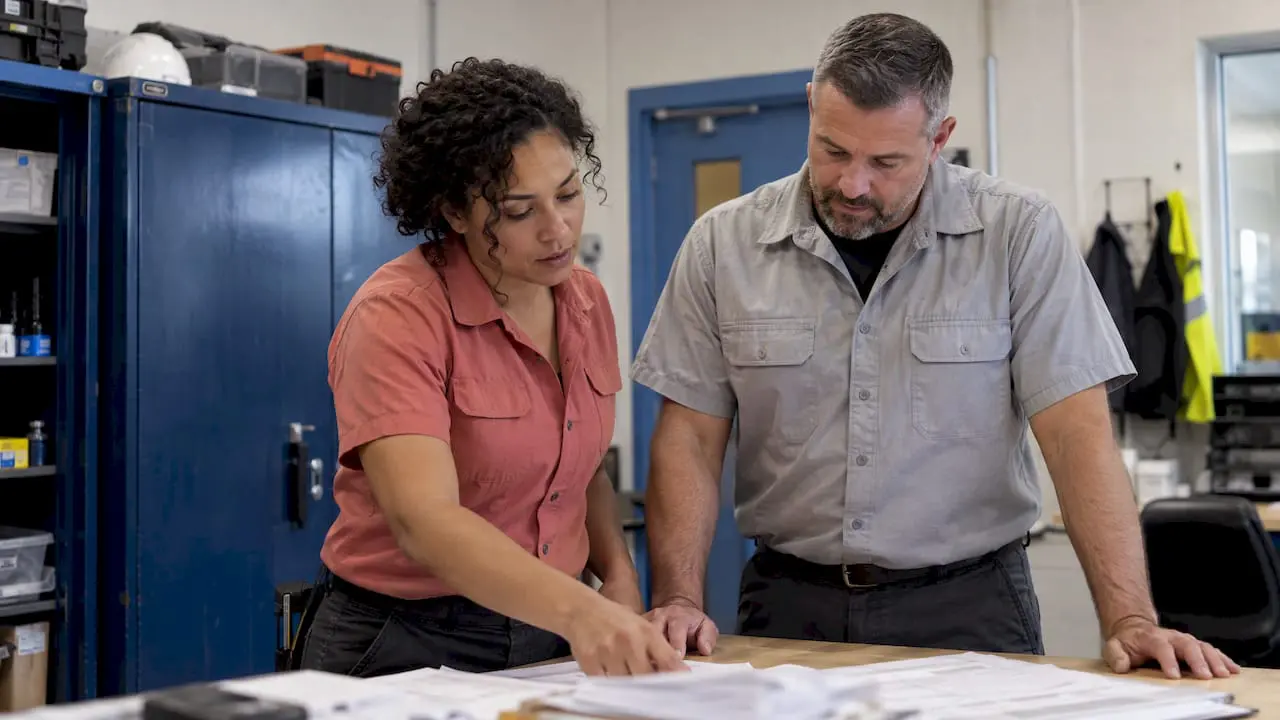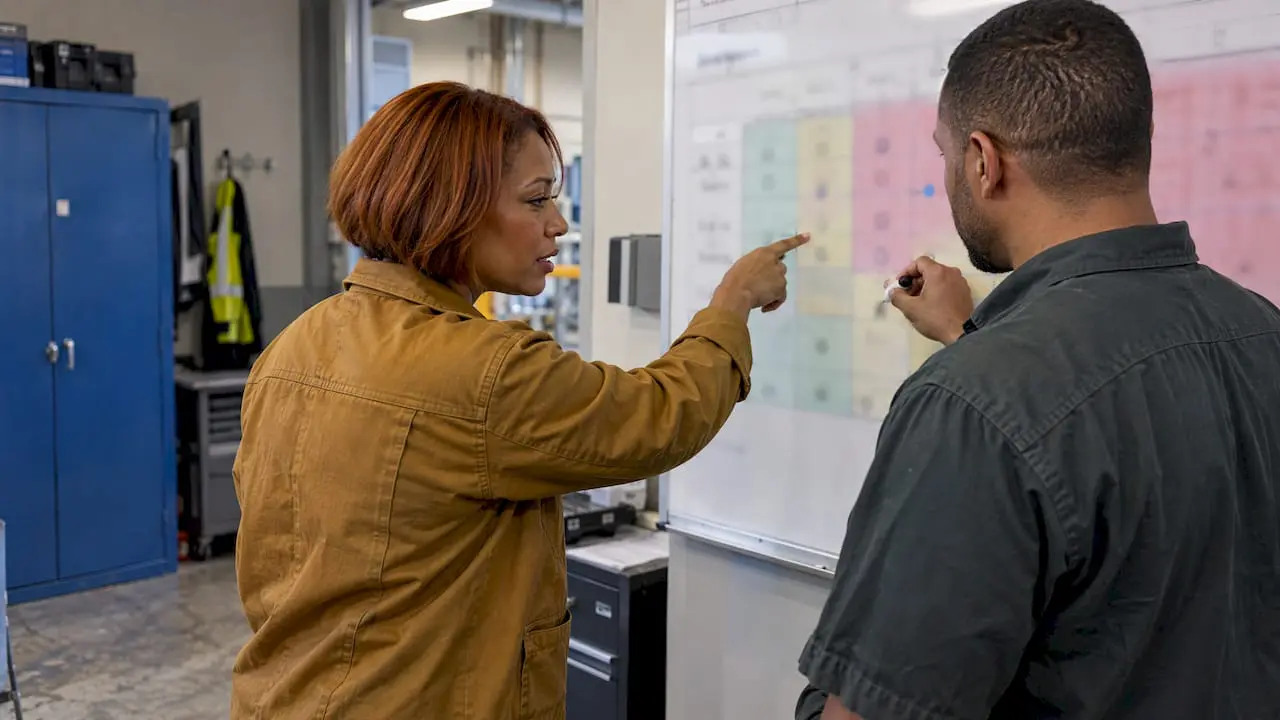
A maintenance shift handover works when the outgoing crew passes on equipment status, open work orders, safety conditions and next actions face to face and in writing, and the incoming crew confirms them before taking over. The most reliable way to make that happen every shift is a shared work order record that both crews read and update, which is what a CMMS gives a maintenance team.
This guide covers the three stages of a sound handover, a checklist you can adopt, rules for the shift log, and how to track maintenance response time so handover records point to real improvements.
TL;DR
- A handover is the transfer of a task and its responsibilities, with accurate communication of what the next crew needs to keep working safely.
- Run it in three stages: outgoing preparation, a face-to-face exchange with two-way feedback, and incoming cross-checking before responsibility changes hands.
- Every log entry needs a time, an author, an equipment tag and a factual description. Correct errors with a new entry, never by overwriting.
- Track response time from request to acknowledgment, start and completion, so delays between shifts become visible.
- Keep handover notes attached to work orders in a CMMS so nothing depends on memory or a paper notebook.
Table of Contents
- What a maintenance shift handover is and why it matters
- The three stages of an effective handover
- A maintenance shift handover checklist
- How to write shift log entries people can trust
- Tracking maintenance response time across shifts
- Using handover records to improve maintenance
- A short example of a good handover
- Put your handover on a work order system
- Getting started this month
- FAQ
- Sources
What a maintenance shift handover is and why it matters
The UK Health and Safety Executive describes shift handover as the transfer of a task and its associated responsibilities to another person or team, with accurate communication of task-relevant information so that work continues safely and effectively. In a maintenance department, that task is usually unfinished: a pump half rebuilt, a lockout still applied, a part on order, a repair waiting on an inspector.
The stakes are real. The same HSE guidance reports that many accidents have involved failed communication at shift handover, and that the majority of those involved planned maintenance work. Those cases were in high-hazard industries, but the mechanism applies to any plant, hospital, campus or facility: the incoming crew does not know what the outgoing crew knew.
The everyday costs are less dramatic and more frequent. A technician repeats a diagnosis that was already done. A work order sits unassigned because each shift assumed the other had it. A machine returns to service with a guard missing because nobody mentioned it. None of these are skill problems. They are information problems at a predictable point in the day.
HSE also recommends that organizations identify their higher-risk handovers, train people in communication skills, provide handover procedures, make clear how much the handover matters, and plan maintenance work to finish within one shift where possible. That last point is practical: the fewer jobs you split across shifts, the fewer you need to hand over.
The three stages of an effective handover
A position paper from Marsh Risk Engineering describes three stages of an effective handover: outgoing preparation, information exchange between outgoing and incoming personnel, and incoming cross-checking before responsibility is assumed. Each stage has its own failure points.
Stage 1: Outgoing preparation
The outgoing technician or lead assembles the shift log before the other crew arrives. This is where most handovers are won or lost, because a rushed last ten minutes produces vague notes.
What goes wrong: people write what they did instead of what the next person needs. “Worked on conveyor 3” tells the next shift nothing. “Conveyor 3 drive belt replaced, tension not yet verified, lockout tag 14 still on the disconnect” tells them exactly where to start.
A fix that works: build the note from the open work orders rather than from memory. If every job has a status, a last action and a next action recorded as it happens, preparation becomes a review, not a reconstruction.
Stage 2: The face-to-face exchange
The Marsh paper describes an uninterrupted, face-to-face handover at the normal workplace, with verbal and written communication and two-way feedback. The conversation matters because a written note answers only the questions its author thought of. The incoming lead asks the rest.
A structured course on shift hand-offs from HSM University uses a simple framework called SAFE for the conversation:
- S: status of the plant or area
- A: activities in progress or planned
- F: faults and alarms
- E: expected events for the next shift
In that model the outgoing lead writes a summary in the electronic log before the hand-off begins, the leads talk through it, the incoming lead adds anything learned, and both sign. The outgoing crew does not leave until the incoming crew owns the building. That last rule is worth borrowing as is.
What goes wrong: the handover happens at the door, in a hallway or by text message while one person is already walking out. Set a fixed overlap, even ten to fifteen minutes, and protect it.
Stage 3: Incoming cross-checking
The incoming crew does not simply accept the briefing. They verify the critical items: walk to the equipment that has a lockout applied, confirm the status of any open permit, and check that the parts the note says are staged are actually there. Only then does responsibility move.
This stage is the one most often skipped, because it feels like distrust. It is better understood as the second half of the transfer. The outgoing person has described the situation. The incoming person confirms they see the same one.
A maintenance shift handover checklist
The Marsh paper lists what a handover should cover. Adapted for a maintenance team, a checklist looks like this:
- Who and when: the shift, the outgoing and incoming names, the date and time.
- Safety: incidents, near misses, hazards, and anything affecting personal or process safety.
- Permits and isolations: open permits, applied locks and tags, who holds them, and what must happen before they are removed.
- Equipment status: what is running, what is down, what is running in a degraded state, and any temporary fixes.
- Work orders: jobs in progress, jobs planned for the next shift, jobs newly raised, and the preparation or permits future jobs need.
- Environmental excursions: spills, releases or readings outside normal limits.
- Staffing: absences, contractors on site, skills gaps for the coming shift.
- Instructions: daily instructions, procedure changes and special instructions from supervisors.
- Routine checks: rounds completed and any still due.
- Signatures: dated sign-off by both the outgoing and incoming person.
On the last item, EPRI’s guidance for power stations says the outgoing and incoming watchstanders should both sign and date the turnover checklist, and that the signatures signify the official transfer of responsibility. A signature turns a chat into an accountable handover.
Design the checklist around the incoming crew
The Marsh paper makes a point that most generic templates miss: a shift log should not be a blank book whose content is left entirely to the outgoing shift. Its layout should reflect what the incoming operators need to know. Ask the people who start shifts what they wish they had been told last week, then add those prompts to the form.
A hospital facilities team will want infection-control and life-safety system status. A manufacturing team will want line changeover and quality holds. A school district will want building access and events that affect work areas. The skeleton stays the same and the prompts change.
How to write shift log entries people can trust
The HSM University lesson gives clear rules for entries. Each one should carry its time, author, equipment tag and a factual description of what was observed or done. Beyond that:
- Write entries as events occur, or as soon as possible afterward.
- Use plain language and record facts and actions, not opinions.
- Correct a mistake with a new entry. Do not delete or overwrite the old one.
The last rule protects you in audits and investigations. A log that can be quietly edited cannot be trusted, and a log nobody trusts stops being read.
EPRI adds that entry requirements should define abbreviations, symbols and any color conventions, for example for lockout and tagout entries. If one technician writes “LOTO” and another writes “tagged out,” a search a month later finds half the records.
Records that support the log
A handover note points to other records rather than replacing them. The HSM University lesson lists round sheets, work orders, permits and lockout registers, inhibit and bypass registers, access logs, visitor or vendor logs, and current drawings and procedures. Link or reference these in the note. Do not retype them.
Paper, spreadsheet or electronic
EPRI recommends considering electronic log keeping that interfaces with other plant and company systems, including equipment databases and lockout and tagout processes. The reason is simple: when the log, the asset record and the work order are three separate places, someone has to copy information between them, and copying is where errors and omissions come in. A CMMS keeps the handover note on the same record as the asset and the job. For more on how that looks in practice, see our guide to electronic maintenance logs.
Tracking maintenance response time across shifts
Handover quality shows up in how quickly work moves. Response time is the measure that makes it visible, and it is easiest to understand as a sequence of timestamps on every work order:
| Timestamp | What it records |
|---|---|
| Request created | Someone reports a problem |
| Acknowledged | A dispatcher or technician accepts it |
| Assigned | A named person owns it |
| Work started | A technician is on the equipment |
| Work completed | The repair is done |
| Returned to service | The asset is back in operation |
From those you can calculate the numbers that matter:
- Time to acknowledge: request created to acknowledged.
- Time to start: request created to work started. This is the one most people mean by work order response time.
- Time to repair: start to completion.
- Total downtime: failure to return to service.
The common mistake is measuring only the repair. Time spent waiting to be noticed, assigned and started, and time spent on verification before restart, is invisible if the work order only records an open date and a close date. Those gaps often sit exactly at shift boundaries, which is why they belong in a handover discussion. For a manufacturing view of the same idea, read our piece on machine downtime tracking best practices. Teams in other industries think the same way: this overview of how to reduce well downtime in Texas and Oklahoma shows how much of an outage can sit outside the repair itself.
Set targets by priority
A single response-time target for every request hides the problem. Define priority levels, for example emergency, urgent, routine and planned, and set an acknowledgment and start target for each that your team can defend. Then review the work orders raised in the last hour of one shift and the first hour of the next. If those wait longer than the rest, the handover is leaking.
Make the timestamps automatic
Technicians will not reliably fill in six time fields at the end of a job. Capture them as a side effect of normal work: the status changes when someone accepts, starts and closes the order, and the system records the time. That is also why work order management software beats a shared spreadsheet for this purpose.
Using handover records to improve maintenance
Once handover notes and response times live on the same records, you can ask better questions each week.
- Which jobs get carried over most? If the same asset or job type appears in handover notes repeatedly, it needs a planned fix or a better shift plan. HSE’s advice to schedule work for completion within one shift applies directly.
- Which handovers precede the slowest starts? Compare time to start for jobs raised near shift change with the rest.
- What do incoming crews ask that the note did not answer? Add those prompts to the form. A good checklist changes as the team learns.
- Which entries are unclear? Read ten random log entries aloud in your weekly meeting. Vague ones show up quickly.
- Are sign-offs complete? A missing signature is a missing transfer of responsibility. Treat it as a process failure, not a paperwork gap.
Keep the review short and regular. A fifteen-minute weekly look at carried-over jobs and response times does more than a quarterly report no one acts on.
A short example of a good handover
Imagine a day-shift lead at a food plant ending a shift. In a CMMS the open work orders already show status. She adds a line to the packaging line 2 order: “Seal bar heater replaced, temperature not yet verified at speed, parts for backup heater in cage B, line is running at reduced rate.” She reviews the lockout register and confirms no tags are applied.
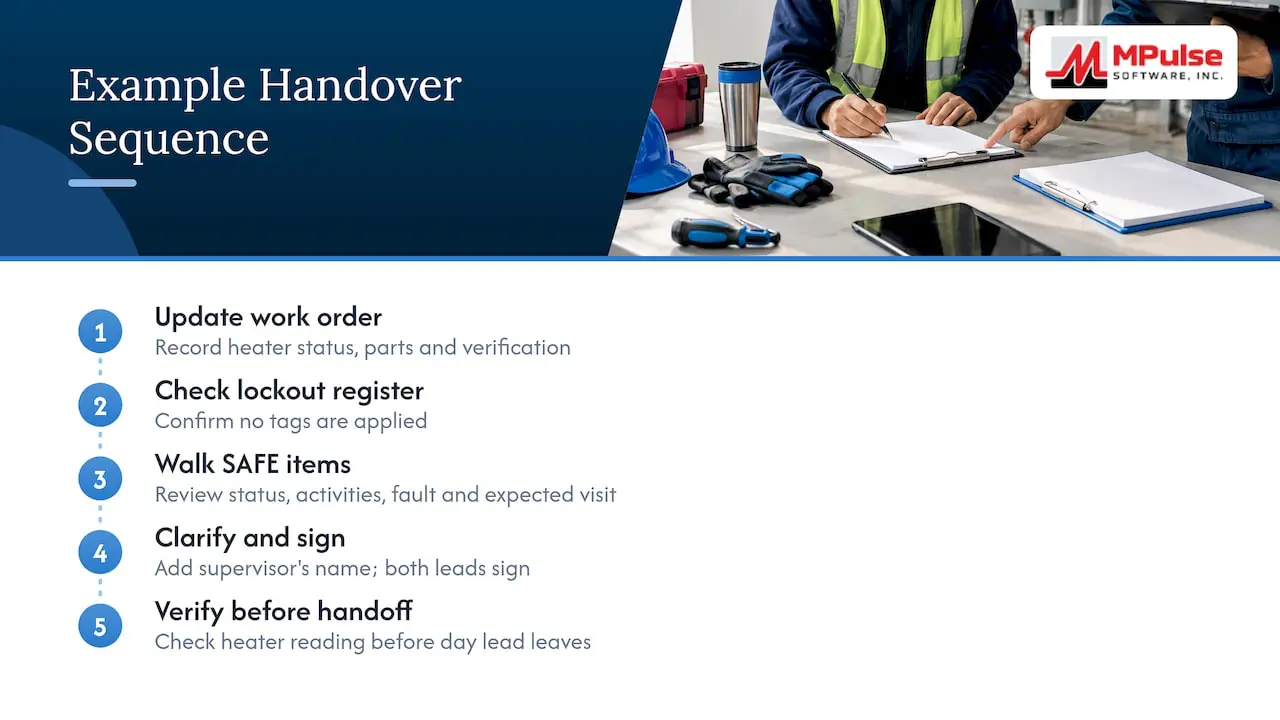
At the overlap, she and the evening lead walk the SAFE items: line 2 status, the activities planned, one fault alarm on the compressor, and a vendor visit expected at 6 p.m. The evening lead asks who approved the reduced rate. She answers, adds the supervisor’s name to the note, and they both sign. The evening lead then walks to line 2 and checks the heater reading herself before the day lead leaves.
Nothing in that exchange is complicated. It is just complete, specific and confirmed.
What we think about handover software
Most handover failures we hear about are not failures of effort. They happen because the information lives in three places: a notebook, a text thread and somebody’s head. Our view is that the work order should be the handover. When a technician records status, parts and next steps on the job as it happens, the next shift opens the same record and sees the same picture.
That is what we built MPulse CMMS to support: work orders, asset records, a calendar view of scheduled work, mobile access and barcode scanning in one system, with unlimited free requesters so anyone in the building can report a problem without taking a license. More than 3,500 customers worldwide use it to run maintenance, and our customers have reported efficiency improvements of up to 40%.
For teams with compliance requirements, a handover that is timestamped, attributed and never overwritten is also the record an auditor wants to see. Build the habit first, then let the software hold the evidence.
Mark
Put your handover on a work order system
MPulse CMMS plans preventive maintenance, manages work orders, tracks assets and parts, and reports on the results, so the notes your crews hand over sit on the same records they already work from. Plans are priced per user per month: Professional is $29 and Advanced is $79. Technician licenses, add-ons and services such as implementation and training are described on our pages. You can compare editions on the MPulse pricing page or see how implementation and training services get a team running.

If you maintain a manufacturing plant, our manufacturing maintenance software page shows how the pieces fit together, and contractors can read why digital work orders matter for maintenance contractors.
Getting started this month
You do not need a large project to improve handovers. A workable sequence:
- Pick one area or one crew and map its current handover. Note where it happens, how long it takes and what is written down.
- Draft a one-page checklist from the list above, then ask incoming crews to mark up what is missing.
- Fix a protected overlap time and make the signature mandatory.
- Agree on the log entry rules: time, author, tag, facts, corrections by new entry.
- Start recording the response-time stamps on every work order.
- Review carried-over jobs and slow starts weekly, and adjust.
After a month, you will know which jobs cross shift lines, which times are weak and what your crews need to be told.
FAQ
What should be included in a shift handover?
Include who is handing over to whom and when, safety incidents and hazards, permit and lockout status, equipment status, work orders in progress and planned, staffing issues, special instructions and routine checks. Both people should sign and date the record. Add prompts specific to your site based on what incoming crews say they need.
What is the difference between a handover checklist and a handover log?
The checklist is the list of topics every handover must cover. The log is the running record of what happened during the shift, with time, author, equipment tag and a factual description for each entry. The checklist makes sure nothing is skipped, and the log supplies the detail behind each item.
How long should a maintenance shift handover take?
It depends on the size of the area and how many jobs are open, so set the overlap by observing your own crews for a few weeks. What matters is that it is uninterrupted, face to face and long enough for the incoming person to ask questions and verify critical items. Organizing work so more jobs finish within one shift shortens it.
How do you measure work order response time?
Record timestamps for request created, acknowledged, assigned, started, completed and returned to service. Time to start, measured from the request to the start of work, is the usual response-time figure. Track it by priority level and compare requests raised near shift change with the rest.
Sources
- Shift handover, Health and Safety Executive
- Risk Engineering Position Paper: Shift Handover, Marsh
- Shift Turnover and Log Keeping for Fossil Generating Stations, EPRI
- Shift hand-offs, logs and documentation, HSM University