
Work order prioritization means ranking maintenance requests by the risk they carry and the resources they need, so the most important work gets done first. To do it consistently, define a small set of priority levels with a response time for each. Score every request against the same criteria: safety, asset criticality, operational impact, and likelihood of failure. Then reassess as conditions change. This guide shows how, with example scales, scoring methods, a step-by-step process and the metrics that tell you whether it works.
TL;DR
- Priority should reflect risk: the consequence of a failure combined with how likely it is. It should never reflect who asked loudest.
- Use four or five priority levels, each with a plain definition and a target response or completion window.
- Score requests on the same factors every time, and record the facts behind the score so another coordinator can reproduce it.
- Reassess open work on a schedule and as it ages, and keep a clear escalation path for safety issues.
- Track downtime on constraint assets, backlog and completion times by priority to confirm the system is working.
Table of Contents
- What work order prioritization is and why it matters
- The factors that should set a work order’s priority
- Define a priority scale your whole site can use
- Three scoring methods compared
- A repeatable process from request to review
- Perspective: priority is a system, not a judgment call
- Measure whether prioritization is working
- How a CMMS supports consistent prioritization
- Put your priority scale into MPulse CMMS
- FAQ
- Sources
What work order prioritization is and why it matters
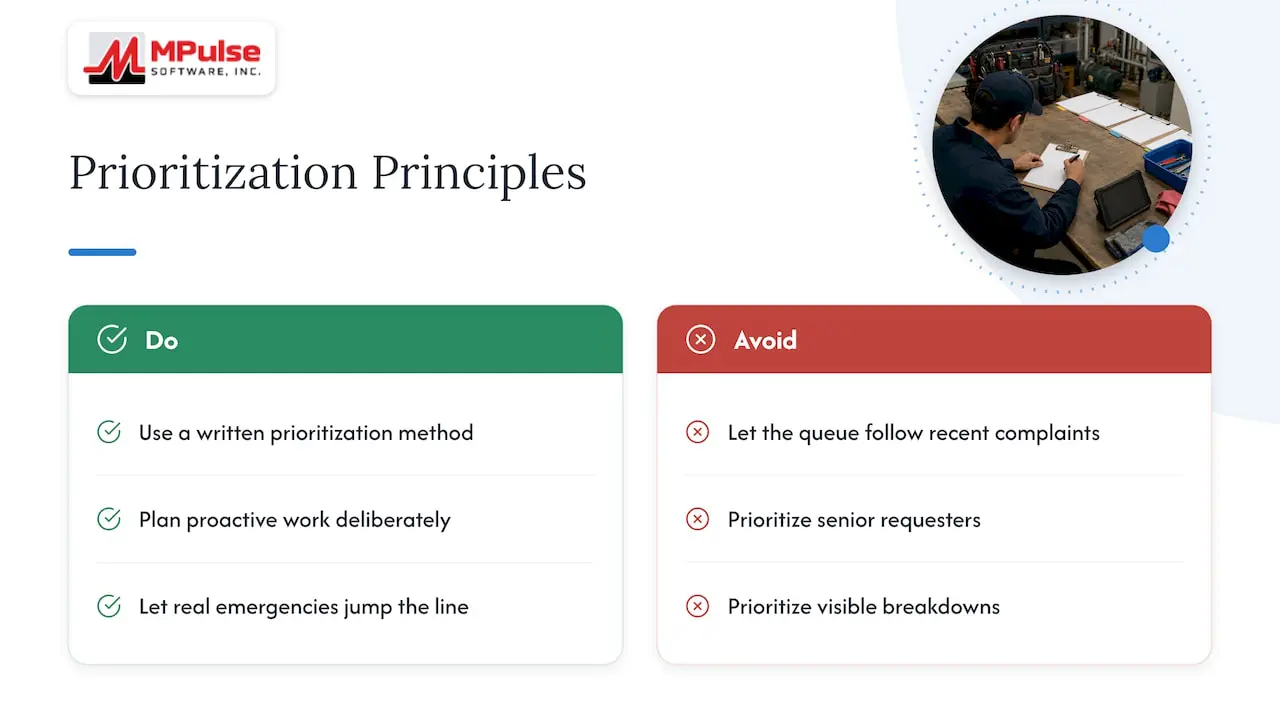
Every maintenance team has more requests than hours. Prioritization is the rule set that decides the order. Without it, the queue drifts toward the most recent complaint, the most senior requester or the most visible breakdown.
The U.S. Department of Energy’s Pacific Northwest National Laboratory explains the core tension. Reactive work is inherently urgent because a fault has already occurred. Preventive maintenance is not inherently urgent, yet it includes some of the most important activities. Skipping it will not break equipment tomorrow, but it erodes the maintenance program over time. The same source warns that unless proactive work is planned deliberately, urgent but less important needs will consume the resources meant for it.
That is the practical case for a written prioritization method. It protects the planned work that prevents tomorrow’s emergencies while still letting real emergencies jump the line.
The factors that should set a work order’s priority
Four questions cover most decisions. Ask them in this order.
- Is anyone at risk right now? Immediate safety exposure goes first, and the priority framework must never delay isolation, escalation or other required safety actions.
- How critical is the asset? A failed air handler in an operating room and a failed one in a storage annex are not the same event.
- What is the operational impact? Consider lost production, stopped zones, missed service commitments and compliance exposure.
- How likely is the failure, and how fast is it getting worse? Equipment that is actively degrading becomes a higher risk as time passes.
PNNL describes the underlying logic through the Eisenhower Decision Matrix, which sorts actions by importance and urgency. Its purpose is to keep resources on important work, including proactive maintenance that is important but not urgent.
For asset criticality, PNNL points to the NASA Reliability Centered Maintenance Guide, which scores system criticality on a scale of 1 to 10. It also says to weigh the probability of failure, using CMMS history or operator experience when data is thin.
Add the cost of the fix
Consequence alone does not finish the picture. A June 2026 Plant Services article proposes a two-factor framework: business impact if the failure repeats, and resource intensity, meaning the labor, spares and outage window the fix realistically needs. Requests land in four groups: Quick Wins, Constraint Focus, Deferred Work and Efficiency Projects.
The author’s point is that the matrix itself matters less than forcing every request to show both the loss it prevents and the resources it consumes. A high-impact, low-effort job gets done today. A high-impact, high-effort job needs a plan and a window.
Define a priority scale your whole site can use
There is no universal naming scheme. What matters is that each level has a definition that a technician, a supervisor and a requester read the same way. A label such as ‘High’ can mean different things on different shifts, so attach an expected action and a time to every level.
Here are four published examples you can adapt.
| Source | Levels | Timing built into the scale |
|---|---|---|
| Plant Services (Doc Palmer) | Emergency, Urgent, Routine-High, Routine-Normal, Routine-Low | Five levels to separate less urgent work |
| Plant Services (due-date model) | Priority 0 to 4 | Start now; 1 week; 2 weeks; 1 month; more than 1 month |
| California State University, Northridge | Critical, Urgent, Normal, Standing | Immediate response; 0 to 4 hours; next available time; continuous jobs |
| Reliability Academy RIME | Five color bands | Red 90 to 100 do now; Orange 50 to 89; Yellow 20 to 49; Green 10 to 19; Blue below 10 |
The CSUN procedure also lets plant staff or shop supervisors change a work order’s priority during its life cycle. That flexibility matters, and it is why the next section covers reassessment.
A simple five-level template
If you are starting from nothing, this structure covers most facilities and plants. Adjust the windows to your equipment, hazards and procedures.
- Emergency: safety risk or production stopped. Work starts now.
- Urgent: degraded performance or imminent failure. Scheduled within days.
- Routine-High: needs attention within a couple of weeks.
- Routine-Normal: scheduled into the normal flow, typically within a month.
- Routine-Low and planned: real work that waits for a shutdown or a planned window, and is often bundled with other jobs.
Why due dates beat adjectives
Doc Palmer argues that priorities tied to due dates work better than stacks of descriptive labels. In his words, priorities help put work in the best order acceptable to both Operations and Maintenance. Operations needs something done, and Maintenance needs to know how long it can wait. A due-date scale answers both questions at once.
Three scoring methods compared
Once the scale exists, you need a repeatable way to place each request on it. These three methods are widely used.
Risk matrix: likelihood by consequence
The Risk Assessment Matrix ranks work on how likely a failure is and what happens if it occurs. Its useful feature is mitigation. Reliability Academy gives the example of a loose handrail: a Priority 1 job becomes a Priority 3 job once a barricade goes up, because the likelihood of injury falls even though the severity stays the same. The repair is still scheduled, but it no longer pulls a crew off other work.
RIME: criticality multiplied by work class
The Ranking Index for Maintenance Expenditure ranks equipment criticality from 1 to 10 and maintenance work classes from 1 to 10. Multiply them and you get a number from 1 to 100, which maps to the color bands in the table above. Its most practical feature is aging: requests can gain points the longer they wait, for example 5 points per week after the due date, so older work does not get lost.
Impact and effort quadrants
The two-factor framework described earlier works well when the main question is capacity. It is especially useful for sorting a large backlog into jobs to do now, jobs to plan and jobs to defer.
If your team is small, start with the risk matrix. If you manage many assets with established criticality rankings, RIME gives a numeric order. If your constraint is labor and outage windows, add the impact and effort view.
A repeatable process from request to review
A good scale fails if each person applies it differently. Use a consistent flow.
- Capture the request completely. Record the asset, location, symptom, who is affected and any safety concern. Combine duplicates: three reports of one noisy conveyor are one work order.
- Run the safety check first. Any immediate hazard triggers isolation and escalation before any scoring.
- Assign the initial priority. At San Jose State University, the work order creator assigns the initial priority and classification, whether work control staff, shop supervisors, managers or directors. Pick one role to own this step on your team.
- Record the reasoning. Note the lost function, people exposed, affected scope, workaround and time until consequence. ‘Three of four zones stopped, fourth limited to six hours, no confirmed backup’ is a reproducible decision. ‘High because the customer is unhappy’ is not, as Bilense explains.
- Schedule by priority, then bundle. Crews work in priority order, with some bundling of less urgent jobs in the same area or on the same asset.
- Reassess on a rhythm. SJSU’s procedure has supervisors and managers review the system regularly and adjust priorities as operations, safety protocols or regulatory requirements change.
- Close and review. Compare actual completion times with the targets for each level.
Set priorities jointly
Maintenance sees the failure mode, and operations sees the business consequence. Priority works best when both contribute. An agreed matrix lets operations help rank requests without turning every call into a negotiation.
Keep triage out of a single person’s head
The discipline in triage is that the same definitions get applied every time. If every requester triages their own request, everything becomes urgent. A single dispatcher who applies every decision creates a different problem: a bottleneck. Teams that run into it can look at workflows that remove dispatcher bottlenecks, where intake rules route routine requests automatically and reserve human judgment for exceptions.
Perspective: priority is a system, not a judgment call
We see the same pattern at many facilities. The team has good people and a priority field on the work order, yet the field says ‘High’ on most requests. The problem is rarely effort. It is that no one agreed what High means, and nothing in the process makes the label expensive to misuse.
Our view is that prioritization works when three things are true. The levels are few and defined by response time. The criteria are written down and applied the same way each time. And the software enforces the process instead of relying on memory. That is how we design MPulse CMMS: preventive maintenance automation keeps planned work visible on an intuitive calendar, so the important but not urgent jobs do not disappear under the day’s emergencies.
We also believe requesters should not be a cost barrier. MPulse offers unlimited free requesters, so anyone in the building can report a problem, and your team decides the priority through the process you define. Customers have reported efficiency gains of up to 40% from organized maintenance workflows. Your results will depend on your starting point, but the principle holds: a clear order of work is the foundation of every other improvement.
Mark
Measure whether prioritization is working
A scale that nobody measures drifts back to habit. Track a few indicators and review them monthly.
- Constraint downtime. Plant Services recommends measuring downtime minutes on the limiting asset or cell rather than total downtime, since an hour lost on a constraint costs more than an hour lost elsewhere.
- Schedule risk. Missed orders and overtime escalation signal that priorities are not matching reality.
- Safety and compliance exposure. Near misses and OSHA or NFPA 70E findings belong in the same review.
- Quality and energy losses. Scrap, rework and abnormal energy use per good unit show hidden costs of deferred work.
- Median completion time by priority. Doc Palmer suggests scoring these medians to show Operations that work finishes inside the expected windows, which discourages marking everything a 1 or 2.
- Backlog age. If Routine-Low work never closes, either the scale needs a planned window or the work needs to be retired.
If the share of Emergency and Urgent requests keeps rising, look upstream. Often the cause is deferred preventive work, which circles back to PNNL’s warning about proactive maintenance.
How a CMMS supports consistent prioritization
Spreadsheets and email can hold a priority scale, but they cannot enforce it. A CMMS adds the structure that keeps prioritization consistent:
- Required fields on the request so the reasoning is captured at intake.
- Priority levels with defined due dates and automatic sorting of the work queue.
- Asset records that hold criticality and failure history, which feed likelihood estimates.
- Preventive maintenance schedules shown on a calendar, so planned work competes visibly with reactive work.
- Reporting on completion time by priority and on backlog.
Our own guides go deeper on the practical side: how to prioritize and assign repair requests and the four levels of maintenance task priorities. If you want a worked scoring example, see our example of a prioritization matrix, and for ways to group jobs, read about combining maintenance tasks when it makes sense.
Put your priority scale into MPulse CMMS
MPulse CMMS combines work order management, preventive maintenance automation, asset tracking, calendar scheduling and graphical reporting, with mobile access and barcode scanning for technicians in the field. Customizable workflows let you reflect your own priority levels and approvals, which matters for organizations with compliance and recordkeeping requirements.
The Professional plan is listed at $29 per month per user, and the Advanced plan at $79 per month per user. See the pricing page for what each includes. If you want help configuring priorities, training your team or connecting to an ERP, our implementation, training and consulting services are built for that.
FAQ
What are the 5 levels of priority in maintenance?
A common five-level scale is Emergency, Urgent, Routine-High, Routine-Normal and Routine-Low, as recommended by Doc Palmer in Plant Services. Five levels separate less urgent work better than three or four. Whatever names you choose, give each level a written definition and a target completion window.
How do I decide between two urgent work orders?
Compare safety exposure first, then asset criticality and operational impact. If both are equal, compare the resources each needs and choose the one that unblocks the constraint asset. Record the facts behind the choice so the next coordinator can reach the same decision.
Can a priority change after the work order is created?
Yes, and it should. Supervisors at institutions such as CSUN can change priorities throughout a work order’s life cycle. Mitigation, such as barricading a hazard, can lower the priority, while worsening equipment or approaching deadlines can raise it.
How often should we review priorities?
Review open work on a regular schedule, and any time operations, safety protocols or regulatory requirements change. A weekly review of Urgent and Routine-High items is a practical starting point. Aging rules, like adding points each week after the due date, keep older requests from being forgotten.
Sources
- Prioritizing O&M Actions, PNNL
- How to establish a work priority system, Plant Services
- Why focusing on CMMS due dates can lead to bad maintenance behavior, Plant Services
- A practical framework for maintenance prioritization in industrial operations, Plant Services
- Routine Maintenance Work Orders SOP, CSUN
- Work Order Prioritization procedure, SJSU
- Prioritising maintenance work requests, Reliability Academy
- Maintenance work-order priority: a clear method, Bilense
- CRM workflows that end the single dispatcher bottleneck