

A technician skills matrix is a grid that lists your technicians down one side and your critical maintenance tasks across the top, with a proficiency mark in each cell. Its value is not the grid. It is what the grid lets you do: assign work to someone qualified, see which tasks depend on one person, and plan training before an absence turns into downtime. A spreadsheet can start this. A CMMS (computerized maintenance management system) keeps it connected to work orders, schedules and qualifications, so the matrix drives daily assignments instead of sitting in a folder. MPulse CMMS includes personnel qualification tracking and work order scheduling for exactly that purpose.
TL;DR
- A skills matrix maps each technician’s proficiency against the tasks your assets require, and flags any critical task that only one person can perform.
- Start with 15 to 30 critical tasks grouped by trade, score each technician on a simple 0 to 4 scale, and require a practical sign-off rather than self-rating.
- Use the matrix every time you assign work: match the job to a qualified person, then use the gaps to schedule cross-training.
- Review it quarterly for safety-critical skills and immediately after hires, departures, training or certification changes.
- Tie the matrix to your work order system so qualification and workload data live in one place.
Table of Contents
- What a technician skills matrix actually shows
- Which skills belong in the matrix
- How to build the matrix, step by step
- Turning the matrix into balanced workloads
- Using the matrix for cross-training
- How often to review the matrix
- Why a spreadsheet stops being enough
- Where MPulse fits
- Perspective
- FAQ
- Sources
What a technician skills matrix actually shows
Most templates you find online are built for HR or project teams. A maintenance version has a narrower job: answer the question “if this asset fails tonight, who on this shift can fix it alone?”
That question changes what goes in the grid. Generic skills like “communication” belong in a performance review. A maintenance matrix lists tasks and competencies tied to your equipment: aligning a pump coupling, troubleshooting a PLC fault, servicing a chiller, completing a lockout/tagout on a specific line.
The matrix then reveals three things a supervisor cannot reliably carry in their head:
- Single points of failure. Critical tasks that only one technician can perform.
- Shift gaps. Skills that exist on days but not on nights or weekends.
- Training priorities. Where one targeted course or ride-along closes the most risk.
The cost of getting this wrong is real. A Siemens study on downtime, as reported by a manufacturing staffing analysis, estimates the world’s 500 largest companies lose almost $1.4 trillion a year to unplanned downtime, equal to 11% of revenues. Small and medium manufacturers can face costs of up to $150,000 per hour. When a breakdown waits for the one qualified person to arrive, those hours add up.
Which skills belong in the matrix
Start from your equipment and your compliance obligations, not from a generic list. The IMEC core competencies for industrial maintenance mechanics are a useful reference for industrial settings. They group the work into safety (PPE, safety data sheets, OSHA and EPA compliance, lockout/tagout), mechanical, hydraulic, pneumatic, electrical, process control with PLCs, piping, welding and fabrication, and quality assurance. They also name performing preventive maintenance and handling PM work orders as competencies in their own right.
For a facility, hospital or campus team, the categories shift but the logic holds:
| Setting | Typical skill groups |
|---|---|
| Manufacturing plant | Mechanical, electrical, PLC and controls, hydraulics and pneumatics, welding, lubrication, condition monitoring |
| Healthcare facility | HVAC and air handling, medical gas, electrical and emergency power, life-safety systems, infection control procedures |
| School or university | Boilers and chillers, building automation, plumbing, electrical, grounds and athletic facilities |
| Contractor | Trade licenses by site, client-specific safety orientation, equipment-specific service certifications |
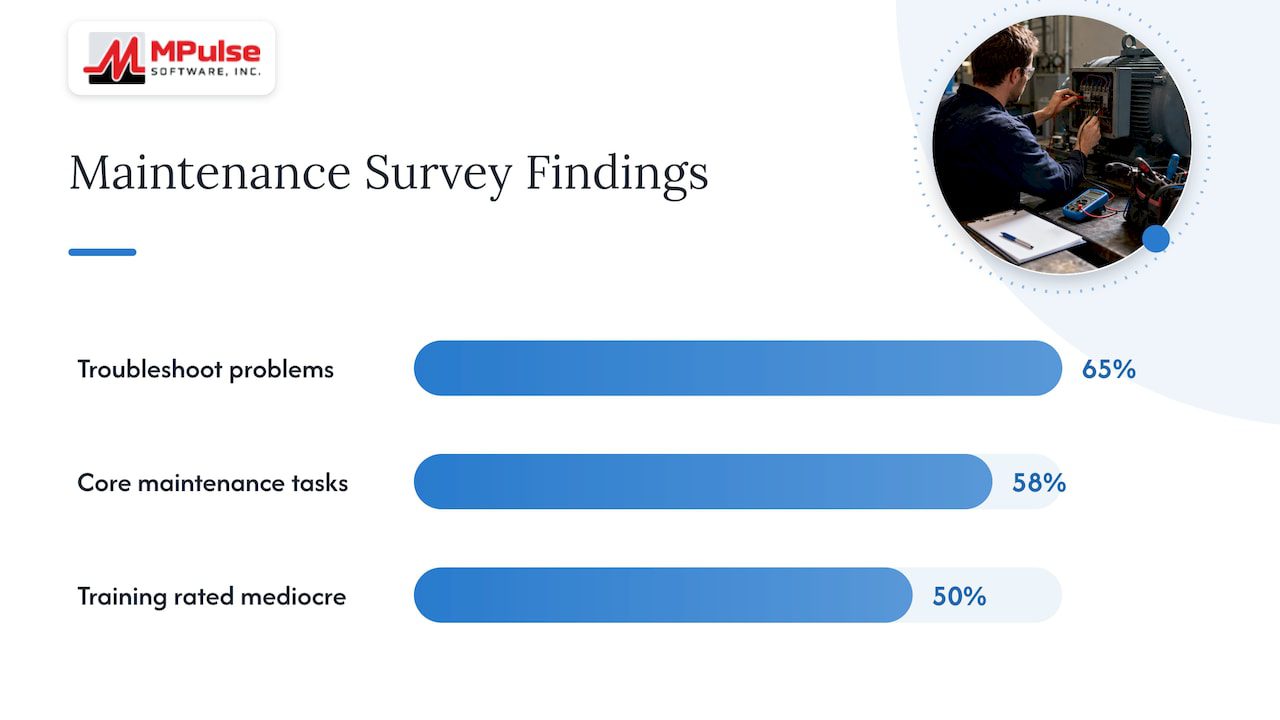
What employers want most is worth knowing when you decide on depth. In a survey of 189 manufacturers by Certus, 65% named the ability to diagnose and troubleshoot problems as the most desired maintenance skill, and 58% named proficiency in core maintenance tasks. Half rated the overall effectiveness of their training as mediocre. Troubleshooting is hard to score from a certificate, which is why the rating method below matters.
Keep the list short enough to maintain
A matrix with 200 rows is abandoned within a quarter. Begin with the tasks where a miss causes a safety incident, a regulatory finding or a line or department stoppage. Fifteen to thirty tasks is a workable first version. You can add detail trade by trade once the habit sticks.
How to build the matrix, step by step
1. List critical tasks and the assets behind them
Pull your asset list and rank it by consequence of failure. For each critical asset, write the three to five tasks that would return it to service or keep it compliant. Name tasks specifically: “replace gearbox seal on Line 2 packaging unit” tells you more than “mechanical repair.”
2. Define proficiency levels everyone interprets the same way
A 0 to 4 scale works well because each level describes what the person can do, not how confident they feel:
- 0: Not assessed or no exposure.
- 1: Awareness. Understands the task but cannot perform it.
- 2: Assisted. Can perform it with guidance from a qualified colleague.
- 3: Independent. Can perform it alone to procedure.
- 4: Coach. Can perform it alone and train others.
Public-sector frameworks use similar ladders. The North Carolina Occupational Safety and Health Resource’s Facility Maintenance Technician competency profile defines three levels: Contributing (a semi-skilled helper), Journey (a fully functioning specialist in at least one trade) and Advanced (multiple trades at journey level or a lead worker). Journey-level technicians perform preventive maintenance on standard building systems and troubleshoot standard issues. If your union agreement or job classifications already define levels, map your scale to them.
3. Assess by observation, not self-rating
Self-scores run high for confident people and low for careful ones. Use a short practical sign-off: the technician performs the task with the job plan in hand while an experienced colleague observes without directing. Watching a repair is exposure, not qualification. Record the date and the evaluator beside each score.
For anything involving hazardous energy, the sign-off carries legal weight. OSHA’s inspection guidance for the lockout/tagout standard, 29 CFR 1910.147, says authorized employees’ training must cover recognizing hazardous energy, the type and magnitude of energy in the workplace, the means of isolating and controlling it, and verifying that control is effective. Treat that training record as a gating item in the matrix: a technician without it is not rated above 2 on any task that involves isolating equipment.
4. Mark required level beside assessed level
For each task, record the level the job requires next to the level each person has reached. A task requiring 3 where the best technician holds a 2 is a gap even though someone “has experience.” Color the cells so a supervisor can read the grid in seconds.
5. Set a coverage rule per shift
The simplest rule: every critical task has at least two people rated 3 or higher on every shift that runs. One qualified person means one sick day or one resignation stops that capability. If you cannot meet the rule today, the matrix has told you where to train first.
Turning the matrix into balanced workloads
This is where most teams stop short. A matrix that is only reviewed at audit time does not balance anything. Workload balancing needs three inputs: the work that is due, the hours it takes, and the people who are qualified and available to do it.
The National Institute of Building Sciences’ job task analysis for building operations professionals describes the underlying workload analysis: develop scopes of work, sum the hours, segregate them by trade, and compare the result against staffing benchmarks. It also lists comparing completed work orders to total staff hours and tracking deferred maintenance backlogs, with a CMMS as a required tool.
Put the matrix and that analysis together and a weekly routine emerges:
- Forecast hours by trade. Total the scheduled preventive maintenance and expected corrective work for the week or month.
- Compare to qualified capacity. Count available hours from technicians rated 3 or higher for each trade, not just total headcount. Ten electrical hours cannot be covered by a mechanic rated 1 on electrical work.
- Rebalance. Where one person holds every critical electrical task, spread the load by scheduling second-line technicians on lower-risk jobs with a rated colleague nearby.
- Check against schedule targets. AXA XL’s maintenance program guideline states that a well-maintained facility reaches at least 85% overall maintenance schedule compliance and at least 95% on preventive and predictive tasks, with backlog held within control limits of typically two to four weeks. Chronic misses on PM compliance often trace to the same overloaded few people.
The same AXA XL document describes comparing workload against available labor to set workforce level, balance crafts, plan shutdowns and decide on contract labor. The skills matrix makes that decision concrete: you can see whether you lack people or lack qualified people, and those need different fixes. Our own guide to how maintenance staff workload is managed effectively goes deeper on the scheduling side.
A worked example
Suppose a plant runs two shifts and has six critical tasks on its packaging lines. The matrix shows:
- Day shift: three technicians rated 3 or higher on servo drive faults.
- Night shift: one technician rated 3, one rated 2.
- Gearbox rebuilds: only one technician across both shifts rated 3.
The night servo coverage is one absence from a gap, and the gearbox rebuild is a single point of failure. The plan: promote the night technician rated 2 to 3 through a supervised servo repair within the quarter, and have the gearbox specialist coach a second technician through two rebuilds on scheduled downtime. No new hire is needed, and the matrix shows which scheduled jobs make the best training vehicles.
Using the matrix for cross-training
Rank gaps by risk: safety consequence, downtime cost, and how many people can currently do the task. For each of the top gaps, record who will train, who will coach, which method (supervised repair, vendor course, job-plan walkthrough) and a target date. Address high-risk gaps first.
Track training in the matrix itself, for example with a marker on cells where a technician is actively developing. That makes progress visible to supervisors building schedules, who can then place the trainee on the right job instead of defaulting to the usual expert.
Plan around known absences too. If the only technician rated 3 on a critical task has leave coming up, you can move preventive work earlier, line up a second person for a supervised repair beforehand, or arrange contract support, all before the absence rather than during it.
Do not forget skills that fade
A rating is a snapshot. A technician who has not performed a task in a year may need to drop from independent to assisted until they have repeated it. Build this into the review: tasks that are rare but critical, such as an emergency generator transfer test, deserve a scheduled refresher.
How often to review the matrix
Match frequency to risk. A workable pattern:
- Immediately after a hire, departure, role change, completed training, certification renewal or equipment upgrade that affects a critical task.
- Quarterly for safety-critical and compliance skills, and for fast-changing equipment such as controls.
- Annually for stable, low-risk skills.
Certifications and licenses expire on their own schedule, so tracking expiration dates alongside the proficiency score prevents the quiet lapse that surfaces during an audit. Our article on technician qualification tracking covers how to catch a lapse before a job is dispatched.
Why a spreadsheet stops being enough
A spreadsheet works for one crew and a dozen tasks. It begins to fail when the team spans several shifts or sites, when auditors ask for evidence, or when the matrix must inform scheduling every day. The grid sits apart from the work orders, so someone has to cross-check by hand, and the cross-check is the step that gets skipped on a busy Monday.
Healthcare, education and manufacturing teams feel this most. Compliance recordkeeping demands that you show who was qualified to do a task when it was done, and multi-site operations need one consistent standard rather than a different file per building.
Where MPulse fits
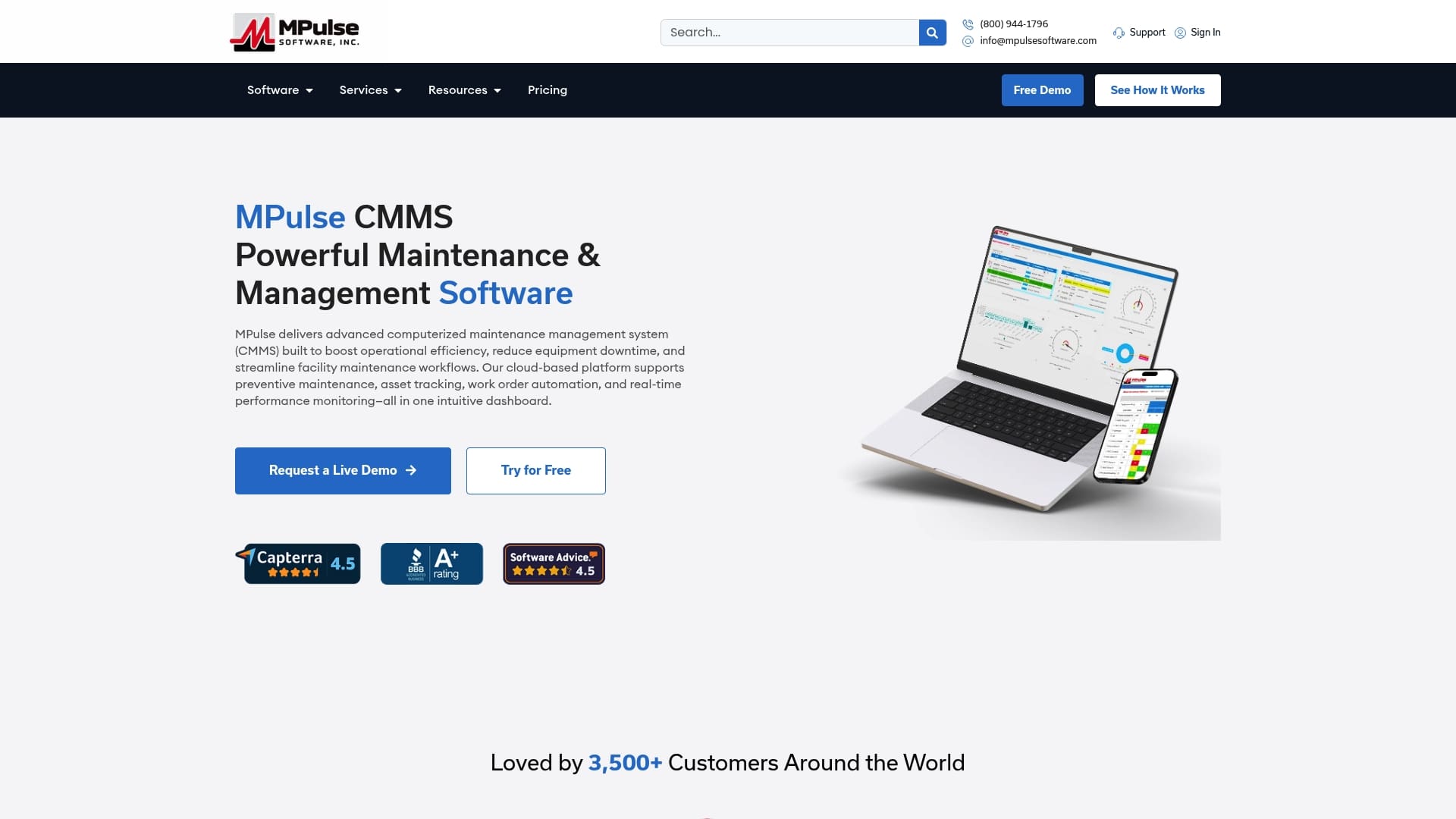
MPulse CMMS combines work order management, calendar scheduling, asset tracking, personnel qualification tracking and graphical reporting in one platform, so qualifications and workload sit beside the jobs they affect. The calendar interface shows scheduled work, and the labor resource management features support planning who does what. The platform is built to support compliance and regulatory recordkeeping, and it integrates with ERP and sensor systems. More than 3,500 customers use MPulse globally.
The Professional plan is $29 per month per user, and the Advanced plan is $79 per month per user, with unlimited free requesters so that anyone in your facility can submit a request. Implementation, training and consulting services are available if you want help setting up qualifications and workflows from the start. See plans and pricing or implementation and training services.
Perspective
A skills matrix fails for one reason: it becomes a document rather than a decision tool. Teams build a careful grid, present it at a meeting, and then assign work the way they always did, by who is nearest or who is most familiar.
We designed our approach around the opposite habit. Qualifications, schedules and work orders belong in the same system, because the moment of truth is the dispatch. When a supervisor builds the week, the question of who is qualified should already be answered on the screen in front of them.
That is also why we emphasize ease of use. A matrix that technicians and supervisors find simple to read and update stays current. One that needs a specialist to maintain it goes stale, and a stale matrix is worse than none, because it gives false assurance.
For compliance-heavy operations, including healthcare, education and manufacturing, the record matters as much as the grid. Being able to show who held which qualification when a task was performed turns an audit from a scramble into a report.
Mark
FAQ
What is the difference between a skills matrix and a competency matrix?
In practice the terms are used interchangeably. A skills matrix lists abilities, while a competency matrix often adds the required level beside the assessed level so gaps are explicit. For maintenance, use the competency version: it tells you not just who can do a task but whether that is enough for the job.
How many technicians must be able to perform each critical task?
A common target is at least two people rated independent on every critical task for every shift. Anything with only one qualified person is a single point of failure. Start with safety-critical and production-critical tasks, then widen the rule as training closes gaps.
Who should rate the technicians?
An experienced supervisor or lead technician should rate them from observed practical work, with the date recorded. Self-assessment is useful as a conversation starter but should not set the official score, particularly for tasks tied to lockout/tagout or other regulated work.
Can the matrix help with maintenance workload balancing?
Yes. Compare the hours due by trade against the hours available from technicians qualified for that trade, not total headcount. This shows whether overload comes from too little labor or too little qualified labor, which points to hiring, cross-training or contract support.
How often should we update it?
Update it right away when someone joins, leaves, finishes training or renews a certification. Run a formal review quarterly for safety-critical and compliance skills, and at least annually for the rest.
Sources
- An Empty Maintenance Seat Costs More Than Its Salary
- IMEC Core Competencies: Industrial Maintenance Mechanic
- The Gap in Industrial Maintenance Team Training (Certus)
- Facility Maintenance Technician competency profile (North Carolina OSHR)
- OSHA: Control of Hazardous Energy (Lockout/Tagout) inspection procedures
- Job Task Analysis for Building Operations Professionals (NIBS)
- Maintenance Program Elements (AXA XL)